Ashtamurti: Shiva in Everything

Earth, water, fire, air, space, sun, moon, soul

The Linga is the formless given form. Ashtamurti is the opposite move. Shiva is not only on the altar. He is the altar, the ash, the river the altar stands beside, the earth under it. This lesson teaches the eight forms in which the tradition says Shiva is already present everywhere.

A Drought in the Old Story

It is the summer of a drought year somewhere in central India, in the time the Shiva Purana was being told and retold around evening fires. A village potter named Bhanu sits on the dry mud of his courtyard. The wheel is still. The clay pile beside it is hard as stone. He has not made a pot in eleven days. He has been to the village Shiva temple every morning, lit a small ghee lamp, sat on the cool floor, and asked the same question.
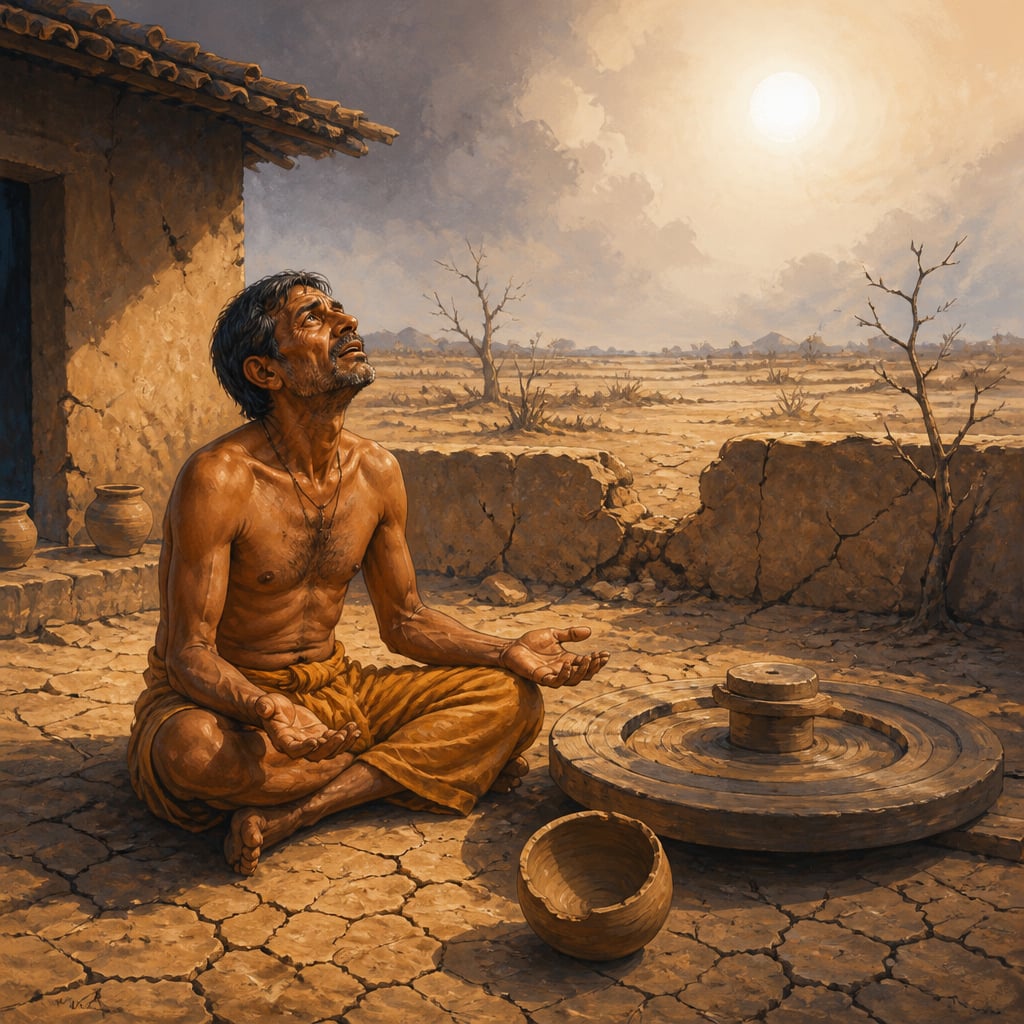
Bhanu the potter sitting on his cracked courtyard during a drought summer

Where are you, my Lord. The temple is full of you and the world is empty of you. Why is one half of life so close to you and the other half so far?

This is the question the Ashtamurti teaching answers. The lamp Bhanu lights is a small Shiva. The pot he cannot make is also Shiva. The river that has not come is Shiva. The sky waiting for cloud is Shiva. The sun that is too bright is Shiva. The moon he sees through the doorway at night is Shiva. The breath in his chest, going in and out as he asks the question, is Shiva. The awareness in him that knows it is asking is Shiva.

The Shiva Purana lists this as the eight forms of Shiva, and the lesson it teaches is the lesson the potter needed. Shiva is not only on the altar. The altar was a starting place. The world is the destination.

The Word Itself

Ashtamurti is two words pressed together. Ashta means eight. Murti means form, or more precisely, the visible shape a formless thing takes when it agrees to be seen. So Ashtamurti is the eight visible shapes of the same one Shiva.

This is not a list of eight different gods. The Shaiva tradition is careful here. There is one Shiva, the Mahadeva of every previous lesson in this course. The eight forms are eight doors into the same house. A Shaiva does not pick a favourite door. He learns to recognise that whichever door he is standing in front of, in any given moment, opens into the same room.

The earliest list comes from a famous opening verse Kalidasa places at the head of his play Abhijnana Shakuntalam, around the fifth century. The verse begins ya srishtih srashtur adya, that which is the first creation of the creator, and walks the reader through all eight forms in turn before it gets to the play. By Kalidasa's time the Ashtamurti was already the standard frame, old enough to be a literary opening device.

The Eight Forms

The canonical Ashtamurti list, given in the Shiva Purana and in the Linga Purana with small variations, is this.

The form What it names The name Shiva carries here
Prithvi Earth, ground, soil, the world that holds your weight Sharva
Apas Water, river, rain, the thing that carries life Bhava
Agni Fire, the priest, the warmth of the body Rudra
Vayu Air, wind, the breath in your chest Ugra
Akasha Space, sky, the silence in which sound happens Bhima
Surya Sun, light, the maker of day Pashupati
Chandra Moon, the cool light, the maker of night Mahadeva
Atma The soul, the awareness that knows all of the above Ishana

Notice the structure. The first five are the Pancha Bhuta, the five gross elements that the previous lessons of this chapter introduced. The next two are the two great lights, Surya and Chandra, the day-light and the night-light. The eighth and last is the Atma, the awareness that holds all seven inside itself.

The list moves from the most outward to the most inward. From the soil under your feet to the awareness behind your eyes. By the time you reach the eighth form, you realise the Ashtamurti is also a map of attention. It is a path the worshipper walks, slowly, from the body outward into the world and back inward into the self, finding the same Shiva at every stop.

Sharva, Bhava, Rudra: The Earth, the Water, the Fire

Sharva is Shiva as earth. The word comes from the root shri, to take refuge. The earth is what every footstep takes refuge in. When you place your weight on the ground and the ground holds it, that holding is Sharva.

The potter Bhanu, sitting on the dry mud of his courtyard, has been resting on Shiva all morning without naming him. Sharva is the form a Shaiva learns to honour first because it is the one that is always under him. A Shaiva touches the ground when he wakes. He touches the ground when he sits down to eat. He touches the ground when he enters a temple. Each of those touches is a small abhisheka, a small bath of Shiva on Shiva.

Bhava is Shiva as water. Bhava comes from the root bhu, to be, to come into being. Water is what makes being possible. The river that has not come to Bhanu's village is Bhava withholding for a reason the village must learn to live with. A Shaiva cups water before he drinks. He pours water on the linga. He bathes in a river before darshan. He is, in each of these acts, meeting the same god in the form that becomes life.

Rudra is Shiva as fire. The Vedic Rudra has now travelled into the hearth. The fire that cooks the family's food, the lamp on the altar, the funeral pyre at the end of life: all three are Rudra. A Shaiva does not blow out a lamp. He waves it gently to a still point with his hand, because the lamp is a small Rudra and one does not blow on a god.

Ugra, Bhima: The Air, the Sky

Ugra is Shiva as air. Ugra means fierce. Wind is the form of Shiva that cannot be held in the hand. It enters the body without permission and leaves the body without ceremony. The breath is Ugra. The Shaiva takes this seriously. Pranayama, the practice of conscious breathing, is in this view a daily relationship with Ugra. Each breath is a small visit from Shiva, and the Shaiva tries to return the visit with attention.

Bhima is Shiva as sky, as the space that holds everything else. Bhima means the vast. Akasha is the most subtle of the elements. It is what makes sound possible: a bell rings through Bhima, a mantra travels through Bhima, the silence between two notes is Bhima. The Shaiva who looks up at the sky is not looking at god. He is looking into god.

This fifth form is also why the Pancha Bhuta Linga of Akasha at Chidambaram has no visible image at all. The temple shows you a curtain, and behind the curtain there is empty space. The empty space is the linga. Bhima cannot be carved in stone. Bhima can only be pointed to. The next lesson of this chapter walks into all five of those temples in detail, but the seed of why one of them is empty is here, in this fifth form of the Ashtamurti.

Pashupati and Mahadeva: The Sun and the Moon

Pashupati is Shiva as the sun. The Vedic title Pashupati means lord of beings. The sun is what makes every being visible. Without him, there is no eye, no colour, no day, no harvest. A Shaiva offers arghya (a libation of water) to the rising sun and is, without naming it that way, offering water to Shiva. Surya Namaskar, the modern morning sequence taught in every yoga school in the world, is in this older view a salutation to one of Shiva's eight forms.

Mahadeva here is Shiva as the moon. The same title used elsewhere for Shiva-as-the-great-god is also used here for his cool, reflective face. The moon does not produce its own light. It receives the sun's light and offers it back, gentler, in the night. Shiva wears a crescent moon in his hair to remind the worshipper of this. The same god who is the burning sun is also the cooling moon. He is not partial to either intensity.

The Shaiva householder watches the moon. He fasts on Pradosham, the thirteenth day of every fortnight, when the moon is at the threshold. He keeps vigil on Mahashivaratri, the dark moon of Phalguna. He marks his year by the moon as much as by the sun. The moon is not decoration. The moon is the seventh form of his god.

Ishana: The Awareness That Knows

The eighth form is the most quietly radical of all. Ishana is Shiva as the Atma, the awareness that knows the other seven.

Who is it that recognises the earth as earth? Who is it that knows water is wet, fire is hot, wind is moving, sky is vast, sun is bright, moon is cool? The seven outer forms have to land in some kind of inner light to be known at all. That inner light, the Shaiva tradition says, is the eighth form. The knowing itself.

This is why the Ashtamurti list ends inward. The worshipper started by touching the ground. By the seventh form he was looking at the moon. By the eighth form he is looking at the looker. The path of the eight forms is a path that gradually turns the worshipper around, from the world to the self, until he discovers that the same Shiva he was finding outside has been the one finding from inside the whole time.

When the eight forms have been seen as one, the seer is no longer separate from the seen, and Shiva is no longer the god you bow to, but the awareness that is bowing.

This is the deepest claim of the Shaiva tradition. It is not that Shiva is everywhere. It is that Shiva is the everywhereness that lets there be a where at all.

Bhanu recognising Shiva in the eight forms of the village landscape

What This Changes in a Day

For Bhanu the potter, sitting on his dry courtyard, this teaching is not a lecture. It is a relief. The temple is not the only address of his god. The empty pot pile, the empty river bed, the empty sky, the breath he is taking, the eye he is seeing with: each of these is a form of the same Shiva. He has been visiting the eight temples without knowing them.

For a 2026 reader, the Ashtamurti is the antidote to a problem most modern lives have. We have learned to keep the sacred in a small room. There is a corner of the house with the puja, an hour on Sunday or a Thursday, a festival in the calendar. The rest of the day is treated as if it were not the territory of god. The Shiva Purana is here to gently dismantle that arrangement. There is no hour, no place, no element of the day that is not already one of the eight forms.

A simple practice will land this. Tomorrow morning, before doing anything else, touch the floor with your right hand and say silently Sharva. When you drink your first water, say Bhava. When you turn on the gas or light a lamp, Rudra. When you take a deep breath, Ugra. When you look up at the sky on the way to work, Bhima. When the sun is full on your face, Pashupati. When you see the moon at night, Mahadeva. Before you sleep, sit one minute and ask, who is it that has known all of this. Ishana.

Do this for one week. The world will not have changed. You will have. The temple will not have shrunk. It will have grown until it covers your day.

Historical context

Late Vedic to Early Medieval India (roughly 1000 BCE to 1000 CE)

The Ashtamurti is one of the most continuously developed teachings in Indian religion. Its Vedic root is the Shri Rudram of the Krishna Yajurveda, composed in the late Vedic period. By the early Puranic age (roughly 200 to 500 CE) the eight names had been organised into the canonical list of eight forms (earth, water, fire, air, space, sun, moon, atma) that the Shiva Purana and Linga Purana fix. Kalidasa's fifth-century opening verse to the Shakuntalam shows that by his time the Ashtamurti was already the standard Shaiva theological frame, well known enough to open a play without explanation. The Shaiva Agamas of the early medieval period (sixth to tenth century) made the Ashtamurti the doctrinal basis for the Pancha Bhuta Linga temple network, where the first five forms were anchored in stone in five South Indian temples that remain active to this day. The eighth-century work of Adi Shankara and the eleventh-century work of Abhinavagupta (in Kashmir Shaivism) integrated the Ashtamurti into both Advaita Vedanta and Shaiva Tantra, ensuring its continuity in the philosophical mainstream as well as the temple practice.

Living traditions

The Ashtamurti is one of the most quietly pervasive teachings in living Hinduism. The five Pancha Bhuta Linga temples of South India are visited by millions every year on a single yatra that, without naming it as such, walks the first five forms of the Ashtamurti in person. The Shri Rudram, which contains the eight names in their oldest form, is chanted daily in thousands of South Indian temples and in homes across the global Tamil and Telugu diaspora. Modern Shaiva environmental movements, including the Cauvery Calling and Save Soil campaigns led by Sadhguru, have explicitly drawn on the Ashtamurti's teaching that the elements are not raw material but Shiva himself, and have framed soil and water restoration as a Shaiva duty. The Indian Supreme Court's 2022 judgement on the Cauvery dispute cited the Pancha Bhuta tradition as part of the cultural and ethical context for water-sharing decisions. The doctrine that began as a Vedic chant and was fixed by Kalidasa in the fifth century is now, in the twenty-first, one of the dharmic frames being used to think about ecology, infrastructure, and inner life on a planetary scale.

Reflection

More in Shiva Tattva: Core Philosophy

All lessons in Shiva Tattva: Core Philosophy ยท Shiva Purana course