Viveka: Pluralism Without Relativism

Why Many Paths to Truth Does Not Mean All Claims Are Equal

Exploring the crucial distinction between Vedic pluralism (many valid paths to one Truth) and modern relativism (no truth, only preferences), and why this distinction matters for authentic wisdom.

The old Rishi stood with his student on the hill overlooking the Saraswati valley. Below them, dozens of streams wound their way down from the mountains, some rushing torrents, some gentle flows, some barely trickling. All seemed to be heading toward the great river.

"See how many paths the water takes?" the Rishi said. "Many streams, one destination."

The student nodded eagerly. "So all paths lead to the same place?"

The Rishi smiled and pointed to a stream disappearing into sandy soil. "Does that one reach the river?" He pointed to another evaporating in the midday sun. "Does that one?" The student fell silent. Not every stream that started toward the ocean would arrive.
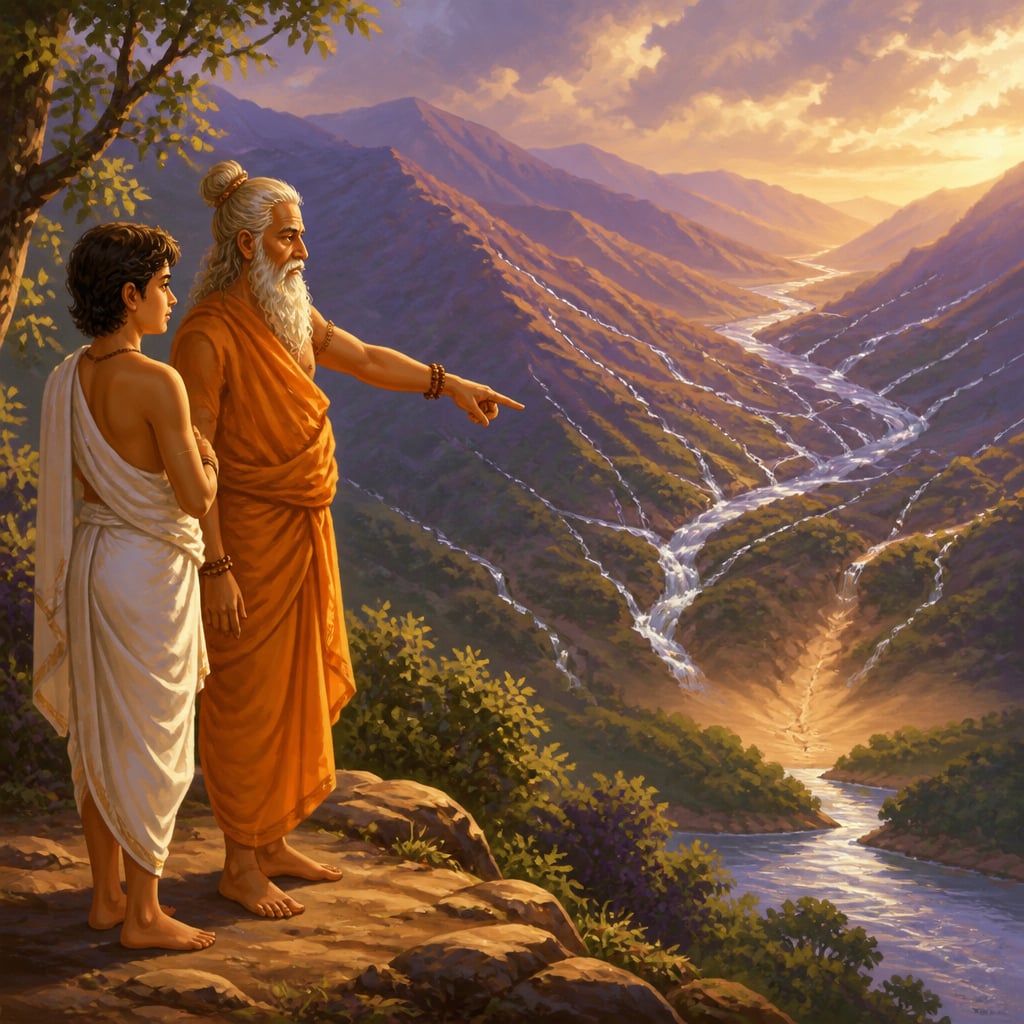
An elderly rishi and his young student watching many streams converge toward the Saraswati

The Danger of a Half-Truth

The previous lessons established a profound Vedic insight: Truth is One, though the wise call it by many names. Many paths can lead to the same Reality. But this insight, when misunderstood, becomes its opposite.

Modern relativism claims: "Since there are many paths, all paths are equally valid. Since truth is approached differently, there is no truth, only perspectives." This sounds similar to Vedic pluralism but inverts it completely.

The Rishis said: There is ONE Truth (Ekam Sat), and many valid approaches to it. Relativism says: There is NO truth, and therefore all approaches are equal by default. The first affirms truth and respects diversity of approach. The second denies truth and makes "diversity" meaningless, if nothing is true, being tolerant of different views costs nothing.

What the Mantras Reveal

The Rig Veda contains a striking verse that illuminates this distinction:

"Ṛtasya panthā na taranti duṣkṛtaḥ", "The path of Ṛta (cosmic truth/order) is not crossed by the wrongdoer."

This is not relativism. The Rishis affirm that there IS a path of truth (Ṛta), and that some actions (duṣkṛta, wrong-doing) cannot travel it. Not all paths lead to truth. Not all actions align with reality. The pluralism of "many names for one Reality" coexists with the discernment that some names are more accurate, some paths more direct, some actions aligned and others not.

Sayana's commentary emphasizes that Ṛta is not merely cosmic order but the principle of truth-correspondence. To walk the path of Ṛta is to align one's understanding and action with how things actually are. This cannot be faked; it cannot be achieved by any arbitrary belief.

Sri Aurobindo adds a psychological dimension: the path of Ṛta requires inner transformation, not just intellectual assent. Someone who claims to follow truth while living in self-deception is not on the path, regardless of their words.

Traditional Wisdom on Discernment

The Dharmic tradition took this principle seriously through rigorous philosophical debate. When Adi Shankaracharya met Mandana Mishra in the 8th century CE, they didn't say "you have your truth, I have mine." They debated for weeks, with Mandana's wife Ubhaya Bharati serving as judge. Both men believed truth existed and could be known, the question was whose understanding was more accurate.

Adi Shankaracharya debating Mandana Mishra with Bharati as judge

Shankara won the debate, and Mandana became his student. This was not intolerance, it was the opposite. Because both men respected truth, they could engage seriously. Pluralism without a commitment to truth produces polite indifference, not genuine dialogue.

The ancient Charvaka school tested this principle from the other direction. The Charvakas were materialists who denied the Vedas, the Devas, and any reality beyond the physical. Did the Dharmic tradition "tolerate" them? Yes, they were debated, not persecuted. Their texts were preserved and studied. But their claims were also refuted. Tolerance of persons is not the same as endorsement of claims. The Charvakas could speak; that didn't make their claims true.

Living This Today

Karl Popper, the philosopher of science, articulated a modern version of this distinction. He argued that science is pluralistic, many hypotheses can be proposed, but not relativistic, hypotheses must be testable, and those that fail the test are rejected. "All swans are white" can be disproven by a single black swan. The openness to many hypotheses serves truth-seeking, not truth-denial.

The Indian Supreme Court operates on similar principles. The Constitution can be interpreted in multiple valid ways, this is pluralism. But not any interpretation is valid. When Justice H.R. Khanna dissented alone in the 1976 Habeas Corpus case during the Emergency, arguing that even emergency powers couldn't suspend fundamental rights, he was not saying "my opinion is as good as yours." He was saying: "There is a truth about what the Constitution means, and I believe the majority has missed it." History proved him right.

S. Radhakrishnan, philosopher and second President of India, spent his life articulating this distinction for the modern world. He argued that Hindu tradition is genuinely pluralistic, welcoming multiple approaches to the Divine, but not relativistic. The Divine is real; the approaches are various; some approaches work better than others; and sincere seekers discover this through practice.

The distinction between pluralism and relativism is crucial for modern discourse. Relativism leads to either paralysis (no truth to seek) or power politics (whoever is strongest determines 'truth'). Pluralism enables genuine dialogue, we can disagree about paths while agreeing that truth exists and matters.

Cognitive science distinguishes between 'motivated reasoning' (believing what we want) and 'accuracy-motivated reasoning' (believing what's true). Research by Dan Kahan shows that intelligence doesn't prevent bias, viveka must be cultivated deliberately.

Ray Dalio's 'Principles' at Bridgewater Associates institutionalized viveka: 'radical truth and radical transparency.' Multiple views are encouraged, but they must be tested against reality. Idea meritocracy, not idea democracy.

Karl Popper's falsifiability criterion embodies viveka in science. Many hypotheses can be proposed (pluralism), but they must be testable and rejectable (not relativism). This makes science self-correcting.

Jonathan Haidt's research on moral psychology shows that productive disagreement requires 'stepping outside your moral matrix.' This is modern viveka, the capacity to evaluate your own framework, not just defend it.

The Shankara-Mandana debate model: both sides commit to truth-seeking, agree on criteria for evaluation, engage fully, and accept the outcome. This produces real resolution, unlike debates where both sides just perform for their base.

Legal systems embody this through appellate review. The Supreme Court can disagree about interpretation (pluralism) but commits to a decision that binds (not relativism). The system assumes truth is discoverable through process.

Your Path Forward

The Vedic distinction between pluralism and relativism has immediate practical implications. When someone says "that's your truth," ask: do they mean "you've found a valid path that works for you" (pluralism) or "there is no truth, so whatever you believe is fine" (relativism)? The first respects both you and truth. The second respects neither.

In your own life, practice viveka, discernment. Honor the many valid paths others may walk. But don't confuse this with endorsing every claim. The liar, the self-deceiver, the one who mistakes comfort for truth, they are not walking the path of Ṛta, regardless of their sincerity. Compassion for persons, clarity about claims.

The next lesson explores how the many forces of the Vedic cosmos actually cooperate, how diversity serves unity through coordinated action.

Case studies

Science and Falsifiability: Karl Popper's Gift to Truth-Seeking

In the early 20th century, science faced a crisis: theories like Freudian psychoanalysis and Marxist historicism claimed to explain everything. No matter what happened, their adherents could explain it. Karl Popper, a Viennese philosopher who later escaped Nazi persecution, saw the problem: theories that explain everything explain nothing. A claim that cannot be disproven is not scientific.

Popper's falsifiability criterion is viveka applied to science. It distinguishes genuine hypotheses (which can be tested and potentially refuted) from pseudo-science (which accommodates any evidence). This is pluralism without relativism: many hypotheses can be proposed, but not all survive testing. The path of Ṛta demands alignment with reality, claims must correspond to how things actually are, not just to what we wish.

Popper's criterion became foundational to modern science philosophy. It enables openness to new ideas (pluralism) while maintaining rigor (not relativism). Einstein's relativity was bold, but it made testable predictions that could have disproven it. That's what made it scientific. Today, the distinction helps evaluate claims from climate science to nutrition to psychology.

True openness requires standards. Science is open to any hypothesis, but the hypothesis must risk being wrong. The Vedic insight applies: many paths can approach truth, but not every claim is a path. Viveka, the capacity to test and discern, is what makes genuine pluralism possible.

In an age of social media where every opinion claims equal validity, the Popperian insight that openness requires standards is urgently needed. Genuine pluralism means many paths can approach truth, but not every viral claim qualifies as a legitimate path.

Popper noted that astrology had been tested for thousands of years and failed, yet astrologers never abandoned it. Science, in contrast, discards disproven theories. This willingness to be wrong is the price of access to truth.

Shankara vs. Mandana Mishra: How Truth-Seekers Disagree

Around 720 CE, the young monk Shankaracharya arrived at the home of Mandana Mishra, the leading scholar of Karma Mimamsa (the school emphasizing Vedic ritual). Mandana's wife Ubhaya Bharati, herself a renowned scholar, agreed to judge the debate. The stakes were real: the loser would become the winner's student. For weeks they debated: Is liberation achieved through ritual action (Mandana) or through knowledge alone (Shankara)?

This was pluralism in action, two brilliant scholars, two valid approaches to Vedic interpretation, engaging in rigorous debate. But it was not relativism: both believed truth existed and could be known. They weren't performing for audiences; they were genuinely trying to discover what was real. When Shankara's arguments proved more compelling, Mandana accepted defeat and became his student Sureshvara, one of the great Advaitins.

Sureshvara (formerly Mandana) wrote some of the most important Advaita commentaries. His understanding of ritual, now integrated into the knowledge path, enriched the tradition. The debate didn't destroy Mimamsa; it clarified its relationship to Vedanta. Both schools continued, with better understanding of their respective domains.

Genuine disagreement, conducted with commitment to truth, advances understanding. The Shankara-Mandana debate is a model: clear criteria, genuine engagement, willingness to accept the outcome. This produces not bitter division but productive synthesis. S. Radhakrishnan called this 'the highest form of tolerance, taking the other seriously enough to engage.'

Productive disagreement is a vanishing skill in polarized societies. The shastrartha model, where opponents agree on criteria before debating, offers a template for everything from parliamentary procedure to online discourse. Without shared standards of evidence, debate degenerates into performance.

The Shankara-Mandana Mishra debate, held around 720 CE, lasted approximately 18 days according to traditional accounts. The judge was Mandana's own wife, Ubhaya Bharati, who was recognized as a scholar in her own right. After accepting defeat, Mandana took the monastic name Sureshvara and authored key Advaita texts.

Reflection

More in Ekam Sat: Many Forces, One Reality

All lessons in Ekam Sat: Many Forces, One Reality · Rig Vedic Philosophy course