Vibhūti: Unity Behind Diversity

How the One Becomes Many Without Losing Itself

Exploring the Vedic understanding of how ultimate unity expresses through diversity, not as fragmentation but as creative manifestation, and how this principle operates in music, biology, and human collaboration.

The Rishi sat facing east, watching the horizon. The sky was still dark, but he knew what was coming. First, the faintest glow, a colorless light. Then, as the sun crested the distant hills, something remarkable happened. The morning mist caught the rays and scattered them: gold here, rose there, amber, violet, blue spreading across the sky in an infinite gradient.

One light. Countless colors. The Rishi smiled. This was not a metaphor he would use to explain unity and diversity. This was unity and diversity, the cosmos demonstrating its own nature at every dawn.
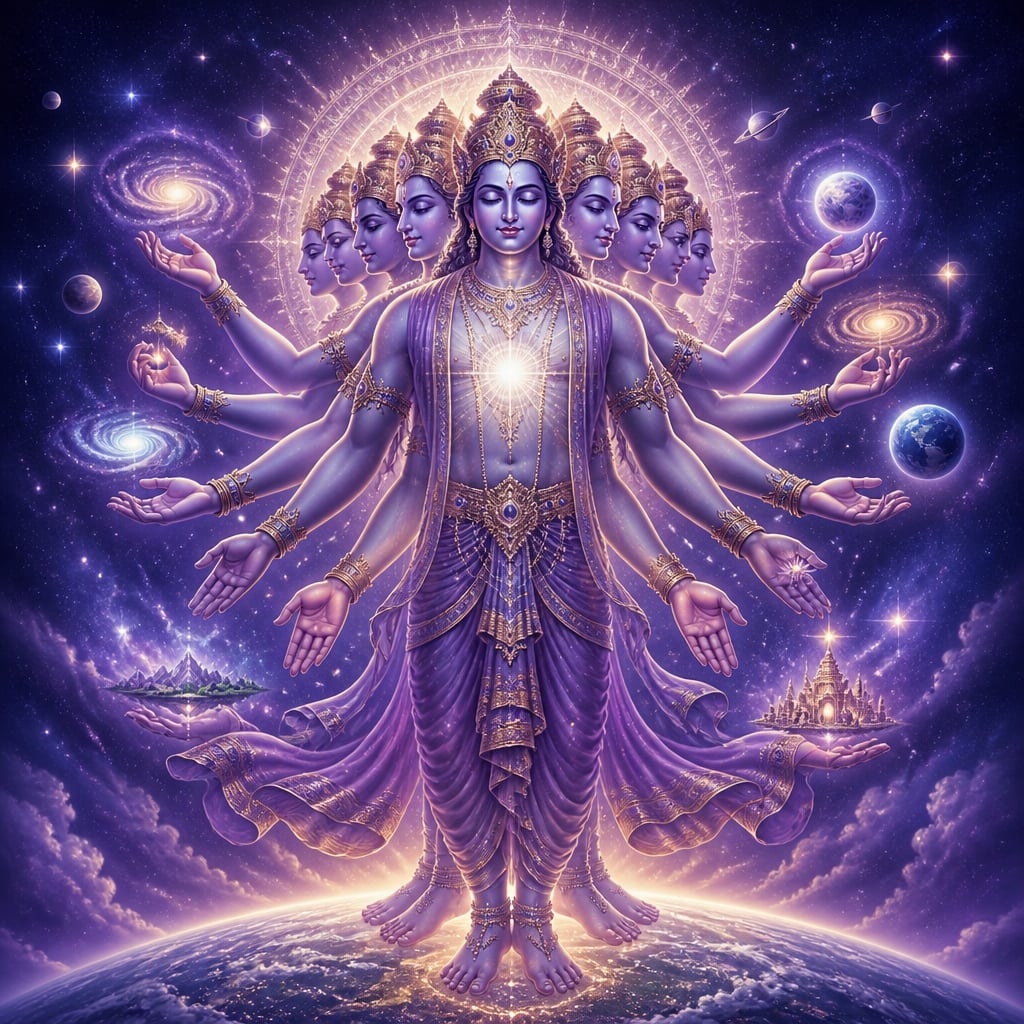
The cosmic Purusha with many radiant heads, arms, and feet against a starlit sky

The Vedic Understanding of Manifestation

The previous lesson established that the Rig Veda speaks of one Truth expressed through many names. But this raises a deeper question: How does the One become many? Is it division, like cutting a pie into pieces, each piece separate? Or is it something else entirely?

The Vedic answer is profound: the One becomes many through manifestation, not fragmentation. When light breaks into colors through a prism, the light is not divided, it is revealed. Each color was always present in the white light; separation shows what was already there. The One does not lose itself by becoming many; it shows itself more fully.

This is why the Rishis could invoke Agni, Indra, Varuna, and Surya without contradiction. Each Deva reveals an aspect of Reality that was always present but needed a particular form to become visible. The many do not compete with the One, they are how the One becomes knowable.

What the Mantras Reveal

The Purusha Sukta offers the most vivid image of this principle:

"Sahasra-śīrṣā puruṣaḥ sahasrākṣaḥ sahasra-pāt", "The Cosmic Person has a thousand heads, a thousand eyes, a thousand feet."

This is not arithmetic. "Thousand" here means infinite multiplicity. The Purusha, the cosmic principle, expresses through countless forms (heads, eyes, feet) while remaining one integral being. Sayana's commentary emphasizes that these are not parts assembled but aspects of a seamless whole. The universe is not built from components but expressed from unity.

The hymn continues: "He pervades the earth on all sides and extends ten fingers beyond." The infinite One is both immanent (pervading everything) and transcendent (extending beyond). The many forms are within the One, not outside it.

Sri Aurobindo interprets this psychologically: the Purusha is consciousness itself, which manifests as individual minds, perceptions, and experiences without ever being truly divided. Your awareness and mine appear separate, but the underlying consciousness, like the white light, is one.

Traditional Wisdom on Creative Manifestation

The Vedic understanding differs crucially from Western models of creation. In many Western frameworks, creation involves making something from nothing, a separation between creator and created. The Vedic model is closer to expression or emanation: the created is not separate from the creator but is the creator in manifested form.

Yaska's Nirukta explains that the Devas are vibhūti, powers or glories, of the One. The Sanskrit root bhū means "to be" or "to become." Vibhūti suggests a becoming that reveals being, an expression that shows essence. When Brahman manifests as Agni, it is not creating something other than itself, it is showing an aspect of its own infinite nature.

This is why the tradition speaks of svarūpa (own-form). Each Deva is a svarūpa of the Supreme, a self-form, not an external creation. The ocean does not create waves as something other than itself; waves are ocean in motion. The Devas are Brahman in dynamic expression.

This understanding of manifestation, rather than creation from outside, transforms how we see ourselves and the world. We are not creatures separate from a distant creator but expressions of the infinite, limited in form but not in essence. This is the foundation for Vedantic spirituality: not becoming divine but recognizing the divine we already are.

Living This Today

The Human Genome Project completed in 2003 offers a striking modern parallel. Scientists from six countries, working in dozens of labs, faced an immense challenge: map the entire human genetic code, three billion base pairs. Francis Collins, who led the U.S. effort, described the breakthrough: "We discovered that the human genome is remarkably uniform. All humans share 99.9% of their DNA. The diversity we see, different heights, skin colors, aptitudes, emerges from that 0.1% variation."

This is biological Ekam Sat. One genetic code expresses through billions of unique humans. The diversity is not despite unity but because of it. The 99.9% shared foundation makes the 0.1% variation meaningful rather than chaotic.

An Indian classical music sabha grounded by one tanpura drone

Indian classical music demonstrates this principle in real-time. Pandit Ravi Shankar, the legendary sitarist, explained: "Every raga, no matter how different, must return to the shruti, the fundamental tone. The shruti does not restrict; it liberates. Because the shruti is stable, the musician can explore anywhere and still be home." Many ragas, one shruti. The unity enables rather than constrains the diversity.

Attachment theory (John Bowlby) shows that secure attachment in childhood creates the foundation for healthy independence later. Children who feel securely connected explore more freely, unity enabling diversity in psychological development.

Seekers from many regions studying at Nalanda

Companies with strong core values (shruti) see more innovation (ragas), not less. Google's 'Don't be evil' (now 'Do the right thing') created space for diverse projects. Clear unity of purpose frees people to experiment.

Ecosystems demonstrate this: the shared carbon cycle, water cycle, and energy flow (shruti) enable billions of species (ragas). Biodiversity collapses when underlying unity (clean air, water, soil) degrades.

Holistic psychology recognizes that each symptom, each dream, each behavior contains information about the whole person. Carl Jung's approach treated individual symbols as windows to the complete psyche, the whole present in each part.

The best leaders see each team member as a complete professional, not a cog. Francis Collins led the Human Genome Project by treating each lab, each scientist as carrying the whole mission, not just executing a piece.

Holography demonstrates this literally: cut a hologram and each piece contains the whole image. Biological systems work similarly, each cell contains the complete DNA. The whole is fractally present in each part.

Your Path Forward

The Vedic principle of manifestation offers a powerful lens for understanding your own life. You express through many roles, professional, parent, friend, seeker, but these are not fragments of a broken self. They are facets of one integrated being, each role revealing an aspect of who you are.

When these roles seem to conflict, the question is not "which is the real me?" All are real. The question is: what is the underlying unity from which all these expressions emerge? Find that, and the apparent conflicts resolve, not by eliminating diversity but by grounding it in unity.

The next lesson explores a crucial nuance: if many expressions point to one truth, does that mean all expressions are equally valid? The Vedic answer is sophisticated and surprising.

Case studies

The Human Genome Project: One Code, Infinite Humanity

In 1990, scientists from six countries launched an unprecedented collaboration: map the entire human genetic code, three billion base pairs. Francis Collins, who led the U.S. National Human Genome Research Institute, coordinated researchers across the globe. The project faced immense challenges: different labs used different methods, different countries had different priorities, and a private competitor (Celera Genomics) threatened to patent the results for profit.

The Human Genome Project embodies the Ekam Sat principle at multiple levels. First, the collaboration itself: many nations, many labs, many scientists serving one shared mission. Second, the discovery: the human genome revealed that all humans share 99.9% of their DNA. The stunning diversity of humanity, different appearances, different aptitudes, different cultures, emerges from that 0.1% variation. Like the Purusha with a thousand heads, humanity is one being expressing through billions of unique forms.

The project completed in 2003, two years ahead of schedule. Collins made a crucial decision: the data would be freely available to all, not patented. This 'shruti' of open access has enabled thousands of subsequent discoveries. The unity of the shared code and the unity of the collaborative spirit together demonstrate how foundation enables flourishing.

Unity is not just an ideal, it's an empirical fact. We are literally one species, one genetic family. The Vedic insight that diversity emerges from unity is written in our DNA. And the collaborative success shows that humans can work as 'one' when the shared purpose is clear.

Genomic medicine is now personalizing treatments based on individual genetic variation while recognizing our shared biological inheritance. The same DNA that proves human unity also explains individual uniqueness, making the one-and-many relationship a practical medical reality.

All 8 billion humans share 99.9% identical DNA. The entire human genetic variation that produces our diversity fits in the 0.1% difference, a scientific expression of 'Ekam Sat.'

Nalanda: One Quest, Many Seekers

From the 5th to 12th century CE, Nalanda Mahavihara in Bihar was the world's first residential university, and perhaps its greatest. At its peak, 10,000 students from across Asia studied there: Buddhists from China and Tibet, Hindu scholars from across Bharat, seekers from Persia, Greece, and Southeast Asia. They studied not just Buddhism but all systems, Vedic philosophy, logic (nyāya), grammar, medicine, astronomy. The Chinese pilgrim Xuanzang spent five years there, later calling it 'the place where the sun of knowledge never sets.'

Nalanda demonstrated the Ekam Sat principle in education. The unity was the quest for knowledge itself, not a single doctrine but the shared aspiration to understand reality. Within this unity, stunning diversity flourished: different philosophies debated, different methods were employed, different traditions contributed. The Chinese Xuanzang studied with the Buddhist master Shilabhadra but also engaged Hindu and Jain scholars. The shruti was truth-seeking; the ragas were the many paths explored.

Nalanda's graduates spread learning across Asia for 700 years. Its library, the Dharmaganja ('Treasury of Truth'), held hundreds of thousands of manuscripts. When Bakhtiyar Khilji destroyed it in 1193, monks reportedly tried to save what they could, some texts survived in Tibet and China. The institution fell, but its model of unity-enabling-diversity influenced every subsequent Asian university.

The greatest learning happens not when one doctrine dominates but when a shared love of truth provides the foundation for diverse exploration. Nalanda's unity was not uniformity, it was a common reverence for knowledge that made productive diversity possible.

The world's most productive research universities function on Nalanda's model: shared institutional purpose with radically diverse intellectual approaches. MIT's Media Lab, Stanford's d.school, and IISc Bangalore all thrive by housing competing perspectives under one roof.

At its peak in the 7th century CE, Nalanda housed approximately 10,000 students and 2,000 teachers. Its library, the Dharmaganja, comprised three multi-story buildings (Ratnasagara, Ratnodadhi, and Ratnaranjaka), and is estimated to have held hundreds of thousands of manuscripts.

Reflection

More in Ekam Sat: Many Forces, One Reality

All lessons in Ekam Sat: Many Forces, One Reality · Rig Vedic Philosophy course