Sahakāra: Cooperation of Forces
How Diversity Serves Unity Through Coordinated Action
Exploring how the Vedic Devas model cooperative action, distinct forces working in harmony, and how this principle applies to teams, ecosystems, and the human body.
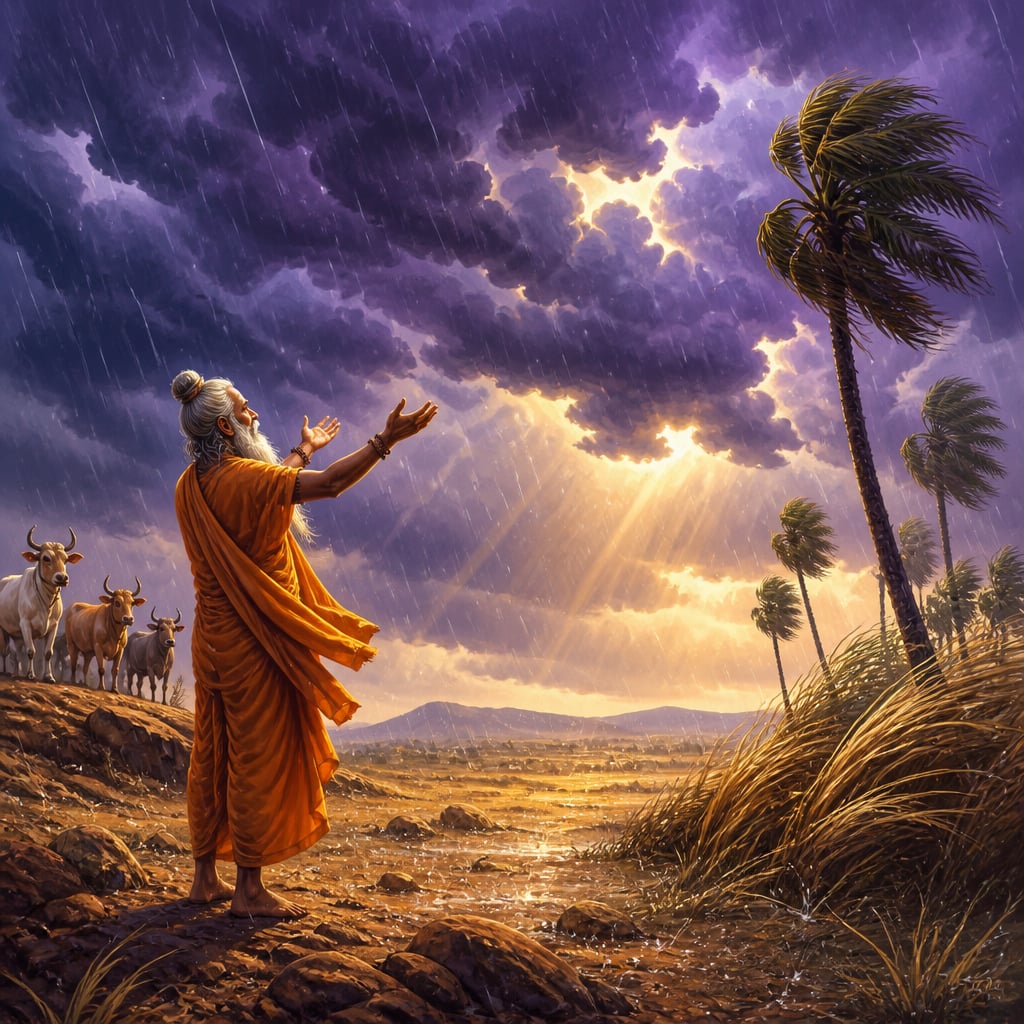
The Rishi had been watching the sky for days. The summer heat had baked the earth hard; the wells were low; the people waited. Then, on the horizon, the first dark clouds appeared. But he knew it wasn't just Parjanya, the rain-god, who was arriving.
First came Vayu, the wind, shifting from hot and dry to cool and moist, carrying the moisture inland from the distant ocean. Then Indra gathered the clouds, dark masses heavy with potential. Parjanya released the rain, but not randomly. The waters fell where the ground could receive them, channeled by the contours Prithvi, the Earth, had shaped over eons. And Agni? Even he participated, the sun's heat had lifted the ocean waters in the first place.
No single Deva brought the monsoon. All of them, working in concert, served one purpose: life.
The Vedic Vision of Coordinated Action
The previous lessons established that many Devas express one Reality. But the Rig Veda reveals something more: the Devas don't just coexist, they cooperate. Each has a distinct function, but these functions interlock like the movements of a great dance.
This is not hierarchy, where one Deva commands and others obey. It is symphony, where each voice contributes its unique part to a shared music. The Rig Veda is full of hymns that invoke multiple Devas together, Agni and Indra, the Ashvins and Ushas, the Maruts and Vayu. They are called in pairs and groups because they act in pairs and groups.
The human body demonstrates this principle intimately. As you read these words, your heart pumps blood, your lungs exchange gases, your digestive system processes nutrients, your immune system patrols for threats, all simultaneously, all without your conscious direction, all serving one life. You are one being expressed through many systems, each system depending on the others.
What the Mantras Reveal
The Rig Veda contains a remarkable hymn invoking the coordinated action of the Devas:
"Saṃ gacchadhvaṃ saṃ vadadhvaṃ saṃ vo manāṃsi jānatām", "Move together, speak together, let your minds be in harmony."
This verse was not addressed to humans, it was addressed to the cosmic forces themselves, recognized as the original model of cooperation. The Rishis saw in the Devas' coordinated action a template for all constructive collaboration.

Sayana interprets this verse as describing the yajña, the Vedic ritual where multiple priests with different specializations performed their distinct roles in precise coordination. The Hotri chanted the mantras, the Adhvaryu performed the physical actions, the Udgatri sang the melodies, and the Brahma supervised the whole. No single priest could perform the ritual alone; the offering reached its destination through their combined effort.
Sri Aurobindo sees in this verse a psychological teaching: the various faculties of consciousness, mind, vital force, physical sensation, must cooperate for integrated action. When they conflict, we experience inner turmoil. When they align, we experience flow.
Traditional Wisdom on Sacred Cooperation

The temple-building traditions of ancient India embodied this principle in stone. A great temple like those of Khajuraho or Thanjavur was not the work of a single genius, it emerged from the coordinated effort of multiple specialized guilds.
The sthapatis (architects) designed the overall structure according to sacred geometry. The shilpis (sculptors) carved the images, each following precise iconographic rules. The sompuras (structural engineers) ensured the building would stand. The priests determined the orientation and consecration rites. The patrons provided resources and vision.
No single guild could build a temple alone. But when they worked together, each contributing expertise, each respecting the others' domains, structures arose that have endured for a thousand years. The cooperation was not compromise (everyone doing less so no one is offended) but synergy (everyone doing their best, which requires others doing their best too).
Modern organizational theory often assumes that coordination requires hierarchy and control. The Vedic model offers an alternative: coordination through shared purpose, clear roles, and mutual trust. This insight applies to teams, organizations, ecosystems, and even our own bodies, which coordinate trillions of cells without any CEO.
Living This Today
Every working day in Mumbai, approximately 5,000 dabbawalas collect 200,000 lunch boxes from homes across the city, sort them through a series of hand-offs, deliver them to the correct office worker, and then reverse the process, all with an error rate of one in 16 million deliveries. Harvard Business School has studied them. Prince Charles has met them. Six Sigma quality experts are baffled by them.
Raghunath Medge, president of the Mumbai Dabbawala Association, explains their secret: "We are not employees of a company. We are partners in a system. Each dabbawala knows his role exactly, and trusts others to know theirs. We don't compete; we coordinate."
The system has no headquarters, no software, no formal management hierarchy. What it has is a shared purpose (every lunch reaches the right person on time), a clear division of labor (each dabbawala handles a specific leg of the journey), and mutual trust (my work depends on your work). This is the Vedic yajna in modern form, distinct roles, coordinated action, shared outcome.
Systems thinker Donella Meadows called this "system behavior emerging from structure." The dabbawalas don't need central control because the structure itself produces coordination. W. Edwards Deming, the quality guru who helped Japan's post-war industrial revolution, made this his central teaching: competition between parts of a system destroys the system; cooperation between parts creates excellence.
Polyvagal theory (Stephen Porges) shows that the nervous system coordinates multiple states through structure, not conscious control. Heart, lungs, digestion cooperate because the vagal system is designed for coordination. Similarly, teams need structural integration, not just managerial oversight.
W. Edwards Deming's 14 Points include 'Drive out fear' and 'Break down barriers between departments.' He saw that competition within organizations destroys quality, while cooperation creates it. The best systems, like the best bodies, coordinate through design.
Donella Meadows identified 'feedback loops' as the key to system behavior. In coordinated systems, each part receives information from other parts and adjusts. The dabbawalas' color-coded system works because information flows with the lunchboxes.
Internal Family Systems therapy recognizes that inner 'parts' (protector, manager, exile) function best when unified under Self-leadership. Inner conflict arises when parts pursue separate agendas; integration comes when they align around shared wellbeing.
Patrick Lencioni's 'The Five Dysfunctions of a Team' identifies lack of trust and fear of conflict as primary problems. Both prevent the alignment that enables coordination. Teams need shared purpose (eka-vrata) before they can coordinate effectively.
Living systems demonstrate that coordination emerges from shared constraints (DNA, physical laws) and distributed intelligence (no central controller). The human immune system coordinates millions of cells through chemical signals, not hierarchy.
Your Path Forward
The Vedic vision of cooperative forces offers a powerful alternative to the modern default of competitive individualism. The Devas don't vie for supremacy, Agni doesn't try to defeat Indra. They contribute their distinct gifts to the functioning of the cosmos.
In your teams, your family, your community, ask: Are we cooperating or merely coexisting? Is each person's contribution valued and integrated? Does our structure enable coordination or require constant management?
The healthiest organizations, like the healthiest bodies, achieve coordination through design rather than control. When each part knows its role, trusts the other parts, and serves the shared purpose, the whole becomes far more than the sum of its parts.
The next lesson explores a crucial interpretive question: How do we understand the Devas without falling into either literalism or dismissive abstraction?
Case studies
The Mumbai Dabbawalas: Modern Yajna in Lunchbox Form
Every working day in Mumbai, approximately 5,000 dabbawalas (literally 'box carriers') collect around 200,000 lunch boxes from homes across the city, transport them through a series of hand-offs using trains and bicycles, deliver each box to the correct office worker by lunchtime, and then reverse the entire process. They've been doing this since 1890. In 2010, Harvard Business School calculated their error rate: one mistake in approximately 16 million deliveries, a Six Sigma performance achieved by semi-literate workers with no computers.
The dabbawala system is a living yajna, coordinated action where distinct roles serve one purpose. Each dabbawala knows exactly his segment of the journey. A simple coding system (colors, symbols) replaces complex software. The 'eka-vrata' (shared purpose) is absolute: every lunch reaches the right person on time. Raghunath Medge explains: 'We don't compete with each other. My success depends on your success. We are not employees; we are partners in a system.'
The system has operated for over 130 years across wars, riots, and pandemics. During the 2008 Mumbai attacks, dabbawalas continued delivering. The structure itself, clear roles, simple information flow, shared purpose, creates resilience that no central control could achieve. Prince Charles met with them; business schools study them; Six Sigma experts cannot replicate them.
Coordination emerges from structure, not control. When roles are clear, purpose is shared, and trust is established, thousands can act as one without headquarters, software, or formal hierarchy. The Vedic yajna model, distinct contributions serving shared intention, operates in Mumbai every lunch hour.
Self-organizing systems, from Wikipedia's editor community to open-source projects like Linux, demonstrate that remarkable coordination emerges without centralized control when structure, shared purpose, and trust are in place. The dabbawala model is now studied in business schools as a case for distributed intelligence.
The dabbawalas' error rate of 1 in 16 million (99.999999% accuracy) exceeds most modern logistics companies. They achieve this with no computerized tracking, only an alphanumeric coding system painted on each box.
Temple Construction: Sacred Synergy in Stone
The great temples of India, Khajuraho, Thanjavur, Konark, were not designed by single architects or built by unified construction companies. They emerged from the coordinated work of specialized guilds operating over decades. The Brihadeeswarar Temple in Thanjavur (11th century CE) required over a decade to complete, with thousands of workers from different guilds: sthapatis (architects), shilpis (sculptors), somapuras (engineers), and numerous others for metalwork, painting, ritual, and administration.
Temple construction was explicitly understood as yajna, a coordinated offering that required distinct expertise aligned toward sacred purpose. The Shilpa Shastras (architectural treatises) specified not just measurements but the relationships between different craftsmen's work. The sculptor couldn't begin until the architect had set proportions; the consecrating priests couldn't act until the structure was complete. Each guild's 'vrata' (commitment to excellence in their domain) served the 'maha-vrata' (the temple's sacred purpose).
Many of these temples have stood for a thousand years, not just architecturally but as living centers of worship. The Brihadeeswarar's main shikhara (tower) is built from granite blocks weighing up to 80 tons, fitted without mortar, in a region with no granite quarries nearby. The coordination required to transport, lift, and fit these blocks, without modern cranes, remains a subject of engineering study.
Lasting excellence emerges from the cooperation of specialized excellence. No single guild could build a temple; no generalist could match the specialists' mastery. The secret was coordination, not compromise but amplification, each guild's excellence enabling and requiring others' excellence.
Modern construction of complex systems, from Boeing aircraft to semiconductor fabs, depends on the same principle: specialized teams coordinating through shared standards rather than generalists attempting everything. The cathedral-building guilds of medieval Europe operated identically to these ancient temple guilds.
The Brihadeeswarar Temple at Thanjavur, completed in 1010 CE by Raja Raja Chola I, stands 66 meters tall with a capstone (shikhara) weighing approximately 80 tonnes. It was engineered to cast no shadow at noon, and its construction required coordinating stone carvers, bronze casters, architects, and painters over 25 years.
Reflection
- In a team or family you're part of, where is coordination working well? Where is it failing? What structural change (not behavioral change) might help?
- The Rig Veda addresses the Devas: 'Move together, speak together, let your minds be in harmony.' What would it mean for the different parts of yourself, mind, body, emotions, to receive this same instruction?
- Deming said competition within systems destroys them. If this is true, why is internal competition (sales contests, performance rankings, departmental rivalries) so common in modern organizations?