Samanvaya: Living With Multiple Truths

From Understanding to Integration: Practicing Ekam Sat

Exploring how to move beyond intellectual understanding of 'many paths, one truth' to actually living it, making decisions, maintaining relationships, and growing as a person while holding multiple valid perspectives.

The master architect stood before the temple foundation, three scrolls of plans spread before him. Each design was valid. One emphasized the gopuram's height, reaching toward the heavens. Another prioritized the garbhagriha's intimacy, creating a womb of darkness where the divine could be most directly encountered. The third balanced exterior grandeur with interior mystery.

The patron was impatient. "Which is correct?"

"All of them," the architect replied. "And yet I must choose one. Today, I commit to this design." He selected the third scroll. "Not because the others are wrong, but because this serves what this community needs now, in this place, at this time."

The patron frowned. "But if all are valid, how can you choose?"

"Because understanding that many paths lead to truth does not paralyze action, it illuminates which path to walk today."
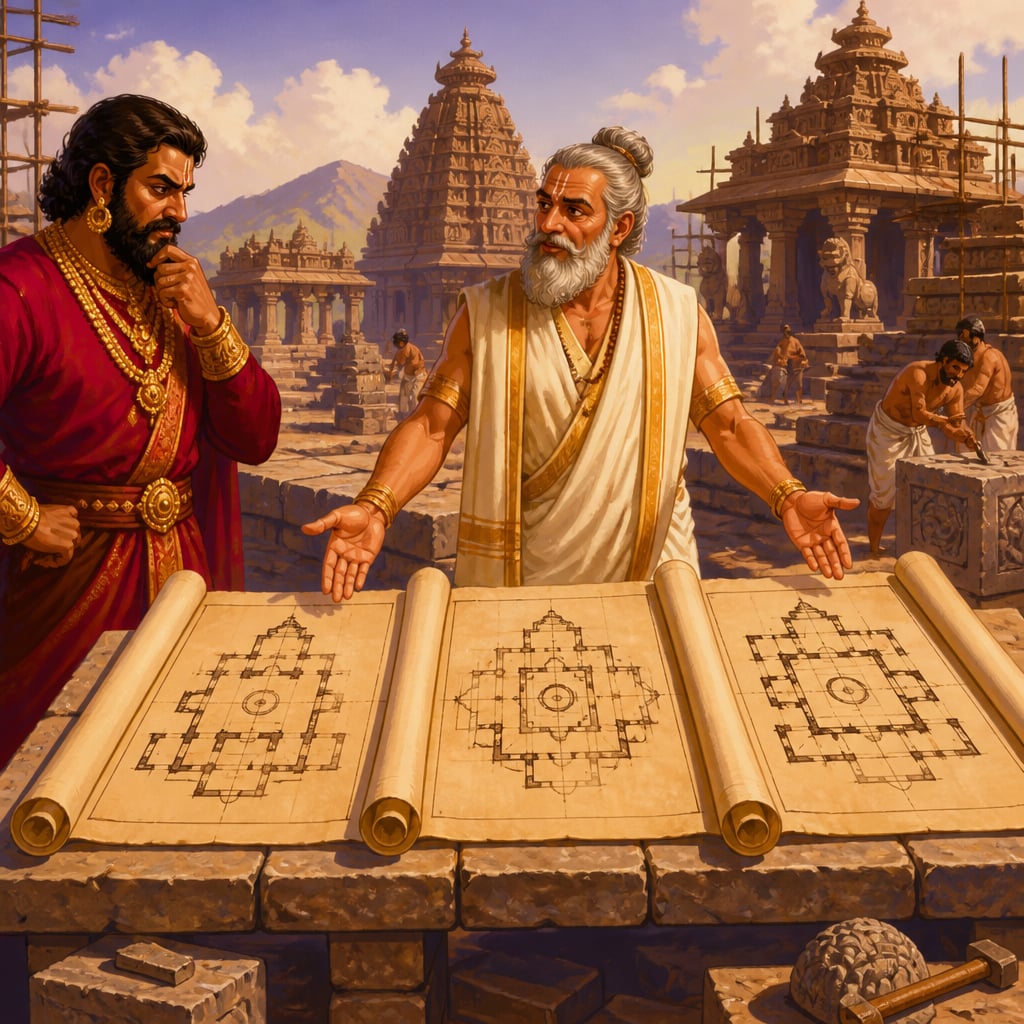
A master temple architect with three palm-leaf plans choosing one design at the construction yard

From Understanding to Practice

The previous lessons have established the Vedic framework: Truth is One, approached through many valid paths. Diversity expresses unity. Pluralism is not relativism. Cooperation enables more than competition. Sacred language operates on multiple levels. All true.

But knowing this is not the same as living it. The question now becomes: How do you actually make decisions when multiple options are valid? How do you maintain relationships with people whose valid perspectives differ from yours? How do you grow as a person without fragmenting into contradictory selves?

The Vedic answer is not to pick one truth and dismiss others. It is not to remain suspended in perpetual indecision. It is integration, holding multiple truths while still acting, relating, and becoming.

What the Mantras Reveal

The Rig Veda offers a remarkable image for this integration:

"Tad ekam", "That One."

This phrase appears in the Nasadiya Sukta, the famous hymn of creation. But notice: the hymn doesn't say "There is only one" or "Everything is one." It says that one, pointing, indicating, invoking. The One is not a proposition to be defended but a reality to be pointed toward.

Sayana explains that "tad ekam" functions like a finger pointing at the moon. The finger is necessary, you need direction. But the finger is not the moon. The Rishi points so that you might see, not so that you might argue about fingers.

This has practical implications. When you hold multiple truths, you're not trying to collapse them into a single formula. You're pointing toward a reality that includes them all. The integration happens not in your concepts but in your orientation, you're facing the same direction even when your maps differ.

Traditional Wisdom on Integration

Ramanujacharya teaching from the Srirangam gopuram terrace

Ramanujacharya, the 11th-century philosopher, faced exactly this challenge. Two great truths seemed to conflict: the Upanishadic teaching that Brahman is the only reality (Advaita) and the devotional experience that the devotee and the Divine are genuinely related (Bhakti). Must one choose?

Ramanuja's Vishishtadvaita ("qualified non-dualism") integrated both. Brahman is indeed the only reality, but this One reality includes within itself the plurality of souls and matter as its attributes (vishishta). The wave is the ocean AND the wave has its own experience. Unity includes relationship rather than abolishing it.

This wasn't compromise, Ramanuja didn't say "a little Advaita, a little Bhakti." It was a higher synthesis that honored both truths by showing how they could both be true simultaneously. The devotee is genuinely different from the Divine (otherwise devotion makes no sense) AND ultimately united with the Divine (otherwise liberation is impossible).

Ramanuja demonstrated that integration is not about averaging positions but about finding the deeper unity that makes both positions possible. The architect's third design wasn't a compromise between height and intimacy, it found a form that expressed both.

In a world of increasing complexity and connection, the capacity to hold multiple truths while still acting, relating, and growing is not optional, it's essential. The Vedic tradition offers millennia of practice in exactly this skill.

Living This Today

Conflict resolution professionals have discovered what the Vedic seers knew: when parties hold genuinely different but valid perspectives, resolution comes not from one side winning but from finding the deeper interests both positions serve.

William Ury, co-author of Getting to Yes and founder of the Harvard Negotiation Project, calls this "going to the balcony", rising above your own position to see the whole conflict from above. From the balcony, you can see that your position and the other's position are both attempts to meet legitimate needs. Resolution comes from addressing the needs, not defeating the positions.

Marshall Rosenberg's Nonviolent Communication takes this further. He taught that beneath every position are universal human needs, safety, connection, meaning, autonomy. When you can identify the needs beneath positions, you often find that apparently opposing positions serve complementary needs. The conflict wasn't really about the positions; it was about unmet needs that both parties share.

Ken Wilber's integral philosophy offers a framework: "transcend and include." Higher stages of development don't reject earlier stages, they include them while adding new capacity. The child's magical thinking isn't wrong; it's included in the adolescent's rational thinking, which is included in the adult's post-rational integration. Nothing is lost; each stage is honored.

Decision science shows that the best decisions often come from considering multiple perspectives before committing. Barry Schwartz's research on choice distinguishes 'satisficers' (who choose when good enough) from 'maximizers' (who can't commit). The Vedic approach is neither, it's honoring multiplicity while committing to this moment's path.

William Ury's 'Getting to Yes' teaches negotiators to understand all parties' interests before proposing solutions. The best solutions aren't compromises but creative options that address multiple interests. This is samanvaya in negotiation.

Systems thinking recognizes that complex problems have multiple valid framings. Donella Meadows taught that leverage points differ depending on your framing, there's no single 'right' view, but there are better and worse choices for specific situations.

Ken Wilber's integral theory maps development through stages and states, showing how each level 'transcends and includes' earlier levels. The adult doesn't kill the child; the sage doesn't reject the scholar. Integration means honoring all of who you've been while growing into who you're becoming.

The best leaders integrate multiple capacities, vision and execution, confidence and humility, results and relationships. Jim Collins's 'Level 5 Leadership' describes this integration: fierce resolve PLUS profound humility, not one or the other.

Marshall Rosenberg's Nonviolent Communication teaches that beneath all our varied behaviors are universal human needs. Integrating multiple identities often means recognizing they all serve the same core needs, just in different contexts.

Your Path Forward

Living with multiple truths requires specific practices:

In decision-making: When facing valid alternatives, ask not "Which is true?" but "Which serves the current situation best?" The architect's third design wasn't more true than the others, it was more appropriate for this community, this place, this time. Commitment doesn't require believing alternatives are false.

In relationships: When someone holds a view different from yours, practice curiosity before critique. "What need does this view serve for them?" Often you'll find their view addresses something your view misses. Integration isn't agreeing, it's understanding how both views point toward something larger.

In identity: You contain multitudes. The professional self, the family self, the spiritual self, the playful self, these are not fragments to be unified into sameness but aspects to be integrated through purpose. What shared direction makes sense of all your selves?

The next lesson, concluding this chapter, explores why this ancient Vedic wisdom remains urgently relevant in 2026 and beyond.

Case studies

The Harvard Negotiation Project: From Positions to Integration

In 1981, Roger Fisher and William Ury published 'Getting to Yes,' revolutionizing conflict resolution. The traditional approach was positional bargaining: each side takes a position, and they haggle toward a compromise. But compromise often leaves both sides dissatisfied, it's a zero-sum game where gains come at the other's expense.

The Harvard Negotiation Project discovered what the Rishis knew: beneath surface positions lie deeper interests, and addressing interests enables solutions that serve everyone. Fisher and Ury call this 'principled negotiation', focusing on interests, inventing options for mutual gain, using objective criteria. This is samanvaya in action: not averaging positions but finding the deeper framework that makes both positions comprehensible and addressable.

The 'Getting to Yes' approach has been used in business negotiations, labor disputes, international conflicts, and family mediations worldwide. Camp David Accords, which achieved peace between Egypt and Israel, used interest-based negotiation. The insight: when you understand why people hold their positions (what needs they serve), creative solutions emerge that position-based bargaining never finds.

Living with multiple truths doesn't mean paralysis or compromise. It means going deeper, to the interests, needs, or values beneath surface positions. At that level, apparent conflicts often become complementary perspectives on shared goals. Integration happens not by splitting differences but by addressing what differences are trying to serve.

Negotiation training at Harvard, Wharton, and IIM Ahmedabad now centers on interest-based bargaining rather than positional compromise. The insight that going deeper resolves surface conflicts has transformed dispute resolution in business, diplomacy, and family mediation alike.

'Getting to Yes' has sold over 8 million copies and remains the foundational text of negotiation training. The FBI uses its principles in hostage negotiation; corporations use them in labor relations; families use them in custody disputes, all because the insight that positions hide shareable interests has proven universally applicable.

Ramanujacharya's Vishishtadvaita: Integration Without Compromise

In 11th-century South India, two great truths seemed to conflict. The Upanishads declared that Brahman alone is real (Advaita, non-duality). But the devotional traditions insisted that the relationship between devotee and Divine was real and meaningful (Bhakti). If only Brahman is real, is devotion an illusion? If devotion is real, is Brahman not truly one? The philosophical giants Shankara and Madhva represented opposite poles; neither seemed satisfying to devotees seeking philosophical grounding.

Ramanujacharya achieved samanvaya through Vishishtadvaita (qualified non-dualism). His insight: Brahman is indeed the only reality, but this One reality contains plurality within itself as its body. Souls and matter are Brahman's attributes (vishishta), not separate from Brahman but not identical either. The wave is the ocean AND has its own experience. This wasn't compromise ('a little Advaita, a little Bhakti') but higher synthesis, a framework that explained how both truths could be fully true simultaneously.

Vishishtadvaita became the philosophical foundation for the Sri Vaishnava tradition, which continues today with millions of followers. Ramanuja's integration showed that apparent contradictions between unity and relationship, between philosophy and devotion, were not contradictions at all when understood at the right level. His 108 pilgrimage temples (Divya Desams) demonstrate lived integration, philosophical precision and devotional ecstasy coexisting.

Integration is not averaging. Ramanuja didn't weaken Advaita to accommodate Bhakti or reduce Bhakti to Advaita. He found a meta-perspective that showed how both could be fully true. When facing apparently conflicting truths, the question isn't 'which is right?' but 'what deeper framework would make both right?'

The integration-without-compromise approach appears in successful modern frameworks from constitutional law (balancing individual rights with collective welfare) to product design (resolving user needs that initially seem contradictory). Finding a meta-perspective that honors both sides remains the mark of sophisticated thinking.

Vishishtadvaita remains the philosophy of the Sri Vaishnava tradition, with over 10 million followers worldwide. The tradition's 108 Divya Desams (sacred temples) are pilgrimage sites that have sustained this philosophy for over 1000 years, demonstrating that integration of apparently opposing truths can be lived, embodied, and transmitted across generations.

Reflection

More in Ekam Sat: Many Forces, One Reality

All lessons in Ekam Sat: Many Forces, One Reality · Rig Vedic Philosophy course