Artha: Avoiding the Trap of Literalism
How to Understand the Devas Without Missing Their Meaning
Exploring how to properly interpret the Vedic Devas, neither as literal beings (missing their cosmic significance) nor as mere metaphors (missing their reality), through the lens of complementarity and multi-level truth.
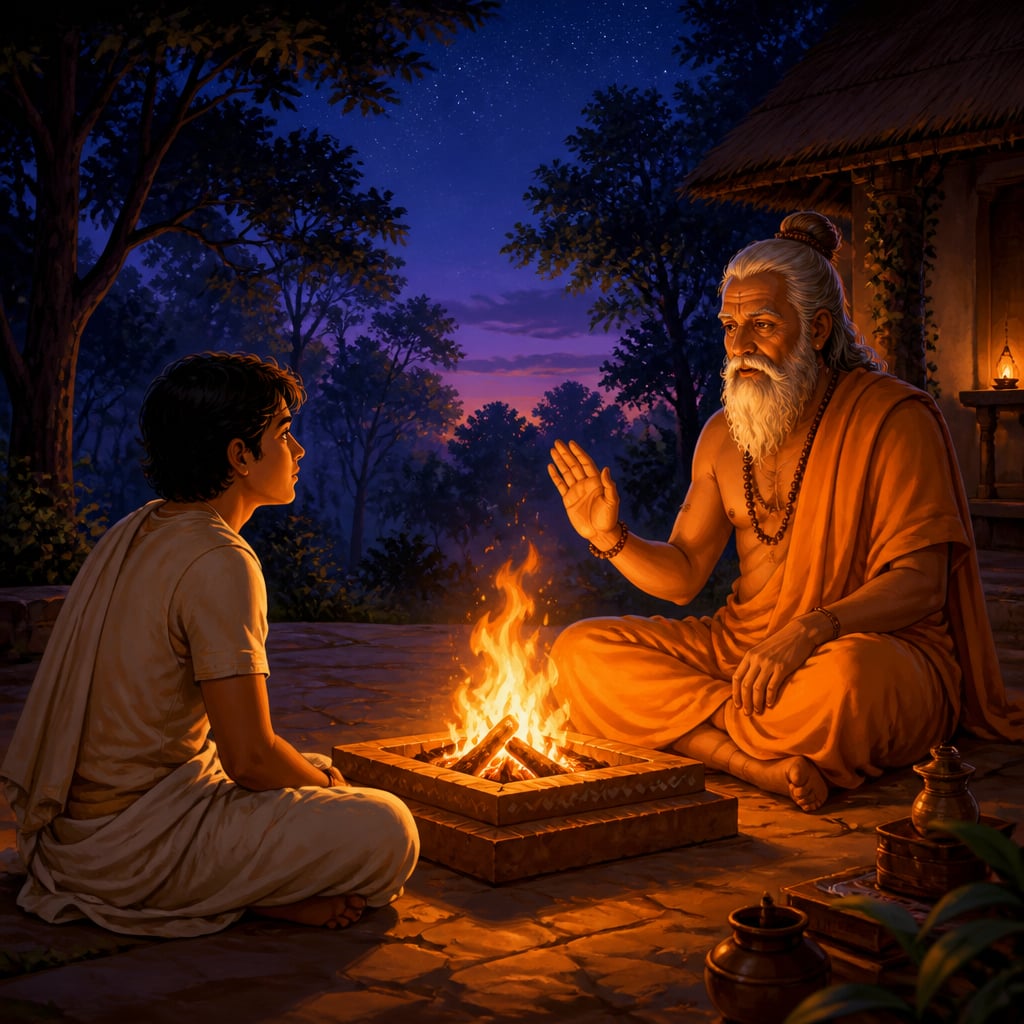
The young seeker sat before the sacred fire, watching the flames dance. His teacher had asked him a question that refused simple answers.
"Is this Agni?"
The seeker hesitated. If he said yes, he would be reducing the cosmic principle of transformation to a particular flame, as if one could contain the infinite in a handful of fire. If he said no, he would be dismissing the tradition that saw Agni in every fire, that recognized the sacred burning in the humblest hearth.
"It is not Agni," he ventured carefully, "and it is not not-Agni."
The teacher smiled. "Now you are ready to learn."
The Two Traps of Interpretation
When approaching the Vedic Devas, modern readers face two opposite dangers. Both are traps; both distort the Rishis' understanding.
The first trap is crude literalism. This treats Indra as a muscular man sitting on a cloud, Agni as merely fire, Varuna as a king of the ocean. This is how 19th-century Western scholars often read the Vedas, projecting Greek mythological categories onto Indian thought. It misses everything that made the Vedic vision sophisticated.
The second trap is dismissive abstraction. This says "Indra is just a metaphor for strength" or "Agni is merely a symbol for transformation." The word "just" and "merely" are the giveaways. This approach treats the Devas as convenient fictions that ancient people used before they had scientific concepts, as if the Rishis were primitive metaphysicians trying to describe what we now know as thermodynamics.
Both traps share a common error: they assume reality must be either literal or metaphorical, either concrete or abstract. The Vedic vision operates at a level that includes both while being reducible to neither.
What the Mantras Reveal
The Rig Veda itself guides us away from both traps. Consider how Agni is addressed:
"Agniṃ dūtaṃ vṛṇīmahe", "We choose Agni as our messenger."
Is the fire in your hearth literally carrying messages to the cosmos? Of course not. Is this verse therefore "just metaphor" meaning nothing real? Also no. The Rishis understood that fire, the transformative principle, genuinely does connect the material to the subtle. Your offerings dissolve into smoke and heat, crossing from gross to subtle matter. Agni-as-messenger is neither literal (the flame isn't a postal worker) nor merely metaphorical (transformation genuinely occurs).
Sayana navigates this beautifully in his commentaries. He provides multiple levels of interpretation: the ritual level (what the priest does), the cosmic level (what the Deva represents in the universe), and the psychological level (what principle operates in consciousness). These are not competing interpretations but complementary dimensions of the same reality.
Traditional Wisdom on Multi-Level Truth

Sri Aurobindo devoted his major work, The Secret of the Veda, to recovering what he called the "psychological interpretation" of Vedic deities. For Aurobindo, Indra was not a sky-god nor merely a symbol but the actual principle of illumined mind, a real power that operates in consciousness.
He wrote: "The Vedic gods are not mere Nature-gods. They are the powers of the one existence manifesting in different forms and functions in the world... They can be approached on different levels, the ritualistic, the cosmic, the psychological, and each approach reveals something true."
This is not "choosing your preferred interpretation" (relativism). It is recognizing that reality itself operates on multiple levels, and the Vedic language was designed to address all of them simultaneously. The Deva is a cosmic principle AND a psychological power AND something that can be invoked through ritual. Not one or the other; all at once.
Yaska's Nirukta, the ancient etymological treatise, supports this multi-level reading. When Yaska explains the names of Devas, he derives them from verbal roots indicating actions and qualities, not from mythological narratives. Agni comes from the root "ag" (to move, lead); Indra from "ind" (to pervade, to master). The names point to principles, not personalities, but principles that are no less real for being universal.
How we interpret sacred and philosophical language shapes what wisdom we can access. Crude literalism misses the cosmic dimensions; dismissive abstraction misses the practical power. Learning to hold multiple levels, as Bohr did with complementarity, as Aurobindo did with the Vedas, opens access to integrated understanding.
Living This Today
Modern physics offers a striking parallel. In the early 20th century, physicists discovered that light behaves as a wave in some experiments and as a particle in others. Is light "really" a wave or a particle?
Niels Bohr proposed the principle of complementarity: light is neither merely a wave nor merely a particle. Both descriptions are true, depending on how you interact with light. Neither is "just metaphor"; both point to something real. The wave and particle models are not competing claims but complementary windows into a reality that exceeds either.
Alfred Korzybski, the founder of general semantics, articulated a related principle: "The map is not the territory." A map of Mumbai is not Mumbai. But does that make the map false? Useless? Of course not. The map is a representation that corresponds to reality in useful ways. It would be foolish to eat the map expecting nutrition (literalism) or to discard the map as mere fiction (dismissiveness).
The Vedic Devas function similarly. They are maps of cosmic territory, neither identical to what they represent nor disconnected from it. The wise person learns to read the maps without confusing them for the territory, while also respecting that these maps were drawn by seers who had directly experienced the territory.
Jung's archetypes work similarly. The 'Mother archetype' is not a literal person but not 'merely a concept' either, it's a psychic reality that organizes experience. Treating archetypes as either literal beings or empty abstractions misses their actual power.
Organizational 'culture' operates on multiple levels. It's not a literal thing you can touch, but dismissing it as 'just a metaphor' ignores its real effects. Effective leaders work with culture as a multi-level reality, both shaping symbols and addressing concrete behaviors.
Economic concepts like 'inflation' or 'the market' are neither literal entities nor mere metaphors. They're emergent patterns that genuinely affect real lives. Korzybski's insight, the map is not the territory but maps matter, applies directly.
Different therapeutic schools (psychodynamic, cognitive, somatic) describe the same human psyche differently. Complementarity suggests these aren't competing ideologies but different windows into a reality that exceeds any single framework. Effective therapists draw on multiple approaches.
The same organizational challenge can be accurately described as 'a communication problem,' 'a structural issue,' and 'a cultural challenge', all simultaneously. Leaders who can hold multiple true descriptions navigate more effectively than those committed to one framing.
Niels Bohr found that subatomic reality required complementary descriptions. Donella Meadows showed that complex systems similarly require multiple models, none complete, all useful. The skill is knowing which model to use when.
Your Path Forward
The interpretive wisdom of the Vedic tradition applies far beyond the Devas. How do you read sacred texts? How do you understand psychological concepts like "ego" or "self"? How do you relate to economic abstractions like "the market" or "inflation"?
In each case, the literal-or-metaphor dichotomy fails. The market is not a person (literalism) but it's also not "merely a metaphor", its movements affect real lives. Psychological archetypes are not beings walking around (literalism) but they're not "just concepts" either, they organize actual experience.
The Vedic approach trains the mind for nuanced engagement with multi-level reality. When you encounter Agni in a text, practice asking: What is this pointing to? What principle operates here? How might this be true on multiple levels simultaneously?
The next lesson explores how to live with multiple truths simultaneously, integrating rather than choosing between valid perspectives.
Case studies
Wave-Particle Duality: Complementarity in Physics
In the early 20th century, physicists faced a paradox: light behaved as a wave in some experiments (showing interference patterns, diffraction) and as a particle in others (the photoelectric effect, discrete energy packets). Both descriptions made accurate predictions. Neither was wrong. But they seemed contradictory, waves are extended, particles are localized. How could light be both?
Niels Bohr proposed the principle of complementarity: wave and particle are not competing descriptions but complementary aspects of a reality that exceeds either. The experiment determines which aspect appears, but both are genuinely present. This mirrors exactly how the Rishis approached the Devas: Agni is the fire in your hearth (concrete, localized) AND the cosmic principle of transformation (extended, universal). Neither description is false; neither is complete; both are necessary.
Complementarity became foundational to quantum mechanics and earned Bohr the Nobel Prize. It resolved the apparent contradiction by recognizing that some realities require multiple descriptions that cannot be reduced to each other. The wave-particle debate ended not with one side winning but with both being integrated into a larger framework.
The literal-or-metaphor dichotomy fails for the same reason that wave-or-particle failed: reality can have aspects that appear mutually exclusive until you recognize them as complementary. The Rishis knew this about the Devas; modern physics discovered it about light. The principle is general: avoid forcing complex realities into single-framework descriptions.
Quantum computing, which exploits superposition and complementarity, is the most direct technological application of this insight. The classical either/or logic that dominates everyday thinking is literally insufficient for describing physical reality at the fundamental level.
Bohr's coat of arms, granted when he was knighted, featured the yin-yang symbol with the motto 'Contraria sunt complementa' (Opposites are complementary). He recognized that complementarity was not just physics but a general principle of knowing.
Sri Aurobindo's 'Secret of the Veda': Recovering Multi-Level Meaning
In the late 19th and early 20th centuries, Western scholars and Indian reformers alike had largely dismissed Vedic religion as 'primitive nature worship.' The Devas were seen as crude personifications of natural forces, storm gods, fire gods, sky gods. Sri Aurobindo (1872-1950), after intense practice and direct yogic experience, proposed a radical recovery: the Devas were neither literal gods nor mere nature symbols but psychological and spiritual powers operating in consciousness.
Aurobindo's 'psychological interpretation' didn't reject the cosmic or ritual dimensions, it added to them. For Aurobindo, Indra was the principle of illumined mind, Agni the flame of aspiration, Soma the bliss of realization. These weren't metaphors but real powers that the yogin could invoke and awaken. The ritual, cosmic, and psychological levels were all valid, and all pointing to spiritual realities that exceed any single formulation.
Aurobindo's interpretation recovered the sophisticated Vedic vision that had been lost to both literalism and dismissiveness. His work influenced how modern Indians understand their own tradition, not as primitive mythology nor as mere philosophy but as integrated wisdom addressing multiple levels of reality. His ashram and its continuation through Auroville demonstrate that this isn't just interpretation but lived practice.
When a tradition's wisdom has been flattened by crude interpretation (whether literalist or dismissive), recovery requires direct experience. Aurobindo didn't argue for multi-level meaning; he practiced into it and described what he found. The Rishis themselves would have recognized this approach, they too were practitioners reporting experience, not theologians arguing abstractions.
Recovering multi-level meaning from texts is now a challenge facing AI researchers building large language models. These systems excel at literal comprehension but struggle with metaphor, irony, and layered symbolism, exactly the dimensions Aurobindo argued were essential to understanding the Vedas.
Sri Aurobindo's 'The Secret of the Veda,' published in serial form between 1914 and 1920 in the Arya journal, reinterpreted over 300 Rig Vedic hymns. He spent approximately 40 years at the Pondicherry Ashram (1910-1950) developing his integral philosophy from direct Vedic study.
Reflection
- What concept in your life do you tend to treat as either 'just literal' or 'just metaphor'? What would change if you held it as operating on multiple levels simultaneously?
- The young seeker said of the fire: 'It is not Agni, and it is not not-Agni.' What would it mean to hold a sacred symbol in this ambiguous, non-dual way?
- Bohr said opposites can be complementary. What implications does this have for apparent contradictions in spiritual or philosophical traditions?