Ekam Sat: Why the Rig Veda Speaks of Many Devas

The Vedic Vision of Unity in Multiplicity

Exploring how the Rig Veda reconciles its proclamation of one ultimate Reality (Ekam Sat) with its invocations of many Devas, and why this is wisdom, not contradiction.

The fire crackled in the pre-dawn darkness. The young priest had risen before the stars faded, as his father had, as his grandfather had before him. He poured ghee into the sacred flames and began his invocations: first to Agni, the fire before him; then to Ushas, the dawn breaking on the horizon; then to Surya, the sun not yet visible but already painting the sky gold.

Three names. Three invocations. Yet as he watched the darkness dissolve into light, a question formed that would echo through millennia: Was he calling to three powers, or to one?
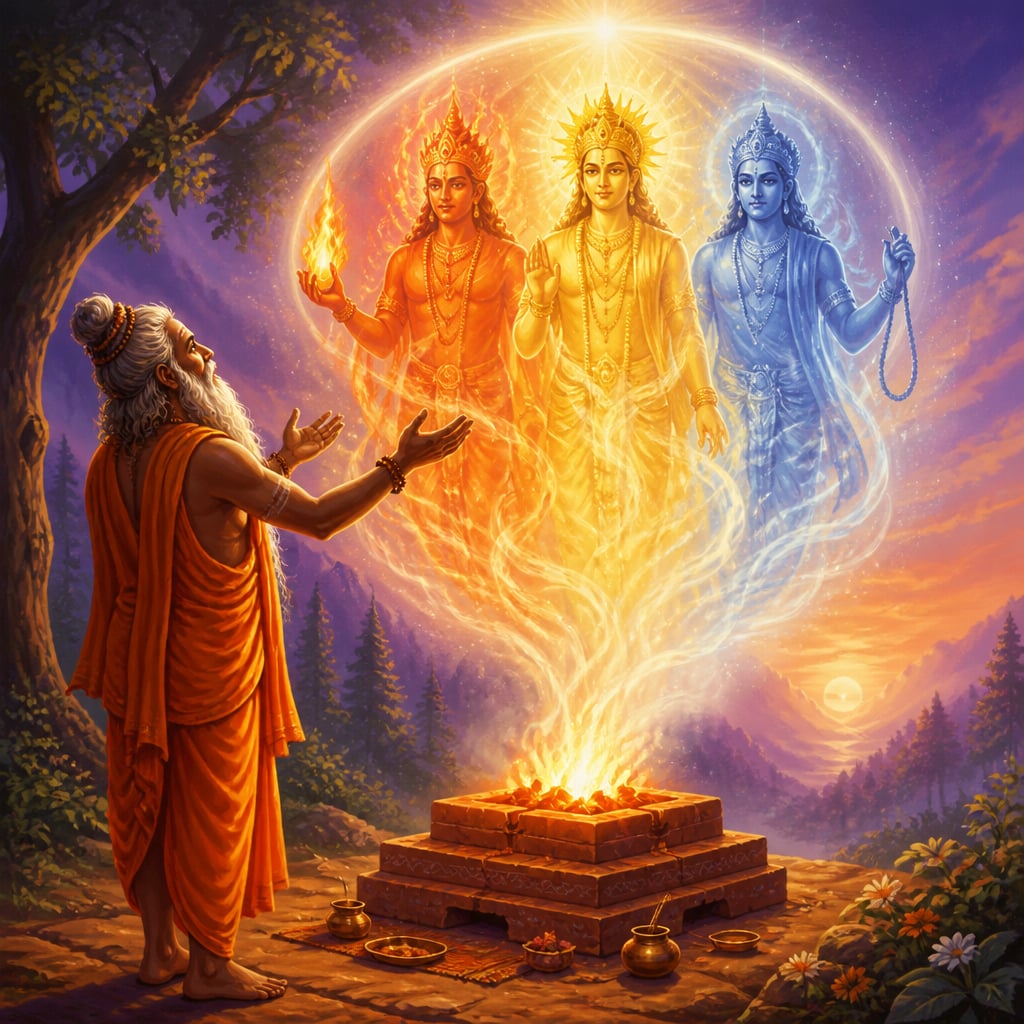
Rishi Dirghatamas before a brick fire-altar at dawn invokes Agni, Ushas, and Surya

The World of the Vedic Seers

The Rishis who composed the Rig Veda lived along the banks of the Saraswati, in a world where the sacred was not separate from the natural. They did not worship nature, they perceived divinity through nature. When they invoked Agni, they were not simply praising fire. They were recognizing the principle of transformation itself: the power that turns wood to ash, food to energy, ignorance to knowledge.

This is the key to understanding why the Rig Veda speaks of many Devas. The Rishis were not confused polytheists who hadn't yet discovered monotheism. They were sophisticated seers who understood something profound: ultimate Reality expresses itself through multiple forces, and each force reveals a different face of the One.

A glass prism breaking sunlight into rainbow colours

The Vedic worldview was not "many gods" versus "one God." It was the recognition that the One becomes many in manifestation, like sunlight passing through a prism, separating into colors while remaining one light.

What the Mantras Reveal

The most famous expression of this understanding comes from Rishi Dirghatamas in his profound hymn:

"Ekam sat viprā bahudhā vadanti", "Truth is One; the wise call it by many names."

This single line dissolves centuries of confusion. The Rishis knew there was one ultimate Reality (Sat). They also knew this Reality could be approached through many names and forms. This was not theological sloppiness but epistemological sophistication.

Consider what Dirghatamas is saying: it is not that there are many truths and we should be tolerant of all. It is that there is one Truth, and different names are different approaches to that same Truth. Agni, Indra, Varuna, Mitra, these are not competing deities but complementary revelations of the same underlying Reality.

Sayana, the great 14th-century commentator, explains that each Deva represents a particular function or power of the One. Agni is the power of transformation. Indra is the power of expansion and conquest. Varuna is the power of cosmic order and moral law. They are not separate beings fighting for supremacy but cooperative principles maintaining cosmic harmony.

Adi Shankaracharya unifying scholars from different schools

Traditional Wisdom on Unity and Multiplicity

Sri Aurobindo, in The Secret of the Veda, offers a psychological interpretation that deepens this understanding. He suggests the Devas represent not just cosmic forces but inner powers, aspects of consciousness that the seeker awakens through practice. Agni is the aspiring will. Indra is the illumined mind. Soma is the bliss of realization.

This interpretation does not contradict Sayana's but adds another layer. The genius of Vedic thought is that it operates on multiple levels simultaneously: the cosmic, the ritual, the psychological, and the spiritual. Many Devas does not mean many ultimate realities, it means one Reality apprehended through many faculties.

The Rig Veda itself provides the key in another verse from the same hymn: "They call it Indra, Mitra, Varuna, Agni, and also the celestial bird Garutman. The wise speak of what is One in many ways." The Rishis were crystal clear: the names differ, the Reality does not.

It is worth pausing here to appreciate why this Vedic understanding matters so profoundly. Understanding the Ekam Sat principle prevents two common errors: the reductive error of thinking Vedic religion was 'just polytheism' (missing its sophisticated unity), and the syncretic error of thinking 'everything is equally true' (missing that unity is not uniformity). The Vedic approach offers a third way: one Reality, many approaches, all grounded in that Reality.

Living This Today

This Vedic insight speaks directly to a modern confusion. We live in a world of apparent contradictions: science versus spirituality, reason versus faith, individual versus collective. The Ekam Sat principle offers a different lens.

Satya Nadella's transformation of Microsoft illustrates this practically. When he became CEO in 2014, Microsoft was a collection of warring fiefdoms, Windows, Office, Azure, Xbox, each protecting its territory. Nadella's "One Microsoft" vision wasn't about eliminating differences but about recognizing that these different expressions served one purpose. The divisions remained; the warfare ended. Many forces, one company.

In ecology, E.O. Wilson's work on biodiversity reveals a similar pattern. An ecosystem is not a collection of competing species but an integrated whole where diversity serves unity. The many species are the One ecosystem expressing itself. Remove the diversity, and the unity collapses.

Internal Family Systems (IFS) therapy, developed by Richard Schwartz, recognizes that the psyche contains many 'parts' or sub-personalities, but these parts are organized around a central Self. The many parts are not disorder but natural multiplicity serving one integrated person.

Satya Nadella's 'One Microsoft' transformation showed that organizational unity doesn't require eliminating divisions. Windows, Azure, Office remained distinct, but aligned around shared purpose. The many forces serve one mission.

E.O. Wilson's work on biodiversity revealed that ecosystem health depends on diversity, many species creating one functioning whole. The rainforest's many species are not competing kingdoms but one integrated living system.

Polyvagal theory (Stephen Porges) shows how multiple nervous system states, fight, flight, freeze, social engagement, serve one purpose: survival and connection. The 'many forces' of our physiology work as one integrated system.

The most effective organizations function like the Vedic pantheon, distinct roles (sales, engineering, marketing) serving one shared mission. When each division sees itself as part of one organism, competition transforms into cooperation.

Climate systems, economic systems, social systems all demonstrate this principle: what appears as many separate forces is actually one interconnected whole. Understanding this prevents the fragmentation that causes system failures.

Your Path Forward

The Rig Veda's teaching on Ekam Sat is not abstract theology, it is practical wisdom for navigating a complex world. When you encounter apparent contradictions, different approaches to the same problem, different perspectives on the same situation, ask: What is the One behind these many?

In your own life, notice how you are many: parent and professional, friend and seeker, practical and idealistic. These are not contradictions to be resolved but expressions of one integrated self. The Rishis would recognize this: you are Ekam Sat in human form, expressing yourself through many roles.

The next lesson explores the philosophical foundations of this unity, how the Vedic seers understood the relationship between the One and the many not as a problem to solve but as a mystery to inhabit.

Case studies

The Indian Constitution: Ekam Sat in Democratic Form

In 1949, the framers of the Indian Constitution faced an unprecedented challenge: how to create one nation from extraordinary diversity. India had 562 princely states, 22 major languages, multiple religions, thousands of castes, and vast regional differences. The partition with Pakistan had shown the deadly cost of failing to hold diversity together. B.R. Ambedkar and the Constituent Assembly had to craft a document that would make many into one without destroying the many.

The Constitutional approach mirrors the Vedic Ekam Sat principle. Rather than impose uniformity (one language, one religion, one culture), the Constitution recognized diverse states, languages, and religions while binding them to one sovereign nation with shared citizenship. Article 1 declares 'India, that is Bharat, shall be a Union of States', unity through federation, not absorption. The many are preserved within the one.

India remains the world's largest functioning democracy, holding together more diversity than any nation in history. The Constitution has been amended over 100 times but its core principle, unity in diversity, has held. When regional, religious, or linguistic tensions threaten, the Constitutional framework provides the 'Ekam Sat' that enables resolution without fragmentation.

Deep unity does not require surface uniformity. The Vedic insight, that the One can express through many without losing its unity, provides a model for any complex system: families, organizations, nations. The question is not 'how do we make everyone the same?' but 'what shared purpose holds our diversity together?'

Federal democracies worldwide struggle with the tension between national unity and regional autonomy. India's model, granting linguistic states genuine cultural sovereignty within a shared constitutional framework, offers a working alternative to both forced homogeneity and fragmentation.

India's Constitution recognizes 22 official languages while establishing English and Hindi as link languages, a practical expression of 'viprā bahudhā vadanti' (the wise speak in many ways).

Adi Shankaracharya: Unifying Through Diversity

In the 8th century CE, Dharmic traditions in Bharat had fragmented into competing schools, Shaiva, Vaishnava, Shakta, Smarta, each claiming supremacy. Buddhism and Jainism offered alternatives. There was no unified 'Hinduism' but a cacophony of traditions often in conflict. Into this fragmentation came Shankaracharya from Kerala, a young sannyasi who would walk the entire subcontinent on foot.

Shankara's genius was not to abolish diversity but to reveal its underlying unity. His Advaita Vedanta declared Brahman as the one Reality (Ekam Sat) while establishing four mathas in four corners of India, each worshipping different deities (Shiva, Vishnu, Shakti, Surya). He didn't say 'stop worshipping your chosen deity.' He said 'recognize that your deity is a name for the One.' This is the Vedic principle in action: preserving the many while revealing the One.

Shankara's four mathas continue today, over 1,200 years later. His framework provided what competing traditions lacked: a philosophical foundation for unity that didn't require uniformity. The Shanmata system (six forms of worship) he formalized allowed Hindus to maintain their preferred deity while recognizing all as valid. Dharmic civilization gained coherence without losing its creative diversity.

Unity is achieved not by eliminating differences but by revealing the deeper connection beneath them. Shankara walked thousands of miles not to conquer but to connect, demonstrating that one person holding the Ekam Sat vision can transform a fragmented landscape into an integrated whole.

Modern organizational leaders face the same challenge Shankara addressed: unifying diverse teams without erasing their distinct strengths. The most effective company cultures, from Pixar to ISRO, create shared purpose that amplifies individual difference rather than suppressing it.

Shankaracharya traveled an estimated 8,000 to 10,000 kilometers on foot across India in the 8th century CE, establishing mathas at Sringeri, Puri, Dwarka, and Joshimath. His Shanmata system formally recognized six forms of worship (Shaiva, Vaishnava, Shakta, Saura, Ganapatya, Kaumara) as equally valid paths.

Reflection

More in Ekam Sat: Many Forces, One Reality

All lessons in Ekam Sat: Many Forces, One Reality · Rig Vedic Philosophy course