Vicāra: Thinking Without Dogma
Holding Ideas as Tools, Not Truths
Exploring how the Vedic tradition developed multiple philosophical frameworks without demanding a single orthodoxy, the art of using ideas effectively while holding them provisionally.
The debate had lasted three days. On one side sat the Naiyayikas, masters of logic, arguing that reality consists of distinct categories that can be known through rigorous inference. On the other side sat the Samkhyas, enumerating the principles of matter and consciousness, mapping creation through a different lens entirely.
Both sides had marshaled their best arguments. Both had ancient texts supporting their positions. Both claimed access to truth.
A visitor from far away watched in confusion. "How can both be right?" he asked an old teacher sitting beside him. "They contradict each other."
The teacher smiled. "They are not contradicting," he said. "They are using different maps of the same territory. The Naiyayikas map reality through categories and logic. The Samkhyas map it through principles and evolution. Each map is useful. Neither is the territory itself."
"But which map is true?"
"That," said the teacher, "is the wrong question. Ask instead: Which map serves this journey? A map of Delhi's roads won't help you navigate Delhi's weather. Different questions require different frameworks."
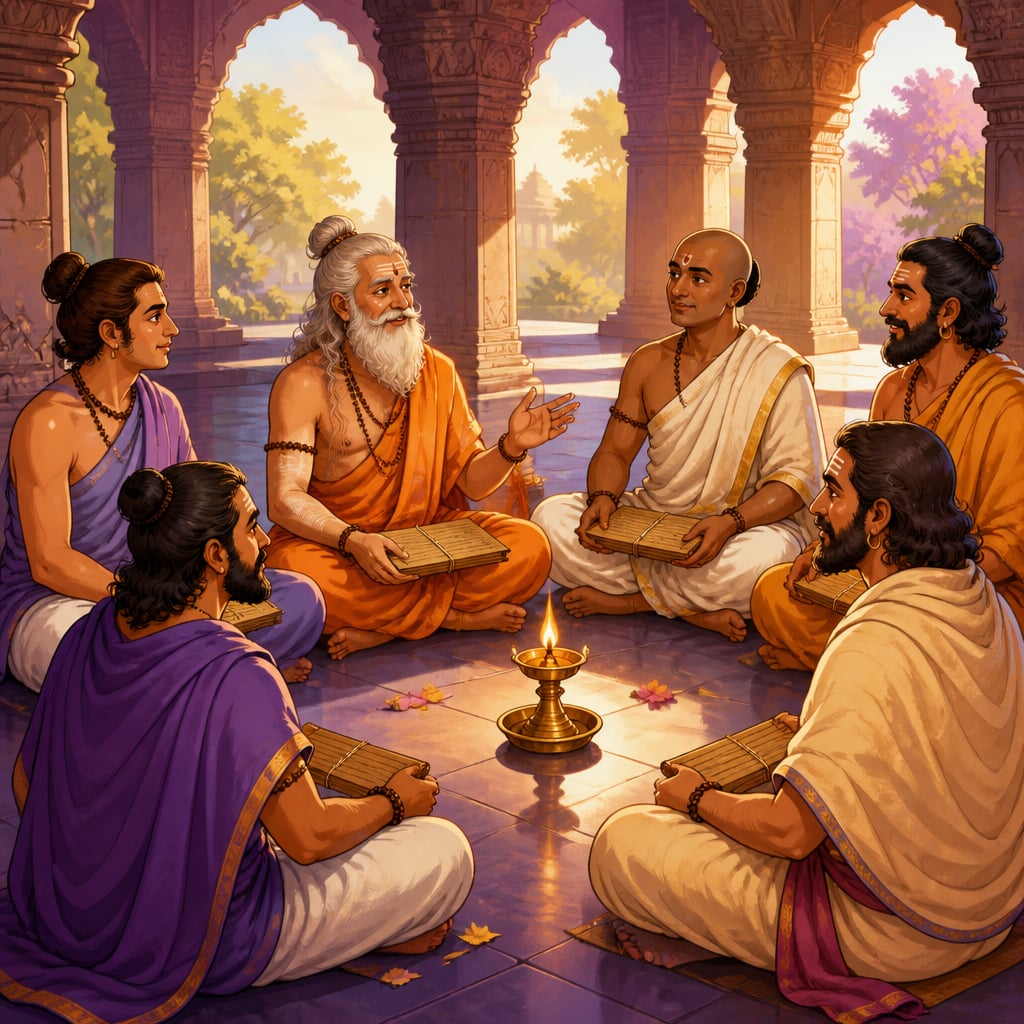
The Plurality of Darshanas
Indian philosophy developed something remarkable: six orthodox schools of thought, the ṣaḍ-darśana, each offering a comprehensive worldview, each internally consistent, and each accepted as a valid path to understanding. Nyaya emphasized logic and epistemology. Vaisheshika analyzed categories of existence. Samkhya mapped consciousness and matter. Yoga developed practical methods for realization. Mimamsa interpreted ritual and dharma. Vedanta explored the ultimate nature of reality.
These weren't competing sects trying to eliminate each other. They were different darśanas, "viewpoints" or "ways of seeing", each illuminating aspects of reality that others might miss. A serious student might learn Nyaya for logic, Samkhya for cosmology, and Yoga for practice, without seeing contradiction.
The Sanskrit term vicāra captures this approach. From vi (apart, in different ways) and cāra (moving, going), vicāra means "moving through" an idea, examining it from multiple angles, testing it against experience and reason. Vicāra is active inquiry, not passive acceptance. It treats ideas as tools for investigation, not conclusions to be defended.
What the Mantras Teach About Frameworks
The Rig Veda contains the seed of this pluralistic approach. Dirghatamas, the blind seer, declared:
"Ekaṃ sad viprā bahudhā vadanti"
Truth is one; the wise speak of it in many ways.
Word by word: ekam (one) sat (truth, being) viprāḥ (the wise ones, the seers) bahudhā (in many ways) vadanti (speak, describe).
This verse is foundational. It does not say all views are equally valid (relativism). It does not say one view is right and others wrong (dogmatism). It says: there is one truth, but the wise approach it through multiple formulations. The formulations are maps; the truth is territory.
This insight enables the entire tradition of multiple darshanas. If truth is one but can be spoken of in many ways, then different philosophical frameworks can coexist without contradiction. Each is a way of speaking about truth, not a final capture of it.
This approach, sophisticated pluralism, has deep roots in Indian thought. The framework of 'truth is one; expressions are many' offers a middle path between relativism (nothing is true) and dogmatism (only my truth is valid). This path remains relevant in an era of competing ideologies and filter bubbles, offering a model for how to hold strong views while remaining open to alternative frameworks.
The Jñāna Sukta (RV 10.71) reinforces this:
"Saktum iva titaunā punanto yatra dhīrā manasā vācam akrata"
Like winnowers sifting grain, the wise ones shaped speech with their minds.
The wise shape speech, they craft formulations, they construct frameworks. This is not passive reception of pre-given truth but active intellectual work. And like winnowers, they are separating useful from useless, refining rather than receiving wholesale.
Charlie Munger's Latticework

Charlie Munger, Warren Buffett's partner at Berkshire Hathaway, became one of the most successful investors in history by applying what he calls a "latticework of mental models." His approach: collect frameworks from multiple disciplines, psychology, physics, biology, economics, history, and use whichever model fits the problem at hand.
"To a man with only a hammer," Munger famously said, "every problem looks like a nail." Most people are trapped in a single framework, their professional training, their ideology, their habitual way of seeing. Munger's edge comes from framework flexibility: he can see a business problem through the lens of evolutionary biology, psychology of incentives, or microeconomics, depending on which illuminates the situation.
The parallel to the ṣaḍ-darśana is precise. Just as a student of Indian philosophy might use Nyaya for logical analysis and Samkhya for understanding causation, Munger uses different mental models for different problems. The models are tools, not identities. You don't become a "Nyaya person" any more than Munger becomes a "psychology investor." You use the framework that serves the inquiry.
Munger's most important insight mirrors the Vedic teaching: holding frameworks lightly. "I'm not entitled to have an opinion on this subject," he often says, "unless I can state the arguments against my position better than the people who support it." This is vicāra, moving through ideas critically, testing them, refusing to calcify into dogma.
Why Frameworks Become Prisons
The danger the Rishis understood, and that Munger warns against, is framework attachment. When you identify with a framework, you stop using it and start defending it. The tool becomes an identity. The map becomes more important than the journey.
Sayanacharya, commenting on the darshanas, noted that each school attracted followers who turned provisional frameworks into fixed positions. What began as vicāra (active inquiry) became mata (opinion, doctrine). The living exploration became dead orthodoxy.
Sri Aurobindo saw this calcification as the perennial danger of intellectual life. Ideas that began as liberating insights become imprisoning dogmas when we stop questioning them. The solution is not to abandon frameworks, we need them to think, but to hold them as the Rishis did: provisionally, as tools for exploration, subject to revision.
The Buddhist philosopher Nagarjuna compared clinging to ideas, even correct ideas, to grasping a snake by the wrong end. The snake of a useful framework becomes poisonous when you grip it with attachment rather than skill.
Ray Dalio's Evolving Principles

Ray Dalio built Bridgewater Associates into the world's largest hedge fund by codifying explicit principles, frameworks for decision-making, hiring, culture, and investment. His book Principles lays out hundreds of these frameworks.
But Dalio's meta-principle is that principles must evolve. He writes: "The worst thing you can be is a dogmatist... Principles should be constantly refined based on what you learn." Bridgewater practices "radical transparency" and "idea meritocracy" precisely so that frameworks can be challenged and updated.
This is the Vedic insight institutionalized. Dalio has principles (frameworks), but he holds them provisionally, subject to revision based on results. He treats his own ideas the way the ṣaḍ-darśana treated their systems: as useful maps that might need redrawing when the territory proves different than expected.
The difference between Dalio and a dogmatist is not whether he has strong views, he does, but whether those views are held as final truths or as working hypotheses. Vicāra treats all frameworks as working hypotheses.
The Art of Framework Switching
The practical skill the darshana tradition cultivated was framework switching, the ability to shift from one mode of analysis to another depending on what the situation requires. A pandita trained in multiple darshanas could apply Nyaya when logical rigor was needed, Samkhya when causal analysis was required, and Vedanta when the question concerned ultimate meaning.
This is not intellectual inconsistency; it is intellectual maturity. The person limited to one framework is like someone who speaks only one language, they can only discuss what that language can express. The person fluent in multiple frameworks can address questions that any single framework might miss.
Munger describes this as "worldly wisdom", the practical intelligence that comes from having multiple models and knowing when to deploy each. The investment world is full of brilliant analysts trapped in single frameworks (only technical analysis, only fundamental analysis, only macro). Munger's flexibility is his edge.
Cognitive flexibility, the ability to switch between different modes of thinking, predicts success across domains. Research by Adam Grant shows that people who can argue against their own positions make better decisions than those locked into single frameworks.
Charlie Munger's 'latticework of mental models' operationalizes the darśana approach for business. He advocates collecting frameworks from multiple disciplines and using whichever fits the problem. 'To a man with only a hammer, every problem looks like a nail.' The solution is more tools, not better hammering.
Complex systems require multiple lenses, what looks like equilibrium from one framework looks like stagnation from another. The ability to switch frameworks reveals dynamics that any single lens would miss. This is the systems application of darśana plurality.
Ray Dalio's approach at Bridgewater institutionalizes continuous refinement. Principles are explicit, but the meta-principle is that principles must evolve. Research on organizational learning shows that companies which update mental models based on results outperform those with fixed frameworks.
Dalio's 'idea meritocracy' creates structures for challenging existing principles. Anyone can question any idea; the goal is truth, not hierarchy. This prevents the calcification of vicāra into mata, it keeps inquiry alive even within institutional structures.
Adaptive systems continuously update their models based on feedback. The moment a system stops updating, treats its current model as final, it begins to fail. The Vedic insight that wise ones are always 'sifting' captures this systemic requirement for continuous learning.
Your Path Forward
You have frameworks, mental models you use to understand your work, your relationships, your decisions. Some are explicit (methodologies, theories, principles). Some are implicit (assumptions, habits of thought, unexamined beliefs).
The vicāra approach asks: Can you hold these frameworks as tools rather than truths? Can you switch frameworks when the situation requires? Can you state the case against your own position as well as its advocates?
This week, identify a framework you rely on heavily, perhaps in your professional domain. Then find someone who uses a different framework for the same domain. Instead of debating who is right, ask: What does their framework illuminate that mine misses? What would it be like to see through their lens?
The goal is not to abandon your framework but to hold it more lightly. The Naiyayikas and Samkhyas debated for centuries, but the wise ones in both traditions knew: our frameworks are fingers pointing at the moon. Mistaking the finger for the moon is the fundamental error.
Ekaṃ sad viprā bahudhā vadanti. Truth is one; the wise speak of it in many ways. Your way of speaking may be valid. It is not the only valid way.
In our final lesson, we'll bring all these threads together: anirukta, nasadiya, saṃśaya, pramāṇa, kārya, and vicāra, exploring their relevance for life in 2026 and beyond.
Case studies
Charlie Munger's Latticework: Multiple Frameworks for Complex Decisions
Charlie Munger, Warren Buffett's partner at Berkshire Hathaway, became one of the most successful investors in history despite, or because of, being a generalist rather than a specialist. Munger advocates building a 'latticework of mental models' from multiple disciplines: psychology, physics, biology, economics, mathematics, philosophy. When analyzing an investment or business problem, he applies whichever model fits the situation rather than forcing everything through a single lens.
Munger's approach is the ṣaḍ-darśana applied to business. Just as a traditional pandita might use Nyaya for logic, Samkhya for causal analysis, and Yoga for practical discipline, Munger uses psychology to understand incentives, physics for scale effects, and biology for competitive dynamics. His insistence that 'to a man with only a hammer, every problem looks like a nail' echoes the Vedic insight that truth is one but the wise speak of it in many ways. The key is framework flexibility, holding each model as a tool, not an identity.
Berkshire Hathaway became one of the most successful conglomerates in history, with Munger and Buffett's multi-framework approach enabling them to evaluate businesses across diverse industries. Munger credits this success not to being smarter than competitors but to having more mental models and knowing when to deploy each. His book 'Poor Charlie's Almanack' has influenced a generation of investors and thinkers to adopt the multi-framework approach.
The competitive advantage comes not from having the 'right' framework but from having multiple frameworks and the wisdom to know which serves each situation. Ekam sat, the business reality is one, but the wise investor speaks of it through many models. Framework flexibility is a moat.
The most effective analysts in venture capital, geopolitics, and medicine are those who fluently switch between frameworks rather than forcing every problem into a single lens. Interdisciplinary thinking, once considered dilettantism, is now the highest-valued skill at organizations like Bridgewater Associates and IDEO.
Munger has identified over 100 mental models he uses regularly, drawn from disciplines including psychology (25+ biases), mathematics (compound interest, inversion), physics (critical mass, tipping points), and biology (evolution, niches). This 'latticework' approach has been adopted at Berkshire Hathaway for over 50 years.
The Six Darśanas: India's Institutionalized Pluralism
Over centuries, Indian philosophy developed six orthodox schools, the ṣaḍ-darśana, each offering a complete worldview. Nyaya developed rigorous logic and epistemology. Vaisheshika analyzed categories of existence. Samkhya mapped consciousness and matter through twenty-five principles. Yoga developed practical methods for realization. Mimamsa interpreted Vedic ritual and dharma. Vedanta explored ultimate reality through analysis of the Upanishads. These schools debated vigorously, yet all were accepted as valid paths to understanding.
The ṣaḍ-darśana represent the institutional application of 'ekam sad viprā bahudhā vadanti.' Instead of demanding orthodoxy, one true view, Indian philosophy cultivated plurality. A serious student was expected to understand multiple darśanas, using each where its strengths applied. This is vicāra institutionalized: active inquiry through multiple frameworks rather than passive acceptance of one. The debates between schools sharpened each position without requiring that only one survive.
This pluralistic approach enabled Indian philosophy to develop sophisticated analyses across multiple domains, logic, metaphysics, epistemology, practice, without the winner-take-all conflicts that plagued Western philosophical and religious history. The tradition produced towering figures who drew on multiple darśanas: Shankara used Vedanta with Mimamsa hermeneutics; Ramanuja integrated devotional practice with philosophical rigor. The framework produced intellectual richness that monolithic traditions couldn't match.
Institutionalizing framework plurality, rather than seeking to eliminate 'wrong' views, produces intellectual fertility. The six darśanas enriched each other through debate without destroying each other through combat. This is a model for how competing frameworks can coexist productively.
Open-source software ecosystems thrive on this same principle. Linux, Python, and React coexist with competing approaches, and the competition strengthens all of them. The most vibrant intellectual communities today, from machine learning research to constitutional law, actively maintain competing schools of thought.
The six orthodox schools (Shad Darshana) of Hindu philosophy coexisted and debated for over 2,000 years: Nyaya, Vaisheshika, Sankhya, Yoga, Purva Mimamsa, and Uttara Mimamsa (Vedanta). Together they produced thousands of texts, with Nyaya alone generating over 1,000 known works on logic and epistemology.
Reflection
- What framework do you rely on most heavily in your professional domain? What does this framework help you see? What might it obscure? What alternative framework could illuminate what yours misses?
- How did Indian philosophy sustain multiple comprehensive worldviews, the ṣaḍ-darśana, without demanding that only one prevail? What made this pluralism possible? What can we learn from it?
- What is the difference between framework flexibility (healthy) and intellectual inconsistency (problematic)? How can you tell whether you're practicing vicāra or simply being unprincipled?