Nasadiya: Creation Without Certainty
Cosmogony as Inquiry, Not Dogma
Exploring the Nasadiya Sukta, the Rig Veda's famous 'Creation Hymn', and how the Rishis approached the ultimate question of origins not with definitive answers but with a revolutionary method of inquiry that modern science is only now rediscovering.
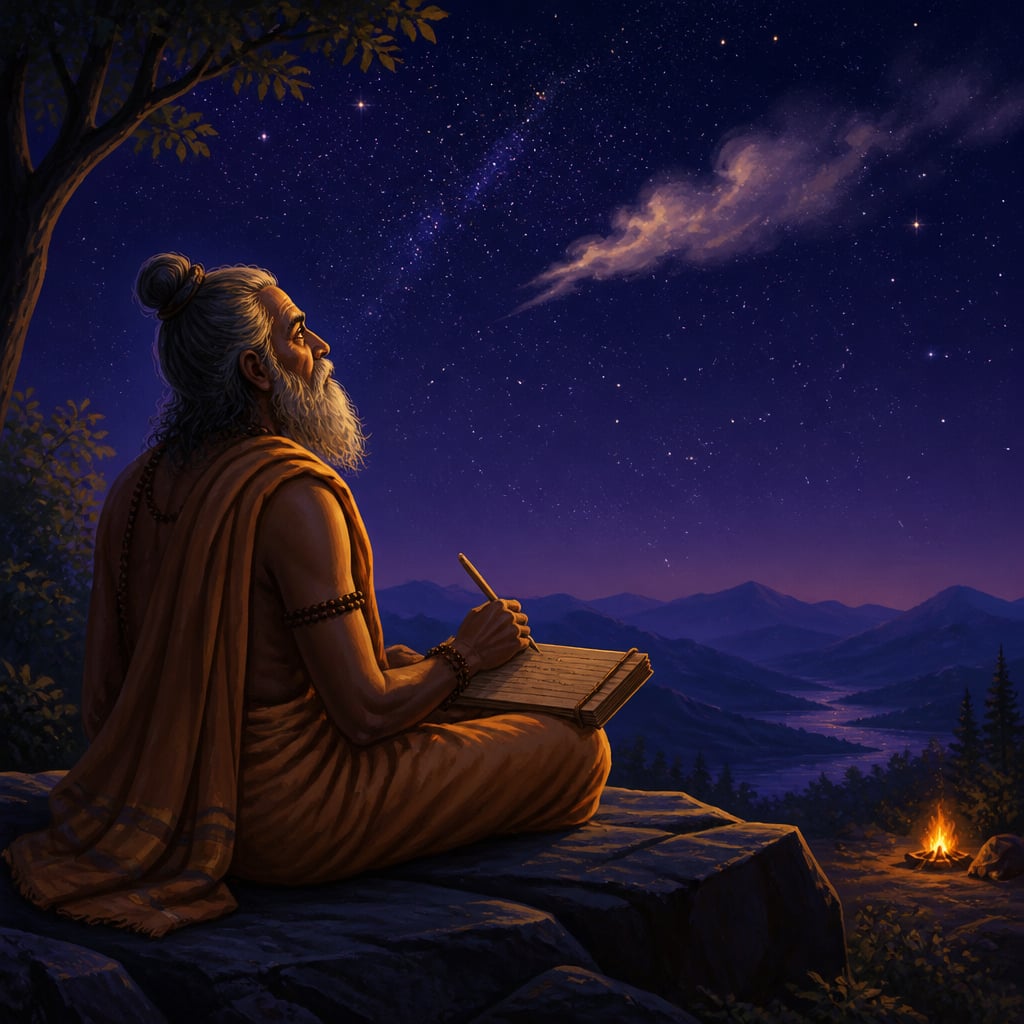
The fire crackled in the pre-dawn darkness. The hotri priest raised the ladle of ghee, ready to pour the morning offering. But today, something made him pause. The mantras he was about to chant spoke of creation, of how the world came to be. He had recited them a thousand times. But this morning, a question surfaced that would not let him proceed: When I speak of the beginning, what am I actually claiming to know?
The priest set down the ladle. The fire waited. And in that pause, that moment of honest uncertainty before the ritual could continue, the seed of the Nasadiya Sukta was born.
Before the Beginning
The Nasadiya Sukta opens not with a statement but with a negation. Nāsad āsīn no sad āsīt tadānīm, "There was not non-being, nor was there being then." Read that again. The Rishi is not saying "In the beginning there was nothing" or "In the beginning there was something." He is saying that our very categories of "something" and "nothing" did not apply.
This is not primitive confusion. This is sophisticated recognition that the question "What existed before existence?" may be malformed. Our language assumes being and non-being as exhaustive options. The Rishi suggests that before creation, even this distinction had no meaning.
The hymn continues: Na mṛtyur āsīd amṛtaṃ na tarhi, "There was neither death nor immortality then." No space, no sky, no covering. What stirred? Where? In whose protection? Was there water, deep and unfathomable?
Notice the method. The Rishi is not asserting what was. He is systematically negating what we assume must have been, and in doing so, pointing toward something our categories cannot capture.
The Hymn's Revolutionary Core
The Nasadiya Sukta's most famous verses appear near its end:
"Kāmas tad agre samavartatādhi manaso retaḥ prathamaṃ yad āsīt"
Desire arose in the beginning, desire, the primal seed of mind.
Here is a cosmological claim: before form, before matter, before the distinctions we take for granted, there was kāma, not mere lust, but the creative impulse itself, the primordial yearning toward manifestation. The sages, searching in their hearts with wisdom, found the bond of being in non-being.
But then, remarkably, the Rishi pulls back:
"Ko addhā veda ka iha pra vocat kuta ājātā kuta iyaṃ visṛṣṭiḥ"
Who truly knows? Who can declare it here, whence was it born, whence this creation?
Word by word: kāmaḥ (desire) tat (that) agre (in the beginning) samavartata (arose, came into being) adhi (upon/first) manasaḥ (of mind) retaḥ (seed) prathamam (first) yat (which) āsīt (was). The Rishi presents a hypothesis, and then immediately questions whether anyone, even the gods who came later, can verify it.
What Kapila Understood

Centuries after the Nasadiya Sukta, the sage Kapila developed Sankhya philosophy, one of the oldest systematic cosmologies in human history. Sankhya meticulously describes creation: from Prakriti (primal nature) emerges Mahat (cosmic intelligence), from Mahat emerges Ahamkara (ego-principle), and so on through the elements and senses.
But Kapila, like the Nasadiya Rishi before him, understood something crucial: a systematic cosmology is a map, not the territory. Sankhya provides a framework for understanding manifestation, not a final answer to what lies before or beyond manifestation. When asked about the ultimate origin of Prakriti itself, Sankhya remains silent, not from ignorance but from recognition that some questions exceed systematic philosophy.
Sayanacharya notes that Kapila's approach exemplifies yukti (reason) operating within its proper bounds. Sankhya doesn't claim to explain everything, it explains what can be explained and honestly acknowledges where explanation stops.
Sri Aurobindo saw in both the Nasadiya Sukta and Sankhya a method rather than a doctrine: rigorous inquiry that holds its own conclusions lightly, always aware that the reality being investigated exceeds any formulation of it.
It is worth pausing here to appreciate the significance of this approach: sophisticated philosophical inquiry existed in India thousands of years before Western philosophy began. The hymn's approach, questioning fundamental categories rather than asserting creation myths, represents an intellectual achievement that influenced all subsequent Indian philosophy and anticipates modern scientific epistemology. Its inclusion in sacred liturgy shows that Dharmic tradition has always valued honest inquiry as part of spiritual practice, not opposed to it.
The CERN Parallel

In 2012, scientists at CERN announced the discovery of the Higgs boson, the particle that explains why matter has mass. It was the culmination of fifty years of theoretical prediction and billions of dollars in experimental infrastructure. The discovery confirmed the Standard Model of particle physics.
But here's what happened next: rather than declaring victory, physicists immediately asked, "What gives the Higgs field its properties? Why these values and not others?" The discovery that answered one fundamental question opened a dozen more. Peter Higgs himself noted that finding the boson was "not the end but the beginning of a new chapter."
This is the Nasadiya method in action. The greatest scientific achievement doesn't close inquiry, it opens it. Each answer reveals the next layer of mystery. The honest scientist, like the Vedic Rishi, knows that explaining the universe means discovering how much more there is to explain.
The parallel goes deeper. Modern cosmology's "fine-tuning problem", why do the constants of physics have the precise values that allow matter, stars, and life to exist?, echoes the Nasadiya Sukta's question about what preceded the conditions for existence itself. Neither ancient seer nor modern physicist pretends to have the final answer.
Creating From Uncertainty
You might think this is merely abstract philosophy, interesting for cosmologists and priests, but what about practical life? Consider: every act of genuine creation begins with not-knowing.
When Tarun Mehta and Swapnil Jain founded Ather Energy in 2013, there was no electric scooter market in India. No charging infrastructure, no consumer demand, no proof the category could exist. They weren't filling a known gap, they were creating something from a space where that something had no prior existence. This is the Nasadiya situation: bringing forth what has no precedent, working in the gap between what is and what might be.
The Nasadiya Sukta teaches that creation doesn't require certainty about outcomes. The primal creative impulse, kāma, precedes the forms it will produce. The Rishis didn't know where their questioning would lead; they followed the inquiry anyway. Every founder, artist, or innovator working at the edge of the new operates in this same space.
Cognitive scientists study 'conceptual combination', how minds create genuinely new concepts rather than just recombining existing ones. Research shows breakthrough creativity often requires suspending categorical thinking, allowing new frameworks to emerge rather than forcing ideas into existing boxes.
DeepMind's AlphaFold solved protein folding, a 50-year-old problem, not by incremental improvement on existing approaches but by reimagining the problem category entirely. Demis Hassabis noted that the breakthrough required 'unlearning' assumptions about how such problems must be approached.
Complex systems often exhibit 'emergence', properties that exist at higher levels but not at lower levels. Emergence means new categories come into being as systems evolve. The Nasadiya insight applies: before the emergent property, the very category for understanding it didn't exist.
Psychologist Mihaly Csikszentmihalyi's research on creativity shows that breakthrough work often begins with 'problem finding' rather than problem solving, the creative person is drawn to investigate before knowing what they'll find. The impulse precedes the form.
Many successful ventures began with a drive rather than a plan. The founders of Razorpay describe starting with frustration about payment friction, not a detailed product vision. The specific solution emerged from pursuing the impulse, not from executing a predetermined blueprint.
Evolutionary systems create through variation and selection, not top-down design. New forms emerge from the 'desire' of the system to persist and propagate, not from a plan. The Nasadiya insight that kāma precedes form describes how creative systems actually work.
Your Path Forward
The Nasadiya Sukta offers a method, not just a text. When facing questions that seem to have no answer, in your work, your decisions, your understanding of your own life, consider that the question itself may be the teaching.
Not all uncertainty needs to be resolved. Sometimes the honest response to "How do I know this will work?" is the same as the Rishi's response to "How did creation begin?": "I don't know for certain, but I can proceed with integrity, holding my best understanding lightly."
The priest who paused before the fire eventually completed his ritual. The pause didn't prevent action, it transformed it. He poured the offering not with false certainty but with honest presence. Perhaps that is all any of us can do.
In our next lesson, we'll explore how this comfort with not-knowing, saṃśaya, becomes not an obstacle to wisdom but its very foundation.
Case studies
CERN and the Higgs Boson: Answering One Question, Opening a Hundred
In 2012, after fifty years of theoretical prediction and $13 billion invested in the Large Hadron Collider, scientists at CERN announced the discovery of the Higgs boson, the particle that explains why matter has mass. The Standard Model of particle physics was confirmed. The media declared physics 'complete.' But physicists themselves responded differently: they immediately asked new questions. Why does the Higgs field have these specific properties? Why these values and not others? What gives the Higgs its mass? The discovery that was supposed to be an ending became a beginning.
The CERN discovery exemplifies the Nasadiya Sukta's method. The hymn offers a cosmological hypothesis, kāma as primal creative force, but immediately questions whether anyone can truly know. CERN found the Higgs, but honest physicists know this answer only reveals deeper questions. Like the Rishi asking 'ko addhā veda' after describing creation, Peter Higgs himself said the discovery was 'the beginning of a new chapter, not the end.' Genuine inquiry doesn't close; it opens.
Post-Higgs physics has focused on questions the discovery raised: the hierarchy problem (why is the Higgs so light?), the fine-tuning problem (why these constants?), and the search for physics 'beyond the Standard Model.' The 'complete' theory turned out to be a door to new mysteries. CERN now pursues experiments that may not yield answers for decades, embracing uncertainty as the Rishis did.
The greatest scientific achievements don't eliminate mystery; they deepen it. The Nasadiya Sukta anticipated this: honest inquiry reveals how much we don't know. An answer that doesn't generate new questions probably isn't the right answer.
Every major scientific breakthrough, from CRISPR gene editing to gravitational wave detection, has followed the same pattern: answering one question opens dozens more. The most productive researchers today are those comfortable with expanding uncertainty rather than those seeking final closure.
The Standard Model, despite its success, explains only about 5% of the universe, the rest is dark matter and dark energy, which physicists cannot yet describe. The 'complete' theory is actually a map of our ignorance.
Kapila and Sankhya: Systematic Cosmology That Knew Its Limits
The sage Kapila, traditionally dated to the 7th century BCE, developed Sankhya, one of the oldest and most influential systematic philosophies in human history. Sankhya provides a detailed cosmology: from Prakriti (primal matter/nature) emerges Mahat (cosmic intelligence), then Ahamkara (ego-principle), then the five subtle elements, five gross elements, five organs of action, five organs of perception, and mind. This 25-principle system elegantly explains how the manifest world emerges from an unmanifest source.
But Kapila, heir to the Nasadiya tradition, knew that even the most elegant system has limits. When asked about the ultimate origin of Prakriti itself, what is Prakriti made of? What preceded it?, Sankhya remains silent. This is not a gap in the system; it is the system's wisdom. Kapila understood that explaining emergence within creation doesn't mean explaining creation itself. His systematic cosmology was a map, and he knew the map is not the territory. Like the Nasadiya Rishi, he offered rigorous inquiry while acknowledging where inquiry cannot reach.
Sankhya became foundational to Indian philosophy, influencing Yoga, Vedanta, and Ayurveda. Its categories shaped how Indians think about mind, matter, and consciousness for three thousand years. Yet its influence comes precisely from its intellectual honesty, it claims what it can demonstrate and remains silent where demonstration fails. Systems that overclaim become brittle; Sankhya's acknowledged limits gave it flexibility to remain relevant.
A good framework knows its boundaries. Kapila built one of history's most durable philosophical systems by being clear about what it could and couldn't explain. The Nasadiya teaching applies: systematic thinking is valuable, but mistaking your system for complete truth is intellectual hubris.
Modern software architecture follows Kapila's principle by design. Well-built systems have clear boundaries specifying what they handle and what lies outside their scope. Frameworks like microservices succeed precisely because each component knows its limits.
Sankhya philosophy identifies exactly 25 tattvas (principles of reality), from Prakriti and Purusha down through Mahat, Ahamkara, 5 tanmatras, 5 sense organs, 5 action organs, 5 gross elements, and Manas. This categorical framework influenced Indian medicine, yoga, and philosophy for over 2,500 years.
Reflection
- What is something you are trying to create, a project, a relationship, a change in yourself, where you feel paralyzed by not knowing the outcome? What would happen if you trusted the creative impulse without demanding certainty about results?
- The Rishi asks whether the one who surveys creation from the highest heaven knows how it began, 'or perhaps even he knows not.' What does it mean that even divine knowledge might not encompass creation's origins? What kind of mystery is being pointed to?
- If our categories of 'being' and 'non-being' don't apply before creation, what does this suggest about the status of our fundamental concepts? Are they discoveries about reality or tools we've developed that have limits?