Pramāṇa: The Limits of Human Knowledge

How the Rishis Mapped What We Can and Cannot Know

Exploring the Vedic theory of pramāṇa, valid means of knowledge, and how the tradition developed sophisticated epistemology while honestly acknowledging that even the best methods have limits.

The debate hall fell silent. Two scholars faced each other in formal śāstrārtha, the ancient tradition of philosophical debate. The first had argued his position with force and eloquence, citing scripture, logic, and tradition. He seemed certain of victory.

The second scholar rose slowly. Instead of counter-argument, he asked a single question: "By what pramāṇa do you know this?"

The first scholar paused. It was not the response he expected.

"You have made claims," the second continued. "Now tell me: through what means of knowledge did you arrive at them? Perception? Inference? Testimony? And whatever your answer, what are the limits of that pramāṇa? Where does it fail?"

The debate shifted in that moment from asserting conclusions to examining the foundations of knowledge itself.
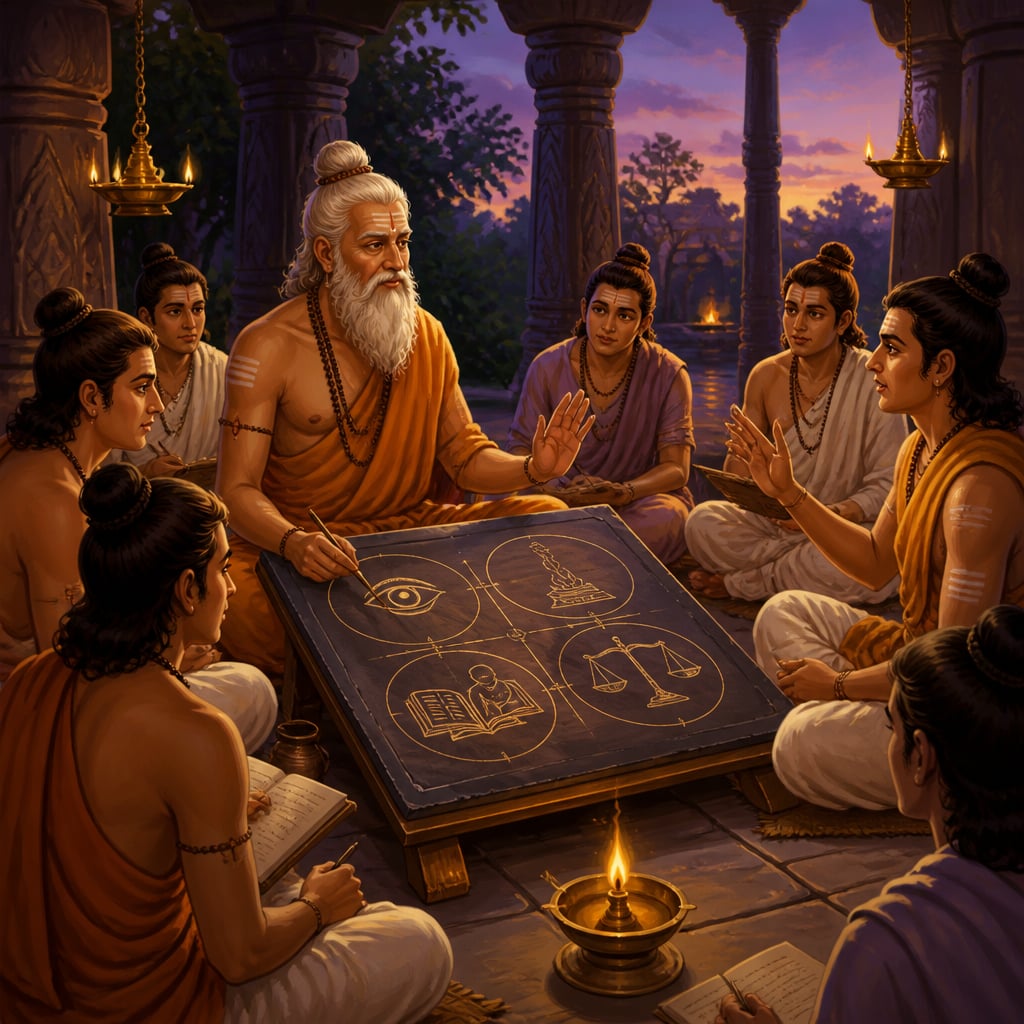
Senior rishi tracing the four pramanas before students in an open mandapa

The Architecture of Knowing

The Sanskrit term pramāṇa comes from pra (forth) and māṇa (measure), from the root (to measure). A pramāṇa is "that by which we measure correctly", a valid means of knowledge, a method that reliably produces truth rather than error.

The Vedic tradition developed sophisticated epistemology, detailed analysis of how we know what we know. Different schools recognized different pramāṇas: pratyakṣa (direct perception), anumāna (inference), upamāna (analogy), śabda (testimony, especially scriptural), arthāpatti (postulation), and anupalabdhi (non-perception). Some schools accepted three, some four, some six.

But here is what matters for our exploration: every school that analyzed pramāṇas also analyzed their limits. The question was never just "How do we know?" but also "Where does this way of knowing fail?"

This dual focus, rigorous method and honest limitation, is the Vedic contribution to epistemology. Knowledge is real. Methods work. But every method has boundaries, and wisdom includes knowing where those boundaries lie.

This deserves emphasis: India developed sophisticated epistemology, analysis of how we know, millennia ago. This tradition offers resources for contemporary discussions of cognitive bias, model limitations, and the boundaries of expertise. The Vedic synthesis of confidence and humility, knowing rigorously while acknowledging limits, remains relevant in an era of information overload and expert failure.

What the Mantras Reveal

The Rig Veda contains verses that acknowledge the limits of even sacred knowledge. In the Asya Vamasya Sukta, Dirghatamas declares:

"Saptārdhagarb hā bhuvanasya reto viṣṇoḥ padamve avarām avāti"

The seven half-embryos are the seeds of the world; they guard the realm of Vishnu below.

This cryptic verse has puzzled commentators for millennia. Sayana offers one interpretation, Aurobindo another. The very difficulty of the verse is instructive: some knowledge resists easy formulation. The Rishi points toward truths that exceed straightforward statement.

More directly, the Jñāna Sukta (RV 10.71) describes knowledge as something that can be present yet hidden:

"Utā tvaḥ paśyan na dadarśa vācam utā tvaḥ śṛṇvan na śṛṇoty enām"

One may look yet not see the truth; one may hear yet not comprehend it.

Word by word: uta (and/but) tvaḥ (one) paśyan (looking) na (not) dadarśa (has seen) vācam (speech/wisdom) uta (and) tvaḥ (one) śṛṇvan (hearing) na (not) śṛṇoti (hears) enām (it).

This is a teaching about the limits of perception itself. Perception, pratyakṣa, is considered the most basic pramāṇa, the foundation of other knowledge. Yet the Rishi points out that looking doesn't guarantee seeing, hearing doesn't guarantee understanding. Even our most direct means of knowledge has limits.

Kaṇāda's Revolutionary Insight

Kaṇāda contemplating the smallest paramāṇu in a grain of sand

The sage Kaṇāda, founder of the Vaisheshika school, developed one of history's earliest atomic theories. He reasoned that if you keep dividing matter, you must eventually reach an indivisible unit, paramāṇu, the smallest particle. These atoms combine in various ways to form the material world.

But Kaṇāda made a crucial epistemological observation: we cannot perceive atoms directly. They are too small. We infer their existence through reason. When we see a pot, we perceive the pot, not the atoms that compose it. The atoms are anumeya, known through inference, not perception.

This acknowledgment is profound. Kaṇāda built a comprehensive physical theory while explicitly noting that its foundation, atoms, lies beyond direct perception. He mapped both what we can know and how we know it, including the gap between inference and perception.

Sayanacharya and later commentators saw in Kaṇāda's approach a model for honest epistemology: build systematic knowledge while acknowledging its foundations. Know the limits of your pramāṇas even as you use them.

Kahneman's Mapping of Cognitive Limits

Kahneman and Tversky testing cognitive biases with index cards

In the 20th century, psychologist Daniel Kahneman spent decades mapping the limits of human reasoning. His research, conducted with Amos Tversky, revealed systematic errors in how humans think, biases that affect everyone, including experts.

Kahneman's "System 1 and System 2" framework describes two modes of thinking. System 1 is fast, automatic, intuitive, and prone to predictable errors. System 2 is slow, deliberate, logical, but easily exhausted and often lazy. We think we're using System 2 when we're actually running on System 1's shortcuts.

The parallels with Vedic epistemology are striking. Like the Rishis, Kahneman doesn't say knowledge is impossible. He says: know your pramāṇas, your methods of knowing, and know where they fail. Perception has limits (optical illusions, inattentional blindness). Inference has limits (confirmation bias, availability heuristic). Even expert testimony has limits (overconfidence, hindsight bias).

Kahneman won the Nobel Prize not for discovering that we can know things, but for mapping where we systematically fail to know. This is the pramāṇa approach applied to modern psychology: rigorous method paired with honest limitation.

The Black Swan Problem

Nassim Nicholas Taleb extended this epistemological humility to domains of prediction and risk. His concept of "Black Swans", high-impact, hard-to-predict events that we rationalize after the fact, maps the limits of inference applied to complex systems.

Taleb's insight: in many domains that matter most (markets, politics, technology, health), what we don't know exceeds what we do know. Our models work, until they catastrophically don't. The 2008 financial crisis, COVID-19, technological disruptions, these are events that standard inference failed to predict because they lay outside the distribution our models assumed.

The Vedic response to this problem is neither to abandon inference nor to pretend it has no limits. It is to hold our knowledge accurately: real but bounded, useful but incomplete. Taleb calls this "epistemic humility." The Rishis called it understanding your pramāṇas.

Where Knowledge Stops

The Vedic tradition identified specific domains where standard pramāṇas fail:

Cosmic origins: As we saw in the Nasadiya Sukta, questions about what preceded creation may exceed any pramāṇa. Neither perception nor inference can reach before the conditions for perception and inference existed.

Ultimate reality (Brahman): The Upanishads teach that Brahman, the ultimate ground of existence, cannot be known as an object is known. Standard pramāṇas grasp objects; Brahman is not an object but the condition for all objects.

Other minds: We infer others' mental states from behavior, but inference has limits. We never directly perceive another's experience.

Future contingents: Inference from past to future assumes continuity. But the future may contain genuinely novel events, what Taleb calls Black Swans, that break the patterns inference assumes.

Acknowledging these limits is not intellectual defeat. It is precision. Knowing where your map ends is as important as knowing where it applies.

Daniel Kahneman's research catalogued specific cognitive biases, systematic errors in human reasoning. Confirmation bias, availability heuristic, anchoring effect, these are the modern mapping of where our mental pramāṇas fail. Knowing the biases doesn't eliminate them, but it enables compensation.

High-performing organizations institutionalize checks on cognitive limits. Amazon's practice of writing six-page memos before meetings forces System 2 thinking over System 1 intuition. Pre-mortems imagine failure before it happens, countering overconfidence bias. These are pramāṇa-correction at organizational scale.

Every model is a simplification of reality, useful within its domain, misleading outside it. George Box's dictum 'All models are wrong, but some are useful' is the systems thinking equivalent of knowing your pramāṇa's limits. The map is never the territory.

Nassim Taleb's 'Black Swan' theory maps the hidden three-quarters: high-impact events that standard models fail to predict. Our inference assumes continuity; reality includes discontinuity. The dot-com crash, 9/11, COVID-19, events that broke the patterns our pramāṇas assumed.

Taleb advocates 'antifragility', building systems that gain from disorder rather than merely surviving it. This is the practical response to acknowledging inference limits: since you can't predict Black Swans, build resilience into systems so that unpredicted events strengthen rather than destroy.

Complex adaptive systems generate genuine novelty, outcomes that weren't implicit in initial conditions. This is the systems-level explanation for why inference fails: the future contains possibilities that no extrapolation from the past could reveal.

Your Path Forward

You have pramāṇas, methods you use to make decisions, evaluate opportunities, judge people, understand situations. Some are explicit (data analysis, frameworks, models). Some are implicit (intuition, gut feeling, pattern recognition).

The Vedic teaching is: know your pramāṇas. Know what they're good for. And know where they fail.

This week, examine one important decision you're facing. Ask: By what pramāṇa am I approaching this? Perception? Inference from past experience? Testimony from experts? Then ask: Where does this pramāṇa have limits? What might I be missing because my method of knowing has blind spots?

The scholar who asked "By what pramāṇa do you know this?" wasn't trying to undermine knowledge. He was trying to make it precise. He wanted to know not just what his opponent believed, but the foundations of that belief, and the limits of those foundations.

In our next lesson, we'll explore how the Rishis lived and acted within these acknowledged limits, how they developed kārya, effective action, without demanding the complete knowledge that would never come.

Case studies

Kahneman and Tversky: Mapping the Limits of Human Reasoning

In the 1970s, psychologists Daniel Kahneman and Amos Tversky began a research program that would reshape how we understand human judgment. They presented subjects with simple problems, probability estimates, risk assessments, predictions, and found systematic errors. Not random mistakes, but predictable patterns of failure. Experts made the same errors as novices. The errors persisted even when subjects were warned about them. Kahneman and Tversky were mapping the limits of human cognition, the boundaries of our mental pramāṇas.

Kahneman's life work embodies the Vedic approach to epistemology. The Rishis asked: By what pramāṇa do we know? And where does that pramāṇa fail? Kahneman asked the same questions about human reasoning and found precise answers. System 1 (intuitive thinking) fails through cognitive biases. System 2 (deliberate reasoning) fails through laziness and exhaustion. Each 'pramāṇa' has specific limits. Like the Jñāna Sukta's teaching that 'one may look yet not see,' Kahneman showed that we can reason yet not reason well.

Kahneman won the Nobel Prize in Economics in 2002, not for discovering how we make good decisions, but for mapping how we systematically fail. His book *Thinking, Fast and Slow* became a global bestseller. His work founded behavioral economics and influenced fields from medicine to law to public policy. The impact came precisely from the precision of his limits-mapping: knowing exactly where reasoning fails enables compensation and correction.

The most valuable knowledge is often not what we can do, but where we fail. Kahneman's contribution wasn't new abilities but new awareness of limitations. The Vedic insight applies: map your pramāṇas, and map their limits.

Behavioral science training is now standard in medical schools, financial advisory firms, and UX design teams. Knowing that human judgment has systematic blind spots, and building checklists and processes to compensate, has become a competitive advantage across industries.

Kahneman's catalog of cognitive biases now includes over 180 documented systematic errors in human reasoning, a comprehensive map of where our mental pramāṇas fail.

Kaṇāda's Atomic Theory: Building Knowledge While Acknowledging Its Foundations

The sage Kaṇāda (c. 6th century BCE) developed a comprehensive theory of matter based on indivisible particles, paramāṇus. He reasoned that if you keep dividing any substance, you must eventually reach a point where further division is impossible. These atoms combine in pairs (dvyaṇuka), then larger aggregates (tryaṇuka), eventually forming the perceivable world. His Vaisheshika Sutras detail how atoms of different types, earth, water, fire, air, combine to produce all material phenomena.

Kaṇāda's genius lay not just in his theory but in his epistemological honesty about it. He explicitly acknowledged that atoms cannot be perceived, they are too small. We know them through anumāna (inference), not pratyakṣa (perception). This creates an epistemological gap: the foundation of his physical theory lies beyond direct verification. Kaṇāda didn't hide this gap; he mapped it. He built systematic knowledge while acknowledging that its foundations depend on inference, not perception. This is pramāṇa-aware science.

Vaisheshika became one of the six orthodox schools of Hindu philosophy, influencing centuries of Indian thought about matter, causation, and knowledge. Kaṇāda's atomic theory anticipated Greek atomism (Democritus) while including more sophisticated epistemological reflection. His categories (dravya, guṇa, karma, etc.) shaped Indian physics, chemistry, and Ayurvedic medicine for millennia.

You can build systematic knowledge while acknowledging its foundations are not directly verifiable. Kaṇāda's honesty about the limits of his pramāṇa, inference rather than perception, made his theory more durable, not less. Acknowledging what you don't directly know is itself a form of knowing.

Modern physics operates on exactly this principle. Quantum mechanics makes stunningly accurate predictions while acknowledging that its foundational interpretation remains debated. Scientists use the framework productively without requiring philosophical certainty about what it ultimately means.

Kanada's Vaisheshika Sutra, composed around the 6th century BCE, proposed that all matter consists of indivisible atoms (paramanu) at least two centuries before the Greek atomist Democritus (c. 460-370 BCE) developed a similar theory independently.

Reflection

More in Anirukta: A World Without Absolute Certainty

All lessons in Anirukta: A World Without Absolute Certainty · Rig Vedic Philosophy course