Kārya: Living Without Complete Control
Acting Decisively Within Acknowledged Uncertainty
Exploring how the Vedic tradition synthesized epistemic humility with effective action, the art of acting decisively without demanding the complete knowledge or control that will never come.
The archer stood motionless, bow drawn, arrow nocked. Before him lay the target, a fish suspended high above, visible only as a reflection in the water below. Around him, the court watched in silence. His competitors had failed, distracted by the crowd, the pressure, the impossibility of the shot.
Arjuna did not know if the arrow would strike true. He could not control the wind, the light, the subtle tremor in his muscles. What he could control was his focus, his preparation, his commitment to the action itself. He released.
The arrow flew. The fish fell.
Years later, facing a far more consequential moment at Kurukshetra, Arjuna would receive the teaching that explains this scene: you have the right to action, never to its fruits. Act fully, but release attachment to outcomes you cannot control.
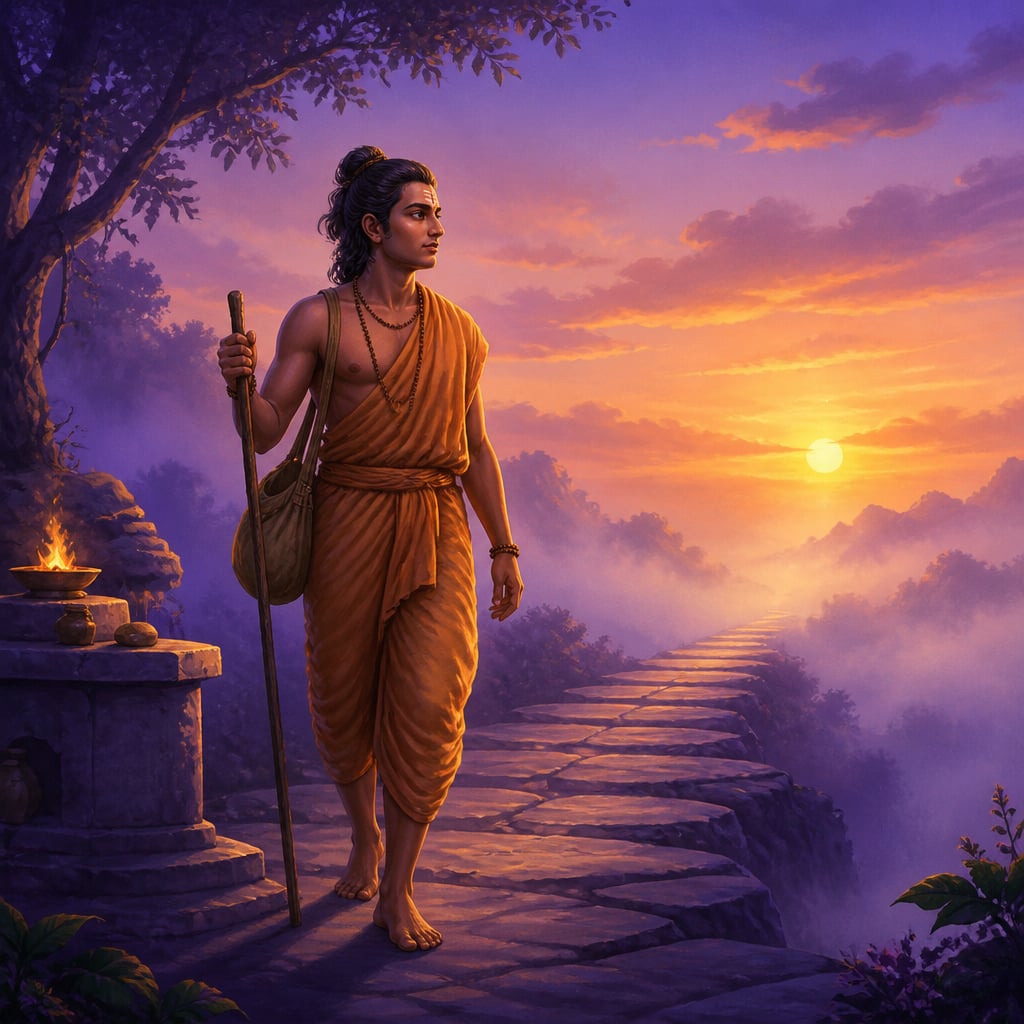
The Paradox of Effective Action
The previous lessons established that the Rishis acknowledged profound uncertainty, about cosmic origins, about the limits of knowledge, about what lies beyond human pramāṇas. A reasonable response might be paralysis: if we cannot know with certainty, how can we act with confidence?
But the Rishis were not paralyzed. They performed intricate rituals requiring precise action. They built communities, raised families, composed hymns, and transmitted knowledge across millennia. Their acknowledgment of uncertainty coexisted with vigorous, effective action.
The Sanskrit term kārya, from the root kṛ (to do, to make), means "that which is to be done," action that is appropriate, necessary, timely. Kārya is not random activity but purposeful doing, action aligned with dharma and situation. The Vedic insight is that kārya does not require certainty about outcomes. It requires clarity about what is to be done now, given what we know and don't know.
This insight resolves the tension between epistemic humility and effective living. You don't need to choose between acknowledging uncertainty and acting decisively. The Rishis showed that these coexist, and that in fact, acknowledging uncertainty enables better action than false certainty does. This framework remains relevant in any domain where decisions must be made without complete information.
What the Mantras Teach About Action
The Rig Veda celebrates action, the dynamic energy of creation, preservation, and transformation. The Purusha Sukta describes cosmic creation itself as an act:
"Yat puruṣeṇa haviṣā devā yajñam atanvata"
When the gods performed the sacrifice with Purusha as the offering, they stretched out the cosmic order.
Word by word: yat (when) puruṣeṇa (with Purusha) haviṣā (as the offering) devāḥ (the gods) yajñam (sacrifice) atanvata (they extended/performed).
Creation itself is portrayed as ritual action, the gods acting to bring forth the world. This is not action from complete knowledge; even the gods, as the Nasadiya Sukta notes, came after creation began. It is action that participates in an unfolding whose totality exceeds any actor's comprehension.
The Karma Sukta (RV 10.117) explicitly addresses the relationship between action and uncertainty:
"Na sa sakhā yo na dadāti sakhye sacābhuve sacamānāya pitvah"
He is no friend who does not give to a friend in need, to the companion who comes seeking food.
The verse commands action, generosity to those in need, without guaranteeing outcomes. You cannot know if your gift will be well-used, if the recipient is truly deserving, if your generosity will be reciprocated. You act anyway, because the action is right (kārya), regardless of results you cannot control.
The Structure of Action Without Control
The Vedic tradition developed a sophisticated framework for acting within uncertainty:
Svadharma, your specific duty given your situation, capacities, and role. You cannot control everything, but you can identify what is specifically yours to do.
Kāla, right timing. Action is not just what to do but when to do it. The Rishis understood that the same action at different times yields different results, and that timing itself involves uncertainty.
Prayatna, effort, the portion of action within your control. You can control your preparation, your attention, your commitment. You cannot control outcomes.
Phala-tyāga, release of attachment to fruits. This doesn't mean not caring about results; it means not making your action contingent on guaranteed outcomes. You act fully while accepting that results depend on factors beyond your control.
This framework enables decisive action without the paralysis that comes from demanding certainty before acting.
Vikramaditya's Wisdom

King Vikramaditya of Ujjain became legendary not for conquering uncertainty but for acting wisely within it. The stories of Vikram and Betaal present him with impossible dilemmas, situations where any choice has costs, where complete information is unavailable, where outcomes cannot be predicted.
In one famous tale, Vikramaditya must judge a case where appearances deceive and evidence is ambiguous. Rather than demanding impossible certainty, he acts on the best understanding available while remaining open to correction. His wisdom lies not in knowing everything but in deciding well with what can be known.
The Betaal challenges Vikramaditya precisely on the limits of knowledge and control: "You cannot know for certain. How then will you judge?" Vikramaditya's responses demonstrate kārya, appropriate action that acknowledges uncertainty while refusing paralysis.
Sayanacharya and later commentators saw in Vikramaditya a model of rāja-dharma, the duty of a king to act decisively despite incomplete information. A king who waits for certainty never acts; a king who ignores uncertainty acts foolishly. Vikramaditya embodied the middle path: decisive action held lightly, commitment paired with adaptability.
SpaceX and Rapid Iteration

In 2002, Elon Musk founded SpaceX with a goal most experts considered impossible: dramatically reducing the cost of space access. The aerospace industry operated on the assumption that rockets required decades of development, billions in funding, and guaranteed success before launch. Musk took a different approach.
SpaceX embraced what they call "rapid iteration", build, test, fail, learn, rebuild. Rather than waiting for complete knowledge before acting, they generated knowledge through action. Rockets exploded on the pad. Boosters crashed into barges. Each failure became data for the next attempt.
This approach embodies the Vedic synthesis of uncertainty and action. SpaceX couldn't know in advance which designs would work. They couldn't control the physics of rocket propulsion. What they could control was their response to failure, treating each explosion not as defeat but as information.
By 2024, SpaceX had achieved what experts said was impossible: reusable rockets, dramatically lower launch costs, and the most frequent launch cadence in history. The company that embraced uncertainty outperformed those that demanded certainty before acting.
The parallel to Vikramaditya is precise: act on best available understanding, remain open to correction, treat setbacks as data rather than defeat. Complete control is impossible; effective action is not.
The Practice of Letting Go
The hardest part of kārya is not acting without certainty, it is releasing attachment to outcomes after you have acted. You prepare fully, execute with commitment, and then... let go.
This is not indifference. The archer who doesn't care whether the arrow hits has not achieved wisdom; he has achieved apathy. Phala-tyāga means caring about results while accepting that results are not entirely within your control. You do your part fully; you release what is not your part.
The Rishis who performed yajñas with meticulous precision also understood that the results of the sacrifice depended on factors beyond their control, the alignment of cosmic forces, the will of the devas, the accumulated karma of all participants. They performed perfectly and released outcomes.
Research on 'action bias' shows that in uncertain situations, taking action often produces better outcomes than paralysis, partly because action generates information that waiting cannot provide. The Vedic emphasis on kārya aligns with findings that decisive action under uncertainty, followed by adaptation, outperforms endless analysis.
Jeff Bezos distinguishes between 'one-way door' decisions (irreversible, requiring extensive analysis) and 'two-way door' decisions (reversible, favoring speed). Most decisions are two-way doors, the cost of being wrong is lower than the cost of not deciding. This framework operationalizes kārya: identify what is yours to do, then do it.
Complex adaptive systems cannot be fully predicted; they must be probed through action and observed for response. The OODA loop (Observe-Orient-Decide-Act) in military strategy and lean startup methodology both recognize that action generates knowledge that analysis alone cannot provide.
Psychologist Angela Duckworth's research on 'grit' shows that sustained effort toward long-term goals predicts success better than talent or IQ. But grit without adaptability becomes stubbornness. The Vedic synthesis, full commitment to action plus release of attachment to specific outcomes, describes effective grit: persistent effort held lightly enough to adapt.
High-performing leaders demonstrate what psychologists call 'committed flexibility', strong conviction about direction paired with willingness to adjust tactics. This mirrors phala-tyāga: commit fully to the action while releasing attachment to exactly how results manifest. The vision stays constant; the path adapts.
Agile methodology institutionalizes committed action held lightly: work in short sprints with full commitment, then reassess based on results. This is the systems-level application of kārya, purposeful action followed by learning and adaptation, rather than rigid adherence to initial plans.
Your Path Forward
You face decisions where complete information is unavailable and outcomes are uncertain. The Vedic teaching offers a framework:
Identify your svadharma: What is specifically yours to do in this situation? Not everything is your responsibility. Clarify the boundaries of your appropriate action.
Prepare fully: The portion within your control, preparation, attention, skill, deserves your complete effort. Don't use uncertainty as an excuse for half-hearted action.
Act decisively: Once preparation is complete and timing is right, act with full commitment. Hesitation rarely improves outcomes and often worsens them.
Release attachment: After acting, let go of what you cannot control. This isn't giving up on results; it's acknowledging that results depend on more than your effort alone.
This week, identify one decision you've been postponing because you lack complete information. Ask: What is my svadharma here? What preparation is within my control? Then act, not because you have certainty, but because kārya does not require certainty.
The archer who struck the fish did not know his arrow would fly true. He knew his preparation was complete, his focus was clear, and the moment required action. That was enough.
In our next lesson, we'll explore vicāra, thinking without dogma, the Vedic approach to holding ideas lightly while still using them effectively.
Case studies
SpaceX's Rapid Iteration: Generating Knowledge Through Action
When Elon Musk founded SpaceX in 2002, the aerospace industry operated on the assumption that rockets required decades of development and guaranteed success before launch. SpaceX took a radically different approach: build, test, fail, learn, rebuild. Their early Falcon 1 rockets exploded on the pad. Their Falcon 9 boosters crashed into drone ships dozens of times before successful landings. Each failure was treated not as defeat but as data for the next iteration.
SpaceX embodies kārya, purposeful action that does not wait for certainty. They could not know in advance which designs would work; they generated knowledge through action. This is the Vedic approach: act on best available understanding, observe results, adapt, act again. Their commitment to each launch was total (prayatna); their attachment to specific outcomes was released (phala-tyāga). When rockets exploded, they didn't abandon the mission, they treated failure as information and continued. This is Vikramaditya's wisdom applied to engineering.
By 2024, SpaceX had achieved what experts considered impossible: reusable orbital-class rockets, launch costs reduced by 90%, the highest launch cadence in history, and contracts with NASA for crewed missions. They did this not by avoiding failure but by embracing it as part of the process. The company that acted under uncertainty outperformed those that demanded certainty before acting.
In complex domains, you cannot know everything before acting. The choice is not between certainty and action; it's between learning through analysis alone and learning through analysis plus action. SpaceX chose action, and generated knowledge their competitors couldn't access through planning alone.
The lean startup methodology that dominates Silicon Valley, from Y Combinator to product teams at Google, is built on this insight. Ship fast, learn from real-world feedback, and iterate. Companies that wait for certainty before launching consistently lose to those willing to learn through action.
SpaceX's Starship development involved multiple dramatic explosions, each publicly celebrated as 'rapid unscheduled disassembly' that provided data for the next iteration. The company normalized failure as part of the process, not its end.
Vikramaditya's Impossible Judgments: Deciding Without Complete Information
King Vikramaditya of Ujjain (c. 1st century BCE) became legendary for his wisdom in impossible situations. The Vikram-Betaal tales present him with dilemmas where every choice has costs, information is incomplete, and outcomes are uncertain. In one famous story, Vikramaditya must determine the true mother of a disputed child when both claimants seem equally convincing. Evidence is ambiguous; witnesses contradict each other; certainty is impossible.
Vikramaditya's approach embodies kārya applied to governance. He doesn't wait for impossible certainty; he acts on the best understanding available while remaining open to correction. His method includes careful observation (pratyakṣa), logical inference (anumāna), and consultation (śabda), but ultimately, he must decide. The king who waits for certainty never acts; the king who ignores uncertainty acts foolishly. Vikramaditya embodies the middle path: decisive action based on available knowledge, held lightly enough to adapt when new information emerges.
The Vikram-Betaal tales preserved Vikramaditya as the model of wise rulership for millennia, not because he was never wrong, but because he demonstrated how to decide well under uncertainty. His legend emphasizes not omniscience but practical wisdom: the art of acting decisively when certainty is unavailable but action is required.
Leadership often requires deciding without complete information. Vikramaditya shows that wisdom is not knowing everything; it's acting well with what can be known while remaining humble about what cannot. The demand for certainty before deciding is itself a failure of leadership.
Emergency room doctors, startup founders, and military commanders all face the same challenge daily: decisions must be made before all information arrives. Training programs in these fields increasingly emphasize decision-making under uncertainty as a core skill rather than a failure condition.
The Vikram-Betaal cycle contains 25 tales, each presenting a moral dilemma with no clear right answer. King Vikramaditya's legendary court at Ujjain (c. 1st century BCE) became so influential that the Vikrama Samvat calendar, beginning 57 BCE, is still used across India today.
Reflection
- What decision have you been postponing because you lack complete information? What is the minimum you would need to act responsibly? What would happen if you acted this week?
- How did the Rishis reconcile profound questioning about cosmic origins with vigorous action in the world? What does their example suggest about the relationship between uncertainty and effectiveness?
- What is the difference between phala-tyāga (release of attachment to results) and indifference to outcomes? How can you care about results while not being attached to them?