Saṃśaya: Doubt as a Form of Wisdom
Why the Rishis Valued Questioning Over Certainty
Exploring saṃśaya, productive doubt, as a Vedic method of inquiry, and how the tradition distinguished between doubt that drives wisdom and doubt that paralyzes action.
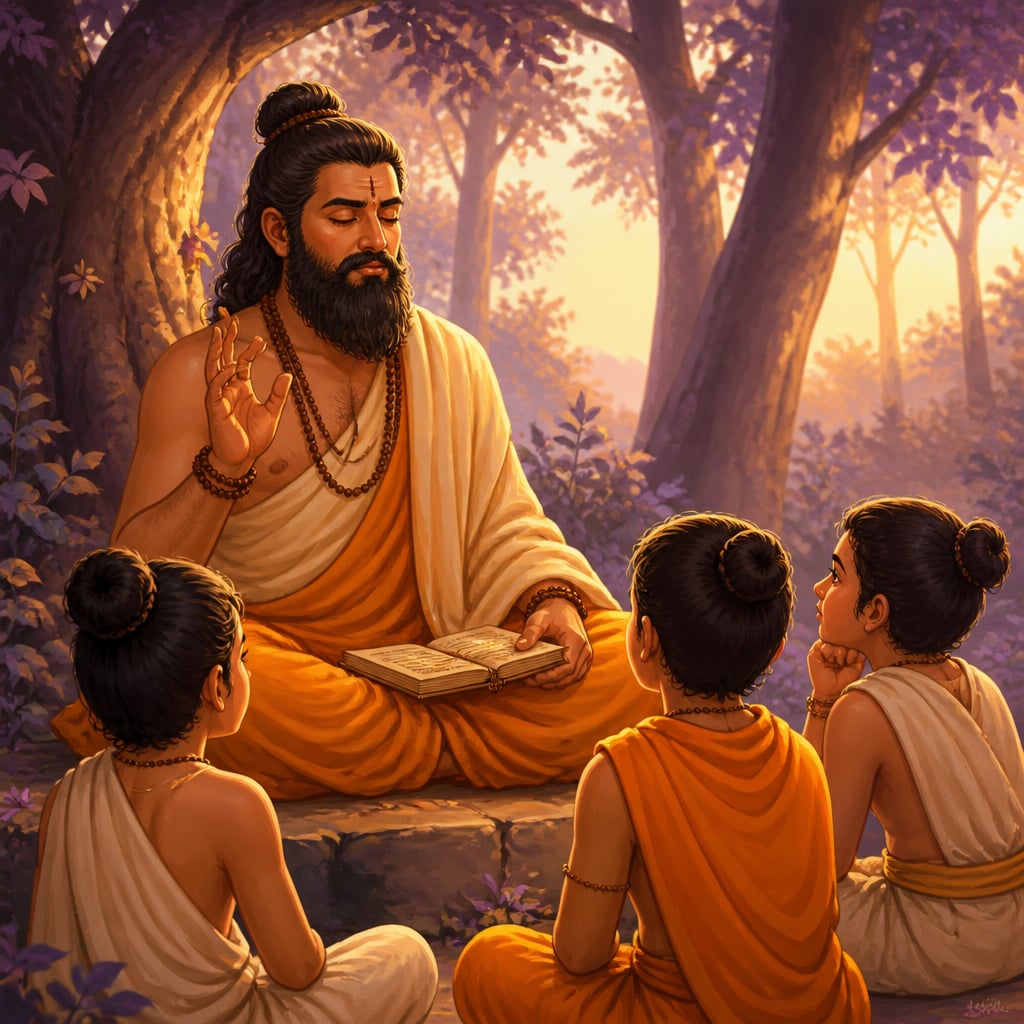
The young brahmachari had completed twelve years of study. He could recite the Vedas without error, every syllable, every accent, every pause in perfect order. His memory was flawless, his discipline unquestioned. On the morning of his graduation, he approached his guru expecting praise.
The old teacher listened to the final recitation, nodded slowly, and said: "Good. Your memory is complete. Now your real education begins."
The student was confused. "But guru-ji, I have learned everything you taught."
"You have memorized everything I taught," the guru replied. "Now you must learn to doubt it. Only then will you understand it."
The Paradox of Sacred Doubt
This teaching story captures something essential about the Vedic approach to knowledge: doubt is not the enemy of wisdom but its prerequisite. The Sanskrit term is saṃśaya, from sam (together) and śaya (lying, resting), suggesting a state where multiple possibilities lie together, unresolved. Saṃśaya is not confusion or despair; it is the fertile ground where genuine inquiry takes root.
The Rishis who composed the Vedas were not doubters in the modern skeptical sense, people who refuse to commit to anything. They were practitioners who performed precise rituals, built communities, and transmitted knowledge across generations. But they understood that genuine knowledge requires passing through doubt, not around it.
Consider the paradox: the Nasadiya Sukta, which we explored in the previous lesson, appears in the Rig Veda, the most sacred text of the tradition. Its questioning is not outside the revelation but part of it. The doubt itself is śruti, heard, revealed, sacred.
What the Mantras Teach About Doubt
The Rig Veda contains numerous passages where the Rishis express genuine uncertainty, not as a failure of faith but as a method of approaching truth. In the Asya Vamasya Sukta, the blind seer Dirghatamas asks:
"Acikitvāñ cikituṣaś cid atra kavīn pṛcchāmi vidmane na vidvān"
Not knowing, I ask the wise ones who know, for the sake of knowing, though I myself do not know.
Word by word: acikitvān (not understanding) cikituṣaḥ (those who understand) cit (even) atra (here) kavīn (the wise poets/seers) pṛcchāmi (I ask) vidmane (for the sake of knowing) na (not) vidvān (knowing).
Dirghatamas admits his not-knowing in order to know. The admission is not weakness but method. He models the intellectual humility that makes genuine learning possible. The question comes from someone serious enough to acknowledge what he doesn't understand.
This is saṃśaya as method: not doubt that dismisses, but doubt that inquires. Not skepticism that closes down, but questioning that opens up.
The Tradition of Productive Doubt
Sayanacharya, commenting on passages like this, distinguishes between saṃśaya and viparīta-jñāna (wrong knowledge). Doubt that drives investigation is different from error that misdirects. The Rishi's uncertainty is productive, it leads somewhere. It is paired with the desire to know (jijñāsā) and the discipline to pursue the question.
Sri Aurobindo saw in the Vedic questioning a model for what he called "integral knowledge", understanding that includes rather than excludes doubt. For Aurobindo, the Rishis demonstrated that spiritual confidence and intellectual humility can coexist. You can be committed to the path while acknowledging that you haven't reached the destination.
This synthesis matters. Modern thought often assumes that doubt and commitment are opposites, that to question is to undermine, that certainty is strength and uncertainty is weakness. The Vedic tradition offers a different model: doubt within commitment, questioning within practice, uncertainty held by faith (śraddhā).
A clarifying note on this tradition: questioning is not a Western invention imported into Indian thought but an indigenous tradition thousands of years old. The Rishis developed sophisticated frameworks for productive doubt, distinguishing it from destructive skepticism, integrating it with practice, and transmitting it across generations. Modern discussions of critical thinking, scientific method, and intellectual humility are anticipated in these ancient sources.
The Buddha's Inheritance

Centuries after the Vedic period, Siddhartha Gautama, the Buddha, articulated a teaching on doubt that crystallized what the Rishis had practiced. In the Kalama Sutta, he addressed villagers confused by competing teachers:
"Do not accept something merely because it is tradition. Do not accept something merely because many people believe it. Do not accept something merely because a teacher has said it. When you know for yourselves that certain things are wholesome and blameless, praised by the wise, and lead to benefit and happiness when undertaken, then you should engage in them."
This is not skepticism that rejects everything. It is doubt as method, the insistence that genuine knowledge must be verified through one's own investigation and experience. The Buddha was heir to the Vedic questioning tradition, applying saṃśaya systematically to the path of liberation.
Notice that the Kalama Sutta doesn't say "doubt everything and believe nothing." It says: doubt as a starting point, then investigate, then verify through experience. The doubt is in service of eventual knowing, not a permanent residence.
Mashelkar's Revolution

In the 1990s, Dr. Raghunath Mashelkar became Director General of India's Council of Scientific and Industrial Research (CSIR), a vast network of 38 laboratories that had become bureaucratic and isolated. The prevailing model was closed innovation: protect your research, guard your secrets, compete rather than collaborate.
Mashelkar doubted everything about this model. What if openness produced better science than secrecy? What if collaboration beat competition? What if the entire paradigm of how Indian science operated was wrong?
He didn't just tweak the system, he questioned its foundations. Mashelkar introduced open innovation before the term was fashionable. He partnered CSIR with private industry, international institutions, and competitors. He challenged the assumption that government labs must work in isolation.
The doubt was productive. CSIR's patent filings increased dramatically. Research impact grew. The institution that was dismissed as a bureaucratic backwater became a model for how public science could work. Mashelkar's questioning, his willingness to doubt what everyone assumed, enabled transformation that incremental improvement never could.
The Structure of Productive Doubt
What distinguishes saṃśaya, productive doubt, from destructive skepticism? The Vedic tradition offers several markers:
Paired with desire to know (jijñāsā): The Rishi's doubt leads to inquiry, not dismissal. "I don't know" becomes "Let me find out," not "No one can know."
Held within practice (sādhanā): The Rishis doubted while continuing to perform rituals, maintain discipline, and live according to dharma. Doubt didn't paralyze action.
Grounded in humility (vinaya): Productive doubt acknowledges one's own limitations. "I may be wrong" opens possibilities that "I am certainly right" forecloses.
Directed toward truth (satya): The goal is understanding, not permanent uncertainty. Saṃśaya is a method, not a destination.
Destructive doubt, by contrast, doubts without seeking resolution, uses skepticism to avoid commitment, and treats uncertainty as an end rather than a means.
Research on 'intellectual humility' by Mark Leary shows that people who can say 'I might be wrong' make better decisions, learn faster, and build stronger relationships. The capacity to doubt oneself, like Dirghatamas, correlates with psychological wellbeing and effectiveness.
Amy Edmondson's research on psychological safety shows that organizations where people can question assumptions outperform those where questioning is punished. The Vedic model, doubt within commitment, describes high-performing teams: people committed to the mission but free to question how it's pursued.
Complex systems require continuous error-correction, which depends on doubt, the willingness to question whether current approaches are working. Organizations that suppress doubt accumulate errors until catastrophic failure. Institutionalized saṃśaya is a survival mechanism.
Dialectical Behavior Therapy teaches 'dialectical thinking', holding apparent opposites together. This capacity to hold faith and doubt simultaneously is a marker of psychological maturity. The Vedic model anticipates what therapy now teaches.
Effective leaders hold vision (śraddhā) and flexibility (saṃśaya) together. They're committed to the destination but willing to question the route. Jeff Bezos calls this 'stubborn on vision, flexible on details', the Vedic synthesis of faith and doubt.
Adaptive systems maintain identity (stability) while continuously adapting (change). Too much stability becomes rigidity; too much change becomes chaos. The integration of śraddhā and saṃśaya describes how healthy systems operate.
Your Path Forward
You likely hold beliefs, about your work, your relationships, your path, that you've never seriously questioned. Not because you've investigated and confirmed them, but because questioning feels disloyal or destabilizing.
The Vedic teaching suggests otherwise. The beliefs that matter most deserve the most rigorous questioning. If they're true, they'll survive doubt. If they're not, better to discover this through inquiry than through failure.
This week, identify one assumption you've never questioned, something you believe about your field, your organization, or yourself. Hold it with saṃśaya. Not to dismiss it, but to investigate it. Ask: How do I know this is true? What would change if it weren't?
The young brahmachari who had memorized everything eventually understood his guru's teaching. Perfect recitation was the beginning, not the end. Real knowledge required passing through doubt, not avoiding it, not getting stuck in it, but using it as the Rishis used it: as a tool for approaching what cannot be memorized but must be realized.
In our next lesson, we'll explore pramāṇa, the Vedic theory of valid knowledge and its limits. If doubt is the method, what counts as resolution?
Case studies
Raghunath Mashelkar's CSIR Revolution: Doubting the Closed Innovation Paradigm
When Dr. Raghunath Mashelkar became Director General of CSIR (Council of Scientific and Industrial Research) in 1995, he inherited 38 national laboratories trapped in a closed innovation model. Each lab protected its research, guarded secrets, and competed rather than collaborated. The assumption was universal: this is how science works. Patents were few, impact was limited, and the organization was seen as a bureaucratic backwater. Mashelkar looked at this paradigm that everyone accepted and asked: What if the entire model is wrong?
Mashelkar embodied saṃśaya applied to institutional assumptions. He didn't just question specific practices; he questioned the foundational belief that closed innovation was the only way. Like Dirghatamas admitting 'I do not know,' Mashelkar was willing to say 'We may be doing this entirely wrong.' His doubt was productive, paired with jijñāsā (desire to know better) and śraddhā (commitment to Indian science's potential). He questioned the paradigm while remaining deeply committed to the mission.
Mashelkar introduced open innovation before the term was fashionable. He partnered CSIR with private industry, international institutions, and even competitors. He opened up research protocols and encouraged knowledge-sharing. CSIR's patent filings increased dramatically, from about 200 patents in 1995 to over 4,000 by 2006. More importantly, research impact grew as isolated labs became nodes in a collaborative network. Mashelkar's willingness to question what everyone assumed enabled transformation that incremental improvement never could.
The most consequential beliefs to question are often the ones that feel beyond questioning, 'This is just how things work.' Mashelkar's saṃśaya wasn't about trivial matters but about foundational assumptions. His example shows that productive doubt, applied to paradigm-level beliefs, can transform entire institutions.
The most disruptive startups, from Ola to Zerodha, began by questioning assumptions their industries treated as fixed. In regulated sectors like healthcare and finance, the next wave of Indian innovation depends on leaders willing to doubt inherited paradigms rather than optimize within them.
Under Mashelkar's leadership, CSIR moved from the bottom to the top among publicly funded research organizations globally in patent filings and industry partnerships, demonstrating that questioning the closed innovation model produced measurable results.
The Buddha's Kalama Sutta: Institutionalizing Doubt as Spiritual Method
The villagers of Kesaputta were confused. Various teachers had passed through their town, each proclaiming his doctrine as truth and dismissing the others as false. The Kalamas didn't know whom to believe. When the Buddha arrived, they asked him directly: 'Sir, we don't know which of these teachers speaks truth. How should we decide?' Rather than simply asserting his own teaching, the Buddha responded with a methodology that would become foundational to his dispensation.
The Buddha's response in the Kalama Sutta is saṃśaya transformed into method. He told the villagers: 'Do not accept something merely because it is tradition. Do not accept something merely because many believe it. Do not accept something merely because a teacher has said it. When you know for yourselves that certain things are wholesome, praised by the wise, and lead to benefit when undertaken, then engage in them.' This is not nihilistic skepticism but productive doubt: question everything, investigate, verify through experience. The Buddha was heir to the Vedic questioning tradition, applying the Rishis' saṃśaya systematically to the path of liberation.
The Kalama Sutta became foundational to Buddhist epistemology. It established that genuine spiritual knowledge must pass through the fire of doubt and emerge verified by one's own investigation. This teaching protected Buddhism from becoming mere dogma, the tradition continued to evolve precisely because questioning was built into its method. Twenty-five centuries later, the Kalama Sutta is cited in debates about critical thinking and empiricism, demonstrating how the institutionalization of productive doubt creates durable intellectual traditions.
The Buddha showed that doubt can be systematized without leading to paralysis. His method was: doubt, then investigate, then verify through experience. Saṃśaya is the starting point, not the destination. The Kalama Sutta offers a protocol for moving from doubt to verified understanding.
In an era of misinformation and algorithmic echo chambers, the Kalama method of testing claims through personal investigation before acceptance has become a survival skill. Media literacy programs worldwide now teach a version of this same sequence: question the source, investigate the evidence, verify through experience.
The Kalama Sutta (Anguttara Nikaya 3.65) lists exactly 10 sources of knowledge that the Buddha told the Kalamas not to rely on blindly, including tradition, hearsay, scripture, and logical reasoning. It remains one of the most cited Buddhist texts on epistemology worldwide.
Reflection
- What is one belief you hold, about your work, your field, or yourself, that you've never seriously questioned? What would happen if you applied saṃśaya to it this week?
- How did the Rishis manage to question profoundly while remaining practitioners, performing rituals, maintaining discipline, transmitting tradition? What allowed doubt and commitment to coexist?
- What distinguishes productive doubt that leads to wisdom from destructive doubt that leads to paralysis or cynicism? How would you recognize each in your own thinking?