Anirukta: Why the Rig Veda Avoids Final Answers

The Vedic Comfort with Open Questions

Exploring how the Rig Veda treats uncertainty not as a problem to solve but as a mature acknowledgment of reality's complexity, and why this ancient approach remains revolutionary for modern thinking.

Dirghatamas was born blind. In a world where the Rishis were called "seers", draṣṭā, those who see, this was no small irony. Yet it was he who composed some of the most searching verses about the nature of reality. Unable to see the physical world, he turned inward, asking questions that those with perfect vision never thought to ask. What can we truly know? What lies beyond the reach of human understanding?

Sitting by the banks of the Saraswati at dawn, feeling the warmth of the rising sun he could not see, Dirghatamas contemplated the ultimate question: not "What is the answer?" but "Can there even be a final answer?"
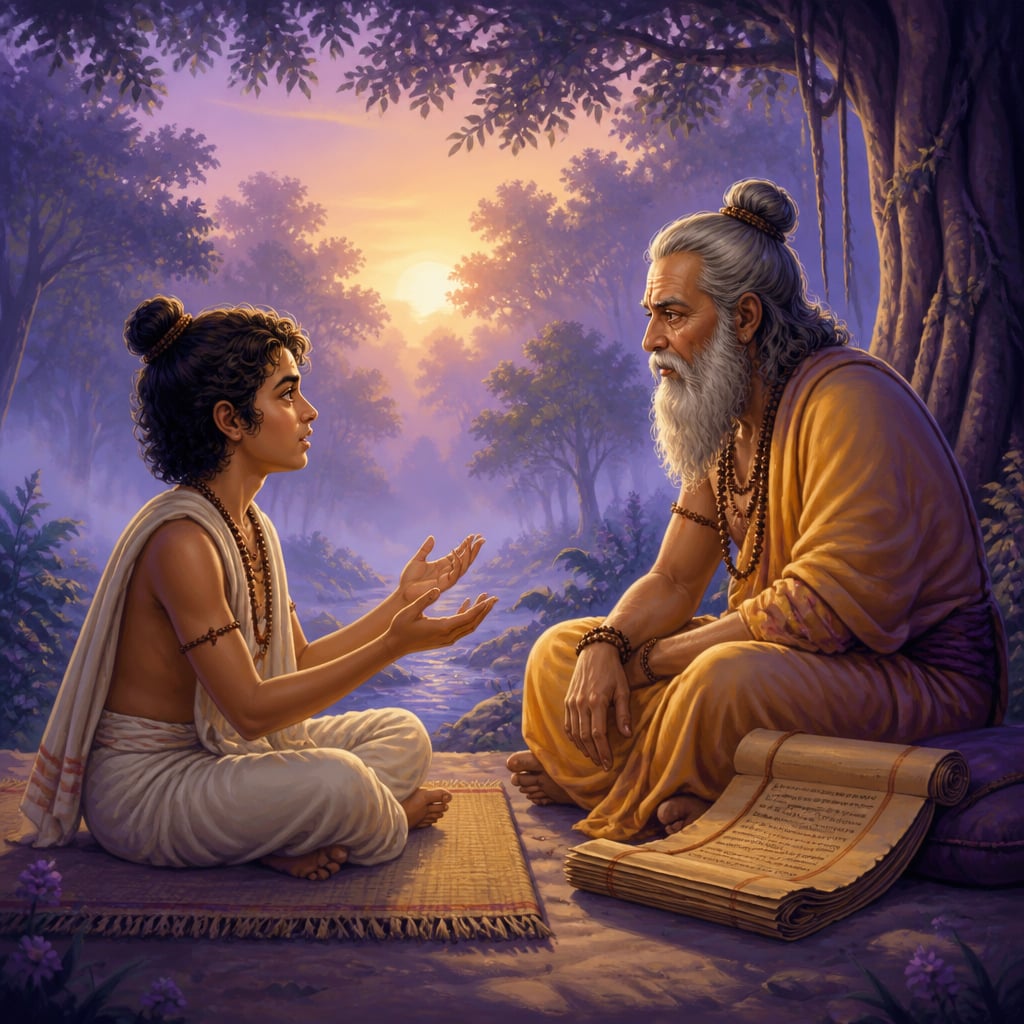
Young rishi student asking his elder teacher a sincere question at dawn in a forest clearing

The Vedic World of Questions

The Saraswati flowed wide and strong in those days, its waters carrying the songs of countless Rishis who gathered on its banks. The fire rituals (yajña) were performed with exacting precision, every syllable, every gesture, every offering measured and meaningful. You might expect such a culture of precision to demand equally precise answers to life's great questions.

But the Rishis understood something profound: precision in practice does not require certainty in metaphysics. They could perform the rituals perfectly while acknowledging that the ultimate nature of reality remained beyond complete human comprehension. This was not contradiction, it was wisdom.

The concept they developed was anirukta, that which cannot be fully expressed, the inexpressible. Not because language fails, but because reality itself exceeds the boundaries of any fixed formulation. The Rishis saw this not as a limitation to overcome but as a truth to embrace.

What the Mantras Reveal

The most famous expression of this Vedic comfort with uncertainty comes from the Nasadiya Sukta, composed by the Rishi Prajapati Parameshtin:

"Ko addhā veda ka iha pra vocat"

Who truly knows? Who can declare it here?

Let these words settle. This is not a casual question asked in passing. It appears in a hymn exploring the very origins of existence, and at the moment when you expect the grand revelation, the Rishi asks instead: Who actually knows this? Who can speak of it with certainty?

Word by word: kaḥ (who) addhā (truly, certainly) veda (knows) kaḥ (who) iha (here, in this world) pra vocat (can declare, can speak forth). The structure itself is revealing, the question repeats kaḥ (who) twice, emphasizing the genuine uncertainty about whether anyone possesses this knowledge.

The Rishi continues: even the gods came later, after creation. So who witnessed the beginning? Perhaps even the one who surveys all from the highest heaven knows, or perhaps even he does not know.

Traditional Wisdom on Uncertainty

Adi Shankaracharya yielding a point in debate with Mandana Mishra

Sayanacharya, the great 14th-century commentator, interpreted this hymn not as expressing doubt about divine knowledge, but as a teaching method. By stating that even the gods may not know creation's origin, the Rishi emphasizes the profound mystery at existence's heart, and by implication, the humility required of any honest seeker.

Sri Aurobindo, in The Secret of the Veda, saw deeper layers. For him, this questioning was not skepticism but a sophisticated recognition that ultimate reality (Sat) transcends the categories of human thought. The Rishis weren't saying "we cannot know" but rather "what we know cannot be captured in final formulations." Knowledge continues, deepens, expands, but never closes.

This distinction matters enormously. The Vedic position is not that truth doesn't exist, but that truth is too vast for any single statement to contain it entirely. Every answer, however valid, remains partial. Every formulation, however accurate, points toward something beyond itself.

A word of caution as we explore this ancient wisdom: understanding the Vedic context prevents us from reading modern assumptions back into ancient texts. The Rishis' 'uncertainty' was not postmodern relativism but rigorous intellectual honesty within a framework of committed practice. They performed rituals precisely while acknowledging metaphysical mystery, a combination modern thinking often assumes impossible. This historical context reveals that comfort with uncertainty and effective action have coexisted for millennia.

Living This Today

A modern technology leader listening to a junior engineer in an open meeting

In 2015, Satya Nadella inherited a Microsoft that had become rigid, defensive, and convinced of its own answers. The company had missed mobile, was losing cloud to Amazon, and its culture had calcified around what employees called "know-it-all" leadership.

Nadella's transformation began not with a new strategy but with a new question: What if we don't have all the answers? He introduced Carol Dweck's "growth mindset" research into Microsoft's culture, the core insight being that saying "I don't know yet" creates space for learning that "I should know" forecloses.

The parallel to anirukta is striking. The Rishis' comfort with open questions wasn't intellectual laziness, they built sophisticated systems of knowledge, ritual, and practice. But they held those systems lightly, knowing that tomorrow's insight might deepen today's understanding. Nadella's Microsoft began operating the same way: strong convictions, loosely held.

The results speak for themselves. Microsoft's market capitalization grew from $300 billion to over $3 trillion. More importantly, the culture shifted from defending positions to exploring possibilities.

Modern research validates this ancient insight. Psychologist Arie Kruglanski's work on "need for cognitive closure" shows that the compulsion to eliminate uncertainty correlates with poor decision-making, increased prejudice, and resistance to new information. Those comfortable with ambiguity make better judgments in complex situations. Amy Edmondson's research on psychological safety at Harvard demonstrates that teams where leaders admit uncertainty outperform those with "know-it-all" cultures, admitting "I don't know" signals safety for others to share concerns and surface problems early.

This maps directly onto modern complexity theory: complex adaptive systems, markets, organizations, geopolitics, are inherently unpredictable. Attempts to force certainty onto such systems typically backfire. The Vedic comfort with uncertainty anticipated this methodological insight by millennia.

Your Path Forward

You might be wondering: How do I apply this? Isn't some certainty necessary to act?

The Rishis would agree. They didn't sit paralyzed by uncertainty, they performed rituals, built communities, composed hymns, and raised families. The insight is subtler: hold your certainties as working hypotheses rather than final truths. Act with conviction while remaining open to revision.

This week, notice when you're defending a position simply because it's yours. Ask yourself: Am I protecting this idea because it's true, or because admitting uncertainty feels uncomfortable? The Rishis found freedom in that discomfort. Perhaps you will too.

In our next lesson, we'll explore the Nasadiya Sukta in depth, the famous "Creation Hymn" that asks how something came from nothing, and whether even asking that question correctly captures the mystery.

Case studies

Satya Nadella's Microsoft Transformation: From 'Know-It-All' to 'Learn-It-All'

When Satya Nadella became Microsoft CEO in 2014, he inherited a company that had become rigid and defensive. Microsoft had missed mobile entirely, was losing cloud computing to Amazon, and internal culture had calcified around protecting existing products rather than exploring new possibilities. Employees described a 'know-it-all' culture where admitting uncertainty was career suicide. Teams competed against each other rather than external threats. The company that had once defined the industry was being written off as a dinosaur.

Nadella's transformation began not with a new product strategy but with a philosophical shift that mirrors the Vedic comfort with uncertainty. He introduced Carol Dweck's 'growth mindset' research throughout Microsoft, the core insight being that 'I don't know yet' opens possibilities that 'I should know' forecloses. This is precisely the Nasadiya Sukta's teaching: genuine inquiry requires comfort with uncertainty. Nadella famously told employees that the learn-it-all would always beat the know-it-all. The Rishis would have recognized this wisdom.

Microsoft's market capitalization grew from approximately $300 billion in 2014 to over $3 trillion by 2024, a tenfold increase. More significantly, the company successfully pivoted to cloud computing (Azure), acquired and integrated LinkedIn and GitHub, and became a leader in AI through its OpenAI partnership. The cultural shift, from defending certainties to embracing learning, enabled strategic flexibility that competitors lacked.

Organizational transformation often requires philosophical transformation first. Nadella didn't just change Microsoft's strategy; he changed its relationship to uncertainty. The Vedic insight that honest questioning enables rather than undermines effective action proved itself at enterprise scale.

Companies that reward admitting 'I don't know' consistently outperform those that punish uncertainty. In an era of rapid AI disruption, the organizations clinging hardest to existing certainties are the most vulnerable to displacement.

Microsoft's employee satisfaction scores improved significantly under Nadella, with the company consistently ranking among the best places to work, suggesting that cultures of learning rather than knowing create better workplaces as well as better outcomes.

Adi Shankaracharya's Debates: The Philosopher Who Knew When He Didn't Know

In the 8th century CE, Adi Shankaracharya traveled across Bharat engaging in philosophical debates (*śāstrārtha*) with scholars of every tradition. His most famous debate was with Mandana Mishra, a celebrated scholar of Karma Mimamsa. The debate lasted seventeen days, with Mandana's wife Ubhaya Bharati, herself a renowned scholar, serving as judge. When Shankara won the philosophical arguments, Ubhaya Bharati challenged him on a topic where his monastic life left him inexperienced: the duties and knowledge of a householder. Rather than bluffing or deflecting, Shankara admitted his limitation and asked for time to gain the necessary knowledge before responding.

Shankara, who would become one of the most influential philosophers in Indian history, demonstrated the Nasadiya principle in action. His willingness to say 'I need to learn more before I can respond' was not weakness but Vedic questioning embodied. He held his vast knowledge lightly enough to acknowledge its limits. The debate format itself (*śāstrārtha*) institutionalized the value of rigorous questioning: truth was expected to emerge through honest exchange, not from defending positions.

After gaining the knowledge he lacked, Shankara returned and satisfied Ubhaya Bharati's challenge. Mandana Mishra became his disciple, and Shankara went on to establish four *pīṭhas* (monastic centers) that continue as centers of learning to this day. His Advaita Vedanta philosophy became foundational to Hindu thought, achieved not by claiming certainty he didn't possess but by honest inquiry that acknowledged its own limits.

The greatest philosophical achievement in Indian history was built on a foundation of intellectual honesty. Shankara showed that 'I don't know' can be the beginning of the deepest knowing. His legacy endures not because he had all the answers but because he demonstrated how to pursue truth with genuine openness.

In professional settings from boardrooms to academia, the willingness to say 'I need to learn more before I respond' is increasingly recognized as a leadership strength rather than a weakness. The rise of coaching cultures in tech companies reflects this same principle: expertise grows faster when it acknowledges its own gaps.

Adi Shankaracharya composed commentaries (bhashyas) on 10 principal Upanishads, the Brahma Sutras, and the Bhagavad Gita before his death at approximately age 32, establishing four mathas that have maintained unbroken succession for over 1,200 years.

Reflection

More in Anirukta: A World Without Absolute Certainty

All lessons in Anirukta: A World Without Absolute Certainty · Rig Vedic Philosophy course