Sthāna-Viśva: Acting Locally, Thinking Systemically
The Local as Doorway to the Universal
The Rishis understood that the universal is accessed through the local, not despite it. The household fire (gārhapatya) connects to the cosmic fire (Agni). The village temple links to the cosmic order. Through the principle of Sthāna-Viśva (place-universe), the Vedic tradition built systems that were simultaneously rooted and expansive.
The village priest kindled the sacred fire at dawn, just as his father had done, and his grandfather before him. But as he recited the ancient mantras, something remarkable happened: his small hearth fire became a point of connection to the sun rising over the horizon, to the fire of stars in distant galaxies, to the metabolic fire burning in every living creature.
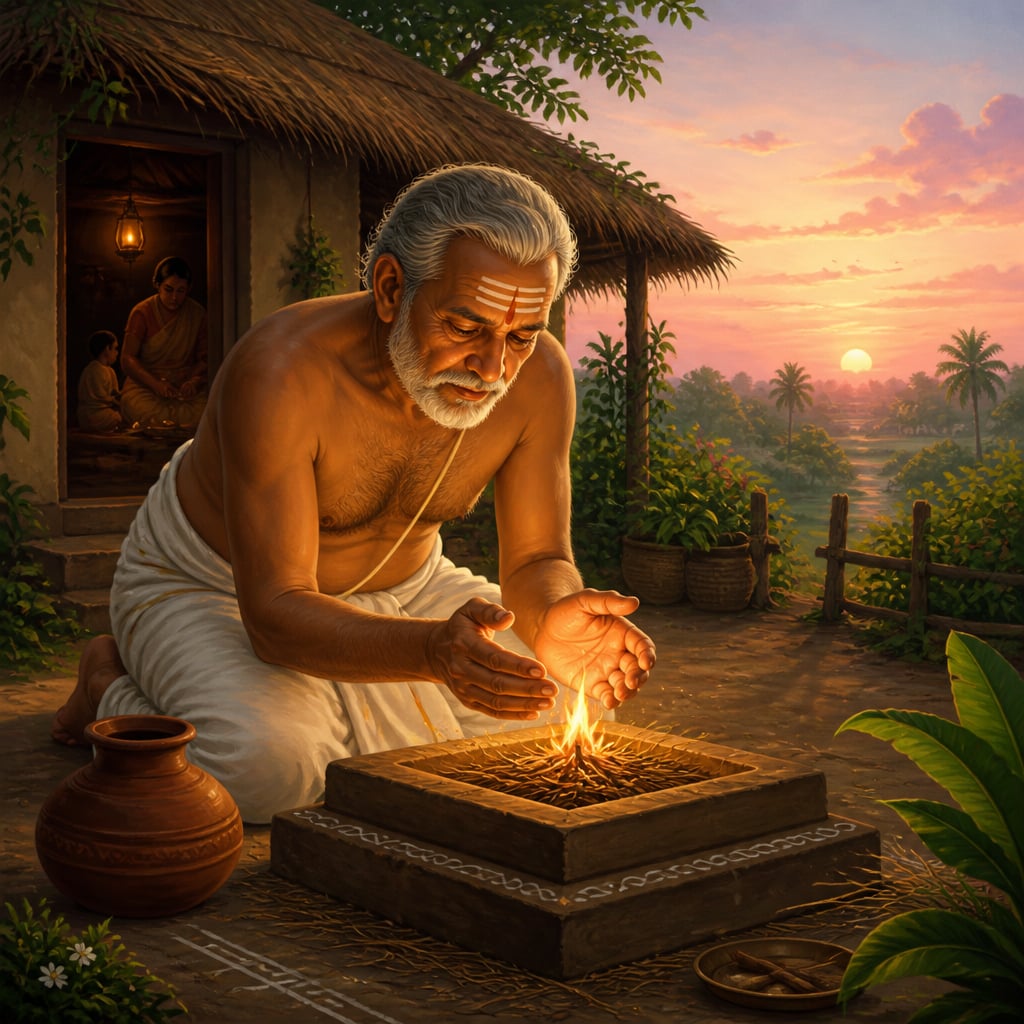
"This is not just my fire," his teacher had explained long ago. "This is the Fire, Agni in his local form. You are not lighting a fire. You are participating in Fire."
This is sthāna-viśva, the principle that the local and the universal are not opposites but doorways to each other.
The Vedic Geography of the Sacred
The Rishis did not see the cosmos as "out there" and daily life as "down here." They understood reality as nested systems, each level containing and expressing the others.
यथा पिण्डे तथा ब्रह्माण्डे "As in the microcosm, so in the macrocosm." , Traditional Vedic axiom
This principle, often summarized as "as above, so below", means that patterns repeat across scales. The human body mirrors cosmic structure. The household mirrors the kingdom. The village temple mirrors the cosmic order.
| Local Form | Universal Pattern |
|---|---|
| Household fire (gārhapatya) | Cosmic Agni, sun, stars |
| Village temple | Cosmic axis (Mount Meru) |
| Human body | Cosmic Puruṣa |
| Family structure | Cosmic order of Devas |
| Annual village festivals | Cosmic cycles of creation |
This is not mere metaphor. The Vedic tradition treated these correspondences as operational truths. Working at the local level, properly aligned, affects the universal level.
The Three Fires: A Model of Nested Systems
Vedic ritual practice centered on the tretagni, three sacred fires maintained in every Vedic household:
- Gārhapatya (householder's fire): The domestic fire, continuously burning, from which all other fires are kindled
- Āhavanīya (offering fire): The fire into which oblations are poured, directed toward the gods
- Dakṣiṇāgni (southern fire): The fire associated with ancestors, facing south toward the realm of the departed
These three fires formed a maṇḍala, a sacred geometry that represented the entire cosmos in miniature. The household became a microcosm of the universe, and the householder's daily fire rituals participated in cosmic maintenance.
अग्निर्मूर्धा दिवः ककुत्पतिः पृथिव्या अयम् "Agni is the head of heaven, the lord of earth." , Rig Veda 8.44.16
When a householder tended the gārhapatya fire, they were not merely cooking dinner. They were participating in the maintenance of cosmic order. The local action had universal significance.
The Temple as Cosmic-Local Bridge
The Hindu temple (devālaya, literally "abode of the divine") exemplifies sthāna-viśva architecture. Consider the design principles:
Vāstu alignment: Temples are oriented to cardinal directions, connecting local structure to cosmic geography. The garbhagṛha (sanctum) typically faces east, toward the rising sun.

Axis mundi symbolism: The temple śikhara (tower) represents Mount Meru, the cosmic axis connecting earth to heaven. The devotee entering the temple symbolically approaches the center of the universe.
Nested sacred spaces: From the outer prākāra (boundary wall) through successive maṇḍapas (halls) to the garbhagṛha, the temple creates layers of increasing sanctity, mirroring the cosmic progression from gross to subtle.
Local adaptation: Yet every temple is intensely local. The deity has a specific name, specific legends, specific festivals. The architecture adapts to local materials and climate. The universal template receives unique local expression.
This is the essence of sthāna-viśva: universal principles expressed through irreducibly local forms.
The Danger of Unrooted Universalism
Modern globalization often imposes universal systems that ignore local context:
- Global supply chains that disrupt local economies
- Standardized education that ignores local knowledge
- International development projects that fail because they don't fit local conditions
- Digital platforms that flatten cultural specificity
The Vedic insight warns against this: universalism without local roots becomes abstraction without life. The cosmic principles work through local forms, not instead of them.
Conversely, localism without universal awareness becomes parochialism, unable to learn from elsewhere, unable to see how local actions affect larger systems.
The Solution: Nested Sovereignty
The Vedic tradition modeled what we might call "nested sovereignty", local autonomy within universal framework:
Village level: The grāma (village) was largely self-governing, managing its own disputes, resources, and festivals through the pañcāyata (council of five).
Regional level: Villages connected to larger kingdoms, providing taxes and military service while maintaining local customs.
Civilizational level: The dharmic framework provided universal ethical and spiritual principles that applied everywhere while being interpreted locally.
Each level had its appropriate scope. The village didn't try to govern the kingdom; the kingdom didn't micromanage the village. The universal dharma provided direction without dictating details.
Yajña: The Technology of Local-Universal Connection
The Vedic yajña (sacred offering) was explicitly designed as a technology for connecting local action to cosmic effect:

अयं यज्ञो भुवनस्य नाभिः "This yajña is the navel of the universe." , Rig Veda 1.164.35
In performing yajña, the ritualist creates a temporary sacred space where heaven and earth meet. The offerings transform from local substances (ghee, grain, soma) into cosmic nourishment. The mantra-energy travels from the ritual site to cosmic recipients.
This is not superstition, it's systems thinking. The Rishis understood that local actions, properly aligned with cosmic patterns, propagate effects through interconnected systems. Modern ecology confirms this: a butterfly's wing can affect weather patterns; local deforestation affects global climate; individual choices aggregate into civilization-level outcomes.
Living Sthāna-Viśva Today
How do we apply this principle in contemporary contexts?
In community: Root yourself in a specific place. Know your neighbors, your local ecosystem, your community's history. Abstract "global citizenship" without local belonging produces drift, not effectiveness.
In work: Understand how your local actions connect to larger systems. Your department's choices affect the whole organization. Your organization's choices affect the industry. Your industry affects society. Act locally with systemic awareness.
In environmental action: "Think globally, act locally" captures sthāna-viśva precisely. Global climate requires local action, but local action informed by global understanding.
In spiritual practice: Universal truths are accessed through specific practices. Don't abandon your local tradition for abstract "spirituality." Dive deep into your particular path; universality emerges from depth, not breadth.
Place attachment research shows that people with strong local belonging report higher well-being and more pro-environmental behavior. Paradoxically, rootedness enables greater concern for distant others, you must belong somewhere to care everywhere.
Management scholar Henry Mintzberg distinguishes 'thin' leadership (abstract strategy) from 'thick' leadership (deep local knowledge). Effective leaders understand specific contexts while connecting to larger organizational purpose. This is sthāna-viśva applied to organizations.
Donella Meadows' 'Leverage Points' shows that small local interventions can produce large systemic effects, if applied at the right points. Knowing where the system is most sensitive requires both local detail and systemic understanding.
Environmental psychology shows that people who treat their homes as meaningful spaces (rather than mere functional containers) report higher life satisfaction. The 'mere dwelling' versus 'sacred home' distinction affects well-being. The Vedic tradition made every home a temple.
Remote work has revealed that home and work are not separate spheres. Leaders who recognize the home as a space of productivity and meaning, not just private life, create more sustainable work cultures. The gṛhastha model integrates work and domestic life.
The home is already connected to global systems: food supply chains, energy grids, information networks. Treating the home as an isolated private space ignores these connections. The Vedic model makes these connections explicit and sacred.
A word of caution as we explore these teachings: Contemporary globalization often imposes universal systems that destroy local distinctiveness. Climate action requires global coordination but local implementation. Digital networks enable global connection but threaten local community. The Vedic model of sthāna-viśva, universal principles expressed through irreducibly local forms, offers a template for globalization that respects particularity while enabling coordination.
Your Path Forward
The village priest understood something that globe-trotting abstractionists often miss: the universal is not elsewhere, it is here, in the particular, properly understood.
This week, try this practice: Choose one local entity, your neighborhood, your workplace, your family system. Map its connections to larger systems. How does what happens here affect what happens there? How do larger patterns manifest locally? You will discover that you already live in sthāna-viśva, you just haven't noticed.
In the next lesson, we explore another aspect of sustainable systems: the willingness to accept imperfect solutions. The Rishis knew that waiting for perfection prevents action, and that upāya, expedient means, is essential wisdom.
Case studies
Transition Towns: Global Network of Local Action
In 2006, Rob Hopkins launched the Transition Town movement in Totnes, England, a community-level response to peak oil and climate change. Rather than waiting for national governments or international agreements, Transition Towns focus on building local resilience: local food systems, local energy, local currencies, skill-sharing networks. What began in one town has spread to over 2,000 communities across 50+ countries. Each Transition initiative is intensely local, responding to specific place conditions, yet all share common principles and learn from each other through a global network. The movement explicitly embraces 'think globally, act locally' as its operating philosophy.
Transition Towns exemplify sthāna-viśva in contemporary form. Each community is a sthāna, a specific place with unique conditions requiring unique responses. Yet all participate in the viśva of global sustainability challenges and share in a universal pattern of resilience-building. Like Vedic villages that governed themselves locally while participating in broader dharmic civilization, Transition Towns maintain local sovereignty while connecting to global purpose. The movement succeeds precisely because it doesn't impose universal templates but allows each sthāna to find its own expression of common principles.
Research on Transition Towns shows measurable increases in community resilience, local food production, carbon footprint reduction, and social cohesion in participating communities. The model has influenced government policy in the UK and elsewhere. Perhaps most significantly, participants report increased sense of agency, the feeling that local action matters for global problems.
Global challenges require local action, but local action informed by global awareness and connected to others doing similar work. The Transition model shows that sthāna-viśva is not just Vedic philosophy but practical methodology for contemporary challenges.
The 'think global, act local' principle now drives everything from community solar projects to local food cooperatives to neighborhood mutual aid networks. During COVID-19, hyperlocal WhatsApp groups and neighborhood support networks proved more responsive than centralized government aid. The most resilient communities are those with strong local institutions connected to broader networks.
Transition Network research shows that communities with active Transition initiatives demonstrate 30-40% higher rates of local food sourcing and significantly lower per-capita carbon emissions compared to non-Transition communities of similar demographics.
Temple Networks: Local Centers of Civilizational Order
South Indian temple networks from the Pallava, Chola, and Vijayanagara periods (6th-16th century CE) created a remarkable system of local-universal integration. Each temple was intensely local: a specific deity with local legends, festivals responding to local agricultural cycles, architecture adapted to local materials and climate. Yet each temple participated in a broader pattern: Vāstu principles aligned structures to cosmic directions; the śilpaśāstras ensured architectural coherence across regions; pilgrimage networks connected distant temples; Brahmin networks transmitted learning across the subcontinent. The temple at Thanjavur was unique, yet it was also clearly 'a Hindu temple,' recognizable to pilgrims from Kerala to Kashmir.
The South Indian temple system perfected sthāna-viśva architecture. Each temple was a sthāna, a specific place where the universal divine took local form. The deity had a local name, local myths, local festivals. Yet each temple also participated in the viśva, cosmic alignment through Vāstu, shared iconographic language, participation in all-India pilgrimage circuits. The genius was integration without uniformity: universal principles expressed through irreducibly local forms. A temple in Tamil Nadu was not a copy of a temple in Karnataka, yet both were recognizably part of the same civilizational pattern.
The temple network sustained Hindu civilization through repeated political disruptions. When kingdoms fell, temples continued. When invaders destroyed some temples, others preserved traditions. The distributed, locally-rooted-yet-universally-connected network proved more resilient than any single centralized institution. Many temples have been in continuous operation for over a thousand years.
Civilizational resilience comes from many local nodes connected by universal principles, not from centralized uniformity. The temple network model shows how diversity and coherence can coexist: each sthāna fully local, all participating in one viśva.
Modern franchise models (McDonald's, Starbucks) operate on a simplified version of this principle: standardized core systems with local adaptation. But the temple network model goes deeper because it integrated economic, educational, cultural, and spiritual functions into a single local institution, creating resilience through functional diversity that single-purpose franchises cannot match.
South Indian temple networks from the 6th to 16th century CE comprised over 30,000 temples across the Pallava, Chola, Pandya, and Vijayanagara periods. Each temple served as a local node in a distributed system, and when individual temples were destroyed, others preserved the same traditions, ensuring civilizational continuity across 1,000 years of political upheaval.
Reflection
- What is your sthāna, the specific place where you are most rooted? How well do you know its ecology, its history, its community? What would it mean to deepen your relationship with this place?
- Consider something in your local environment, your home, your workplace, your neighborhood. How does what happens there connect to larger systems, economic, ecological, social? What becomes visible when you map these connections?
- How do we navigate between harmful localism (parochialism, tribalism) and harmful universalism (homogenization, abstraction)? What distinguishes healthy sthāna-viśva from either extreme?