Bahutva: Complexity Over Simplicity
Why Sustainable Systems Embrace Multiplicity
The Rig Veda reveals that lasting systems are never simple. Through the concept of Bahutva (multiplicity), the Rishis understood that sustainable structures, whether ecological, social, or personal, thrive through embracing complexity, not reducing it.
The old Rishi sat at the edge of the forest where three rivers met. His students expected him to point to one river and say, "This is the source of life." Instead, he remained silent, watching the waters merge, separate, and merge again in patterns that never quite repeated.

Finally, a student asked, "Guru-ji, which river should we follow to find truth?"
The Rishi smiled. "You ask the wrong question. Truth does not flow in one stream. It flows in bahutva, in many streams, meeting and parting, each necessary to the whole."
The Vedic Understanding of Complexity
The Rig Veda does not offer simple formulas. This was not a failure of ancient thinking, it was its genius. The Rishis observed nature with extraordinary precision and noticed something that modern systems scientists are only now articulating: sustainable systems are inherently complex.
Consider how the Rishis understood Agni, the fire deity. Agni is not one thing. He is:
- The fire in the hearth (gārhapatya)
- The fire of digestion (jaṭharāgni)
- The fire of the sun (sūryāgni)
- The fire of lightning (vidyut)
- The fire of consciousness (cit-agni)
A simple mind might ask: "Which one is the real Agni?" The Vedic answer is that the question misses the point. Agni's power comes precisely from his multiplicity. Reduce him to one form, and you lose the principle entirely.
विश्वरूपं हरिणं जातवेदसं परायणं ज्योतिरेकं तपन्तम् "The all-formed, golden one, knower of all births, the supreme goal, the one light that illumines" , Rig Veda 1.164.46
This mantra captures the paradox: Agni is "all-formed" (viśvarūpa) AND "one light" (jyotir ekam). The unity emerges from multiplicity, not in spite of it.
What the Commentators Reveal
Sayanacharya emphasizes that the Vedic Devas represent cosmic functions, not separate beings competing for worship. When the Rig Veda declares "ekam sat viprā bahudhā vadanti", "Truth is one, the wise call it by many names", it is not promoting vague universalism. It is stating a systems principle: diverse expressions serve a unified function.
Sri Aurobindo goes deeper in The Secret of the Veda, arguing that the apparent complexity of Vedic cosmology reflects the Rishis' understanding of layered reality. The physical, vital, mental, and spiritual dimensions interpenetrate. A sustainable system cannot address only one layer, it must honor all.
This differs markedly from approaches that seek to simplify systems for easier control. The Vedic insight is that control through simplification is temporary; sustainability through complexity is enduring.
The Trap of Simplification
Modern systems often fail because they pursue simplicity as an end rather than a means. Consider these patterns:
| Simplification Approach | Short-term Result | Long-term Consequence |
|---|---|---|
| Monoculture farming | Higher initial yield | Soil depletion, pest vulnerability |
| Single-metric success | Clear measurement | Gaming, perverse incentives |
| Centralized control | Faster decisions | Brittleness, single points of failure |
| One-size-fits-all policy | Easier administration | Local misfit, resistance |
The Rishis would recognize each of these as violations of Ṛta, the cosmic order that operates through dynamic balance, not static simplicity.
Bahutva in Practice: The Wisdom of Multiple Paths
The Rig Veda's approach to the divine offers a practical model. Rather than insisting on one correct path, the tradition developed:
- Multiple ritual forms appropriate to different contexts
- Multiple Devas addressing different aspects of life
- Multiple lineages (gotras) preserving diverse knowledge
- Multiple valid interpretations of the same hymns
This is not confusion or primitive polytheism. It is sophisticated systems design. When one path fails, others remain. When one interpretation grows stale, fresh perspectives revive the tradition.
इन्द्रं मित्रं वरुणमग्निमाहुरथो दिव्यः स सुपर्णो गरुत्मान् एकं सद्विप्रा बहुधा वदन्त्यग्निं यमं मातरिश्वानमाहुः "They call it Indra, Mitra, Varuna, Agni, and also the divine bird Garutman. Truth is One; the wise call it by many names, they call it Agni, Yama, Matarishvan." , Rig Veda 1.164.46
The word-by-word meaning reveals the principle: ekam (one) sat (truth/being) viprāḥ (the wise) bahudhā (in many ways) vadanti (speak/call). Unity expresses through multiplicity, this is not contradiction but completion.
Living Complexity Today
What does this mean for us now? Consider how we approach problems:
The simplification reflex: When facing complexity, the instinct is to reduce variables, eliminate options, and find "the one right answer." This works for mechanical problems with clear cause-and-effect. It fails for living systems, organizations, relationships, ecosystems, societies.
The Vedic alternative: Embrace bahutva. When designing systems, build in redundancy. When making decisions, preserve options. When solving problems, address multiple dimensions simultaneously.
Satya Nadella's transformation of Microsoft illustrates this principle. Rather than simplifying Microsoft's sprawling product line, he embraced complexity through a unifying vision, "mobile-first, cloud-first", that gave coherence without forcing artificial simplicity. Azure, Office 365, LinkedIn, and gaming now operate as a complex ecosystem where each element strengthens the others.
Psychologist Paul Rozin's research on 'moral pluralism' shows that healthy ethical reasoning requires multiple moral foundations (care, fairness, loyalty, authority, sanctity, liberty), not reduction to a single principle. The mind that can hold multiple valid perspectives is more adaptive.
Jim Collins' research in 'Good to Great' found that enduring companies embrace the 'Genius of the AND', holding paradoxes rather than choosing between them. They pursue profit AND purpose, discipline AND creativity, continuity AND change.
Donella Meadows' 'Thinking in Systems' emphasizes that systems resilience comes from functional redundancy, multiple ways to achieve the same function. When one pathway fails, others remain. This is bahutva in action.
Cognitive flexibility research shows that individuals who can shift between multiple mental frameworks handle stress better and solve problems more effectively. Rigidity, insistence on one approach, correlates with anxiety and poor outcomes.
Amazon's 'two-pizza teams' create multiple independent groups working on related problems, embracing organizational complexity rather than forcing coordination through hierarchy. This bahutva approach drives innovation.
Ecological succession shows that mature ecosystems are complex ecosystems. Early-stage systems (recently disturbed) are simple; climax communities are intricate webs of relationship. Sustainability requires maturation toward complexity.
A word of caution as we explore these teachings: Understanding Vedic complexity prevents two errors: dismissing the tradition as primitive polytheistic confusion, or reducing it to simplistic formulas that lose its depth. The Rishis developed a framework for sustainable living based on sophisticated observation of natural and social systems. Their insight, that sustainability requires embracing complexity rather than eliminating it, becomes increasingly relevant as modern systems face the consequences of over-simplification.
Your Path Forward
The Rishi at the confluence of rivers was teaching something practical: don't seek the one stream when many streams carry you where you need to go.
This week, notice where you're forcing simplicity:
- Are you looking for "the one cause" of a complex problem?
- Are you trying to reduce a relationship to a single dynamic?
- Are you demanding one right answer when multiple good answers exist?
The Vedic teaching is not that complexity is always better than simplicity. It is that sustainable systems honor the complexity inherent in living things. Artificial simplification creates fragility. Embraced complexity creates resilience.
As we move deeper into this chapter, we'll explore how this principle of bahutva connects to long-term thinking, intergenerational responsibility, and the integration of local action with systemic awareness. The Rishis built a framework for sustainable living that modern systems science is only beginning to recover.
Case studies
Indian Railways: Complexity as Survival
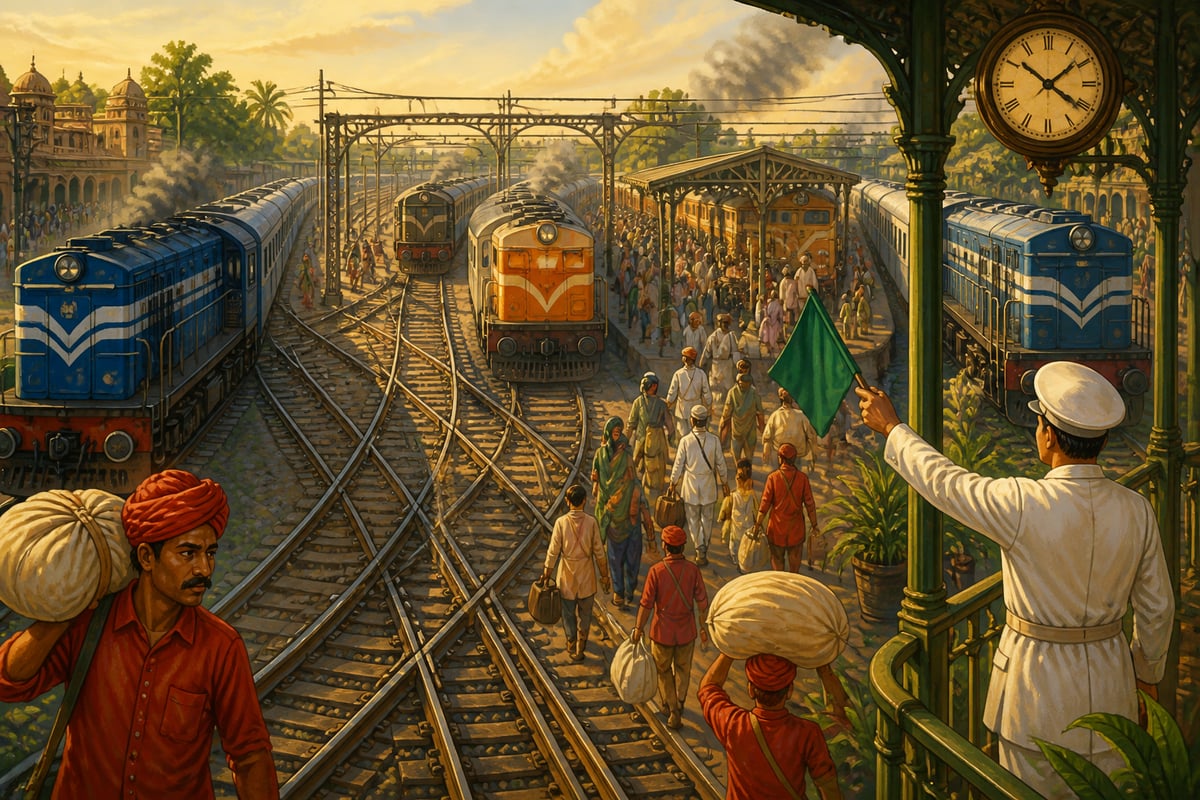
Indian Railways operates 13,000+ trains daily, serving 23 million passengers across 67,000+ route kilometers. Countless consultants have proposed 'simplification', reducing routes, standardizing services, centralizing scheduling. Yet the system persists precisely because it resists simplification. Multiple gauge types (broad, meter, narrow) serve different terrains. Overlapping routes create redundancy. Diverse train classes (Rajdhani, Shatabdi, local, freight) serve different needs. The complexity that frustrates efficiency experts is exactly what enables the network to function despite infrastructure challenges, political pressures, and demand spikes during festivals.
Indian Railways embodies bahutva, multiplicity as operational principle. Like the Vedic understanding of Agni manifesting in many forms, the railway manifests through many train types, many routes, many service levels. Attempts to 'rationalize' by reducing this diversity would create the brittleness of monoculture. The system's resilience comes from its complexity, not despite it.
When COVID-19 struck in 2020, Indian Railways converted passenger coaches to hospital cars, ran oxygen express trains, and maintained essential goods movement, adaptations possible only because the system's inherent complexity provided flexibility. The 'inefficiency' of multiple overlapping capabilities became critical resilience.
Complexity that seems inefficient in normal times becomes essential in crisis. Systems designed for bahutva can adapt; systems optimized for simplicity can only perform their optimized function.
Organizations that optimize for efficiency in stable times often discover they have no capacity to handle disruption. The COVID-19 pandemic revealed this pattern globally: hospitals with 'inefficient' surge capacity saved lives, while lean-optimized systems collapsed. Redundancy looks wasteful until it becomes essential.
During COVID-19, Indian Railways ran 2,800+ Shramik Special trains evacuating 40 lakh migrants, a capacity that existed only because of the system's un-simplified complexity.
Chola Temple Economy: Integrated Complexity
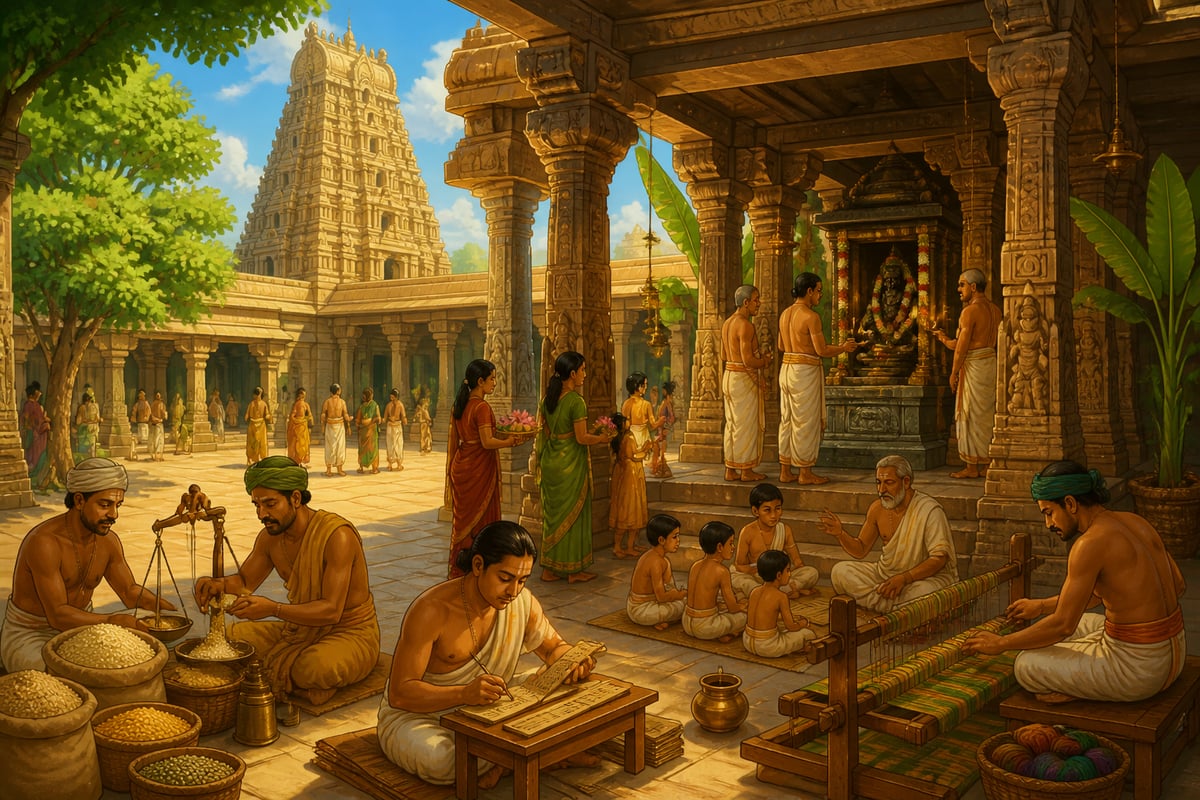
The Chola Empire (9th-13th century CE) developed one of history's most sophisticated decentralized administrative systems, centered on temples. The Brihadeeswara Temple at Thanjavur was not merely a religious site, it was the hub of a complex economic network. Temple records (inscriptions on temple walls) reveal intricate systems: 400+ dancers, musicians, and priests employed; multiple villages assigned for temple upkeep; craft guilds producing bronze, textiles, and jewelry; banks (shrenis) managing temple wealth; hospitals and schools operating under temple administration; agricultural land managed through complex water-sharing arrangements.
The Chola temple economy exemplified samanvaya, integration of diverse functions into coherent purpose. Rather than separating religion, economy, education, healthcare, and administration into 'efficient' specialized units, the Cholas recognized these as interconnected aspects of community flourishing. The temple served as the integrating center that gave coherence to complexity. This mirrors the Vedic understanding of yajña (sacred action) as the center that coordinates cosmic functions.
The Chola system sustained complex society for over 400 years. Temple inscriptions show detailed records of land grants, water rights, employment terms, and dispute resolutions spanning generations. When the empire eventually declined due to external invasions, the temple-based local systems proved resilient, many continued functioning for centuries after central authority collapsed.
Sustainable systems create integration at multiple scales. The Chola temples were simultaneously local (serving village needs), regional (coordinating resources), and civilizational (preserving knowledge and culture). This multi-level complexity created redundancy: when one level failed, others continued.
Modern 'platform' businesses like Amazon and Alibaba function similarly, serving as economic hubs that integrate commerce, logistics, finance, and community services into a single ecosystem. The most resilient economic systems, ancient and modern, are those that integrate multiple functions at the local level rather than depending on distant centralized providers.
Chola temple inscriptions record detailed transactions spanning over 400 years: the Brihadeeswara Temple alone employed 400 temple servants, 57 musicians, and managed lands producing 2,000 kalam of rice annually, functioning as an integrated economic, cultural, and spiritual center.
Reflection
- Where in your life are you currently forcing simplicity on a situation that may actually require embraced complexity?
- How might the Vedic understanding of 'Ekam Sat, Viprā Bahudhā Vadanti', Truth is One, called by many names, change how you approach disagreement with others who see the world differently?
- What is the difference between embraced complexity (bahutva) and mere chaos? How do we know when complexity serves sustainability versus when it becomes dysfunction?