Dīrghadṛṣṭi: Long-Term Thinking
Seeing Beyond the Immediate Horizon
The Rishis thought in millennia, not moments. Through the concept of Dīrghadṛṣṭi (far-sightedness), they created systems designed to endure across countless generations, a radical departure from modern short-term optimization that proves increasingly fragile.
The young student found his guru sitting alone at midnight, gazing at the stars. For hours, the old man had been silent, watching the slow wheel of constellations that his own guru had watched, and his guru's guru before him.
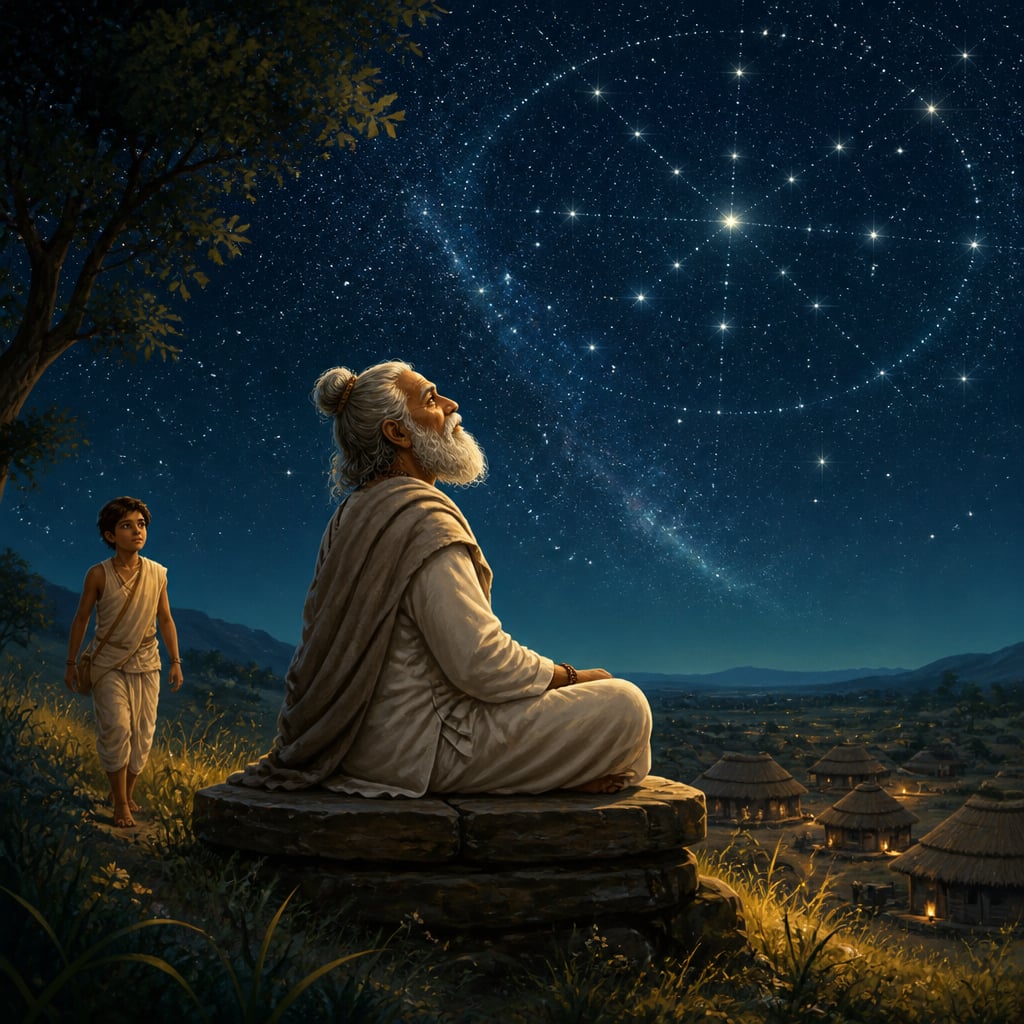
"What do you see, Guru-ji?" the student finally asked.
"I see my great-great-grandchildren," the Rishi replied. "They will sit where I sit, look at these same stars, and chant the same mantras. I am teaching not you alone, but them. I am speaking to students not yet born."
This was dīrghadṛṣṭi, the far-seeing vision that transformed how the Rishis approached everything.
The Temporal Horizon of the Vedas
The Rig Veda was composed with an astonishing temporal perspective. The Rishis were not solving immediate problems, they were creating structures meant to persist for thousands of years. And they succeeded: we can still recite the same mantras, in the same Vedic Sanskrit, with the same precise intonation, that Rishis chanted by the Saraswati over five millennia ago.
How did they think about time?
आ नो भद्राः क्रतवो यन्तु विश्वतः "Let noble thoughts come to us from all directions." , Rig Veda 1.89.1
The word viśvataḥ (from all directions) includes time as well as space. Noble thoughts come from the past (ancestors), the present (contemporaries), and the future (descendants yet unborn). The Rishis positioned themselves at the intersection of all temporal directions.
This is fundamentally different from modern thinking, which treats the past as obsolete and the future as someone else's problem.
What the Commentators Reveal
Sayanacharya notes that Vedic rituals are structured around cosmic cycles, not human convenience. The agnihotra (fire offering) is performed at sunrise and sunset, aligning human action with solar rhythm. The darśa-pūrṇamāsa offerings follow the lunar cycle. Seasonal rites (cāturmāsya) mark the year's turning. This wasn't superstition, it was training in temporal awareness.
Sri Aurobindo observes in The Secret of the Veda that the Rishis understood consciousness itself as participating in cosmic time. When the mantra says "satyam ṛtam bṛhat", "truth, cosmic order, vastness", the vastness (bṛhat) includes temporal vastness. To see truly is to see beyond the immediate.
The Vedic framework thus builds dīrghadṛṣṭi into daily practice. You cannot perform the rituals correctly without attuning to rhythms larger than your personal timeline.
The Tyranny of the Immediate
Modern systems suffer from temporal myopia, an inability to see beyond the next quarter, the next election cycle, the next performance review. Consider the consequences:
| Short-Term Focus | Immediate Benefit | Long-Term Cost |
|---|---|---|
| Quarterly earnings pressure | Stock price stability | Underinvestment in R&D, infrastructure |
| Electoral cycles | Responsive democracy | Policy instability, short-term fixes |
| Annual performance reviews | Clear accountability | Risk aversion, gaming metrics |
| Social media engagement | Instant feedback | Attention fragmentation, anxiety |
The Rishis would diagnose this as a failure of dṛṣṭi (vision), seeing only what is close, missing what is far.
Kāla: Time as Teacher
The Sanskrit word Kāla means both "time" and "death." This is not coincidence but insight. Time reveals truth; time tests durability; time exposes what is sustainable and what is not. The Rishis personified Kāla as a cosmic force that educates through duration.

कालो अश्वो वहति सप्तरश्मिः "Time is a horse bearing seven reins." , Atharva Veda 19.53.1
The "seven reins" represent the seven aspects of time the Vedic tradition tracked: day, fortnight, month, season, half-year, year, and cosmic age (yuga). To practice dīrghadṛṣṭi is to hold all seven simultaneously, acting today while considering the yuga.
Ṛtu: Right Timing and Patience
Related to long-term thinking is the concept of Ṛtu, often translated as "season" but meaning more precisely "the right time." The Rishis understood that sustainable action requires not just doing the right thing, but doing it at the right time.
ऋतस्य पथा प्रेत "Go forth on the path of Ṛta (cosmic order/right timing)." , Rig Veda 1.41.4
This means accepting that some things cannot be rushed. A seed planted today yields fruit in its season, not on demand. A tradition built today serves generations, if built with patience.
The opposite of ṛtu is forcing outcomes before their time. Modern culture's demand for instant results violates this principle systematically.
Building for Descendants
The Rishis designed the Vedic transmission system with explicit awareness that they were building for people they would never meet. Consider the engineering:
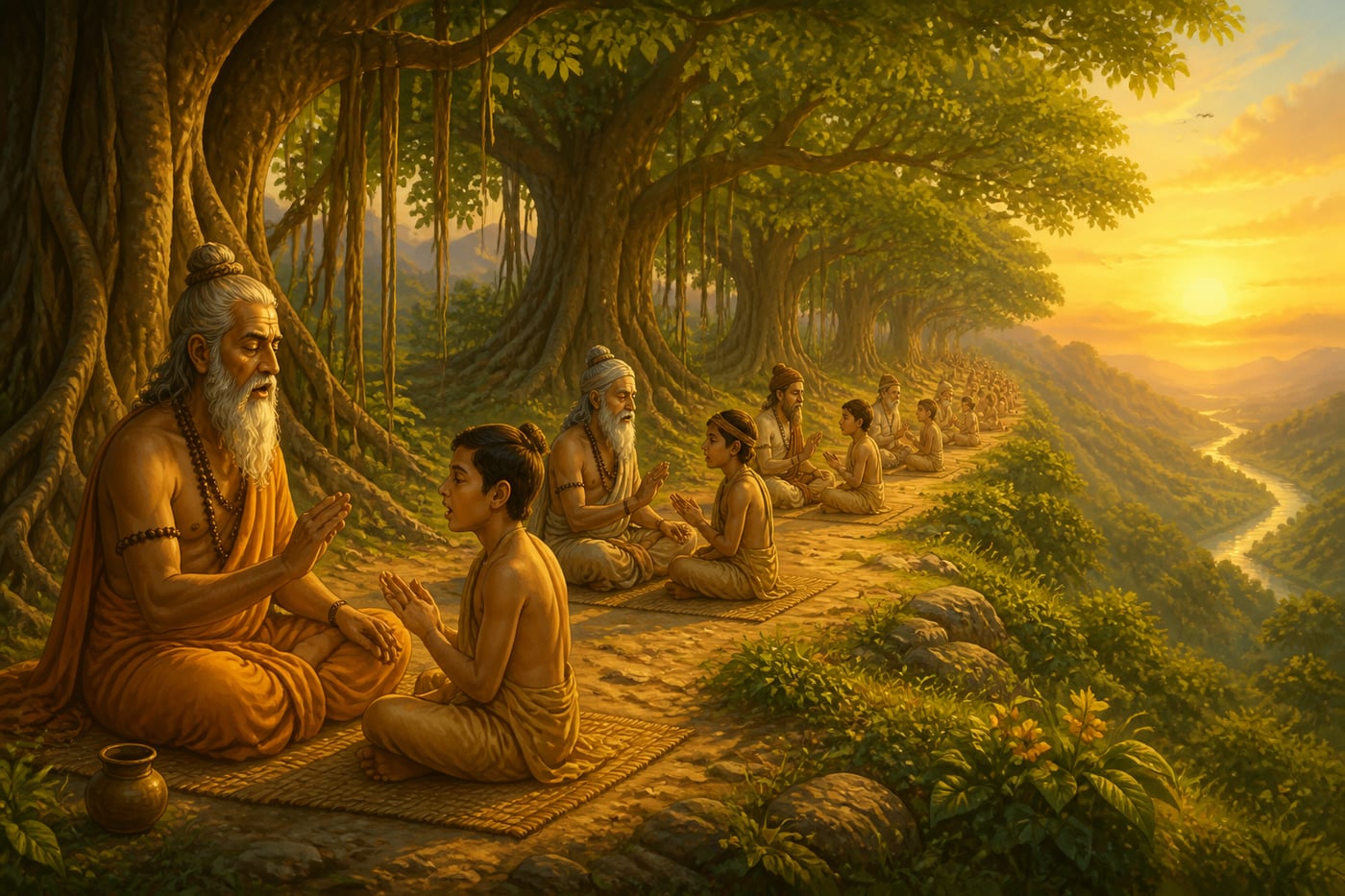
- Redundancy: Multiple śākhās (recension branches) ensured that if one lineage broke, others continued
- Precision: The padapāṭha (word-by-word recitation) preserved exact pronunciation across millennia
- Distribution: Knowledge spread across families and regions, never concentrated in one vulnerable location
- Ritual embedding: Daily practice ensured continuous transmission, not just storage
This is dīrghadṛṣṭi in action, designing not for your own benefit but for the benefit of the unborn.
Living Long-Term Thinking Today
What does dīrghadṛṣṭi look like in practice now?
In decisions: Before acting, ask: "Will this still make sense in ten years? In a generation?" Most short-term optimizations fail this test.
In relationships: Invest in connections that compound over time. The friendship maintained for decades, the family bonds nurtured across generations, these are assets that appreciate.
In work: Build skills and reputation that endure. The specialist in a dying technology is displaced; the person who cultivates transferable wisdom adapts across decades.
In institutions: Design for succession. Every organization depends on the question: "What happens after I leave?" The Rishis answered this question definitively, their transmission system outlived not just individuals but civilizations.
Research by Hal Hershfield at UCLA shows that people who can vividly imagine their future selves make better long-term decisions. Those who see their future self as a stranger tend toward short-term gratification. Dīrghadṛṣṭi is this imaginative capacity extended across generations.
The concept of 'seventh generation thinking' in Indigenous governance, considering impacts seven generations ahead, mirrors the Vedic approach. Leaders who ask 'What would my successor's successor think of this decision?' make fundamentally different choices.
Donella Meadows identified 'time delays' as crucial leverage points in systems. Short feedback loops encourage short-term thinking; longer feedback awareness enables systemic change. Dīrghadṛṣṭi is training the mind to track longer feedback loops.
Walter Mischel's marshmallow experiments revealed that capacity for delayed gratification in childhood predicts life outcomes decades later. But follow-up research shows this capacity is trainable, not fixed. Ṛtu awareness is trainable delayed gratification.
Jeff Bezos distinguishes 'one-way door' decisions (irreversible, require patience) from 'two-way door' decisions (reversible, can move fast). This is modern ṛtu-awareness: different types of decisions require different temporal approaches.
Complex systems have natural rhythms that cannot be overridden. Forcing a system faster than its natural pace creates backlash and resistance. Working with system timing (ṛtu) achieves lasting change; fighting it achieves temporary change that reverses.
A word of caution as we explore these teachings: Modern civilization faces long-term challenges, climate change, institutional decay, cultural transmission, that require dīrghadṛṣṭi. The Vedic tradition provides not just inspiration but practical models: how to design for succession, how to create resilient transmission systems, how to think across centuries. These are not antiquarian interests but urgent contemporary needs.
Your Path Forward
The Rishi watching stars at midnight was practicing something simple but profound: extending his temporal horizon.
This week, try this exercise: Before any significant decision, pause and ask three questions:
- How will this look in one year?
- How will this look in ten years?
- How will this look to my children, or my successor?
If the answer to all three is "still good," proceed. If not, reconsider.
The Vedic insight is not that long-term is always better than short-term. It is that sustainable systems require vision across multiple time horizons simultaneously. The immediate matters, but so does the generational. Dīrghadṛṣṭi holds both.
In the next lesson, we'll explore how this long-term vision translates into specific responsibility across generations, the concept of santati, or continuity of lineage.
Case studies
Japan's Shinise: Businesses That Think in Centuries
Japan has over 33,000 businesses more than 100 years old, and over 3,100 that have operated for more than 200 years. The oldest, Kongō Gumi (a construction company), operated for 1,400 years before merging in 2006. These 'shinise' (old shops) include Hōshi Ryokan (a hotel operating since 718 CE), Sudo Honke (sake brewing since 1141), and Nintendo (founded 1889, originally for playing cards). These companies share common characteristics: they prioritize survival over growth, maintain core competencies across generations, adapt slowly but deliberately, and treat themselves as stewards rather than owners.
Shinise companies embody dīrghadṛṣṭi institutionally. Like the Rishis who built for descendants they would never meet, shinise founders designed businesses as perpetual trusts rather than personal assets. The Japanese concept of 'ie' (household/lineage) mirrors the Vedic santati, continuity across generations. Just as Vedic tradition prioritizes transmission over innovation, shinise prioritize endurance over growth. Their temporal horizon extends not to the next quarter but to the next century.
Research by Professor Makoto Kanda found that shinise companies significantly outperform newer businesses during economic crises. Their conservative capital structures, long supplier relationships, and reputation accumulated over generations provide resilience that short-term-optimized competitors lack. The 'inefficiency' of not maximizing short-term profit turns out to be a form of insurance.
Longevity requires designing for succession from the beginning. Shinise founders asked: 'What would the 40th-generation owner need?' This question, thinking forward 1,000 years, creates fundamentally different decisions than 'What would maximize this quarter's returns?'
The contrast is stark in tech: companies built for founder enrichment (WeWork, Theranos) flame out, while those built with institutional DNA for long-term survival (Tata, Bosch) endure across generations. The growing 'long-termism' movement in business and philosophy argues that the most important decisions are those made with century-scale consequences in mind.
The average lifespan of a company on the S&P 500 has declined from 61 years in 1958 to approximately 18 years today. Meanwhile, Japan's shinise have operated for centuries. The difference is not luck but temporal orientation.
Vedic Oral Transmission: Designing for Millennia
The Rishis faced an engineering problem: how to preserve complex, precise information across thousands of years without writing. Their solution was an oral transmission system of extraordinary sophistication. They developed multiple recitation methods: saṃhitāpāṭha (continuous recitation), padapāṭha (word-by-word), kramapāṭha (step-by-step pairs), and jaṭāpāṭha (woven recitation where words are recited forward and backward). They created redundancy through multiple śākhās (recension branches). They embedded practice in daily ritual so transmission was continuous, not episodic. They distributed knowledge across thousands of families and geographic regions.
This was dīrghadṛṣṭi at its most deliberate. The Rishis were not solving their immediate problem (they already knew the mantras) but solving a problem for people millennia in the future. Every design choice reflected this: redundancy for resilience, precision mechanisms to prevent drift, daily practice to ensure continuous transmission, distributed storage to prevent single-point failure. They designed the system as if they would be held accountable by the 100th generation, and they were right to do so.
The Rig Veda has been transmitted for over 5,000 years with remarkable accuracy. Scholars comparing oral traditions with recently discovered written manuscripts find minimal divergence, sometimes less than 1% variation across millennia and continents. The system the Rishis designed has outlasted civilizations, languages, and empires.
Long-term preservation requires redundancy, precision, continuous practice, and distributed responsibility. The Rishis understood that no single mechanism, no matter how clever, would survive Kāla's testing. Only a system of interlocking mechanisms, each reinforcing the others, could achieve true durability.
Blockchain technology attempts to solve the same problem digitally: creating tamper-proof records that persist across time without depending on any single institution. But the Vedic approach had an advantage that digital systems lack. Human practitioners who embody the knowledge can adapt it to new contexts, while digital records can only preserve what was originally encoded.
The Rig Veda's oral transmission system uses 11 distinct recitation patterns (pathas), including word-by-word (pada), reversed pairs (krama), and a woven pattern (ghana) that ensures each word is recited in 13 different combinations. Comparing oral traditions with manuscripts shows less than 1% textual variation across 5,000 years.
Reflection
- What is one area of your life where you are optimizing for the short-term at the expense of the long-term? What would change if you extended your time horizon by ten years?
- The Rishis designed systems to serve people they would never meet. What are you building, whether in work, family, or community, that might endure beyond your own lifetime?
- How do we balance the Vedic emphasis on long-term thinking with the reality that we cannot predict the future? When does planning become presumption?