Santati: Responsibility Across Generations
The Unbroken Thread of Ancestors and Descendants
The Vedic tradition understood that each person stands at the center of an unbroken chain, receiving from ancestors, transmitting to descendants. Through the concept of Santati (continuity), the Rishis built systems of intergenerational responsibility that made sustainability not an abstract ideal but a lived obligation.
The young father sat by the sacred fire, his newborn son cradled in his arms. Around him, three generations watched: his father, his grandfather, and in memory, his great-grandfather who had passed the previous monsoon.
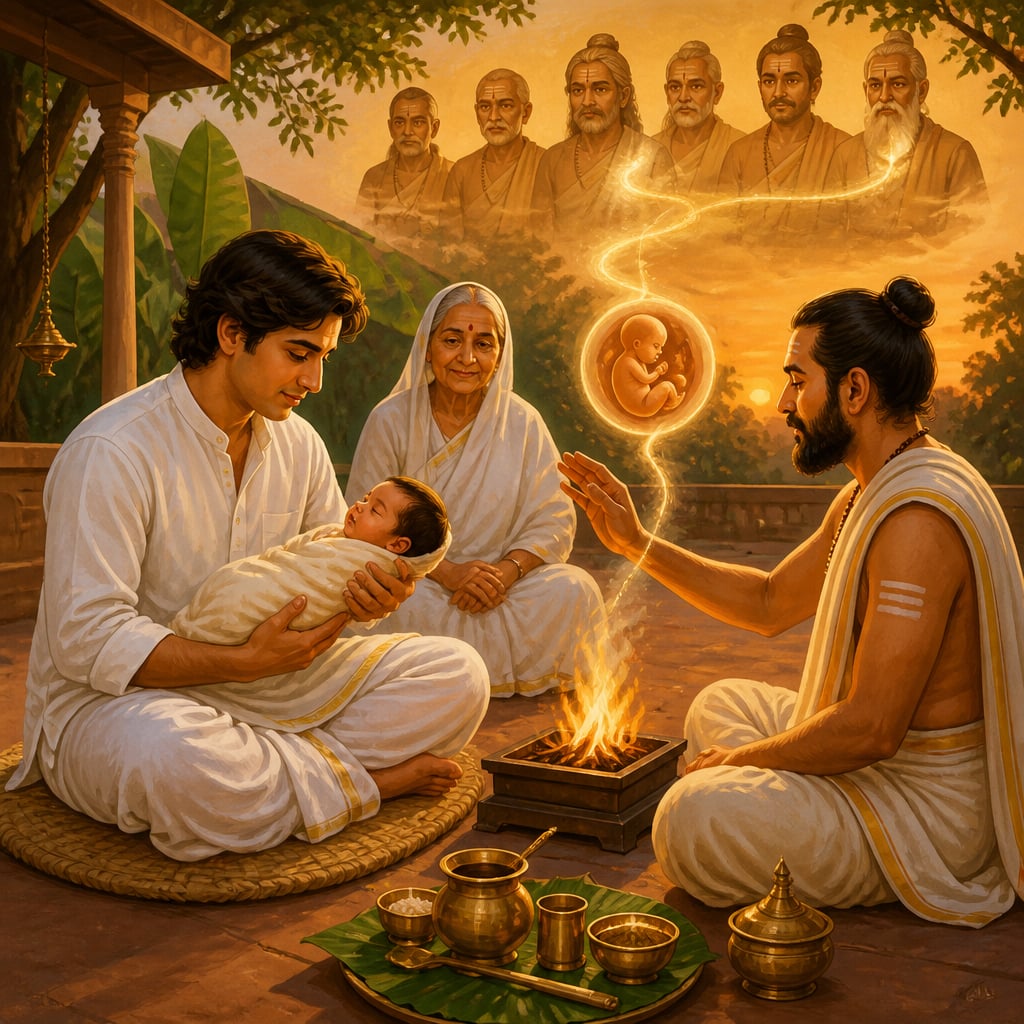
As the priest chanted the jātakarma saṃskāra, the birth rite, the father understood something that words could not capture: he was not holding just a child. He was holding the future of everyone who had come before him, and the past of everyone who would come after.
This is santati, the unbroken thread of continuity that transforms individual life into generational flow.
The Three Debts: Ṛṇatraya
The Vedic tradition articulated intergenerational responsibility through a remarkable concept: Ṛṇatraya, the three debts that every person is born with.
| Debt | To Whom | How It Is Repaid |
|---|---|---|
| Pitṛ-ṛṇa | Ancestors | Through having and raising children, performing śrāddha |
| Deva-ṛṇa | The cosmic forces | Through yajña and dharmic living |
| Ṛṣi-ṛṇa | The sages who preserved wisdom | Through study and transmission of knowledge |
This was not guilt but recognition: you did not create yourself. You received language, culture, genetics, knowledge, and the conditions of your existence from those who came before. You owe them, not in the sense of burden, but in the sense of acknowledgment.
पितृदेवमनुष्याणां वेदश्च ब्रह्मचारिणाम् ऋणानि त्रीण्यप्रणाय्यानि प्रजनन मेधोपवासकाः "One is born with three debts, to the ancestors, to the gods, and to the sages." , Taittirīya Saṃhitā 6.3.10.5
Modern individualism often obscures these connections. The Vedic framework made them explicit: you are the temporary steward of something larger than yourself.
Pitṛ Yajña: Honoring the Ancestors
The Vedic tradition institutionalized ancestor responsibility through Pitṛ Yajña, the rituals honoring the departed. The most well-known form is Śrāddha, performed annually on the death anniversary and during Pitṛ Pakṣa (the fortnight of ancestors).
But Śrāddha was not merely ritual. It was a technology of intergenerational memory. In performing the rites, a person:
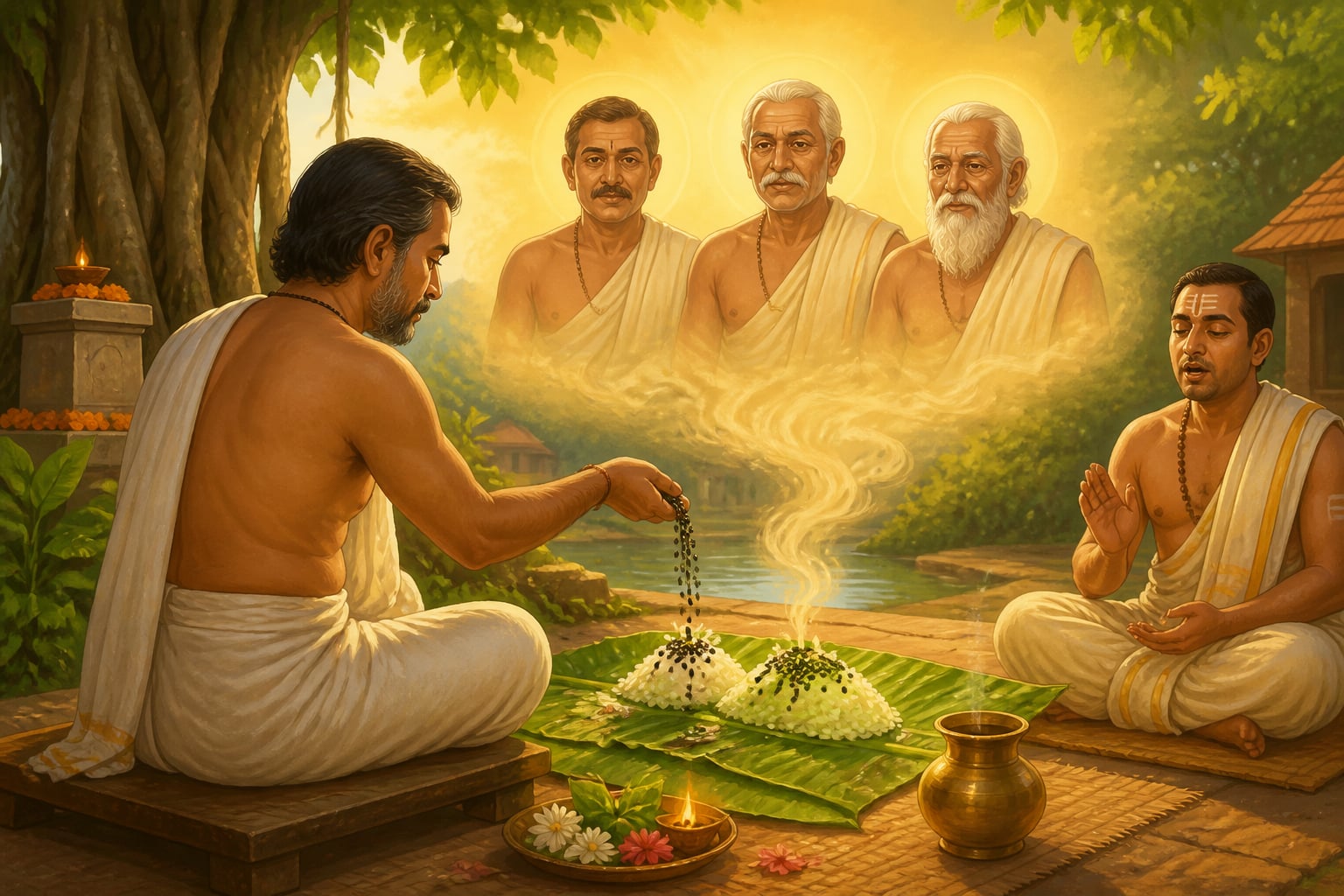
- Names their father, grandfather, and great-grandfather (and maternal equivalents)
- Offers food symbolically to three generations of ancestors
- Recites the gotra (lineage) connecting to founding sages
- Affirms their place in an unbroken succession
This practice trained intergenerational awareness. A person who regularly names their ancestors, contemplates their lives, and acknowledges their debts naturally thinks beyond their own lifespan.
The Gotra System: Genetic Wisdom
One of the most sophisticated expressions of intergenerational thinking was the Gotra system, a method of tracking patrilineal descent that had profound practical implications.
Each gotra traces to a founding Rishi. Marriage within the same gotra is prohibited, a practice called sagotra vivāha niṣedha. What seems like mere ritual rule turns out to encode sophisticated genetic wisdom:
- It prevents close consanguineous marriages across many generations
- It ensures genetic diversity across family lines
- It creates networks of alliance between different gotra groups
- It maintains genetic health over centuries, not just generations
Modern genetics has confirmed what the Rishis intuited: populations that avoid close inbreeding show greater disease resistance, cognitive diversity, and adaptability. The gotra system achieved this through social structure rather than scientific measurement.
सगोत्रां न विवहेत "One should not marry within the same gotra." , Manusmṛti 3.5
This is santati applied to biology: designing marriage rules that optimize genetic health not for one generation but for hundreds of generations. The Rishis were thinking in centuries when making rules that governed whom their descendants could marry.
Paramparā: Transmission Beyond Blood
Santati includes more than biological continuity. The tradition of Paramparā, the teacher-student lineage, extends the concept to knowledge transmission.
Every traditional school traces its lineage back through named teachers to founding Rishis. When a student recites their guru-vandana (salutation to teachers), they name:
- Their immediate teacher
- Their teacher's teacher
- The chain back to the original Rishi-founder
This creates accountability across time. A teacher who breaks the chain fails not just their students but every predecessor. A student who receives but does not transmit betrays the trust of generations.
The Responsibilities Flow Both Ways
Intergenerational responsibility in the Vedic framework runs in both directions:
Obligations to Ancestors:
- Remember them through ritual and narrative
- Complete what they could not complete
- Honor their values while adapting to new conditions
- Repay the debt of existence through worthy action
Obligations to Descendants:
- Preserve and transmit knowledge
- Maintain systems and institutions
- Leave resources, not just debts
- Create conditions for their flourishing
The person in the middle, which is every living person, serves as a bridge. They receive from the past and transmit to the future. Their life is not their own possession but a temporary stewardship.
Breaking the Chain
Modern culture has largely severed this intergenerational consciousness:
- Families disperse geographically, breaking continuous contact
- Knowledge is stored in books and databases, not embodied in lineages
- Ancestor rituals are often seen as superstition rather than intergenerational technology
- The future is discounted, "that's someone else's problem"
The consequences appear in systems that extract from the future for present benefit: unsustainable debt, environmental degradation, institutional decay. When intergenerational consciousness weakens, so does intergenerational responsibility.
Living Santati Today
How do we rebuild intergenerational awareness in modern contexts?
In families:
- Know your ancestors' names, stories, and values
- Create rituals of remembrance (they need not be Vedic to be meaningful)
- Think explicitly about what you want to transmit to your children
In organizations:
- Design for succession from day one
- Document not just processes but wisdom, the "why," not just the "how"
- Ask: "What would my successor need to know that I've never written down?"
In society:
- Support institutions that serve future generations (education, conservation, research)
- Vote and act with descendants in mind, not just personal interest
- Resist the discount rate that treats future people as less real
Research on 'generativity' (Erik Erikson's concept) shows that caring for future generations is a key developmental need in adulthood. Those who feel generative, concerned with guiding the next generation, report higher well-being. The Vedic ṛṇa framework provides a structure for this natural human need.
Servant leadership theory emphasizes that leaders are stewards, not owners, of their organizations. The best leaders ask 'What will I leave for my successor?' This is pitṛ-ṛṇa applied to organizations, acknowledging that you inherited something and must pass it on improved.
Ecological thinking recognizes that current generations inherit the biosphere from predecessors and hold it in trust for descendants. The concept of 'natural capital' attempts to make this debt visible. The Vedic tradition made such debt central to personal identity.
Terror Management Theory research shows that 'symbolic immortality', the sense that something of oneself will continue after death, reduces existential anxiety. Contributing to something larger than yourself (family, tradition, institution) provides this meaning. Santati offers a framework for this natural human need.
The Collins and Porras 'Built to Last' research found that visionary companies think beyond individual founders. Their 'core ideology' outlives any single leader. This is organizational santati, building something that transcends individual lifetimes.
Resilient systems have memory and transmission mechanisms. Oral traditions, rituals, and institutions preserve accumulated wisdom. When transmission fails, each generation must relearn from scratch. Investing in transmission is investing in system resilience.
A word of caution as we explore these teachings: Modern society faces an intergenerational crisis: climate debt passed to future generations, institutional decay, cultural discontinuity, and demographic challenges. The Vedic framework offers practical tools: structural mechanisms for intergenerational voice (like the Seven Generations principle), practices that train intergenerational consciousness (like Śrāddha), and biological wisdom encoded in social rules (like gotra exogamy). These are not antiquarian interests but urgent contemporary needs.
Your Path Forward
The father holding his newborn son by the sacred fire understood something essential: he was not an individual choosing his own adventure. He was a link in a chain stretching back millennia and forward into futures he would never see.
This week, try this practice: Write down the names of your grandparents and great-grandparents. What do you know about their lives? What did they transmit, intentionally or unintentionally, that shaped you? Now ask: What are you transmitting to those who come after?
Santati is not about being bound by the past. It is about recognizing that you exist because others acted with the future in mind. The question is whether you will do the same.
In the next lesson, we explore how this intergenerational awareness connects to place, acting locally while thinking systemically across the Sthāna-Viśva, the local-universal continuum.
Case studies
Seven Generations: Indigenous Governance for the Unborn
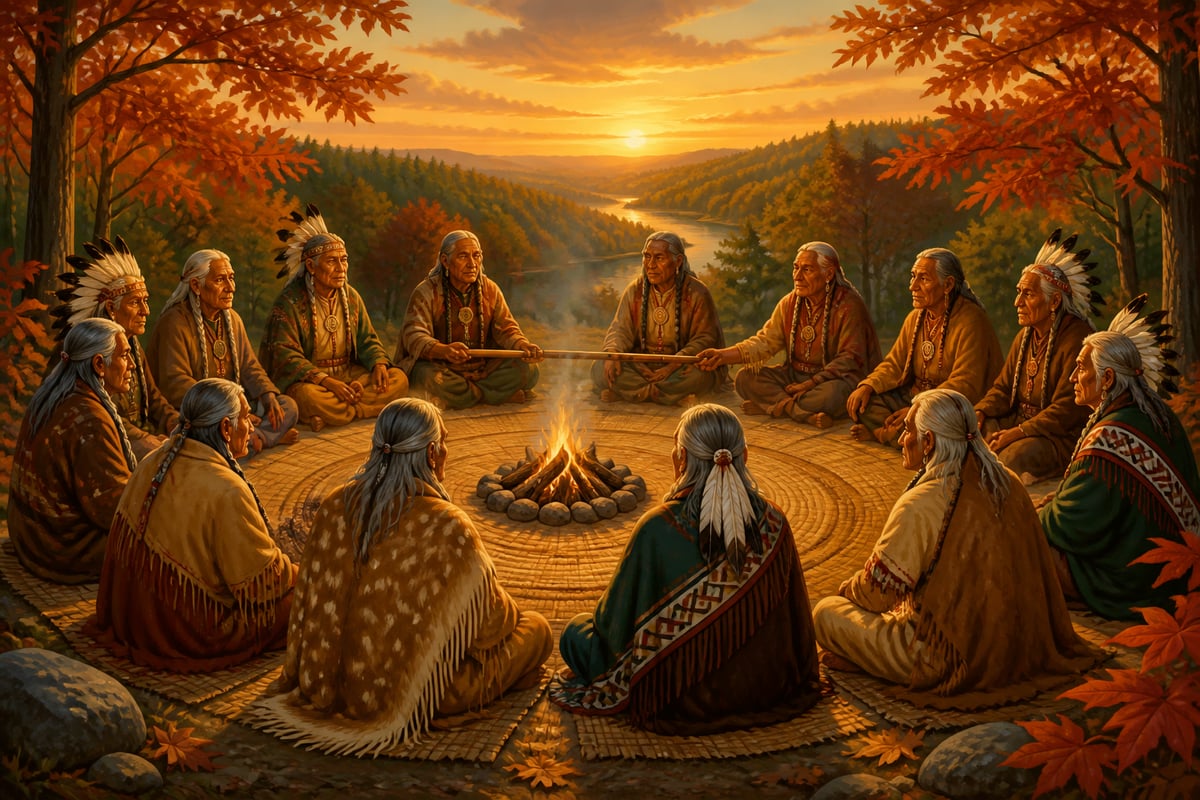
The Haudenosaunee (Iroquois Confederacy) of North America developed a governance principle that requires decisions to consider their impact seven generations into the future. The Great Law of Peace, which has governed the Six Nations for centuries, mandates that leaders ask: 'How will this affect the children seven generations from now, those whose faces are yet beneath the ground?' This principle was so influential that it shaped the U.S. Constitution (Benjamin Franklin explicitly credited Iroquois governance), and it continues to guide Indigenous governance today. In contemporary applications, the Seven Generations principle is invoked in environmental decisions, treaty negotiations, and resource management.
The Seven Generations principle mirrors the Vedic concept of santati with remarkable precision. Both frameworks position the decision-maker not as an individual optimizing for self, but as a link in a chain extending far into the future. The Iroquois 'faces yet beneath the ground' parallel the Vedic pitṛ (ancestors) and the unborn descendants who will inherit current choices. Both traditions make intergenerational responsibility structural, embedded in governance, not left to individual conscience.
The Haudenosaunee Confederacy has endured for over 500 years, longer than most nation-states. Its governance system survived colonization, forced relocations, and systematic attacks. The Seven Generations principle has now been adopted by environmental movements, sustainable business frameworks, and governance theorists worldwide as a model for long-term thinking.
Sustainable governance requires structural mechanisms for intergenerational voice. Neither the Vedic tradition nor the Iroquois left future generations' interests to individual goodwill, they built requirements into decision-making processes. The unborn need representation in current choices.
Constitutional provisions protecting the environment for future generations (like Bhutan's mandate to maintain 60% forest cover) and sovereign wealth funds (like Norway's $1.4 trillion fund) are modern attempts to institutionalize intergenerational thinking. The challenge remains that electoral cycles incentivize short-term decisions, making structural mechanisms for long-term voice essential.
The Seven Generations principle calculates to roughly 175-200 years of impact consideration. Studies show that most corporate and governmental decisions consider impacts for less than 5 years, a 40:1 gap in temporal horizon.
Śrāddha: Technology of Intergenerational Memory
The Śrāddha ritual, performed by Hindus for over three millennia, is often dismissed as superstition, offering food to the dead. But examining its structure reveals sophisticated intergenerational technology. In performing Śrāddha, the performer must: (1) Name three generations of paternal ancestors and three of maternal ancestors; (2) Recite the gotra lineage connecting to founding Rishis; (3) Prepare specific offerings for each ancestor; (4) Invite Brahmins as representatives of the ancestors; (5) Feed the hungry as merit for ancestors; (6) Reflect on what each ancestor contributed to the lineage. The ritual must be performed annually on death anniversaries and during Pitṛ Pakṣa (ancestor fortnight), ensuring regular intergenerational contemplation.
Śrāddha is applied santati, a practice that trains intergenerational consciousness through repeated action. Unlike modern ancestor acknowledgment (visiting graves occasionally), Śrāddha requires active engagement: naming, contemplating, offering. This transforms ancestor awareness from passive memory to active relationship. The person performing Śrāddha cannot avoid thinking about their place in the chain, they must name those before them and, implicitly, those who will perform Śrāddha for them.
Śrāddha has been performed continuously for over 3,000 years, one of humanity's longest-running ritual traditions. It has preserved family lineages, maintained gotra awareness, and trained countless generations in intergenerational thinking. Even when theological beliefs vary, the practice maintains its function: regular, structured ancestor contemplation.
Intergenerational consciousness requires regular practice, not just occasional reflection. The Vedic tradition understood that awareness of ancestors and descendants must be trained through repeated ritual, not left to spontaneous remembrance. The technology is the practice itself, not the beliefs accompanying it.
The modern decline of ancestral awareness, with most people unable to name great-grandparents, correlates with shorter decision-making horizons. Genealogy platforms like Ancestry.com and 23andMe have become billion-dollar businesses partly because they restore a sense of lineage that urbanized, nuclear-family cultures have lost. The hunger for connection to past and future is not nostalgic but functional.
Shraddha rituals have been performed continuously for over 3,000 years. The annual Pitru Paksha period at Gaya draws over 500,000 pilgrims performing ancestral rites. Genealogical records (vanshavalis) maintained by pandas at pilgrimage sites preserve family lineages spanning 20-30 generations.
Reflection
- What have you received from your ancestors, parents, grandparents, teachers, that you might not have explicitly acknowledged or thanked them for? What would it mean to 'repay' this debt?
- If your descendants three generations from now could observe your current life choices, what would you want them to see? What might embarrass you? What would make them grateful?
- How do we balance obligations to ancestors (honoring their values) with the need to adapt to changed circumstances? When does honoring tradition become merely repeating the past?