Samanvaya: Living in Alignment
Integrating All Dimensions for Sustainable Living
This synthesis lesson brings together all the principles explored in this chapter, bahutva (complexity), dīrghadṛṣṭi (long-term thinking), santati (generational continuity), sthāna-viśva (local-universal connection), and upāya (pragmatic adaptation), into the encompassing vision of samanvaya. True sustainability is not achieved through any single dimension but through the dynamic alignment of multiple dimensions simultaneously: ecological, economic, social, spiritual, and temporal.
The Symphony of Alignment
Imagine an orchestra preparing to perform. Each musician is individually excellent, the violinist's technique is flawless, the timpanist's rhythm perfect, the flautist's tone pure. Yet if each plays their own piece at their own tempo, the result is chaos. The magic emerges only when all instruments align, not in uniformity, but in harmony. Each contributes its unique voice while attending to the whole.
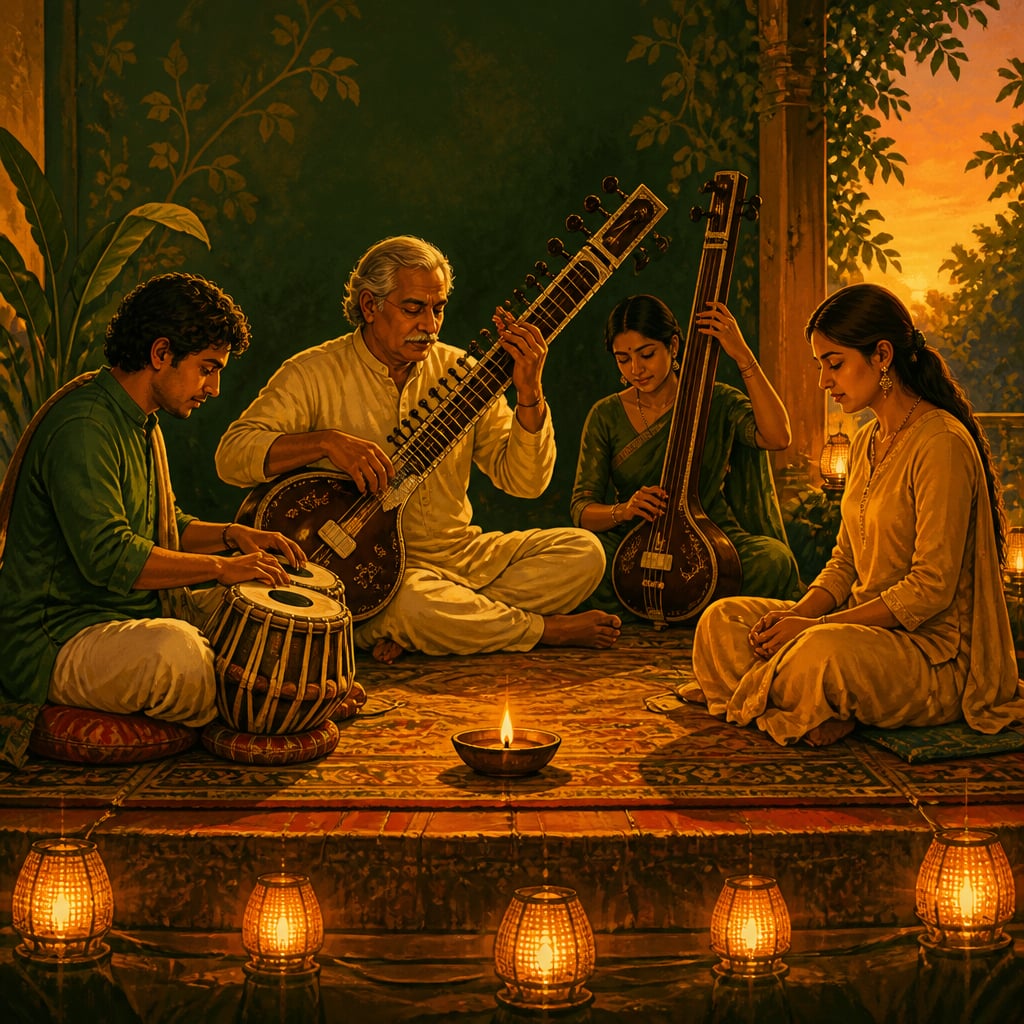
This is samanvaya, the art of alignment that transforms fragmented excellence into integrated wisdom. Throughout this chapter, we have explored five essential dimensions of sustainable living: the embrace of complexity (bahutva), the cultivation of far-sight (dīrghadṛṣṭi), the honoring of generational continuity (santati), the integration of local and universal (sthāna-viśva), and the acceptance of pragmatic imperfection (upāya). Each is valuable. Each is necessary. Yet none alone is sufficient.
Samanvaya reveals that sustainability is not a problem to be solved but a symphony to be conducted, an ongoing practice of holding multiple dimensions in dynamic relationship.
The Vedic Vision of Integration
The Ṛg Veda does not treat the cosmos as a collection of separate entities but as an integrated whole where every part participates in every other. The famous nāsadīya sūkta (Creation Hymn, 10.129) presents creation itself not as a linear event but as an emergence from undifferentiated unity: 'Then was not non-existent nor existent... that One breathed, windless, by its own impulse.'
This primordial unity does not dissolve into disconnected multiplicity. Rather, the manifest world maintains invisible threads of connection, bandhu, that link seemingly disparate elements. Fire connects to speech, sun to sight, wind to breath. The Vedic ritualist understands that to act on one element is to influence all connected elements.
This is precisely what modern sustainability science has rediscovered: that ecological systems, economic systems, social systems, and psychological systems are not separate domains but interconnected aspects of a single complex reality. You cannot address climate change without addressing economics. You cannot address economics without addressing social equity. You cannot address social equity without addressing cultural and spiritual dimensions.
Samanvaya is the Vedic term for living in recognition of this fundamental interconnection.
The Five Dimensions in Concert
Let us now see how the five principles we have studied work together in samanvaya:
Bahutva and Dīrghadṛṣṭi: Complexity thinking without long-term perspective produces paralysis, we see so many variables that we cannot act. Long-term thinking without complexity awareness produces naive utopianism, we project simple solutions far into the future without recognizing how complexity will transform them. Together, they enable adaptive foresight: the capacity to anticipate how complex systems will evolve while remaining humble about our predictions.
Santati and Sthāna-Viśva: Generational responsibility without local rootedness becomes abstract moralism, we preach about future generations while ignoring the concrete places where those generations will live. Local action without generational thinking produces short-sighted NIMBYism, we protect our backyard today while externalizing costs to our children. Together, they enable placed continuity: the practice of tending specific places across generations.
Upāya and Bahutva: Pragmatic acceptance without complexity awareness degenerates into lazy compromise, we accept the first workable solution without exploring the full space of possibilities. Complexity awareness without pragmatic acceptance becomes perfectionist paralysis, we keep analyzing without ever acting. Together, they enable iterative wisdom: the capacity to make imperfect moves that open new possibilities.
Samanvaya is the meta-principle that holds all these pairs in relationship, ensuring that no single dimension dominates and that all contribute to the whole.
The Puruṣārtha Framework: Ancient Integration Model
The most sophisticated Vedic model of integration is the puruṣārtha framework, the four aims of human life: dharma (righteous living), artha (prosperity), kāma (pleasure), and mokṣa (liberation).
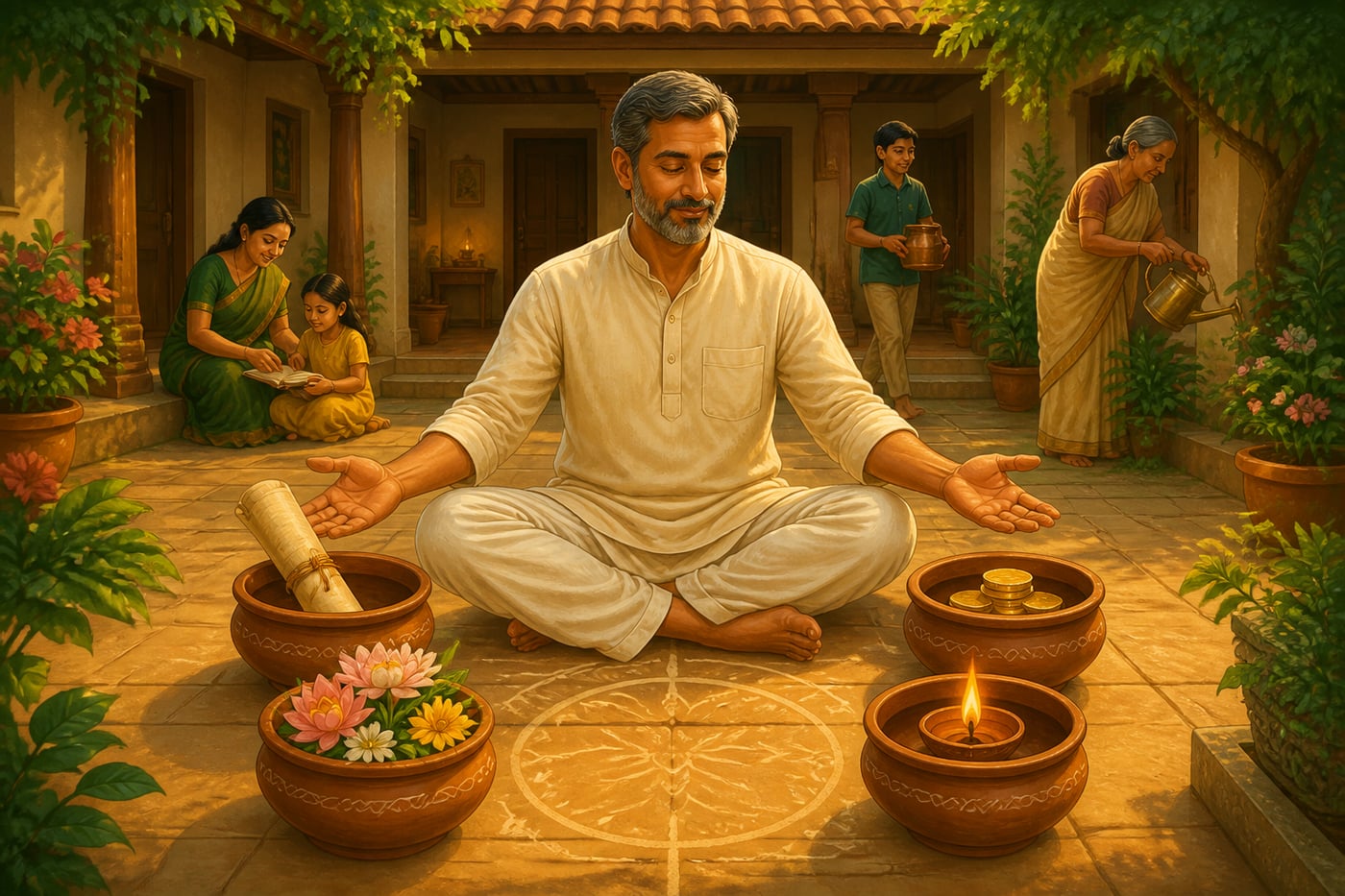
This framework acknowledges that human beings have multiple legitimate needs and drives. We need material security (artha). We need enjoyment and satisfaction (kāma). We need moral coherence (dharma). We need ultimate meaning and freedom (mokṣa). A life that sacrifices any of these for the others becomes imbalanced and unsustainable.
Crucially, the puruṣārthas are not ranked in a simple hierarchy but exist in dynamic tension. Artha pursued without dharma becomes exploitative greed. Kāma pursued without dharma becomes destructive hedonism. But dharma pursued without artha and kāma becomes joyless moralism. And mokṣa sought by abandoning the world becomes escapism.
The sustainable life integrates all four: prosperity that is ethically earned, pleasure that is responsibly enjoyed, duty that does not destroy joy, and transcendence that embraces rather than rejects the world.
This is samanvaya at the individual level, the alignment of our own multiple dimensions.
From Individual to Civilizational Alignment
What applies to individuals applies also to communities and civilizations. A sustainable society cannot pursue economic growth while ignoring ecological limits. It cannot seek technological progress while abandoning cultural wisdom. It cannot champion individual rights while dissolving communal bonds. It cannot honor tradition while refusing to adapt.
The great civilizations that have endured, not merely survived but retained vitality across centuries, have practiced some form of samanvaya. They found ways to hold multiple dimensions in productive tension rather than allowing any single dimension to dominate.
Consider how traditional India integrated:
- Spiritual and material: Temples were also economic centers, maintaining the connection between sacred and mundane
- Individual and collective: The joint family system balanced personal growth with communal responsibility
- Innovation and preservation: New philosophical schools emerged while older traditions were maintained
- Local and cosmopolitan: Village autonomy coexisted with civilizational unity
This integration was never perfect, no human society achieves perfect samanvaya. But the aspiration toward integration, the recognition that multiple dimensions must be honored, shaped the civilizational architecture.
The Modern Challenge of Dis-Integration
Modernity has achieved remarkable advances by isolating and optimizing single dimensions. Scientific method progresses by narrowing focus. Economic efficiency increases by externalizing costs. Technological innovation accelerates by ignoring unintended consequences. Political ideologies simplify by reducing human complexity to single principles.
These focused approaches have produced genuine benefits. But they have also produced what we might call dimensional imperialism, the domination of one dimension over all others. Economic thinking colonizes education, healthcare, relationships. Technological solutionism dismisses wisdom that cannot be coded. Political ideologies demand total allegiance.
The result is a civilization that is extraordinarily powerful in narrow domains but increasingly incapable of integration. We can put humans on the moon but cannot coordinate climate action. We can sequence the genome but cannot maintain community health. We can connect billions through networks but cannot bridge political divides.
This is why samanvaya is not merely a nice ideal but an urgent practical necessity. The great challenges of our time, climate change, biodiversity loss, social fragmentation, meaning crisis, are all integration failures. They cannot be solved by optimizing any single dimension but only by realigning multiple dimensions.
Kerala's Model: Modern Samanvaya in Practice
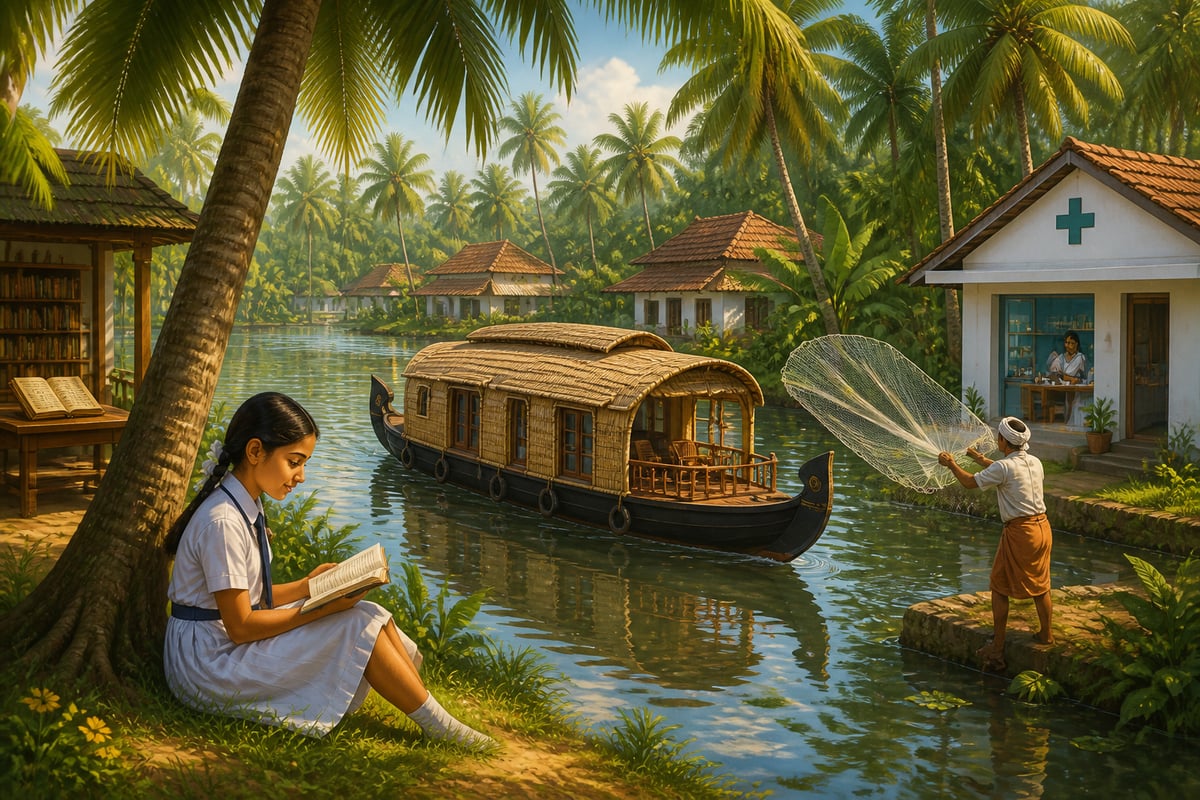
Kerala, a small state in southern India, offers a remarkable example of modern samanvaya. Despite relatively modest economic resources, Kerala has achieved human development indicators comparable to wealthy nations: near-universal literacy, life expectancy matching Europe, low infant mortality, and high social equality.
What is striking is that Kerala did not achieve this through any single intervention but through the alignment of multiple dimensions:
Social reform: Religious and caste reform movements created a culture that valued education and equality before government programs existed.
Political participation: High levels of civic engagement ensured that development priorities reflected community needs rather than elite interests.
Economic pragmatism: Rather than pursuing ideological purity, Kerala combined public investment in health and education with private enterprise in commerce and manufacturing.
Ecological awareness: Traditional practices of water management, agroforestry, and land use were preserved even as modernization proceeded.
Cultural vitality: Arts, literature, and spiritual traditions flourished alongside material development, maintaining meaning and identity.
Kerala's success cannot be attributed to any single factor. It emerged from the alignment of multiple factors, each reinforcing the others. This is samanvaya at societal scale.
Practicing Alignment: Personal Samanvaya
How do we practice samanvaya in our own lives? Not through dramatic transformation but through ongoing attention to alignment:
Regular assessment: Periodically examine your life across multiple dimensions. Where are you over-investing? What dimensions are you neglecting? What is out of alignment?
Creative tension: Rather than trying to eliminate tensions between dimensions (career vs. family, individual vs. community, tradition vs. innovation), learn to hold them productively. Tension is not the enemy of alignment, it is the source of creative energy.
Iterative adjustment: Samanvaya is not a state to be achieved but a practice to be maintained. As circumstances change, alignment must be renewed. Small, frequent adjustments prevent large imbalances.
Community support: Alignment is easier in community than in isolation. Seek relationships that support your multiple dimensions rather than reducing you to a single role.
Temporal integration: Practice holding past, present, and future in alignment. Honor your ancestors while serving your descendants. Learn from tradition while adapting to change.
The Unending Practice
Samanvaya is never complete. Every moment of alignment is also a moment of movement, and movement requires renewed alignment. This is not failure but the nature of living systems.
The river does not achieve a permanent state of flowing, it flows continuously. The musician does not achieve a permanent state of harmony, they attend continuously to the shifting relationships of sound. The family does not achieve a permanent state of love, they practice love continuously through changing circumstances.
So too with sustainability. It is not a destination to be reached but a practice to be maintained. Each generation must discover its own samanvaya, drawing on the wisdom of the past while responding to the conditions of the present.
The Ṛg Veda closes with a hymn of unity: 'Saṅgacchadhvaṃ saṃvadadhvaṃ saṃ vo manāṃsi jānatām', 'May you move together, speak together, may your minds comprehend alike.' This is the prayer of samanvaya: not uniformity but alignment, not perfection but harmony, not stasis but the dynamic integration that sustains life across time.
In learning to live in alignment, with ourselves, our communities, our ancestors, our descendants, and the living systems that sustain us all, we participate in the oldest and most essential human practice: the art of sustainable life.
Modern life often demands specialization that starves other dimensions. The 'workaholic' sacrifices family and health for career. The 'spiritual seeker' may neglect material responsibilities. The 'hedonist' ignores longer-term meaning. The puruṣārtha framework offers a diagnostic: which dimension are you over-emphasizing? Which are you neglecting? What would better alignment look like?
Modern organizations often struggle with 'siloed' functions that optimize locally while undermining the whole. Finance may cut costs that damage quality. Marketing may make promises that operations cannot fulfill. Sustainability departments may be isolated from core strategy. The temple model suggests that integration across functions, not just coordination but genuine alignment, creates organizational resilience.
Case studies
Kerala's Development Model
In the latter half of the 20th century, Kerala achieved remarkable human development despite modest economic resources. This coastal state in southern India attained near-universal literacy, life expectancy comparable to developed nations, low infant mortality, and significant gender equality, all while remaining a relatively low-income region.
From a Vedic perspective, Kerala exemplifies the puruṣārtha balance at societal level: dharma (social reform creating ethical foundation), artha (economic policies ensuring basic security for all), kāma (arts and culture sustaining quality of life), and mokṣa (spiritual traditions remaining vital). The state also demonstrates santati (generational investment in education) and sthāna-viśva (local traditions connected to global knowledge).
Kerala's multi-dimensional alignment produced development outcomes that defied conventional economic logic. The state demonstrated that prosperity, measured in human wellbeing rather than GDP alone, can emerge from the integration of social reform, political participation, ecological awareness, and cultural vitality. However, new challenges have emerged as globalization and migration patterns test whether this alignment can be sustained under changing conditions.
Kerala's success demonstrates samanvaya at societal scale: no single factor explains the achievement, but rather the alignment of multiple factors. Social reform movements challenged caste discrimination and promoted education before government programs existed. High political participation ensured responsive governance. Land reform reduced inequality without destroying agricultural productivity. Public investment in health and education was sustained across changing governments. Traditional ecological practices were maintained alongside modernization. Cultural and artistic traditions flourished, maintaining meaning and identity.
Kerala's model is now studied alongside Scandinavian welfare states as evidence that human development does not require Western-level GDP. Countries like Rwanda, Costa Rica, and Sri Lanka have drawn on similar principles: prioritizing education, healthcare, and social equity alongside economic growth, rather than treating them as luxuries that follow prosperity.
Kerala achieved a Human Development Index of 0.78 in 2020, comparable to many European nations, despite a per capita income less than one-fifth of theirs. Female literacy reached 96%, infant mortality dropped to 6 per 1,000 (vs. India's national average of 28), and life expectancy hit 77 years.
The Puruṣārtha Framework in Classical India
Classical Indian civilization developed an explicit framework for integrating the multiple aims of human life: dharma (righteousness, duty), artha (prosperity, power), kāma (pleasure, desire), and mokṣa (liberation, enlightenment). This framework was not merely theoretical but shaped practical life, education, marriage, occupation, and governance were all understood in relation to these four aims.
The puruṣārtha framework represents the Vedic integration principle applied to individual life. Just as the cosmos maintains unity through diversity (the many emerge from and remain in the one), so the complete human life integrates diverse aims into a coherent whole. The four āśramas (life stages) provide temporal structure for this integration: student life emphasizes dharma-learning, householder life emphasizes artha and kāma, and later stages emphasize mokṣa, yet all stages maintain all aims in proper proportion.
The purushartha framework shaped practical institutions across Indian civilization: the ashrama system organized life stages around the four aims, the varnashrama system structured social roles, and texts like Arthashastra (artha), Kamasutra (kama), Dharmashastra (dharma), and Upanishads (moksha) provided detailed guidance for each aim. The framework proved adaptable across centuries, surviving the transition from Vedic to classical to medieval periods.
The puruṣārtha framework embodies sophisticated integration thinking. Unlike systems that privilege a single value (maximize pleasure, or renounce the world, or accumulate wealth), this framework insists that all four aims are legitimate and necessary. But they are not independent, they must be aligned. Artha pursued without dharma becomes greed. Kāma without dharma becomes destructive hedonism. Dharma without artha and kāma becomes joyless moralism. Mokṣa sought by abandoning all becomes escapism. The challenge is to pursue all four in ways that support rather than undermine each other.
Modern frameworks like Maslow's hierarchy of needs, positive psychology's PERMA model, and the UN's Sustainable Development Goals all attempt what the purushartha framework achieved: integrating multiple dimensions of human flourishing into a coherent whole. The growing 'beyond GDP' movement, which measures national success by well-being rather than just economic output, echoes the ancient insistence that prosperity without purpose is incomplete.
The purushartha framework structured Indian civilization for over 2,500 years, influencing texts from Manusmriti to Arthashastra to Kamasutra. Each text addressed one or more of the four aims, creating an integrated body of knowledge across 100+ major works spanning ethics, economics, aesthetics, and liberation.
Reflection
- Consider your own life across the four puruṣārthas: dharma (righteous living), artha (prosperity), kāma (enjoyment), and mokṣa (spiritual growth). Which of these receives most attention? Which is most neglected? What small shift might bring better alignment?
- Reflect on the image of streams converging into a river. What allows water to flow together naturally? What might it mean for human beings to 'follow ṛta' in seeking alignment, to find the natural convergence rather than forcing artificial unity?
- If sustainability is understood as practice rather than achievement, how does this change the way we approach environmental, social, and personal sustainability? What does a 'practice' orientation make possible that an 'achievement' orientation does not?