Relevance in 2026 and Beyond
Aligning Systems When Everything Seems Broken
How the Vedic principles of bahutva (complexity), dīrghadṛṣṭi (long-term thinking), santati (generational continuity), sthāna-viśva (local-universal connection), upāya (pragmatic adaptation), and samanvaya (integration) apply to modern sustainability challenges, from climate action to organizational resilience to personal well-being.
The Weight of Knowing
You've read the reports. You know the trajectory. The IPCC's sixth assessment warns of cascading climate tipping points. Biodiversity is declining faster than at any time in human history. Political polarization makes coordinated action seem impossible. And yet you're supposed to go about your day, working, parenting, planning a career, while carrying the knowledge that the systems sustaining human civilization are under unprecedented stress.

How do you hold this? How do you act meaningfully without either numbing into denial or collapsing into despair? This is not an abstract philosophical question. It's the lived reality for millions of people in 2026 who are trying to reconcile urgent knowledge with limited agency.
The Modern Sustainability Dilemma
The challenge isn't just that problems are big, it's that they're interconnected in ways that defy simple solutions. Consider the European Union's Green Deal, launched with ambitious climate targets. By 2024, the policy faced unexpected pushback: farmers protesting in Brussels and Berlin, energy costs spiking during the Russia-Ukraine conflict, industries warning of 'carbon leakage' to less regulated regions. The lesson? Climate policy that ignores economic reality, political feasibility, and social equity doesn't just fail, it can trigger backlash that sets the cause back.
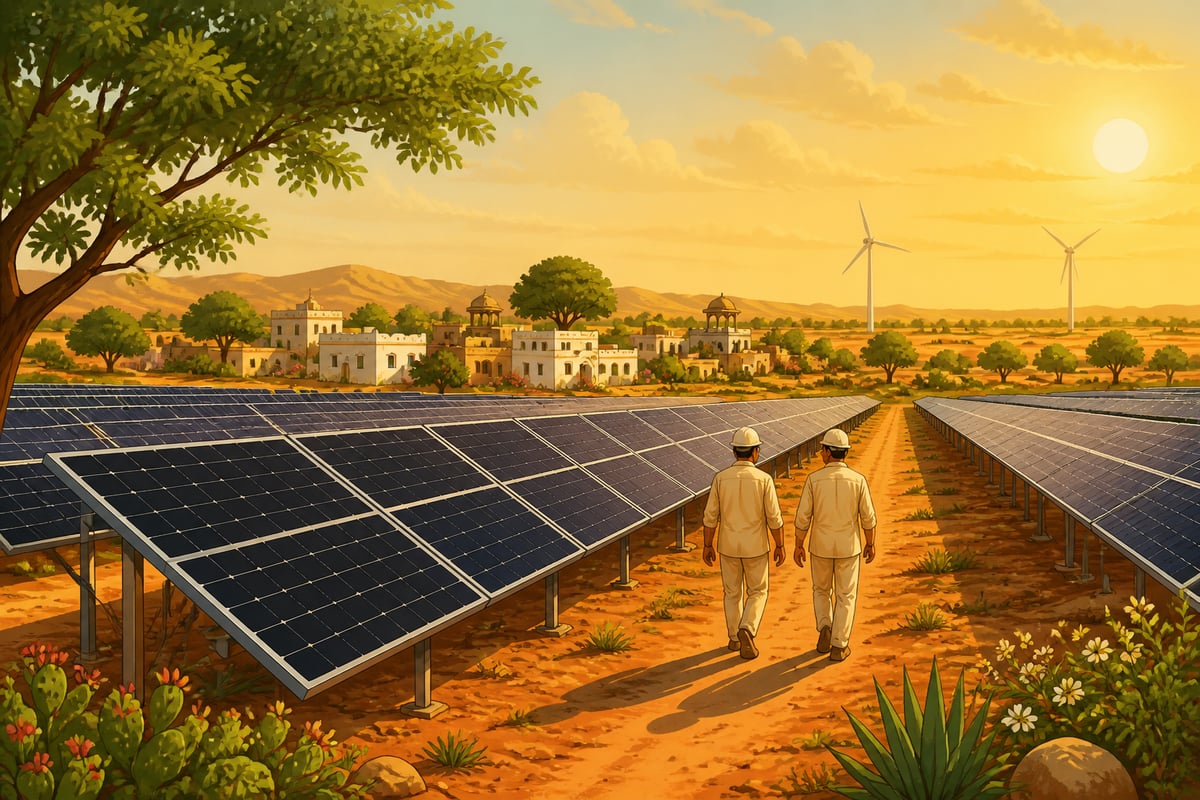
Or consider India's remarkable renewable energy expansion, adding 75 GW of solar capacity between 2020 and 2025, on track for ambitious 2030 targets. Yet the transition creates winners and losers: coal-dependent communities face displacement, grid infrastructure struggles to handle intermittent power, and the supply chain for batteries and panels raises new environmental and geopolitical concerns. Progress on one dimension creates challenges on others.
This is the modern sustainability dilemma: single-dimension solutions don't work. Economic growth without ecological limits leads to climate catastrophe. Environmental protection without economic transition creates political backlash. Technical solutions without social acceptance fail to scale. Individual action without systemic change feels futile.
We need a different way of thinking, one that can hold complexity without paralysis, take long-term perspective without ignoring present needs, honor past wisdom without being trapped by it.
What the Rishis Understood
Three thousand years ago, the Rishis faced their own complex challenges. Their ecosystem was fragile, dependent on monsoons, vulnerable to drought, shaped by interconnected forests, rivers, and agricultural lands. Their social systems were intricate, balancing individual and community, local and cosmic, present and ancestral.
What emerged was not a set of technical solutions but a way of seeing that enabled sustainable response:
Bahutva: Embrace complexity rather than simplifying it away. The universe is not reducible to single causes or simple rules. Sustainable action requires holding multiple factors in awareness simultaneously.
Dīrghadṛṣṭi: Cultivate far-sight, the capacity to see seven generations ahead while acting in the present. This is not prediction but preparation: acting in ways that preserve optionality for descendants.
Santati: Honor generational continuity. We are not isolated individuals but links in a chain. What we receive from ancestors, we pass to descendants. This creates responsibility, and meaning.
Sthāna-Viśva: Act locally while thinking systemically. The universal expresses through the particular. Tend your specific place while understanding its connection to larger patterns.
Upāya: Accept imperfect solutions. The perfect is the enemy of the good. In complex systems, action under uncertainty is unavoidable, embrace iterative progress rather than demanding final answers.
Samanvaya: Integrate all dimensions into dynamic alignment. No single principle is sufficient; sustainable life requires holding them all in productive tension.
The Bridge: Ancient Wisdom, Modern Practice
In Climate Psychology
Eco-anxiety, the chronic fear related to environmental doom, affects an estimated 45% of young people globally according to a 2021 Lancet study. The standard response is either denial (don't think about it) or activism (do something!). But the Vedic approach offers a third way: hold the uncertainty without requiring resolution.
Dīrghadṛṣṭi doesn't demand we know the future, it asks us to act with future generations in mind while accepting we cannot control outcomes. This is remarkably similar to what psychologist Todd Kashdan calls 'psychological flexibility', the capacity to hold difficult experiences while pursuing valued action. The difference: the Vedic approach is embedded in a larger worldview of santati (generational continuity) that gives meaning to the action.
In Organizational Leadership
The ESG (Environmental, Social, Governance) movement has swept corporate boardrooms, but implementation often fails. Why? Because companies try to add sustainability as another metric rather than integrating it into core strategy. They optimize ESG scores while undermining long-term value creation, a classic dimensional imperialism.
Samanvaya suggests a different approach: don't add sustainability as a separate dimension; realign all dimensions so they support sustainability naturally. This is harder, it requires rethinking business models, not just reporting practices. But it's more resilient. Companies like Patagonia that have integrated purpose into their DNA prove more adaptable than those treating sustainability as a compliance exercise.
In Personal Life
The puruṣārtha framework offers individuals a practical diagnostic: are you over-investing in one dimension (career, perhaps) while starving others (relationships, meaning, joy)? Modern burnout often results from dimensional imbalance, maximizing achievement while minimizing integration.
Upāya reminds us that we don't need perfect balance, we need good-enough balance that allows ongoing adjustment. This is permission to act imperfectly while remaining aligned with values. Not 'I'll be sustainable when circumstances are right,' but 'I'll do what I can now while building capacity for more.'
What About Skeptics?
Isn't this just wishful thinking dressed in Sanskrit? Ancient societies weren't sustainable, many collapsed. Critics argue the Vedic world was defined by caste oppression and gender inequality. Why should we look to it for guidance?
Fair objections. Three responses:
First, we're not advocating return to ancient society, we're extracting principles that might inform modern action. Newton's physics enabled rockets even though Newton believed in alchemy. We can learn from Vedic systems thinking without endorsing every Vedic social practice.
Second, the principles themselves point toward humility. Upāya acknowledges imperfection. Dīrghadṛṣṭi accepts uncertainty about outcomes. These teachings don't claim to have all answers, they offer frameworks for navigating without answers.
Third, the alternative, continuing to optimize single dimensions while ignoring integration, is demonstrably failing. The Vedic approach may not be sufficient, but the modern approach is clearly insufficient. We need more tools, not fewer.
Carrying Forward
What might you actually do with these teachings?
Start with self-assessment: Which dimension are you over-investing in? Which are you neglecting? The puruṣārtha audit (dharma, artha, kāma, mokṣa) offers a simple diagnostic.
Practice holding uncertainty: When you notice yourself forcing certainty about climate futures, political outcomes, or personal trajectories, pause. Ask: 'Can I hold this more lightly while still acting responsibly?' This is dīrghadṛṣṭi in practice.
Tend your place: Rather than abstractly worrying about global systems, ask what local system you can actually influence. Your household, neighborhood, workplace, community. Sthāna-viśva grounds cosmic concern in concrete action.
The Rishis didn't have answers to our problems. But they developed capacities, for holding complexity, for seeing far, for honoring continuity, for integrating dimensions, that we desperately need today. The question isn't whether their world was perfect. The question is whether their wisdom can help us navigate ours.
The answer, I believe, is yes. Not as final solutions, but as living practices. Not as ancient relics, but as present possibilities. The work of samanvaya continues, through you, now, here.