Viṣāda: Burnout as Misalignment
When Work Depletes Instead of Fulfills
The Vedic tradition recognized that work can go wrong, not just fail externally, but deplete internally. Viṣāda (dejection, despair) is the state where action becomes paralyzed because meaning has drained away. This lesson explores burnout not as simple overwork but as misalignment: the gap between what we do and who we are meant to be.
The warrior stood frozen on the battlefield. Around him, armies waited. Conches had been blown, arrows notched, drums silenced in anticipation. And Arjuna, the greatest archer of his age, the hero who had never failed, could not move.
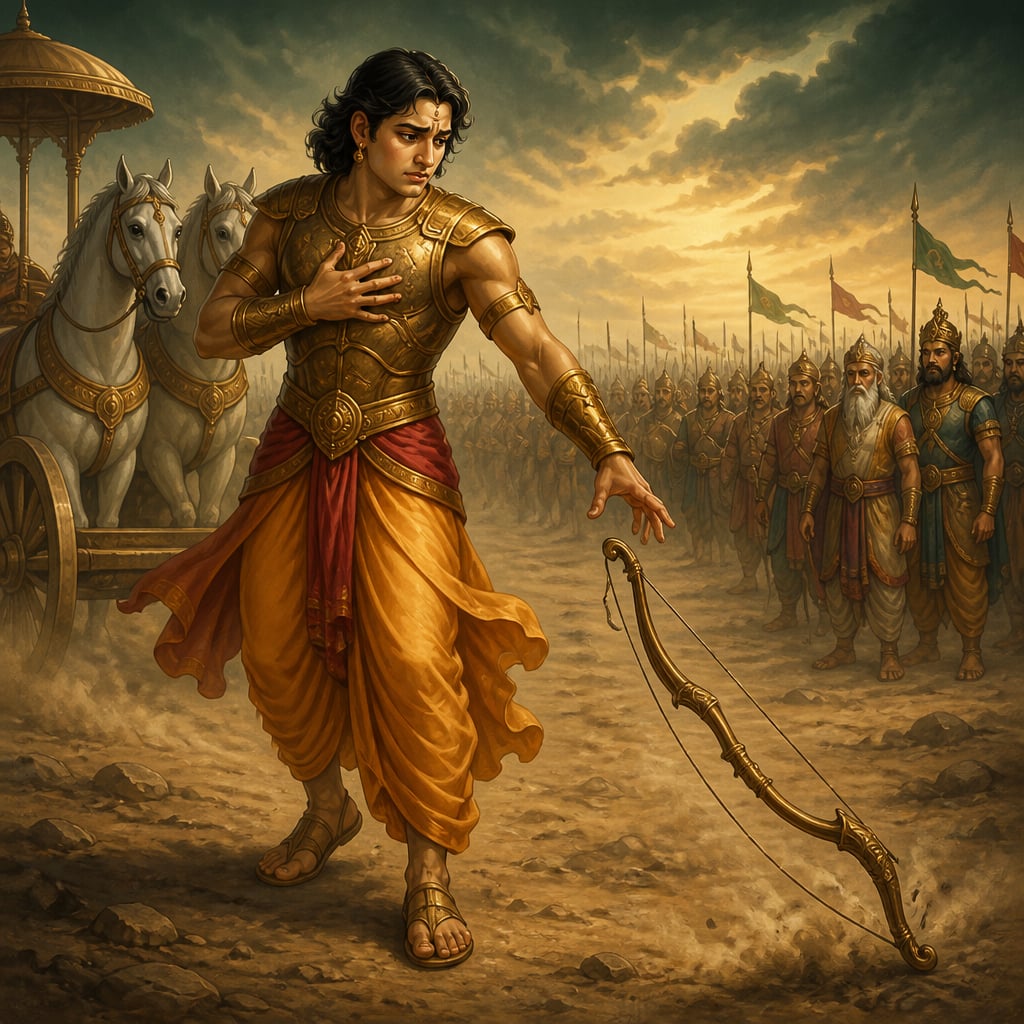
His hands trembled. His bow slipped. His mind, usually sharp as his arrows, dissolved into confusion. He saw teachers on both sides, relatives, friends. He saw the violence to come. And something in him collapsed.
"My limbs fail," he told Krishna. "My mouth is parched. My body trembles. My skin burns. I cannot stand. My mind whirls."
This was not cowardice. This was not laziness. This was viṣāda, the crisis of meaning that strikes when action no longer aligns with purpose.
The Vedic Understanding of Viṣāda
Viṣāda means dejection, despair, depression of spirit. The Bhagavad Gita opens with the Arjuna Viṣāda Yoga, the yoga of Arjuna's despair. This is remarkable: the text treats his crisis not as failure but as yoga, a path, a discipline, a necessary stage.
The Vedic tradition understood that viṣāda is not random collapse. It is a signal. It tells us that something has gone wrong in the relationship between self and action. Arjuna's paralysis was not about the specific battle; it was about a deeper question he had never faced: Why am I fighting? For whom? Toward what end?
Viṣāda arises when the meaning that sustained action drains away. The work continues, but the why has vanished. This is what modern psychology calls burnout, not just exhaustion from too much work, but emptiness from work that no longer connects to anything that matters.
What the Rig Veda Teaches
The Rig Veda does not use the term viṣāda, but it speaks repeatedly of the conditions that prevent it: alignment with Ṛta (cosmic order), connection to purpose (saṅkalpa), participation in flows larger than the self (yajña). When these connections break, work becomes depleting rather than sustaining.
Consider the hymn to Vāk (Sacred Speech):

"उतो त्वस्मै तनुवं वि सस्रे" "And to him, she reveals her true form."
Vāk, the goddess of inspired speech, hides from those who misuse her. She reveals herself only to those who approach with alignment and respect. When we work in misalignment, forcing speech without inspiration, action without meaning, Vāk withdraws. We speak, but the words are empty. We work, but the work is hollow.
Word by word:
- Uta, and, moreover
- U, verily
- Tasmai, to him (the aligned one)
- Tanuvam, her true form/body
- Vi sasre, she reveals, unfolds
The teaching: when we lose alignment, the animating force of work withdraws. We can continue the motions, but the life has departed.
The Three Signs of Viṣāda
The tradition identifies three dimensions of viṣāda that correspond to modern burnout research:
1. Klama (क्लम), Exhaustion
Klama is fatigue that rest does not cure. It is the tiredness of the soul, not just the body. The burned-out worker sleeps but wakes tired. The weekends provide no recovery because the problem is not hours of work but the emptiness within those hours.
2. Virakti (विरक्ति), Disconnection
Virakti is detachment in its shadow form, not the healthy non-attachment (vairāgya) we explored earlier, but a numbing disconnection from the work, the people, the purpose. The burned-out person shows up but is not present. They perform but do not engage.
3. Asāmarthya (असामर्थ्य), Reduced Capacity
Asāmarthya is the sense of ineffectiveness, that no matter what you do, it doesn't matter, doesn't work, doesn't connect. Skills that once flowed become effortful. Tasks that were once manageable become overwhelming.
Modern burnout research (Maslach, 1981) identifies almost identical dimensions: exhaustion, cynicism, and reduced efficacy. The Vedic tradition anticipated this framework by millennia.
Why Misalignment Causes Viṣāda
Burnout is often attributed to overwork, too many hours, too many demands. But the Vedic analysis goes deeper: viṣāda arises from misalignment, not merely from effort.
A person doing meaningful work can sustain enormous effort. The farmer at harvest, the artist in flow, the healer with a patient, they work long hours without depleting. Why? Because the work connects to something larger: purpose, skill, contribution. The yajna model holds: action as participation sustains the actor.
But action disconnected from purpose depletes regardless of hours. The corporate worker in meaningless meetings, the professional doing tasks they don't believe in, the expert whose expertise is ignored, they can burn out on forty hours a week. The problem is not the quantity of action but its quality: action without the yajña connection becomes extraction, and extraction depletes.
This is why the Gita's first chapter is not "Arjuna's Laziness" but "Arjuna's Yoga." His collapse was a spiritual crisis, the sudden clarity that his action had lost its meaning. The battlefields we face are often internal: the war between who we are and what we're doing.
Traditional Interpretations: Sayana and Aurobindo
Sayanacharya, commenting on passages about misaligned action, emphasizes the importance of adhikāra, qualification, fitness, readiness. When we undertake action for which we are not prepared, or which violates our nature (svabhāva), the action cannot flow properly. It becomes forced, mechanical, depleting. Viṣāda is the signal that adhikāra is absent.
Sri Aurobindo reads Arjuna's viṣāda as a necessary death of the old consciousness. Before transformation can occur, the previous mode of being must collapse. Viṣāda is not failure but threshold, the dark passage between an outgrown identity and a new one not yet born. The darkness is not punishment but transition.
Both perspectives reframe viṣāda: it is not just suffering to be avoided but signal to be heeded and threshold to be crossed.
Modern Resonance: The Quiet Quitting Phenomenon
In 2022, a phrase went viral: "quiet quitting." It described workers who remained employed but withdrew their discretionary effort, doing only what was required, nothing more. Critics called it laziness. But the phenomenon was better understood as mass viṣāda.
Decades of corporate messaging had promised that work would be meaningful: "We're a family." "We're changing the world." "Your growth is our priority." When these promises proved hollow, when layoffs came, when profits mattered more than people, when "changing the world" meant surveillance ads, workers experienced the gap between rhetoric and reality.
Quiet quitting was not apathy but response, the withdrawal of engagement when the yajña connection broke. Workers were saying, in action if not words: "I will no longer offer my full self to work that does not reciprocate. I will preserve my energy for what actually matters."
This is viṣāda's wisdom: when action is not aligned, withdrawal is protective. The problem is not the withdrawal but the misalignment that made it necessary.
Christina Maslach's Burnout Inventory (MBI) measures three dimensions: exhaustion, cynicism, and reduced efficacy. These map to the Vedic klama, virakti, and asāmarthya. Modern research confirms the ancient observation: burnout is multi-dimensional, not just tiredness.
Gallup research shows that 70% of the variance in team engagement depends on the manager. Leaders who create meaning (connection to purpose) and alignment (matching roles to strengths) prevent viṣāda. Leaders who treat workers as interchangeable parts create it.
In systems terms, burnout is 'resource depletion without replenishment.' The system draws energy out but doesn't put meaning back in. Sustainable systems cycle energy; depleting systems extract until collapse. Organizations are no different.
Positive psychology identifies 'recovery experiences' that restore depleted resources: psychological detachment (from work), relaxation, mastery (doing something you're good at for its own sake), and control (choosing your activities). These are different 'fuels' that reawaken the inner fire.
Organizations that prevent burnout provide not just rest but meaning. Salesforce's 'V2MOM' process ensures every employee can articulate how their work connects to vision and values. This is organizational samidh, the fuel that keeps the collective fire burning.
In ecological terms, burnout is like soil exhaustion from monocropping. The solution is not just rest (fallow periods) but diversification and rotation, different 'crops' (activities, roles, purposes) that replenish what has been depleted.
A word of caution as we explore these teachings: Understanding viṣāda as misalignment rather than weakness changes everything. It removes shame and replaces it with inquiry. It shifts focus from 'pushing through' to 'realigning.' And it reframes the crisis as threshold, not just suffering to be endured but transformation to be undergone. Modern burnout epidemics might find resources in this ancient wisdom.
Your Path Forward
If you recognize viṣāda in yourself, the exhaustion that rest doesn't cure, the disconnection that weekends don't heal, the sense that your efforts don't matter, the first step is not to push harder. The first step is to listen.

Viṣāda is signal, not failure. It asks: Where is the misalignment? Is this work connected to purpose? Does it use your real gifts? Does it contribute to something you value? If the answers are no, the solution is not more effort but realignment.
This week, try a diagnostic practice: For each major area of your work, ask: "Does this feel like yajña (offering) or extraction (taking from me)?" Areas of offering sustain you. Areas of extraction deplete you. The ratio matters. If extraction dominates, viṣāda is not far away, or perhaps already present.
In the next lesson, we explore the remedy: svadharma, the realignment of work with one's true nature and calling.
Case studies
Quiet Quitting: Mass Viṣāda in the Modern Workplace
In 2022, the term 'quiet quitting' went viral on social media. It described workers who remained employed but had stopped giving discretionary effort, doing only what their job description required, nothing more. No extra hours. No going 'above and beyond.' No emotional investment in the company's success. Older commentators called it laziness or entitlement. But the workers themselves described something different: exhaustion, disillusionment, the feeling that their effort wasn't valued or reciprocated.
Quiet quitting was mass viṣāda expressed through action rather than words. Decades of corporate messaging had promised meaningful work, growth, 'family.' When these promises proved empty, layoffs during record profits, return-to-office mandates after pandemic flexibility, wages stagnant while executive pay soared, the yajña connection broke. Workers experienced the gap between offering (their effort) and reciprocation (meaning, respect, fair reward). Viṣāda's wisdom is withdrawal when the exchange is broken.
The phenomenon forced organizational rethinking. Companies that responded with threats ('perform or leave') saw continued disengagement. Companies that responded with genuine dialogue, examining what makes work meaningful, adjusting management practices, reconnecting work to purpose, saw recovery. The crisis revealed that viṣāda cannot be solved by demanding more effort; it requires addressing the underlying misalignment.
Quiet quitting demonstrates that viṣāda is systemic, not just personal. When millions of workers simultaneously withdraw, the problem is not individual weakness but collective misalignment. The Vedic teaching applies: when the yajña breaks, when work becomes pure extraction, withdrawal is rational. The solution is not to force re-engagement but to rebuild the conditions that make engagement possible.
The Great Resignation of 2021-2022, where 47 million Americans voluntarily left their jobs, confirmed this diagnosis at massive scale. Employers who responded by raising wages alone saw limited re-engagement. Those who redesigned work to restore meaning, autonomy, and connection saw lasting improvement. The data is clear: engagement cannot be purchased; it must be earned through systemic alignment.
Gallup's 2022 State of the Global Workplace report found that only 21% of employees worldwide were engaged at work. 60% were 'not engaged' (quiet quitting). This is not a few malcontents; it is the majority of the global workforce experiencing some degree of viṣāda.
Bhartrihari: The King Who Saw Through the Palace
Bhartrihari ruled the kingdom of Ujjain in the 5th-7th century CE. He had everything: power, wealth, a beautiful queen, the adulation of a kingdom. Yet increasingly, something felt hollow. The pleasures that once satisfied left him empty. The court politics that once engaged him now seemed pointless games. He composed poetry that revealed his inner state, verses about the futility of worldly pursuits, the deception of pleasure, the trap of desire. He was a king experiencing viṣāda in the midst of plenty.
Bhartrihari's viṣāda was not caused by deprivation but by misalignment at the deepest level. His svabhāva (true nature) was that of a poet-philosopher, not a politician-king. The royal role, for all its privileges, violated who he actually was. His Śṛṅgāra Śataka (hundred verses on love), Nīti Śataka (hundred verses on conduct), and Vairāgya Śataka (hundred verses on renunciation) trace his journey from enchantment through disillusionment to wisdom.
Bhartrihari eventually renounced the throne entirely, becoming a wandering ascetic. Legend says he renounced seven times, pulled back to worldly life before finally achieving permanent vairāgya. His poetry survived as classics of Sanskrit literature, far outlasting his kingdom. The king who felt his royal work was meaningless became a poet whose work has meant something for fifteen centuries.
Bhartrihari shows that viṣāda can strike anyone, including those with every external advantage. His crisis was not about lack, it was about misalignment between role and nature. His resolution was not to try harder at kingship but to find work that matched his svabhāva. Sometimes the answer to viṣāda is not adjustment within the current situation but transformation into a new one entirely.
Mid-career pivots and 'encore careers' are increasingly common as life expectancy rises and people have 40-50 working years ahead of them. The growing popularity of sabbaticals, career coaching, and 'designing your life' programs reflects widespread recognition that misalignment between role and nature is a solvable problem, not an inevitable condition of adult life.
Bhartrihari's three Shatakas contain exactly 300 verses (100 each on detachment, love, and ethics). His Vakyapadiya, a treatise on the philosophy of language, influenced 1,500 years of linguistic thought and is still studied in university Sanskrit departments worldwide.
Reflection
- Have you experienced viṣāda, exhaustion, disconnection, sense of futility, in your work? Looking back, was this about overwork, or was there a deeper misalignment? What was the signal trying to tell you?
- The Gita calls Arjuna's crisis 'yoga', a path, a discipline. How can despair be a yoga? What might viṣāda teach that comfort cannot?
- If 'quiet quitting' is a form of mass viṣāda, what does it reveal about modern work? Is the problem with the workers, the organizations, or the very structure of contemporary labor?