Svadharma: Realigning Work With Purpose
Finding Your Own Path of Right Action
After understanding viṣāda (burnout as misalignment), this lesson offers the remedy: svadharma, 'one's own dharma.' Svadharma is work that aligns with your true nature (svabhāva), uses your genuine gifts, and connects to purpose larger than yourself. This is not one path for everyone but your unique path, the work only you can do in the way only you can do it.
The young Rishi approached his teacher with frustration. He had studied the scriptures, mastered the rituals, memorized the mantras. Yet something was wrong. The practices that transformed other students left him cold. The path that seemed so clear for his brothers felt like a foreign road to him.
"Guru-ji," he said, "I have done everything correctly. Why does it not work?"
The old teacher smiled. "You have followed dharma," he said. "But have you found your dharma?"
"Is there a difference?"
"Dharma is the cosmic law that governs all. Svadharma is how that law expresses uniquely through you. The sun follows dharma by shining. The river follows dharma by flowing. But the sun does not try to flow, and the river does not try to shine. Each follows its own dharma, svadharma."
The Meaning of Svadharma
Sva means one's own, self, intrinsic. Dharma means law, duty, right action, natural order. Together, svadharma is the particular expression of dharma that is uniquely yours, the work that aligns with who you actually are.
The Bhagavad Gita makes a startling statement:
"श्रेयान्स्वधर्मो विगुणः परधर्मात्स्वनुष्ठितात्" "Better is one's own dharma, though imperfectly performed, than the dharma of another well performed."
This is radical. It does not say that everyone should follow the same path. It says that your path, even done imperfectly, is better for you than someone else's path done excellently. Why? Because your path aligns with your nature. Another's path, no matter how well executed, remains foreign to your being.
Svadharma is not about avoiding effort or seeking easy work. It is about finding the work where your effort flows naturally, where the action expresses who you are rather than requiring you to be someone else.
What the Rig Veda Teaches
The Rig Veda does not use the term svadharma (that appears later in the Gita), but it establishes the foundation: the understanding that different beings have different natures (svabhāva), and right action flows from nature, not against it.
Consider this verse about the Maruts, the storm gods who move together yet each has their own distinct role:
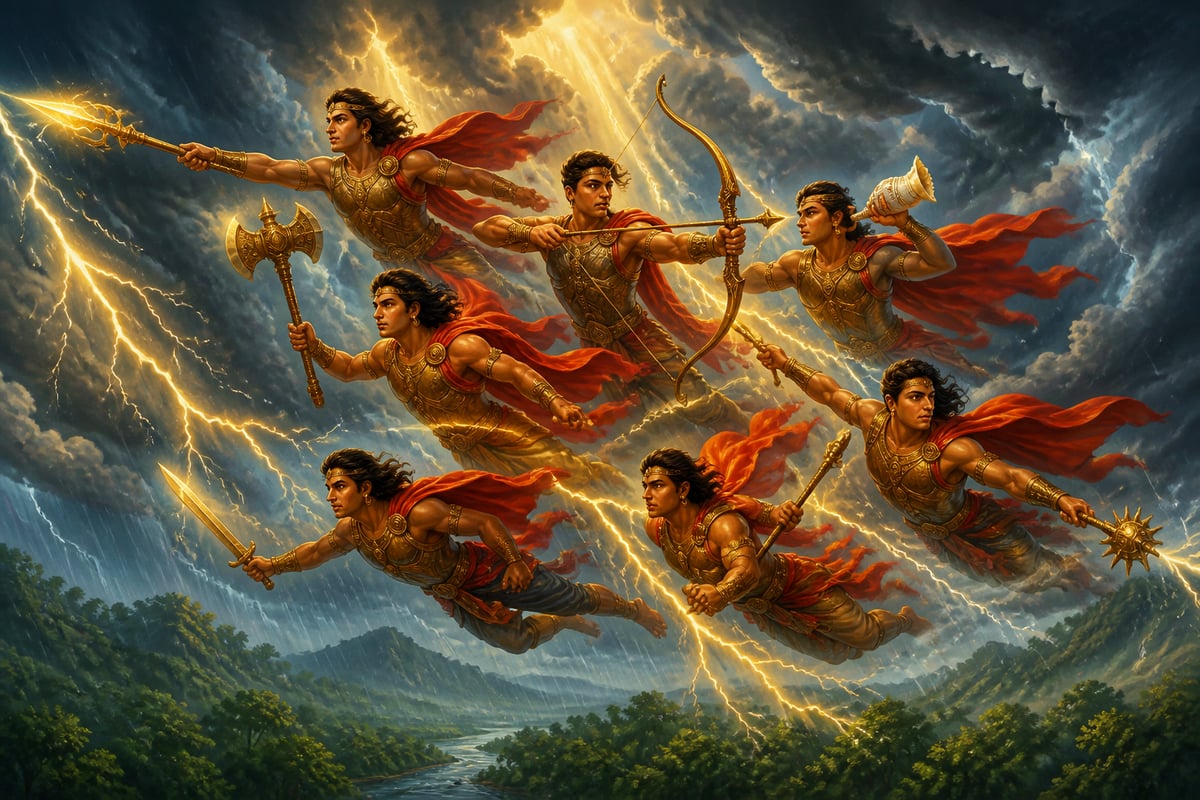
"समानं मन्त्रं अभि मन्त्रयन्ते" "They chant the same mantra, yet each in their own way."
The Maruts share a common purpose (same mantra) yet express it individually (their own way). This is svadharma within collective dharma: alignment with the group's purpose without losing individual nature.
Word by word:
- Samānam, the same, common, shared
- Mantram, mantra, purpose, sacred word
- Abhi, toward, with
- Mantrayante, they chant, they counsel together
The teaching: unity of purpose does not require uniformity of expression. Each being contributes to the whole by being fully themselves, not by becoming identical to others.
The Three Elements of Svadharma
The tradition identifies three components that, when aligned, create svadharma:
1. Svabhāva (स्वभाव), One's True Nature
Svabhāva is your inherent disposition, not the personality you've constructed, but the nature you were born with. Some people are natural creators; others are natural organizers. Some thrive in solitude; others flourish in community. Some think in systems; others think in stories. Svadharma begins with honest recognition of svabhāva.
2. Guṇa (गुण), Quality of Energy
The tradition speaks of three guṇas, sattva (clarity, harmony), rajas (activity, passion), and tamas (stability, inertia). Each person has a characteristic mix. Work that matches your guṇa-constitution feels natural; work that violates it feels depleting. The sattvic person suffers in chaotic environments; the rajasic person wilts in slow-moving bureaucracies.
3. Adhikāra (अधिकार), Qualification and Readiness
Adhikāra is your earned capacity, the skills, knowledge, and development that qualify you for particular work. Svadharma is not just what you're born for but what you've prepared for. The musician's svadharma requires years of practice; the leader's svadharma requires development of judgment and character.
When svabhāva (nature), guṇa (energy), and adhikāra (qualification) align with the work, svadharma emerges. The work feels like natural expression rather than forced performance.
Traditional Interpretations: Sayana and Aurobindo
Sayanacharya interprets svadharma in relation to the varna system, the ancient organization of society by function. For Sayana, each varna (brahmin, kshatriya, vaishya, shudra) has its characteristic svadharma based on predominant guṇa. The teaching is that people should perform the duties of their nature, not aspire to others' roles. While the social application became rigid, the underlying insight remains: work must match nature.
Sri Aurobindo universalizes svadharma beyond social categories. In his reading, each soul has a unique svadharma, a particular way of manifesting the Divine that no one else can replicate. Your svadharma is your contribution to the cosmic purpose. Finding it is not social assignment but spiritual discovery. The work only you can do is the work you are here to do.
Both perspectives point to the same core: alignment between self and action is the foundation of meaningful work.
How to Discover Svadharma
Svadharma is not found in a single revelation but discovered through attention over time. The tradition offers several approaches:
Observe what energizes versus depletes. When you finish certain activities, you feel more alive than when you started, even if tired. Other activities leave you drained regardless of rest. The energizing activities hint at svadharma; the depleting ones suggest misalignment.
Notice what you do without being told. What do you naturally gravitate toward when unconstrained? What did you love as a child before social conditioning? What do you find yourself doing even when no one is watching or paying? These spontaneous inclinations often point to svabhāva.
Listen to the feedback of life. Where do your actions create positive ripples? Where do others naturally seek your contribution? Where does effort seem to produce disproportionate results? Sometimes svadharma is revealed not through introspection but through the world's response.
Experiment and refine. Svadharma may not be fully clear from the start. It emerges through trial, reflection, and adjustment. Each work experience teaches something about what fits and what doesn't. The path clarifies by walking it.
Modern Resonance: Ikigai and Purpose
The Japanese concept of ikigai, "reason for being", maps closely to svadharma. Ikigai sits at the intersection of four questions:
- What do you love? (passion)
- What are you good at? (skill)
- What does the world need? (service)
- What can you be paid for? (sustainability)
Where all four overlap, you find ikigai, a life of meaning and purpose.
This framework echoes the Vedic understanding. Svadharma is not just personal preference (what you love) but includes capacity (what you're good at), contribution (what the world needs), and sustainability (what supports life). The work that aligns all four is the work you are meant to do.
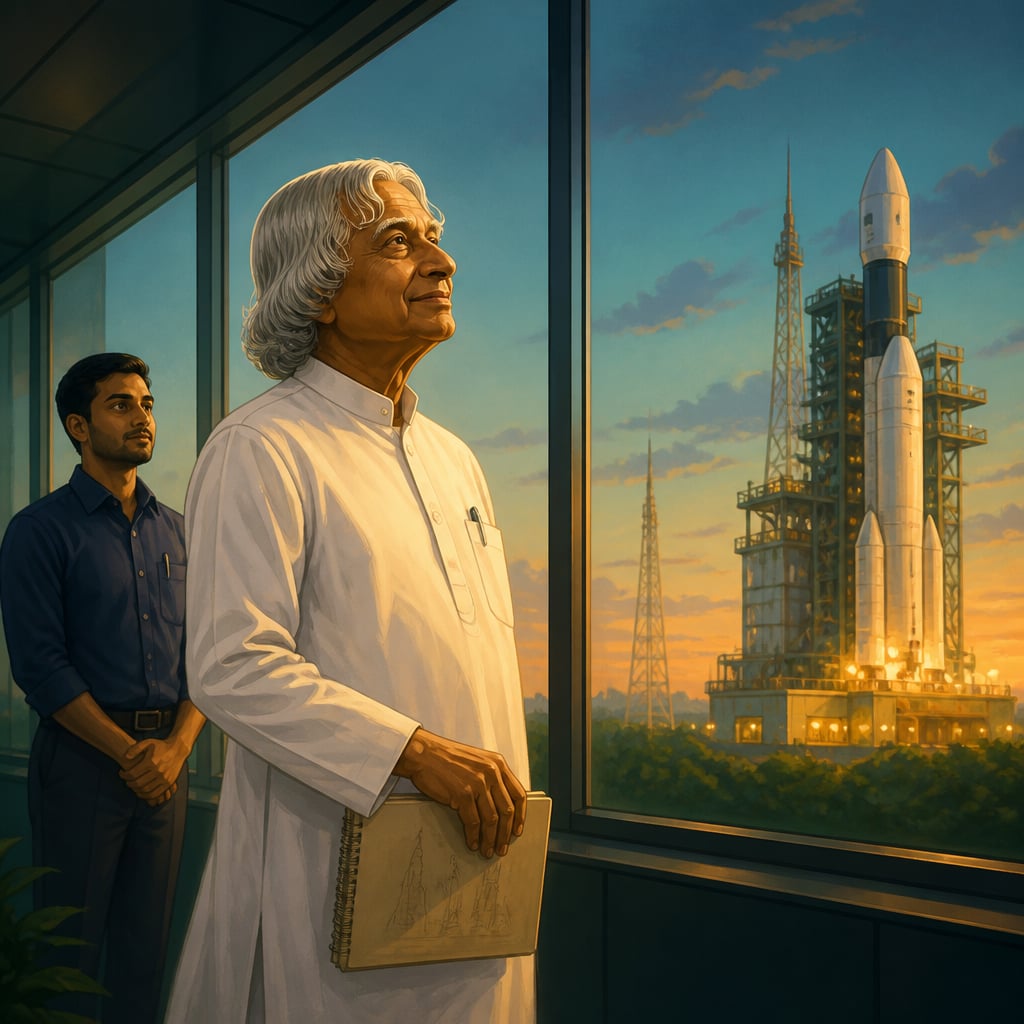
APJ Abdul Kalam exemplified this alignment. Born in a fishing village in Rameswaram, he discovered svadharma in the intersection of science, service, and spirituality. His passion for aerospace, his skill in system design, India's need for missile defense, and his position at DRDO and ISRO, all converged. He did not become a scientist despite his humble origins; he became a scientist because his svadharma was waiting to be discovered and followed.
Strengths-based psychology (Gallup's CliftonStrengths) shows that people who use their natural strengths daily are 6x more likely to be engaged at work. This is empirical svadharma: alignment with nature produces engagement; violation produces disengagement.
Marcus Buckingham's research shows that the best managers don't try to fix weaknesses but amplify strengths. They help employees find roles matching their nature. This is organizational svadharma, placing people where their gifts can flow.
In ecosystems, each species fills a unique niche. Diversity is not just tolerated but essential, each organism's contribution enables the whole. Human systems work similarly: svadharma is finding your niche in the larger ecology of purpose.
Group dynamics research shows that the most effective teams are diverse in nature but aligned in purpose. Homogeneous teams avoid conflict but miss insights. Diverse teams with shared vision produce the best outcomes.
Patrick Lencioni's 'Working Genius' framework identifies six types of contribution, each person has two natural geniuses. Effective teams include all six types. This is organizational application of svadharma: the team needs diversity of nature aligned by purpose.
Complex systems require variety, Ashby's Law of Requisite Variety. A system with only one type of agent cannot respond to complex challenges. Svadharma diversity is not a nice-to-have but a systemic necessity.
A word of caution as we explore these teachings: In an era of unlimited career options but widespread disengagement, svadharma offers a compass. The question is not 'What can I do?' (almost anything, with enough effort) but 'What should I do?' (what matches my nature and serves genuine need). This framework can guide the overwhelmed toward clarity and the burned out toward renewal.
Your Path Forward
The young Rishi finally understood. He had been following the dharma prescribed for others of his caste and community. But his svabhāva was different. His svadharma lay not in ritual but in healing, not in recitation but in diagnosis. When he began to study medicine, the practices that had felt forced suddenly flowed. The work became offering rather than obligation.
This week, try a svadharma inquiry: Make three lists. First, activities that consistently energize you. Second, skills that feel natural to express. Third, contributions that the world seems to welcome from you. Where do these lists overlap? That overlap may be pointing toward your svadharma, the work only you can do in the way only you can do it.
In the final lesson, we explore how these Vedic insights about work apply to life in 2026 and beyond.
Case studies
APJ Abdul Kalam: From Rameswaram to Rashtrapati Bhavan
Avul Pakir Jainulabdeen Abdul Kalam was born in 1931 in Rameswaram, a small island town in Tamil Nadu. His father built boats; his family lived in poverty. By conventional measures, his circumstances should have confined him to the same life. Instead, Kalam became India's leading aerospace scientist, the father of India's missile program, and eventually the 11th President of India. How did a boy from a fishing village find his way to directing space research and leading a nation?
Kalam's life demonstrates svadharma discovery through alignment of svabhāva (nature), guṇa (energy), and adhikāra (developed capacity). His svabhāva was curiosity and creativity, as a child, he wondered how birds flew. His guṇa was sattvic-rajasic: clarity of purpose combined with tireless action. His adhikāra developed through education and apprenticeship. When these aligned with India's need for aerospace capability, svadharma crystallized into a life of extraordinary contribution.
Kalam led the development of India's first satellite launch vehicle (SLV-III), the Agni and Prithvi missiles, and Pokhran-II nuclear tests. As President, he visited countless schools, inspiring millions of young Indians. His book 'Wings of Fire' became a touchstone for finding purpose. He died in 2015 while doing what he loved, teaching students. His svadharma was complete to the last moment.
Kalam's life shows that svadharma transcends circumstances. Birth conditions do not determine destiny when nature finds its proper channel. His famous advice, 'Dream is not what you see in sleep, dream is something which doesn't let you sleep', captures svadharma's call: the work you cannot not do, the contribution your nature demands you make.
First-generation college students from disadvantaged backgrounds who succeed often credit a single teacher or mentor who recognized their potential. Programs like Teach For India, Ashoka Fellows, and countless NGOs operate on Kalam's insight: discovering and channeling individual nature matters more than standardized curricula. The most effective education systems help students find their svadharma, not just pass exams.
Kalam reportedly visited over 100,000 students per year during his presidency, traveling to remote villages and slums. His message everywhere was the same: discover your svadharma and follow it. His impact was not just in rockets but in millions of lives redirected toward their true paths.
Thiruvalluvar: The Weaver Who Wove Wisdom
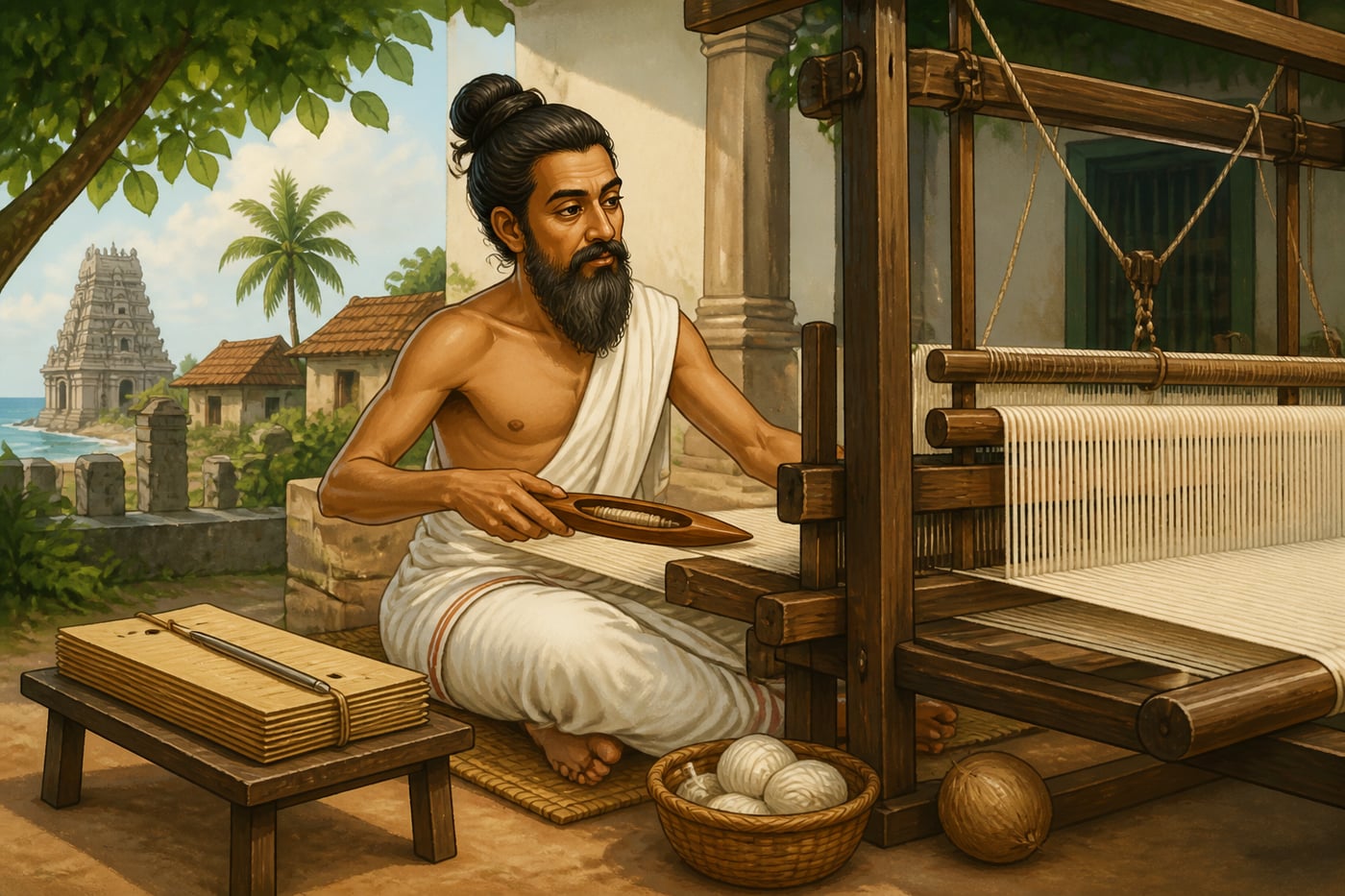
Thiruvalluvar lived in Tamil Nadu sometime between the 1st century BCE and 5th century CE, scholars debate the exact period. He was a weaver by trade, spending his days at the loom. Yet from this humble profession emerged the Tirukkural, 1,330 couplets of moral, political, and spiritual wisdom that became one of the great works of world literature. How did a weaver produce a text that Tamil culture holds equal to the Vedas?
Thiruvalluvar exemplifies svadharma integration rather than abandonment. He did not renounce weaving to become a philosopher; he wove *and* philosophized. His svabhāva was contemplative wisdom; his livelihood was textile craft. Rather than treating these as incompatible, he integrated them. The rhythm of the loom became the rhythm of reflection. The work of the hands freed the mind for insight. His svadharma was not weaving *or* wisdom but wisdom-through-weaving.
The Tirukkural became the foundational ethical text of Tamil culture, translated into over 100 languages, studied for two millennia, quoted by Gandhi and global leaders. Thiruvalluvar's statue in Kanyakumari stands 133 feet tall (representing the 133 chapters). A weaver's reflections became civilization's guidance. Yet he never abandoned his loom; he transformed it into a seat of wisdom.
Thiruvalluvar demonstrates that svadharma is not always about grand career changes. Sometimes it is about transforming the work you already do, finding the path of wisdom within ordinary labor. His svadharma was not *despite* being a weaver but *through* being a weaver. The humblest work can become the greatest contribution when aligned with inner nature.
The rise of the creator economy, where millions earn livelihoods through unique personal expression (writing, art, teaching, coding), validates Thiruvalluvar's model. The most successful creators are those who transform their existing skills and perspectives into unique contributions, not those who abandon their backgrounds to imitate others.
Thiruvalluvar composed 1,330 couplets while working as a weaver. His Tirukkural has been translated into over 100 languages. A 133-foot statue of Thiruvalluvar stands at Kanyakumari, and Tamil Nadu celebrates Thiruvalluvar Day annually on January 15th, making him one of the most honored poet-philosophers in Indian history.
Reflection
- What activities consistently energize you, leaving you more alive after than before? What skills feel natural, almost effortless to express? What contributions does the world seem to welcome from you? Where do these three overlap?
- The Gita says your own dharma, imperfectly performed, is better than another's dharma well performed. Why might this be true? What is lost when we follow paradharma, even successfully?
- If everyone followed their svadharma, would society function? Don't some roles require people to do work that doesn't match their nature? How does individual svadharma relate to collective needs?