Kauśala: Effort, Skill & Intention
The Art of Doing Well
The Rig Veda valued not just action (karma) and giving (dāna), but action performed with excellence. Kauśala (skill), tapas (focused effort), and saṅkalpa (intention) transform ordinary work into mastery. This lesson explores the Vedic understanding that how we work matters as much as what we do, and that skillful action is itself a form of worship.
The young apprentice watched his master shape the altar. Each brick was measured, placed, adjusted, and then removed. "Guru-ji, it looked perfect. Why did you take it out?"
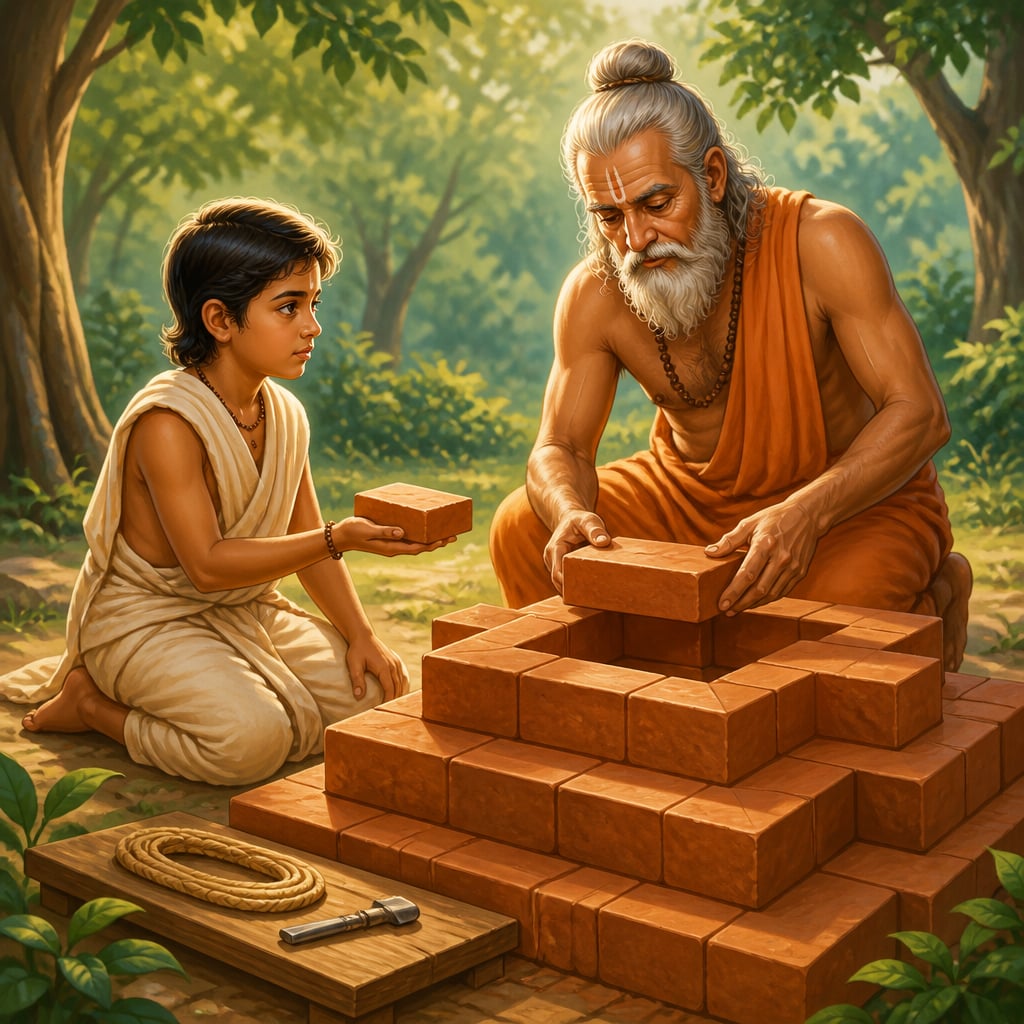
The master smiled. "It was correct. But it was not right." He placed the brick again, this time with a subtle shift in angle. "Now it participates."
The apprentice did not understand. The difference was invisible to his eye. But his master, a Śilpi trained in the sacred geometry of Vedic architecture, could feel what the untrained could not see: the alignment of the brick with forces larger than itself, the movement of the sun, the flow of prāṇa, the proportions that connected earth to heaven.
"Anyone can place bricks," the master said. "A craftsman places bricks that belong."
The Vedic Concept of Kauśala
Kauśala means skill, expertise, proficiency, but in the Vedic context, it carries a deeper resonance. The root kuśa refers to a sacred grass used in rituals; kauśala suggests action performed with the precision and purity that ritual demands. Skill is not merely technique; it is alignment.
The Rig Veda celebrates kauśala across every domain of human activity. The poet praises the rathin (charioteer) whose hands guide horses with perfect responsiveness. The priest is honored for mantras recited with exact intonation, not a syllable misplaced. The warrior is valued not for brute strength but for the skill (śikṣā) that makes each arrow find its mark.
What unites these is the understanding that skill transforms action from mere doing to meaningful participation. The unskilled worker imposes their will on the material. The skilled worker collaborates with it, understanding the grain of the wood, the flow of the river, the rhythm of the season.
What the Mantras Reveal
The Rig Veda addresses Vishwakarma, the Divine Craftsman, with a revealing epithet:

"विश्वकर्मा विमना आद् विहायाः" "Vishwakarma, of vast mind, extends across the heavens."
Vishwakarma is the architect of the cosmos. He fashioned the sun and moon, designed the vehicles of the Devas, created the weapons of the gods. But the verse emphasizes not his products but his mind, vimanā, vast or expanded. Divine craftsmanship begins in consciousness, not in the hands.
Word by word:
- Viśvakarmā, "all-maker," the one whose work encompasses everything
- Vimanāḥ, "of vast/expanded mind"
- Āt, from, extending from
- Vihāyaḥ, the heavens, the expansive space
The teaching: skill is not accumulated technique but expanded awareness. Vishwakarma does not force creation; he perceives possibilities that others cannot see and gives them form. This is why the Rig Veda calls skilled workers śilpin, from śilpa, meaning art, craft, creation. The craftsman is an artist; the artist is participating in cosmic creation.
The Three Dimensions of Excellent Action
The Vedic tradition identifies three qualities that transform ordinary action into excellent action:
1. Tapas (तपस्), Focused Effort
Tapas literally means "heat", the concentrated energy that transforms. Just as fire transforms raw grain into food, tapas transforms raw ability into refined skill. The Rig Veda praises those who have undergone tapas: the Rishi who sat in meditation until insight arose, the warrior who trained until response became instinct, the craftsman who practiced until the hand knew what the mind had not yet thought.
Tapas is not mere repetition. It is deliberate effort, sustained attention applied to the edge of one's current ability. The musician who practices scales mindlessly accumulates hours; the musician who practices with tapas accumulates mastery.
2. Kauśala (कौशल), Developed Skill
Kauśala is the fruit of tapas, the skill that emerges from disciplined effort. But Vedic kauśala has a specific quality: it is knowledge that has become body. The skilled charioteer does not think about what to do; his hands know. The skilled priest does not remember the mantras; they arise. This is what the Gita would later call yogaḥ karmasu kauśalam, yoga is skill in action.
Skill, in this view, is not a collection of techniques but a state of being. The truly skilled are not those who know more methods but those who have become their craft.
3. Saṅkalpa (संकल्प), Clear Intention
Saṅkalpa is resolve, intention, the mental commitment that directs action. Before any Vedic ritual, the priest makes a saṅkalpa, a formal statement of intention that aligns the action with purpose. Without saṅkalpa, even skilled action can be aimless.
The Rishis understood that intention shapes outcome. The arrow shot with distracted mind flies differently than the arrow shot with focused purpose. The meal cooked with resentment nourishes differently than the meal cooked with love. Saṅkalpa is not magical thinking; it is the alignment of consciousness with action that allows skill to express fully.
Traditional Interpretations: Sayana and Aurobindo
Sayanacharya emphasizes the ritual dimension of skill. For Sayana, the precision of Vedic ritual, exact measurements, correct timings, proper pronunciations, is not arbitrary formalism but alignment with cosmic law. The skilled ritualist does not create effects through personal power but through precision that allows Ṛta to flow through the action. Skill is the removal of obstacles between intention and manifestation.
Sri Aurobindo reads skill as the yoga of action. In his interpretation, kauśala represents the state where the ego steps aside and a larger intelligence acts through the person. The truly skilled are not those who have mastered a craft but those who have become instruments of the craft itself. This is why mastery often feels less like "I am doing" and more like "it is happening through me."
Both perspectives point to the same truth: skill is not domination of material but collaboration with it.
Correcting a Misconception
Modern culture often equates skill with efficiency, doing more in less time. The skilled worker is the fast worker; the skilled surgeon is the quick surgeon. Speed becomes the measure.
The Vedic view differs. Skill is not speed but rightness, the action that fits perfectly with what the situation requires. Sometimes rightness is fast; sometimes it is slow. The master who removed the "perfect" brick was not being inefficient; he was perceiving something the apprentice could not. Speed that sacrifices rightness is not skill but haste.
This is why the Vedic tradition speaks of ṛtam (rightness) alongside satyam (truth). Right action is action in harmony with the situation, the material, the purpose. The skilled worker does not impose a preconceived outcome but discovers what the moment actually calls for.
Modern Resonance: The Science of Expertise
Psychologist K. Anders Ericsson spent decades studying world-class performers, musicians, athletes, chess players, surgeons. His research on "deliberate practice" confirms what the Rishis knew about tapas: expertise comes not from time-on-task but from focused, effortful practice at the edge of current ability.
Ericsson found that elite performers share common patterns:
- They practice with full attention, not mindless repetition
- They seek immediate feedback on errors
- They work at the boundary of their ability, where failure is possible
- They maintain this practice over years, not months
This is tapas in scientific language. The violinist who practices difficult passages with focused attention for two hours develops more skill than the violinist who practices easy pieces mindlessly for eight hours. Heat, concentrated energy, transforms.
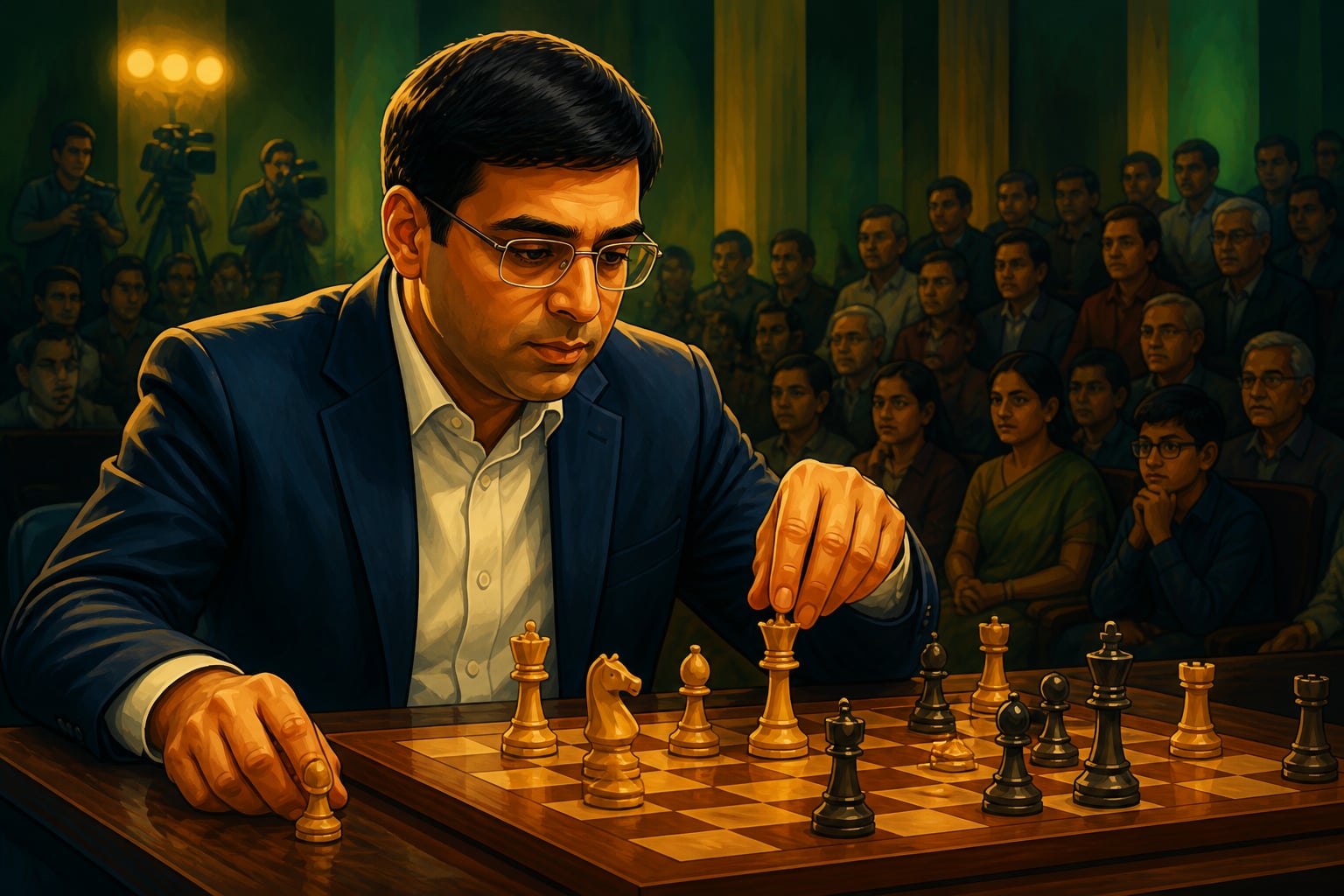
Viswanathan Anand, India's chess grandmaster, exemplifies this principle. Anand did not become World Champion through natural talent alone. He spent decades in deliberate study, analyzing positions, playing through grandmaster games, identifying weaknesses and systematically addressing them. When asked about his process, Anand described something that sounds remarkably like tapas: "You have to put in the hours. But it's not just hours, it's how you use them. You have to push into positions where you're uncomfortable, where you might fail."
K. Anders Ericsson's research on deliberate practice shows that expertise requires focused attention, immediate feedback, and working at the edge of ability, not just time-on-task. This is the scientific formulation of tapas: concentrated effort that transforms.
Angela Duckworth's research on 'grit' shows that sustained, passionate effort over years predicts success better than talent alone. The highest performers combine skill with what the Vedas call tapas, the fire of committed practice.
In skill acquisition, the 'deliberate practice' zone is at the edge of current ability, where failure is possible but not certain. This edge is where the system reorganizes at a higher level. Comfort zones produce stagnation; challenge zones produce growth.
Implementation intention research (Gollwitzer, 1999) shows that stating 'when, where, and how' before action dramatically improves follow-through. This is the psychological mechanism behind saṅkalpa, clear intention organizes the mind for effective action.
The 'commander's intent' in military strategy gives teams a clear purpose that guides action even when plans fail. This mirrors saṅkalpa: the why behind the what, allowing skilled adaptation when circumstances change.
In goal-setting research, 'process goals' (how you'll do it) combined with 'purpose goals' (why you're doing it) outperform either alone. Saṅkalpa integrates both: clear intention that aligns technique with meaning.
A word of caution as we explore these teachings: Recovering the Vedic understanding of skill transforms how we approach expertise. Kauśala is not mere technique but expanded consciousness. Tapas is not punishment but transformation. Saṅkalpa is not magical thinking but alignment of intention with action. This integrated view offers an alternative to the modern fragmentation of skill from meaning.
Your Path Forward
The master's lesson to his apprentice was not about bricks. It was about consciousness. The difference between "correct" and "right" was not visible because it was not physical, it was a quality of attention, a depth of awareness, an alignment with forces the untrained could not perceive.
This week, choose one activity and practice it with tapas: full attention, working at the edge of your ability, seeking feedback on what you cannot yet do. It might be a work skill, a creative practice, or even a conversation. Notice whether focused effort over time, heat applied consistently, begins to transform the activity.
In the next lesson, we explore what the Vedic tradition teaches about our relationship to outcomes, the fruits of our skillful action. How do we act with full commitment while releasing attachment to specific results?
Case studies
Viswanathan Anand: Tapas at the Chessboard
Viswanathan Anand learned chess at age six in Chennai. By 18, he was India's first grandmaster. By 2000, he was World Champion. But between his first world title and his fifth in 2012, Anand faced a challenge that raw talent could not solve: younger competitors with better computer preparation. He was no longer the youngest prodigy; he was the aging champion. How did he adapt? Through what he called 'targeted work', identifying specific weaknesses and addressing them systematically over years.
Anand's career demonstrates all three dimensions of Vedic kauśala. His tapas (sustained effort) was legendary, hours of daily study for decades. His skill (kauśala) evolved continuously, adapting to computer-age chess while maintaining his intuitive style. His intention (saṅkalpa) remained clear: not just to win but to play beautiful chess. When asked about his longevity, Anand spoke of 'pushing into positions where I'm uncomfortable', the edge where tapas transforms.
Anand won five World Championship titles across three different formats, remaining competitive at the highest level for over 30 years. He did this not by natural talent alone, many talented players peak and fade, but by continuous, deliberate refinement. At 50+, he still competes at super-grandmaster level, adapting his style to each era of chess evolution.
Excellence is not a destination but a continuous practice. Anand's 'vast mind' (vimanāḥ) expanded over decades through tapas. The difference between talent and mastery is sustained, focused effort applied over years, the heat that transforms. Skill is not what you're born with; it's what you forge through practice.
The '10,000 hours' rule (popularized by Malcolm Gladwell, drawn from Anders Ericsson's research) is the modern articulation of the same insight: sustained deliberate practice, not innate talent, produces mastery. Peak performers across fields, from surgeons to musicians to athletes, consistently credit focused repetition over years rather than natural ability.
Anand has competed at the top level for 35+ years, longer than most chess careers last entirely. His rating has remained above 2700 (super-grandmaster level) for over 25 years, requiring continuous adaptation as chess itself evolved.
Vishwakarma's Lineage: The Sacred Craftsmen
In Vedic tradition, Vishwakarma is not only a deity but the ancestor of five crafting lineages: the Manu (ironworkers), Māyā (woodworkers), Tvaṣṭṛ (metalworkers), Śilpi (stonemasons), and Viśvajña (goldsmiths). Each lineage treated its craft as divine inheritance, not mere occupation but sacred calling. Children began apprenticeship at age 5-7, learning not just technique but the mantras, rituals, and philosophical understanding that transformed craft into worship.
The Vishwakarma tradition embodies all three elements: tapas (years of rigorous apprenticeship), kauśala (mastery of inherited techniques plus individual refinement), and saṅkalpa (work dedicated to divine service). The craftsman's chisel became ritual implement; the workshop became temple. Before beginning work, artisans recited mantras invoking Vishwakarma, aligning intention with cosmic creation.
This tradition produced India's temple architecture, bronze sculpture, jewelry, and textile arts, works that still stand after millennia. The temples of Mahabalipuram, Konark, Khajuraho, and thousands of others were built by Vishwakarma lineages. The tradition persists today: Vishwakarma communities across India maintain ancestral crafts, blending traditional techniques with modern applications.
When craft is understood as sacred inheritance, as participation in Vishwakarma's cosmic making, skill becomes more than profession. It becomes identity, calling, and worship. The Vedic teaching: work done with full skill, focused effort, and aligned intention is not separate from spiritual practice, it *is* spiritual practice. Every well-made thing is an offering.
The maker movement, artisanal revival, and growing consumer preference for handcrafted goods reflect a hunger for work experienced as craft rather than commodity. Japanese concepts like ikigai (life's purpose) and shokunin (craftsman's spirit) resonate globally because they articulate what industrial-era work culture lost: the experience of skill as identity and labor as meaningful expression.
Vishwakarma tradition craftsmen built temples that have survived over 1,000 years of earthquakes, invasions, and monsoons. The Konark Sun Temple used interlocking stone blocks requiring no mortar, with individual stones weighing up to 20 tons, lifted and placed with precision measurable to millimeters.
Reflection
- What is one skill you would like to develop? Are you currently practicing it with tapas (focused effort at the edge of ability) or with comfortable repetition? What would change if you shifted from repetition to deliberate practice?
- The Rig Veda praises Vishwakarma for his 'vast mind' (vimanāḥ) before praising his creations. What does it mean that divine craftsmanship begins in consciousness rather than technique? What might 'expanding the mind' look like for a craftsman, or for you?
- The master builder removed a 'correct' brick because it was not 'right.' What is the difference between correct and right? Can something be technically perfect but still wrong? What would 'rightness' mean in your work?