Dāna: Work as Contribution
When Giving Becomes the Work Itself
The Rig Veda presents work not as extraction, taking from the world for personal gain, but as offering. The concept of Dāna (giving) transforms how we understand labor itself. When work is understood as contribution to something larger, it stops being a burden and becomes a source of meaning, connection, and even joy.
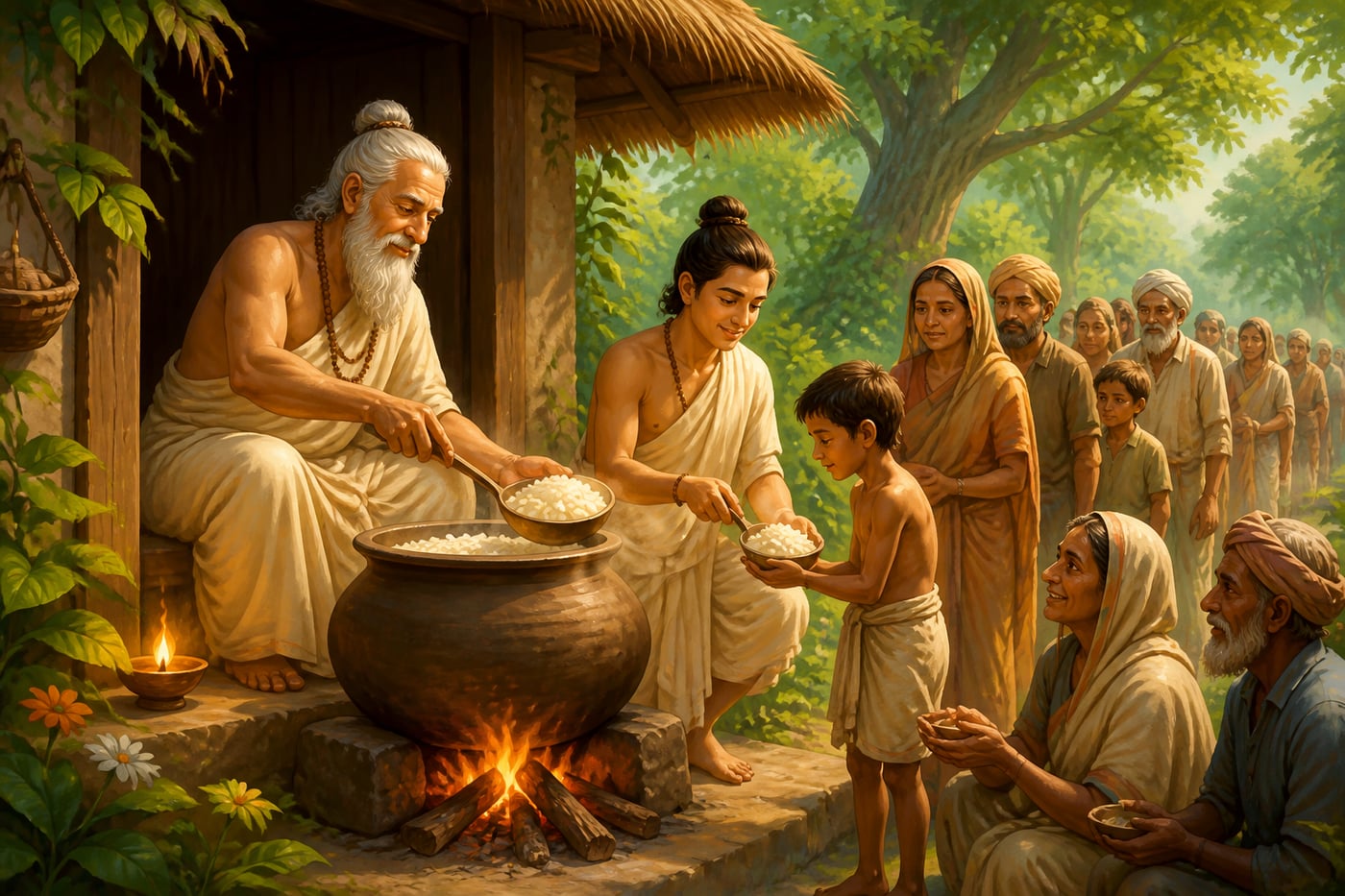
The village was starving. Three years of failed monsoons had emptied the granaries. The Rishi Bharadvāja watched families gather at the crossroads, uncertain where to turn. He had little himself, a small store of grain, barely enough for his āśrama. But that morning, he did something that would echo through Vedic literature. He lit a fire. He cooked. And he fed everyone who came.
"Guru-ji," his student asked, "we cannot feed all of them. There isn't enough."
Bharadvāja kept cooking. "There is never enough," he said, "if you are counting. There is always enough if you are giving."
The grain ran out. And then, somehow, it didn't. What happened next became legend, the origin of the akṣaya pātra, the inexhaustible vessel. But the deeper teaching was not about magical bowls. It was about the nature of giving itself.
The Vedic Principle of Dāna
Dāna means giving, offering, sharing. But the Rig Veda understands dāna not as charity, the wealthy condescending to help the poor, but as a fundamental cosmic principle. The sun gives light without asking for payment. Rivers give water without discrimination. Trees give shade to whoever stands beneath them. This is not metaphor; this is observation. The universe operates through giving.
The Rishis saw that human beings have a choice. We can work in the mode of extraction, taking from the world what we need, hoarding for ourselves. Or we can work in the mode of contribution, giving our effort, skill, and attention to processes larger than our individual interests. The first mode creates scarcity, competition, and anxiety. The second creates abundance, cooperation, and meaning.
The Rig Veda makes this explicit:
"मोघमन्नं विन्दते अप्रचेताः" "Meaningless is the food of one who does not share."
Food (anna) here represents all fruits of labor. Work that accumulates without flowing outward becomes stagnant, purposeless. It is not the having that creates meaning, it is the giving.
What the Mantras Reveal
One of the most powerful verses on dāna appears in the Rig Veda's hymn to generosity:
"केवलाघो भवति केवलादी" "One who eats alone gathers only sin."
This is startling language. Kevala means "alone" or "isolated." Agha means fault, sin, or harm. The Rishi is saying that consumption without sharing is inherently harmful, not as punishment from outside but as a natural consequence. The one who eats alone becomes alone. Isolation is both cause and effect.
Word by word:
- Kevalāghaḥ, one whose harm/sin is solitary
- Bhavati, becomes
- Kevalādī, one who eats alone
The Rishi who composed this verse was not moralizing. He was describing how systems work. In any living system, ecological, social, economic, hoarding creates blockage. Flow creates health. A river that cannot give to the ocean becomes a stagnant pond. An organism that cannot give to its environment becomes isolated and dies.
Traditional Interpretations: Sayana and Aurobindo
Sayanacharya interprets dāna verses in terms of yajna, the ritual offering. For Sayana, giving is not optional generosity but essential participation in cosmic order. The householder who shares food is performing yajna as surely as the priest who pours ghee. Every meal offered to a guest is an offering to Agni, to the Devas, to the cosmic process.
Sri Aurobindo reads dāna as the psychological principle of self-offering. In his view, the external gift symbolizes an inner surrender, the offering of ego, attachment, and the illusion of separate existence. When we give, we enact our true nature as participants in a larger whole. The gift is the practice; the transformation of consciousness is the result.
Both interpretations converge on a key insight: giving is not loss but expansion. When I give, I do not become less; I become more connected. The isolated self shrinks; the relational self grows.
Correcting a Misconception
Modern culture often frames giving as sacrifice, you give up something valuable for someone else's benefit. This creates a zero-sum view: your gain is my loss. From this perspective, giving is either heroic self-denial or naive foolishness.
The Vedic view is different. Giving is not loss but circulation. The sun does not sacrifice by giving light; shining is what the sun is. The river does not sacrifice by flowing; flow is the river's nature. When humans give, whether food, effort, knowledge, or attention, they participate in a cosmic pattern of circulation that benefits everyone, including the giver.
This is why the Rig Veda connects dāna to śrī, prosperity, radiance, good fortune. The generous person does not become poor; they become radiant. Generosity is not a moral obligation grudgingly fulfilled but an alignment with how abundance actually works.
Modern Resonance: The Gift Economy

In 1991, a Finnish programmer named Linus Torvalds did something unusual. He created an operating system kernel, Linux, and gave it away. Not sold, not licensed for profit, but freely shared. Anyone could use it, modify it, improve it, and redistribute it.
This was, by conventional economic logic, absurd. Torvalds had created something valuable. Why not sell it?
But Torvalds understood something the Rishis knew millennia ago: some things become more valuable by being given away. Linux didn't diminish because it was shared; it grew. Thousands of developers contributed improvements. Companies built infrastructure on top of it. Today, Linux runs the majority of the world's servers, supercomputers, and smartphones. The value of Torvalds' gift multiplied precisely because it was given.
This is not charity. It is contribution, work offered to something larger than individual profit. The open-source movement demonstrates the Vedic principle: when work becomes dāna, it generates abundance that no individual could create alone.
Similar patterns appear across domains. Wikipedia's volunteer editors contribute without payment; the result is the world's largest encyclopedia. Scientists share research openly; collective knowledge accelerates. Teachers give knowledge to students; the knowledge doesn't diminish, it grows.
Research on the 'helper's high' (Allan Luks, 1991) shows that giving activates the same neural pathways as receiving rewards. Generosity reduces cortisol levels and increases oxytocin. The body knows what the Rishis observed: giving is not loss.
Adam Grant's research ('Give and Take') shows that 'givers', those who contribute without immediate expectation of return, outperform 'takers' in the long run. Organizations with giving cultures show higher innovation and retention.
In ecology, 'keystone species' are those whose giving (nitrogen fixation, pollination, seed dispersal) supports entire ecosystems. Humans can choose to be keystone contributors, their giving creates cascading benefits beyond any individual transaction.
Mihaly Csikszentmihalyi's research on 'flow' shows that the most meaningful work experiences occur when we are fully absorbed in contribution, when we forget ourselves in service to the task. Self-focused work rarely achieves flow.
Companies with strong mission orientation (Patagonia, TOMS) outperform profit-only competitors in employee engagement and customer loyalty. When work feels like contribution to something larger, people bring their whole selves.
In complex systems, nodes that only extract (parasites) weaken the whole. Nodes that contribute (mutualists) strengthen it. Organizations and individuals face the same choice: extract or contribute. The system rewards contribution.
A word of caution as we explore these teachings: Understanding dāna as cosmic participation rather than moral obligation changes how we approach work. If giving is natural flow, then extractive work is unnatural, working against the grain of how abundance operates. Modern economies built on extraction create the isolation and emptiness the Rishis warned against. Recovering the Vedic view offers an alternative: work as contribution, labor as offering, life as ongoing dāna.
Your Path Forward
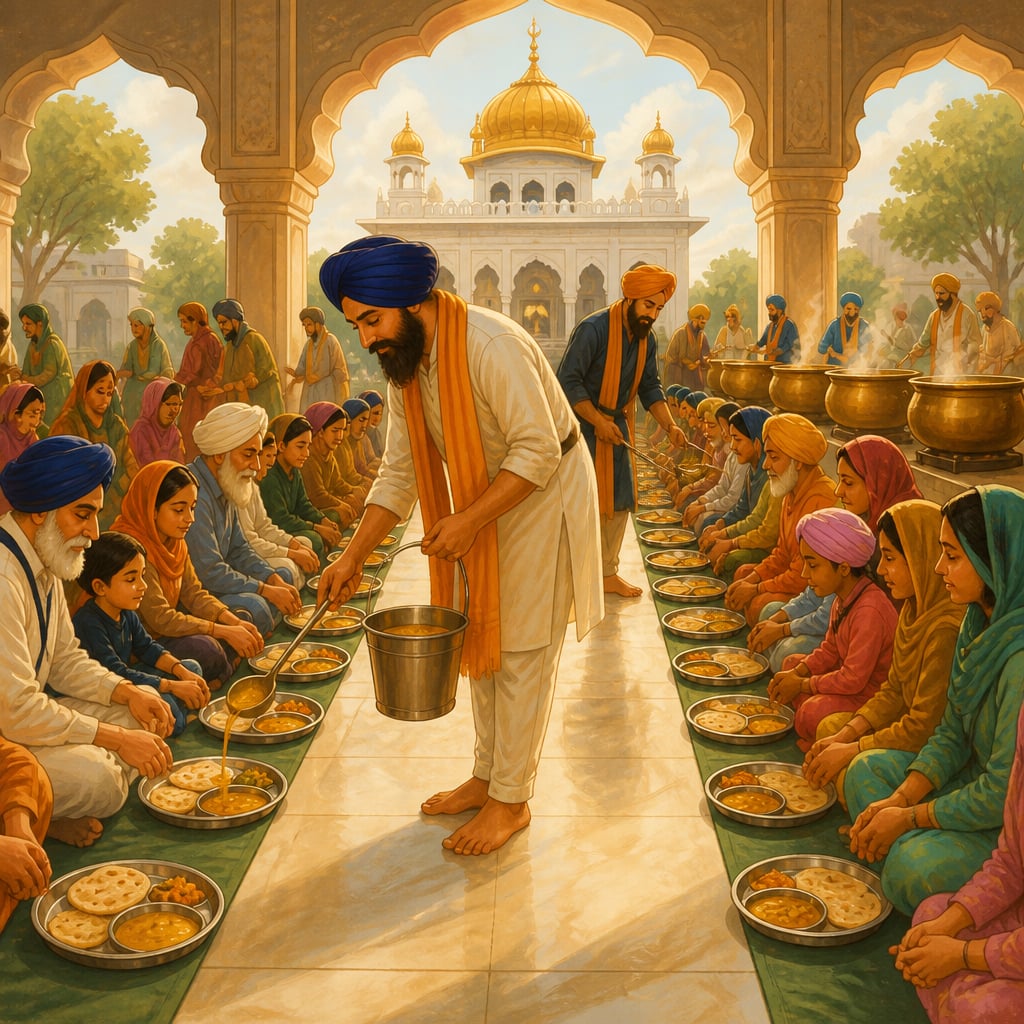
Bharadvāja's legend ends not with the magical bowl but with its consequence: a tradition of anna dāna, the giving of food, that persists to this day. Every langar in a gurudwara, every temple prasādam distribution, every free meal at a wedding carries forward the Rishi's insight: there is never enough if you are counting, always enough if you are giving.
This week, try a simple practice: In one area of your work, shift from extraction mode to contribution mode. Ask not "What can I get from this?" but "What can I give to this?" It might be a meeting, a project, a conversation. Notice what happens, not to the external outcome, but to your experience of the work itself.
In the next lesson, we explore what makes work excellent, not just doing, but doing with skill, effort, and intention. The question becomes: What does it mean to give well?
Case studies
Linux: The Gift That Built the Internet
In 1991, Linus Torvalds was a 21-year-old computer science student in Finland. He created an operating system kernel, Linux, and made a decision that defied conventional economics: he gave it away. Anyone could use it, modify it, and redistribute it freely. Companies worth billions, governments, and hobbyists alike could access his work without payment. Over the next three decades, thousands of developers contributed improvements, also freely. No central company controlled Linux; no one owned it.
Torvalds enacted the Vedic principle of dāna at civilizational scale. By giving his work, he did not diminish it, he expanded it beyond what any individual or company could have created. Linux demonstrates the Rig Veda's teaching: 'mogham annaṃ vindate apracetāḥ', work hoarded becomes meaningless. Work given freely became the infrastructure of the modern internet.
Today, Linux runs the majority of the world's servers, 100% of the top 500 supercomputers, all Android phones, and critical infrastructure from banking to air traffic control. The value created by this gift is incalculable, trillions of dollars of economic activity flow through Linux-powered systems. Torvalds himself became wealthy (through speaking, consulting, and stock grants from companies that use Linux), but the wealth is secondary to the contribution.
The open-source movement demonstrates that work-as-dāna can operate at scale in the modern economy. When contribution replaces extraction as the organizing principle, abundance multiplies. The gift economy is not naive idealism, it's how the most valuable infrastructure of the 21st century was built.
The open-source model now extends far beyond software. Open-access scientific publishing, Creative Commons educational materials, and open-source hardware (like Arduino) all demonstrate that contribution-based systems can outproduce extraction-based ones. The most valuable infrastructure of the digital age was built by people who gave their work away.
Over 15,000 developers from 1,500 companies have contributed to the Linux kernel. The collective effort represents billions of dollars in value, all built on the foundation of one Finnish student's decision to give rather than sell.
The Langar: Five Centuries of Anna Dāna
In the 15th century, Guru Nanak established a revolutionary practice: the langar, a community kitchen where anyone could eat, regardless of caste, religion, gender, or wealth. All sat on the floor together. All ate the same food. The wealthy served the poor; the Brahmin sat beside the outcaste. This was not occasional charity but daily practice, every Sikh gurudwara, then and now, runs a langar where any visitor is fed.
The langar institutionalizes the Rig Vedic teaching that 'kevalāgho bhavati kevalādī', eating alone is harmful. Guru Nanak took the ancient principle of anna dāna and made it a social practice that dissolved the boundaries that separated humans from each other. Work in the langar, cooking, serving, cleaning, became seva (service), a form of worship. The kitchen became a temple.
Today, the langar at Harmandir Sahib (Golden Temple) in Amritsar feeds approximately 100,000 people daily, free of charge. During crises (COVID-19, natural disasters), gurudwaras worldwide have scaled their langars to feed communities far beyond Sikh populations. The infrastructure of giving, maintained for five centuries, proved instantly adaptable to modern emergencies.
Anna dāna demonstrates that giving can be systematized without losing its sacred quality. The langar is not a charity program run by an organization; it is a spiritual practice performed by a community. When work becomes offering, when cooking becomes prayer and feeding becomes worship, sustainability follows naturally. The practice has persisted for 500 years because it transforms both giver and receiver.
Community kitchens have surged worldwide during crises, from COVID-19 mutual aid networks to World Central Kitchen's disaster response. The model works because giving food is simultaneously practical (people need to eat) and transformative (the act of feeding changes both giver and receiver). Organizations that frame their work as service consistently attract more dedicated volunteers than those framing it as charity.
The Golden Temple langar serves approximately 100,000 free meals daily, using 12,000 kg of flour, 1,500 kg of rice, and 1,500 kg of dal. During COVID-19, Sikh gurudwaras worldwide served an estimated 30 million meals to affected communities.
Reflection
- Where in your work life do you operate in 'extraction mode', focused on what you can get? Where do you operate in 'contribution mode', focused on what you can give? What would shift if you moved one extraction-mode activity to contribution-mode?
- The Rig Veda says 'one who eats alone gathers only sin.' Why might isolation be the natural consequence of hoarding? What does the word 'alone' mean in this context, is it about physical solitude or something deeper?
- The open-source movement created trillions of dollars in value by giving away work. Does this suggest that contribution is actually more economically productive than extraction, or is it a special case? Can all work be dāna?