Karma: Action in the Rig Veda
Why Action Is Never Just Action
Before karma became associated with rebirth and cosmic justice, the Rig Veda used the word differently. Karma was action as participation, ritual, work, and deed as the way humans join the cosmic dance. This lesson explores the original Vedic understanding of action: not as something we do to get results, but as something that connects us to forces larger than ourselves.
The fire had been burning since before dawn. The hotri priest stood motionless, ladle raised, ghee glistening in the first light. Around him, the other priests waited, the adhvaryu who would tend the altar, the udgātṛ whose chants would carry the offering upward. But the hotri did not move. His teacher, an old Rishi who had performed a thousand such rituals, watched from the shadows. Finally, the young priest lowered the ladle. "Guru-ji," he said, "I understand the words. I know the movements. But I do not understand what I am doing. What happens when I pour this offering into the fire?"
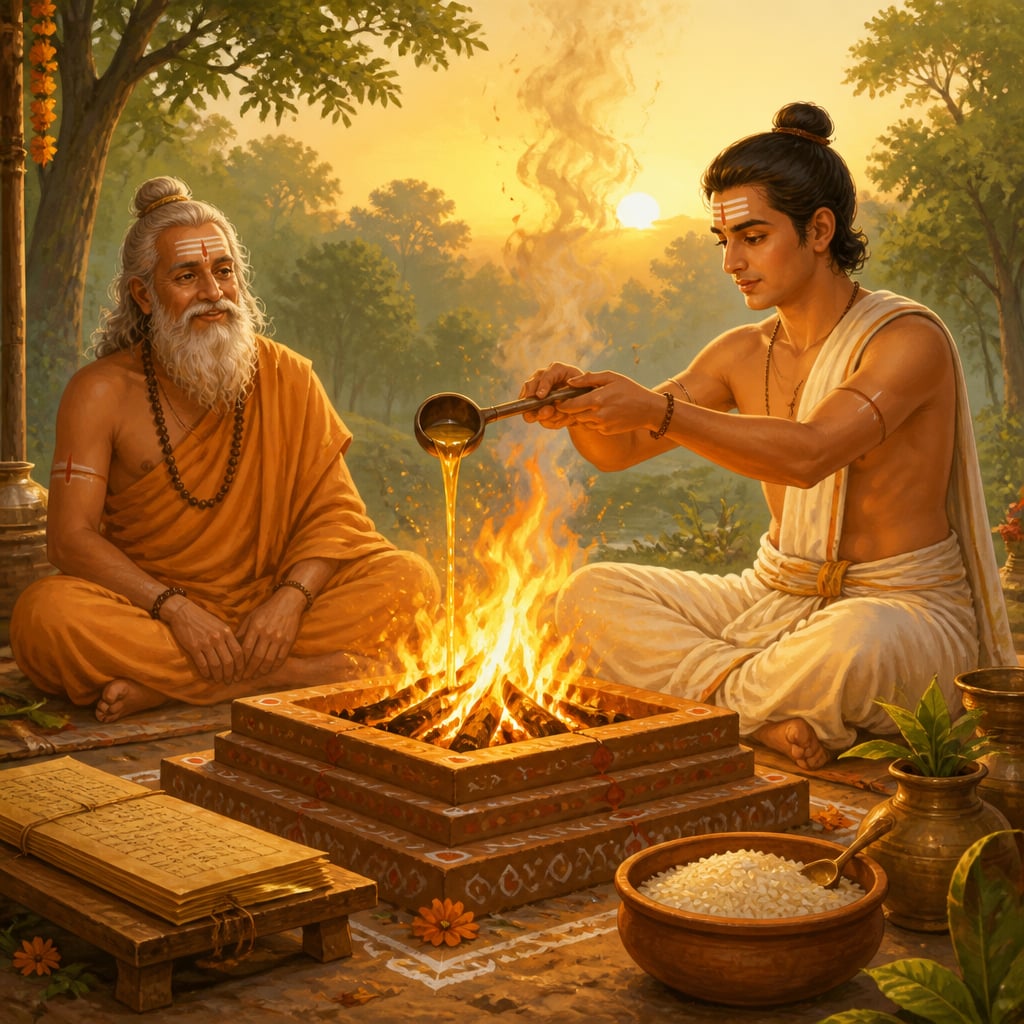
The old Rishi smiled. This was the question he had waited years to hear. "You are not merely pouring ghee," he said. "You are participating."
The Vedic Meaning of Karma
The Sanskrit word karma comes from the root kṛ, "to do, to make, to act." In modern usage, karma often refers to a cosmic ledger: good actions earn rewards, bad actions earn punishment, and the balance carries across lifetimes. But this understanding developed later, in the Upanishads and the epics. The Rig Veda uses karma differently.
In the Rig Veda, karma refers primarily to ritual action, the yajna, the sacrifice, the offering. But the Vedic concept of ritual was not about appeasing gods for favors. It was about participation. When the priest poured ghee into the fire, he was joining a process already underway, the cosmic exchange that keeps the universe functioning.
The Rishis observed that everything in nature operates through exchange. The sun gives light; plants transform it into food; animals eat plants and return nutrients to the soil; rain falls, rivers flow, and the cycle continues. Nothing exists in isolation. And humans, the Rishis realized, were not exempt from this web. Our actions, our karma, either participate in this cosmic flow or obstruct it.
What the Mantras Reveal
One of the most important mantras on action appears in the Purusha Sukta:
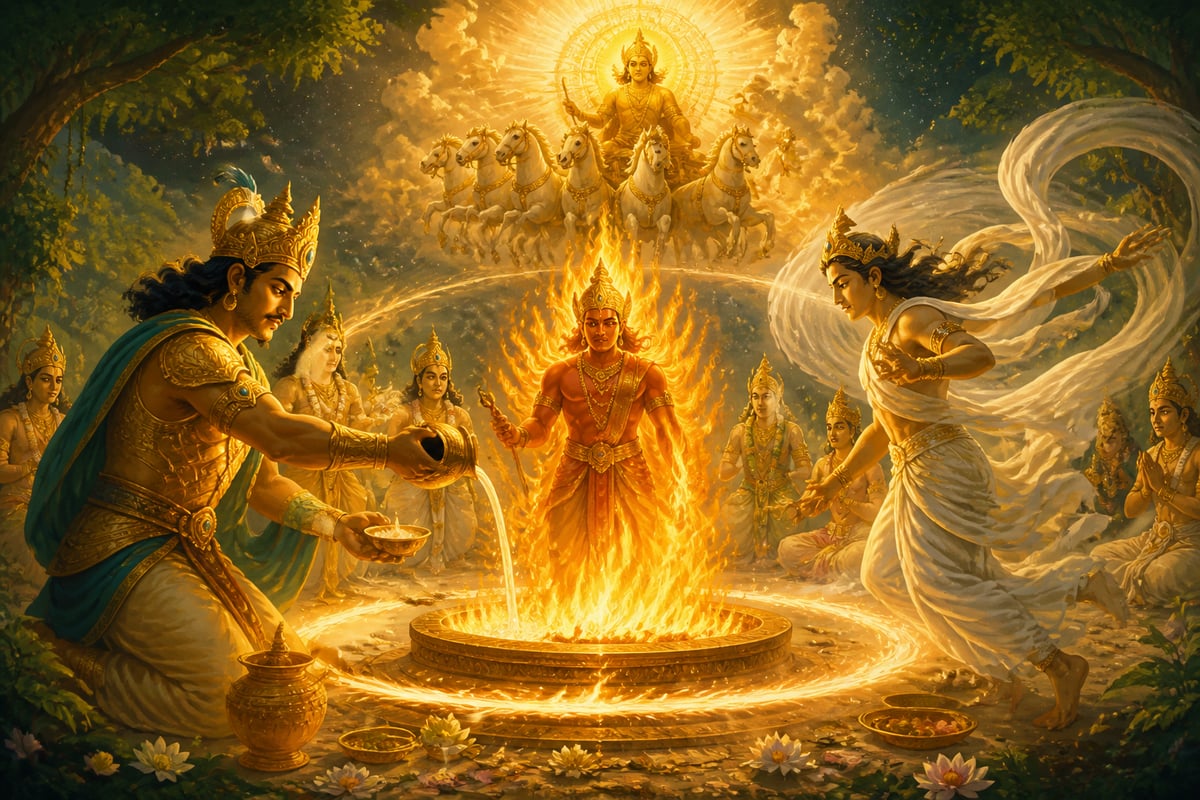
"यज्ञेन यज्ञमयजन्त देवाः" "By yajna, the Devas performed yajna."
This seems circular, but the circularity is the point. The Devas, the cosmic forces, sustain themselves through action. There is no moment when they step outside the cosmic process to observe from a distance. Agni, the fire, is not a being who uses fire; Agni is the transformative principle, always acting. Vāyu, the wind, does not sometimes blow and sometimes rest; Vāyu is movement itself.
The mantra tells us: even the gods participate. They do not command from above. They act within the system. And if the cosmic forces sustain themselves through continuous action, what does that mean for humans?
Word by word:
- Yajñena (by yajna), through ritual action, through offering
- Yajñam (the yajna), the sacrifice, the cosmic process
- Ayajanta (they performed), they participated, they enacted
- Devāḥ (the Devas), the cosmic forces themselves
The teaching is radical: action is not what we do to the universe. Action is how we join it.
Sayana and Aurobindo: Two Views of Vedic Action
Sayanacharya, the 14th-century commentator, interprets Vedic karma in terms of ritual precision. For Sayana, the yajna works because its elements, mantras, offerings, timings, align with cosmic law (Ṛta). When performed correctly, the ritual creates effects as reliably as planting seeds creates crops. This is a technical understanding of karma: action produces results according to natural law.
Sri Aurobindo, in The Secret of the Veda, offers a psychological reading. For Aurobindo, the external yajna symbolizes an inner sacrifice, the offering of ego, desire, and limitation to the transformative fire of consciousness. Karma, in this view, is not just outer action but inner orientation. The quality of our consciousness during action matters as much as the action itself.
Both perspectives illuminate something essential. Sayana reminds us that action has real effects in the real world, it is not merely symbolic. Aurobindo reminds us that mechanical action without awareness is incomplete. The Vedic Rishi who poured ghee into the fire was doing both: performing a precise physical act and aligning his consciousness with cosmic purpose.
Correcting a Misconception
Modern discussions of karma often reduce it to moral accounting: "Do good, get good; do bad, get bad." This makes karma sound like a cosmic vending machine, insert the right coin, receive the right outcome.
The Rig Veda offers no such guarantee. The Rishis understood that action participates in a system too complex for any individual to control. A farmer plants seeds, but whether the rains come depends on forces beyond his will. A priest performs the ritual perfectly, but the outcome remains with Varuna, the guardian of cosmic order.
This is not fatalism. The Rishis did not say, "Nothing we do matters." They said something more nuanced: "What we do matters, but we are not the sole authors of outcomes." Action has meaning not because it guarantees results, but because it connects us to the larger order. The farmer who plants is participating in the cycle of growth, and that participation has value regardless of whether this particular crop succeeds.
Modern Resonance: Meaning Beyond Transaction
In 2024, the corporate phrase "work-life balance" reveals how we typically think about action: work is the price we pay for life. Action is transactional, we do it to get something else.
But research on motivation tells a different story. Psychologist Amy Wrzesniewski's studies on "job crafting" show that people who view their work as a calling, not just a job or a career, experience greater meaning and well-being. What distinguishes a calling? The sense that the work matters beyond personal benefit. Hospital cleaners who see themselves as "part of the healing team" report higher job satisfaction than those who see themselves as "just cleaning."
This is precisely the Vedic insight. When we understand our action as participation in something larger, a family, a community, a craft tradition, a nation, a cosmic order, the action itself becomes meaningful. We are not just doing a task; we are joining a process that transcends us.
Satya Nadella, Microsoft's CEO, describes his leadership philosophy in terms that echo Vedic karma: "The learn-it-all does better than the know-it-all." This isn't just humility, it's an orientation toward action as ongoing participation rather than finished achievement. The "know-it-all" sees action as a way to prove mastery. The "learn-it-all" sees action as a way to stay connected to a reality larger than the self.
Self-Determination Theory (Deci & Ryan) shows that intrinsic motivation, acting for the sake of the activity itself, produces better outcomes and well-being than extrinsic motivation. The Vedic insight: participation is inherently fulfilling; transaction depletes.
Patrick Lencioni's research on team dysfunction shows that the most effective leaders 'go first', they model the participation they expect. Satya Nadella at Microsoft demonstrates this by regularly joining product teams as a learner, not just an evaluator.
In complex systems, every node is both cause and effect. Donella Meadows observed that trying to 'control' complex systems usually fails; participating intelligently succeeds. The Vedic yajna model is proto-systems thinking.
Research on 'locus of control' shows that extreme internal locus ('I control everything') correlates with burnout and anxiety. A balanced locus, doing fully while accepting uncertainty, matches the Vedic kartṛ who acts but does not control outcomes.
Jim Collins' 'Good to Great' identifies 'Level 5 leaders' who combine fierce resolve with humility. They drive action while acknowledging forces beyond their control. This mirrors the Vedic doer-not-controller orientation.
Complex adaptive systems are inherently unpredictable. The wise actor does not try to control emergence but participates skillfully, observing and adjusting. The Vedic Rishi understood this before chaos theory existed.
A word of caution as we explore these teachings: Recovering the original Vedic understanding of karma liberates the concept from moralistic oversimplification. Karma is not about earning cosmic points. It is about how we participate in reality. This framing makes the concept directly relevant to modern work: not 'Will this action earn me rewards?' but 'What am I joining when I act?'
Your Path Forward
The young priest finally understood. Pouring ghee into the fire was not a technique for obtaining blessings. It was a way of joining, participating in the same cosmic exchange that powered the sun, grew the crops, and filled the rivers. Every action, performed with awareness, was an opportunity to connect.
This week, try a simple practice: Before any significant action, a meeting, a conversation, a project, pause and ask: "What am I participating in? What larger process does this action serve?" You may find, as the Rishis did, that action becomes less about what you get and more about what you join.
In the next lesson, we explore how this understanding transforms our view of work itself, from burden to contribution, from extraction to offering.
Case studies
ISRO's Chandrayaan-3: Kartavya Over Career
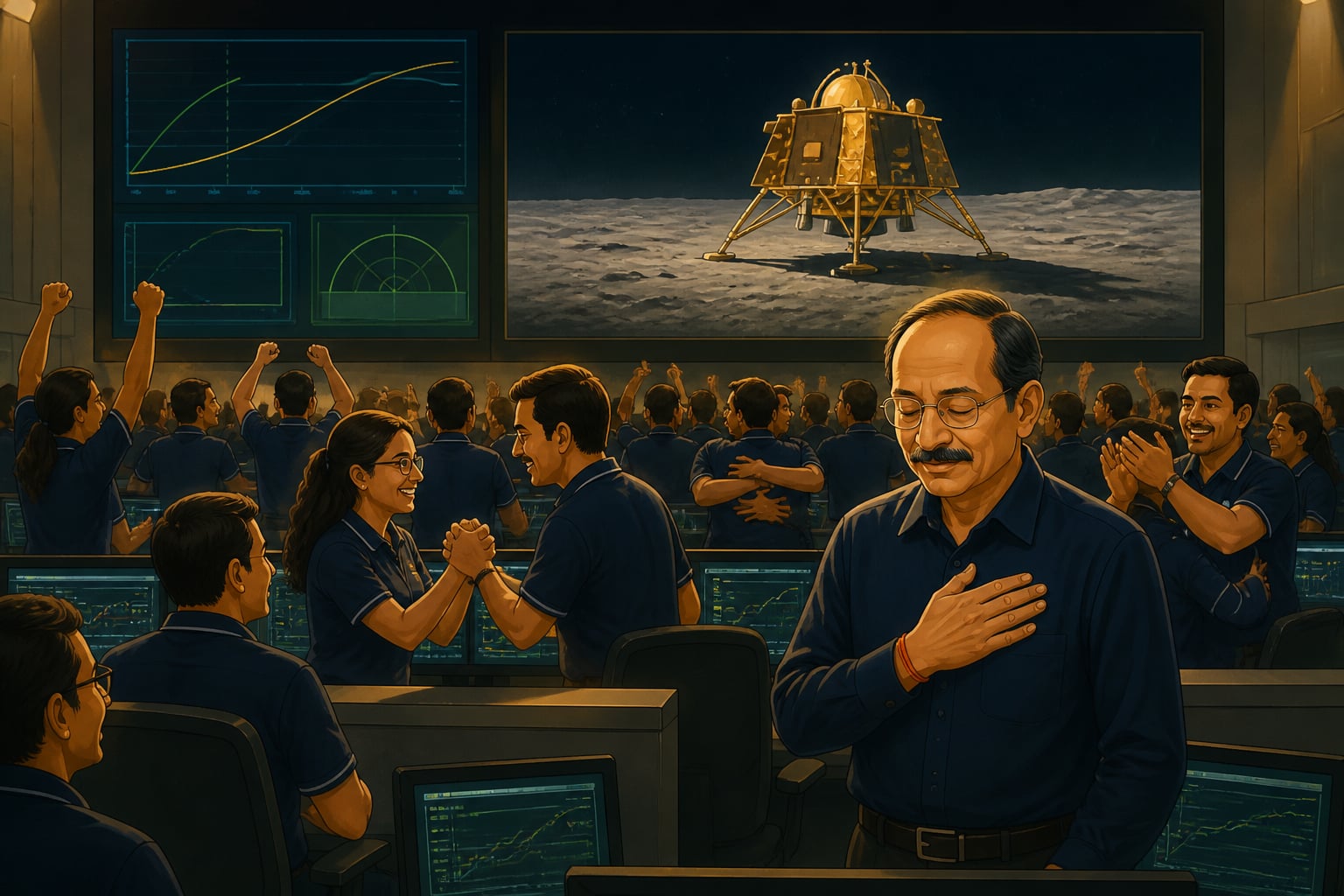
On August 23, 2023, India became the fourth nation to soft-land on the Moon, and the first to reach the lunar south pole. What made Chandrayaan-3's success remarkable wasn't just the technology. It was how the ISRO team approached their work. After Chandrayaan-2's lander crashed in 2019, the team didn't scatter to higher-paying opportunities abroad. They stayed. They analyzed every failure mode. When asked why, engineer P. Veeramuthuvel used a telling word: 'kartavya', sacred duty. 'This is not a job,' he said. 'This is our offering to the nation.'
The ISRO team demonstrated the Vedic understanding of karma as participation rather than transaction. They could have 'cashed out' their expertise for higher salaries at SpaceX or Blue Origin. Instead, they saw their work as yajña, an offering that connected them to something larger than individual careers. Their action (karma) gained meaning not from personal gain but from participation in national and civilizational purpose.
Chandrayaan-3 succeeded where Chandrayaan-2 failed. The soft landing on the lunar south pole opened new possibilities for water-ice research critical to future Moon bases. The mission cost approximately $75 million, less than the budget of many Hollywood films about space. And India joined an elite group of space-faring nations, inspiring millions of young scientists.
When work is understood as participation (yajña) rather than transaction, people bring their full selves to the task. Failure becomes learning, not defeat. Success becomes offering, not conquest. The Vedic insight, that action gains meaning through connection to larger purpose, powered one of the 21st century's great technical achievements.
SpaceX, DRDO, and other mission-driven organizations consistently outperform comparable teams on salary and resources alone. Purpose-driven work environments show 30-40% higher retention and productivity in organizational studies. The lesson scales beyond space agencies: any team that connects daily tasks to a meaningful larger mission unlocks discretionary effort that transactional management cannot purchase.
ISRO's budget is roughly 1/20th of NASA's, yet it has achieved comparable milestones. The difference isn't just efficiency, it's orientation toward action as service rather than transaction.
Bhishma's Vow: Lifelong Action Anchored in Dharma
When the young prince Devavrata learned that his father, King Shantanu, was in love with a fisherwoman whose father demanded the throne for her sons, he faced a choice. He could protect his own claim to kingship. Or he could act for his father's happiness and the kingdom's stability. Devavrata chose to renounce the throne, and more. He took an extraordinary vow: lifelong celibacy, ensuring he would never produce heirs to challenge his stepbrothers' lineage. So fierce was this vow that even the Devas trembled, and he was renamed Bhishma, 'the one of terrible oath.'
Bhishma's vow demonstrates karma as alignment rather than calculation. He did not weigh personal benefits against costs. He asked a different question: 'What action serves dharma?' Once he identified the answer, he committed fully, for a lifetime. His action (karma) was not a one-time transaction but a continuous participation in the order of his family and kingdom. Every day of celibacy was a fresh enactment of his original commitment.
Bhishma became the grand-patriarch of the Kuru dynasty, serving as regent, protector, and teacher through multiple generations. His presence stabilized the kingdom for decades. Even in the Mahabharata war, when circumstances forced him to fight on the side he knew would lose, he maintained his dharmic alignment, advising the Pandavas how to defeat him because truth (satya) was higher than personal survival.
Bhishma shows that meaningful action is not ad hoc but anchored. When karma is grounded in a binding commitment (vrata), every subsequent action becomes part of a coherent whole. We are not constantly re-deciding; we are continuously participating in what we have already chosen. This creates clarity, strength, and freedom from the endless recalculation of self-interest.
Long-term commitments, from marriage vows to military oaths to startup founder agreements, all function on the same principle. The initial commitment eliminates the need for daily re-evaluation, freeing mental energy for execution. People who anchor their work in a declared purpose report higher satisfaction and resilience than those who continuously optimize for circumstance.
Bhishma served the Kuru dynasty through five generations of rulers, spanning an estimated 80+ years from his vow until the Kurukshetra war. The Mahabharata dedicates over 20,000 verses to his teachings on dharma, governance, and ethics in the Shanti and Anushasana Parvas.
Reflection
- Think of your current work (job, studies, household duties). Do you approach it primarily as a transaction (effort in, reward out) or as participation (joining something larger)? What would shift if you changed your orientation?
- The Purusha Sukta says 'By yajna, the Devas performed yajna.' What does it mean that even the cosmic powers sustain themselves through action? What does this suggest about the nature of reality itself?
- If we are 'doers' (kartṛ) but not 'controllers,' how should we relate to outcomes? Is there a way to act with full commitment while genuinely releasing attachment to specific results?