Vṛtra-Vadha: Chaos as a Constant, Not an Exception

Why True Leaders Prepare for Disruption, Not Stability

The Rig Veda's most repeated story is not of peace but of battle, Indra slaying Vritra, the force of obstruction. This lesson explores why the Rishis placed cosmic conflict at the center of their understanding of order, and what this means for leaders who assume stability is the norm.

The rains had stopped. Not for a season, but seemingly forever. The rivers shrank to trickles, the crops withered, and the people of the Sapta-Sindhu looked to the skies with growing despair. They had performed the rituals correctly, offered the soma, chanted the mantras with precision, yet the waters would not come. Something was holding them back.
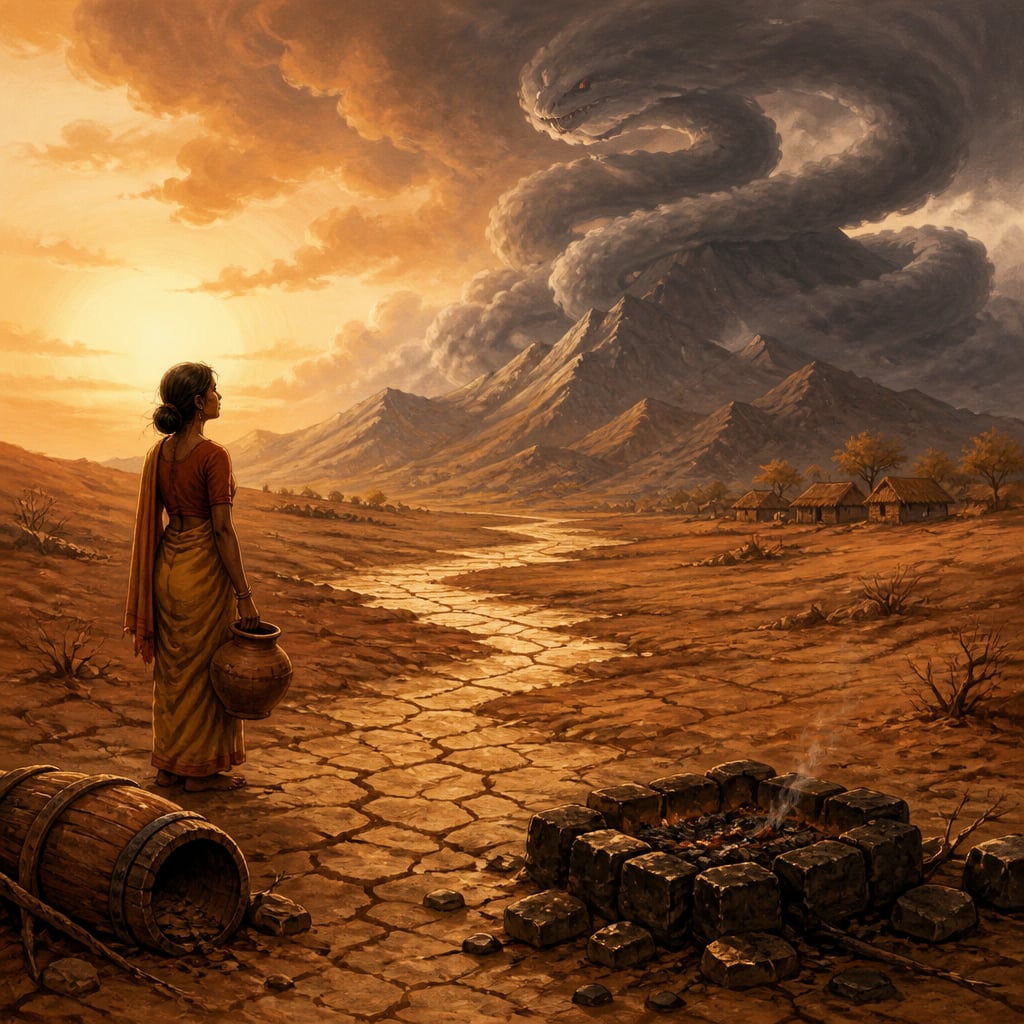
A parched Vedic plain at dawn with a lone woman holding an empty pot

The Rishis understood what was happening. High in the mountains, coiled around the sources of the seven rivers, lay Vṛtra, the serpent of obstruction. This was no ordinary drought. This was cosmic blockage. And they knew that relief would come not through more rituals alone, but through vadha, the violent breaking of what obstructs.

A word of context as we explore this teaching: The Vṛtra-vadha narrative establishes that the Vedic tradition understood order as something achieved through effort, not received passively. This has profound implications for modern leadership: rather than planning for stability and treating disruption as exceptional, the Vedic model suggests planning for disruption and treating stability as a temporary achievement. This framework proves particularly relevant in an era of accelerating technological and social change, where chaos-as-constant may be the most accurate description of our operating environment.

The Waters Held Hostage

Picture the Vedic world: a civilization built along mighty rivers, dependent on the monsoon's rhythms, organized around the fire sacrifice that connected earth to heaven. This was not a people unfamiliar with order. The yajña required exacting precision, wrong syllables could void the offering, improper timing could anger the cosmic forces. The Rishis were masters of Ṛta, the cosmic order.

Yet the most frequently invoked deity in the Rig Veda is not a god of peace or stability. It is Indra, the warrior who slays Vṛtra. Over 250 hymns celebrate his battle against the serpent of obstruction. Why would a culture so devoted to order place cosmic violence at the center of their sacred literature?

Because they understood something modern leadership often forgets: order is not the natural state. Order must be won, defended, and won again. The waters do not flow on their own, they must be released from whatever holds them captive. This is the essence of Vṛtra-vadha: the necessary breaking of obstruction.

What the Mantras Reveal

The Rishi Hiraṇyastūpa composed the central hymn of Indra's victory:

"Ahan vṛtraṃ vṛtrataraṃ vyaṃsam indro vajreṇa mahatā vadhena"

He slew Vṛtra, the greatest of obstructors, Indra with his mighty vajra, with great force., RV 1.32.5

Word by word: ahan (he slew) vṛtram (Vṛtra) vṛtrataram (the greatest obstructor) vyaṃsam (the enveloper) indraḥ (Indra) vajreṇa (with the thunderbolt) mahatā (great) vadhena (with force/slaying).

Notice what the mantra emphasizes: not just that Vṛtra was defeated, but that he was vṛtrataram, the supreme obstructor, the ultimate blockage. The Rishis weren't describing a minor inconvenience. They were articulating a cosmic principle: the greatest forces of order must prepare for the greatest forces of obstruction.

Indra hurling the vajra at coiled Vrtra

The hymn continues to describe the aftermath: "Then the waters flowed for the benefit of humanity." Order was not the starting point, it was the result of confronting chaos. This sequence matters: first the battle, then the flow.

The Commentaries Speak

Sayanacharya, in his 14th-century bhāṣya, interprets Vṛtra as both literal and symbolic. Yes, there is a cosmic serpent who holds the waters. But vṛtra also means "that which covers, conceals, obstructs", derived from the root vṛ (to cover, to restrain). Every leader faces their own vṛtra: the market forces that block growth, the competitors who obstruct progress, the internal resistance that prevents change.

Sri Aurobindo, in The Secret of the Veda, deepens this reading. For him, Vṛtra represents tamas, the force of inertia, resistance, and stagnation that exists within consciousness itself. Indra is not merely a storm god but the divine power of illumined mind breaking through the darkness of unconsciousness. The battle is psychological before it is physical.

Both interpreters agree on the essential point: obstruction is not an accident to be surprised by, it is a structural feature of existence. The Rishis built their entire cosmology around this recognition. A leader who expects smooth sailing has already misunderstood the nature of the journey.

Leading in the Age of Disruption

Jio telecom war room lighting up India

In 2016, Reliance Jio entered India's telecom market and created the largest disruption the industry had ever seen. Within months, established players like Airtel, Vodafone, and Idea were fighting for survival. Prices collapsed by 90%. Companies that had seemed unshakeable were suddenly scrambling.

Mukesh Ambani and his team did not achieve this by assuming stability. From the beginning, they prepared for chaos, not as an exception but as the operating environment. They invested ₹250,000 crore before making a single rupee in revenue. They built infrastructure to handle disruption from competitors, regulators, and even their own rapid growth.

More instructively, when chaos came to Jio, network outages, regulatory challenges, competitor lawsuits, the response was not surprise. The team had built systems assuming disruption was constant. Their crisis management protocols weren't afterthoughts; they were core architecture.

This is Vṛtra-vadha thinking in corporate form: assume the serpent is always coiling around your water sources. Assume obstruction is the norm. Build your vajra before you need it.

Your Leadership Tested

You might be reading this during a period of relative calm in your work or life. Perhaps things are flowing smoothly. The temptation in such moments is to assume this is the natural state, that disruption, when it comes, will be the exception requiring exceptional response.

The Rishis would gently disagree. They would point to the 250+ hymns celebrating the endless battle against obstruction and ask: if chaos were exceptional, why would it dominate our sacred literature? If stability were natural, why would we need Indra at all?

The practical insight is this: use periods of calm to prepare for chaos, not to assume chaos is over. Build your capacity to respond before the crisis. Develop your ojas (vital force) and tejas (brilliant energy) when you have the space, so they're available when Vṛtra appears.

In our next lesson, we'll explore Vṛtra himself more deeply, understanding the nature of obstruction, how it manifests, and why the Rishis personified it as a serpent holding back the waters of life.

Research on 'stress inoculation' by Donald Meichenbaum shows that exposure to moderate stressors builds psychological resilience for major challenges. Athletes, soldiers, and emergency responders train in chaos because stability is not their operating environment. The Vedic assumption of constant disruption anticipates this: build your capacity through practice, not through hoping for calm.

Nassim Taleb's concept of 'antifragility' describes systems that grow stronger from disorder rather than merely surviving it. Companies like Amazon and Reliance Jio build for disruption as the normal state, investing in optionality and resilience rather than efficiency and prediction. This is corporate Vṛtra-vadha: assuming obstruction and building the capacity to break through it.

Complex adaptive systems theory recognizes that disruption, far from being exceptional, drives evolution and adaptation. Ecosystems require periodic disturbance (fires, floods, predation) to maintain diversity and vitality. Organizations that eliminate all variance become brittle. The Vedic model of constant battle with obstruction describes a healthy, adaptive system.

Research on 'proactive coping' (Aspinwall & Taylor) demonstrates that people who prepare for future challenges before they arrive show better outcomes than those who only react. This includes building skills, resources, and mental frameworks. The Vedic emphasis on ojas-accumulation is essentially proactive coping at civilizational scale.

Warren Buffett's famous advice, 'Only when the tide goes out do you discover who's been swimming naked', reflects the ojas principle. Companies with accumulated resources (cash reserves, talent, reputation) survive disruptions that destroy their more efficient but fragile competitors. Build slack, not just efficiency.

Resilient systems maintain redundancy and reserves that seem 'wasteful' during normal operation but prove essential during disruption. The human body stores fat, ecosystems maintain biodiversity, and robust organizations maintain capabilities beyond immediate needs. Ojas is systemic resilience.

Case studies

Jio's Telecom Disruption: Building for Chaos as the Operating Environment

In September 2016, Reliance Jio launched with an unprecedented offer: free voice calls and data at a fraction of competitor prices. Within months, established telecom giants, Airtel, Vodafone, Idea, saw their revenue models collapse. Prices dropped by 90%. The industry that had seemed stable was suddenly fighting for survival. But what made Jio remarkable wasn't just the disruption it caused, it was how the company had prepared for the chaos it knew would follow. Before making a single rupee in revenue, Jio invested over ₹250,000 crore ($35+ billion). They built infrastructure to handle not just customers but attacks: regulatory challenges, competitor lawsuits, network strain, and the operational chaos of scaling from zero to 100 million subscribers in six months.

Jio's approach embodied the Vṛtra-vadha paradigm. They assumed obstruction was constant, from competitors, regulators, technology constraints, and their own growth. Their pre-launch preparation was ojas-accumulation at corporate scale: building the capacity to break through obstacles before those obstacles fully materialized. When chaos came, network outages in the early days, interconnection battles with competitors, spectrum challenges, the response was not surprise but execution of pre-planned contingencies. The vajra had been forged before it was needed.

Jio reached 100 million subscribers faster than any telecom company in history. By 2024, it had over 450 million subscribers and had fundamentally restructured India's digital economy. Competitors were forced to merge (Vodafone-Idea) or dramatically transform (Airtel). The 'chaos' Jio created became the new operating environment for the entire industry, and Jio, having prepared for chaos, thrived in it.

Leaders who prepare for disruption as the constant condition, rather than treating stability as the baseline, build organizations capable of both causing and surviving chaos. Jio's massive pre-launch investment looked risky from a stability-assuming perspective; from a chaos-assuming perspective, it was the minimum requirement for victory.

Companies that treat market disruption as the default state, not an exception, consistently outperform those that plan for stability. Amazon's perpetual 'Day 1' philosophy and Netflix's willingness to cannibalize its own DVD business reflect the same insight: prepare your strongest assets before the disruption arrives, because it always does.

Jio's ₹250,000 crore+ investment before revenue represents one of the largest 'ojas-accumulation' exercises in business history, preparing the vajra before facing the industry's collective vṛtra.

Krishnadevaraya's Vijayanagara: Golden Age Built on Constant Warfare

Sri Krishnadevaraya ruled the Vijayanagara Empire from 1509 to 1529 CE, a period celebrated as its golden age. Under his rule, the empire reached its greatest territorial extent, sponsored magnificent temples and literature, and achieved unprecedented prosperity. Yet Krishnadevaraya's reign was marked by near-constant warfare. He fought the Deccan sultanates on his northern borders, managed internal rebellions from subordinate chiefs, confronted Portuguese colonial ambitions on the coast, and maintained readiness against potential invasions from multiple directions. In any given year, at least one front required active military attention. Remarkably, Krishnadevaraya never treated these conflicts as interruptions to his 'real' work of governance and culture. He treated multi-front chaos as the normal operating environment for a medieval Indian emperor.

Krishnadevaraya embodied the Vedic understanding that order emerges through confrontation with chaos, not through its absence. His military campaigns were Vṛtra-vadha at geopolitical scale: identifying and breaking the forces that obstructed his people's prosperity and security. Crucially, he didn't wait for chaos to arrive, he maintained standing armies, built fortifications, cultivated alliances, and kept diplomatic channels open with potential adversaries. This was ojas-accumulation as statecraft: building capacity for the battles that would certainly come.

Vijayanagara under Krishnadevaraya became one of the wealthiest and most culturally vibrant kingdoms of the era. Portuguese visitors described Hampi as comparable to Rome in grandeur. The empire's economy flourished precisely because the military maintained sufficient pressure on obstruction to allow commerce, agriculture, and art to flow. The lesson was proven inversely forty years after his death: when the empire's successors failed to maintain this readiness, the coalition of sultanates destroyed Vijayanagara at Talikota (1565). Without constant Vṛtra-vadha, the waters of civilization were held hostage once again.

Krishnadevaraya demonstrated that prosperity and conflict are not opposites, prosperity often requires the ongoing management of conflict. A leader who assumes they can achieve stability first and then focus on growth misunderstands the relationship. Growth flows when obstruction is actively managed, not when it has been permanently eliminated.

The most successful modern organizations manage conflict and growth simultaneously rather than sequentially. Companies like Samsung operate in fierce competitive markets while investing heavily in R&D, understanding that growth does not require the absence of competition but rather its active management.

Under Krishnadevaraya, Vijayanagara's annual revenue reached an estimated 300 million gold varahas. Portuguese traveler Domingo Paes described the capital as 'large as Rome' with a population exceeding 500,000.

Reflection

More in Vṛtra-Vadha: Leadership in Times of Chaos

All lessons in Vṛtra-Vadha: Leadership in Times of Chaos · Rig Vedic Leadership course