Vṛtra-Svarūpa: Understanding the Nature of Obstruction

Why the Rishis Personified Obstruction as a Serpent

Before you can defeat your Vṛtra, you must understand it. The Rishis didn't describe obstruction as a wall or a boulder, they chose a serpent: coiling, constricting, patient, and deceptive. This lesson explores why understanding the nature of your enemy is the first step to victory.

The old warrior-priest sat by the sacrificial fire, teaching the young kṣatriya princes who would one day lead their clans. One prince, impatient for the secrets of victory, asked: "Guru-ji, teach us how to defeat our enemies. Teach us the techniques of Indra."
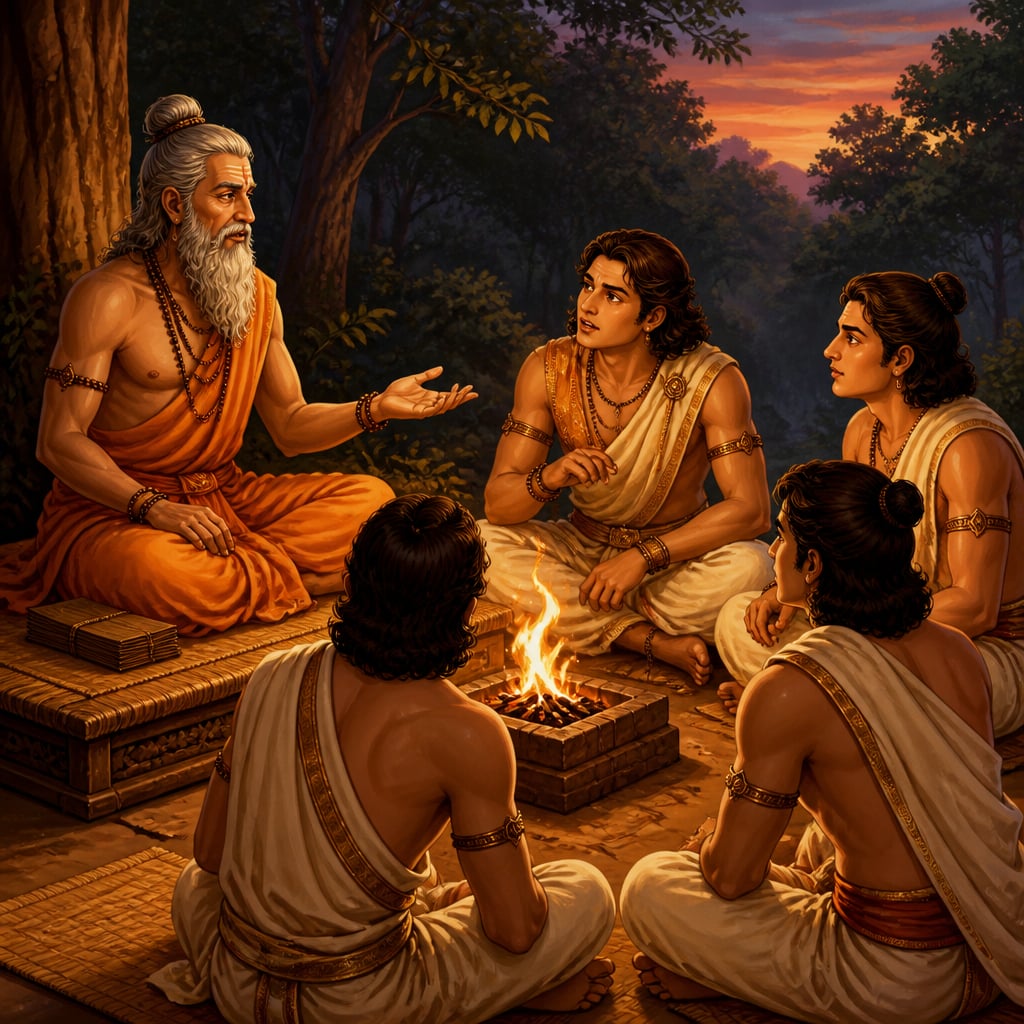
An old warrior-priest teaching young kshatriya princes by the fire

The teacher shook his head slowly. "Before you ask how to defeat your enemy, you must ask: What is your enemy? What is its nature? How does it hold you? A serpent is not defeated the same way as a tiger. And Vṛtra is a serpent, the greatest of all serpents."

"But why a serpent?" the prince pressed. "Surely any form would do."

"No," the teacher replied. "The Rishis chose the serpent for reasons you must understand before you can ever wield a vajra."

This understanding emerges from lived experience: In an era of accelerating change, leaders face new forms of obstruction regularly. The Vṛtra-svarūpa teaching, that understanding the nature of obstruction must precede action against it, proves increasingly relevant. The failures of Blockbuster, Kodak, Nokia, and countless other organizations stem not from lack of resources but from misdiagnosis. The Vedic framework provides a diagnostic method: look for coiling (where is the source being held?), look for concealment (what can't you see?), and question what feels permanent.

The Serpent's Nature

Consider what the Rishis knew about serpents. They do not attack openly like a lion or charge like an elephant. They coil. They constrict. They wrap themselves around that which they wish to hold, and they squeeze slowly, patiently, until life cannot flow.

This is precisely how obstruction works in life and leadership. Your Vṛtra rarely announces itself with roaring confrontation. It wraps around your resources quietly. It constricts your possibilities gradually. By the time you feel the squeeze, you have been held for longer than you knew.

Vrtra the serpent coiled on the mountain hiding waters

The Rig Veda describes Vṛtra as lying coiled around the mountains where the waters originate. He is ahí, the serpent, and also dānava, the restrainer. He doesn't just block; he holds. The waters exist behind him, full of potential. But they cannot flow. This is the anatomy of obstruction: potential that cannot become actual because something has wrapped around the source.

What the Mantras Reveal

Rishi Hiraṇyastūpa describes Vṛtra's position with revealing precision:

"Ahim parvate śiśriyāṇaṃ tvaṣṭāsmai vajraṃ svaryaṃ tatakṣa"

The serpent lying coiled upon the mountain, for him, Tvaṣṭṛ fashioned the heavenly vajra., RV 1.32.2

Word by word: ahim (serpent) parvate (on the mountain) śiśriyāṇam (lying, resting, coiled) tvaṣṭā (Tvaṣṭṛ, the divine craftsman) asmai (for him, i.e., for Indra) vajram (the thunderbolt) svaryam (heavenly) tatakṣa (fashioned).

Notice: the serpent is śiśriyāṇam, lying, resting, comfortable in its coiled position. Vṛtra is not struggling; he is settled. He has been there so long that his presence seems natural. This is crucial for understanding obstruction: by the time you notice it, the serpent has made itself at home. It feels like the normal state of affairs.

Another verse deepens our understanding:

"Apāṃ nihitam guhā śayānaṃ vṛtro avīvarad"

Vṛtra lay hidden in the cave, holding back the concealed waters., RV 1.32.10

The waters are nihitam guhā, placed in a cave, hidden. Vṛtra doesn't just obstruct; he conceals what he obstructs. You don't know what you're missing until he is slain. This is perhaps his most dangerous quality: the potential he blocks is invisible to you.

The Commentators' Insight

Sayanacharya emphasizes that Vṛtra represents āvaraṇa, covering, veiling. The obstruction works by making you forget what could be. Leaders who have lived with a particular Vṛtra for years stop seeing the waters it holds. They adapt to the constrained state and lose awareness that flow is even possible.

Sri Aurobindo, in The Secret of the Veda, identifies Vṛtra with the psychological force of tamas, not mere inertia but active resistance to light. Tamas doesn't just sit passively; it actively opposes the forces that would awaken, enlighten, or liberate. Your internal Vṛtra doesn't just fail to see opportunities, it resists seeing them because seeing would require change.

This psychological reading is profound for leaders. The obstruction you face may be external, competition, regulation, resource constraints, but the nature of how you perceive it is often shaped by internal tamas. You may be misidentifying your Vṛtra, fighting the wrong serpent while the real one remains coiled around your source.

The Danger of Misdiagnosis

A Blockbuster store at twilight under flickering tubes

Between 2000 and 2010, Blockbuster Video faced what its leadership believed was a price war. Netflix was offering cheaper rentals. The obvious response: compete on price, match offers, protect the core store-based business model. Blockbuster even had opportunities to acquire Netflix, and passed.

But Blockbuster's Vṛtra was not price. Their serpent was convenience, the friction of driving to a store, the late fees, the limited selection. Netflix understood this; Blockbuster did not. The Blockbuster leadership was trying to slay the wrong serpent.

When Blockbuster finally launched its own online service, they tethered it to their store network, the very thing causing the obstruction. It was as if they tried to defeat Vṛtra by strengthening the mountain he coiled around. By 2010, Blockbuster filed for bankruptcy. The waters, customer convenience, unlimited selection, no-friction access, flowed through Netflix while Blockbuster fought phantoms.

This is the cost of misunderstanding your Vṛtra. You can wield the mightiest vajra, strike with all your ojas, and still lose, because you struck the wrong target.

The Five Signs of Vṛtra's Nature

From the Vedic descriptions, we can identify five characteristics that reveal true obstruction:

1. It coils around the source, not the flow. Vṛtra doesn't block the river downstream; he holds the waters at their origin. True obstruction often sits at the source of your potential, your assumptions, your business model, your core capabilities, not at the periphery.

2. It conceals what it holds. You cannot see the waters Vṛtra imprisons until he is slain. This means your greatest unrealized potential may be invisible to you right now, hidden by the very obstruction you need to understand.

3. It feels natural after long presence. Śiśriyāṇam, lying at rest, comfortable. The longer an obstruction has been in place, the more it feels like just "how things are." Question what feels permanent.

4. It constricts gradually. The serpent's coil tightens slowly. Year by year, quarter by quarter, your options narrow without dramatic crisis. By the time you feel unable to breathe, the constriction is severe.

5. It resists being seen. The tamasic nature of Vṛtra means it actively resists your attempts to understand it. When you start asking "What's really blocking us?", expect resistance, internal and external.

Your Own Serpent

The young prince listened as his teacher spoke. "So how do I know my Vṛtra?" he asked finally. "How do I see what is hidden?"

"Three questions," the teacher replied. "First: What potential do you sense but cannot manifest? There you will find the hidden waters. Second: What have you stopped questioning because it seems permanent? There lies the serpent at rest. Third: Where do you feel resistance when you try to examine closely? There is the tamasic nature revealing itself."

These questions remain valid millennia later. Your obstruction may be an outdated strategy, a relationship pattern, a limiting belief, a market assumption, or a process that once served but now constrains. But you cannot defeat it until you understand its true nature, until you see how it coils, where it holds, and what it conceals.

In our next lesson, we'll explore how Indra responded once he understood Vṛtra's nature, the art of decisive action without panic, the moment when understanding becomes power.

Cognitive behavioral therapy distinguishes between 'surface' and 'core' beliefs. Surface problems (anxiety about a presentation) often mask deeper obstructions (fear of judgment, impostor syndrome). Treatment that addresses only symptoms fails. The Vedic emphasis on understanding Vṛtra's svarūpa anticipates this: diagnose the core before treating the surface.

Toyota's '5 Whys' technique, asking 'why' five times to reach root cause, mirrors the Vedic approach to understanding Vṛtra. Most organizational problems present as symptoms; the serpent coils around a source further upstream. Leaders who act on first-level symptoms waste resources fighting shadows.

Donella Meadows' 'leverage points' theory shows that interventions at different system levels have vastly different effectiveness. Working on 'paradigms' is far more powerful than working on 'parameters.' The Vedic understanding that Vṛtra coils at the source anticipates this: find where the system is truly constrained, not where symptoms appear.

In psychoanalytic terms, the unconscious 'conceals' material that is too threatening to acknowledge directly. Therapy often involves making the invisible visible, seeing past the psyche's own Vṛtra to access hidden potential. The Vedic insight that obstruction works through concealment maps directly onto depth psychology.

Clayton Christensen's 'Jobs to Be Done' framework reveals hidden customer needs that companies fail to see because they're looking at their products rather than their customers' lives. The 'concealed waters' are real customer jobs; the 'Vṛtra' is product-centric thinking that hides them.

System archetypes like 'Limits to Growth' describe how constraints become invisible over time, the system adapts around them. The constraint becomes 'how things are.' Seeing the hidden constraint is the first step to breaking through it. The Vedic concept of guhā (cave of concealment) describes exactly this organizational blindness.

Case studies

Blockbuster's Misdiagnosis: Fighting the Wrong Serpent

In the early 2000s, Blockbuster Video was the dominant force in home entertainment, with 9,000 stores and millions of loyal customers. When Netflix emerged offering mail-order DVD rentals, Blockbuster's leadership diagnosed the threat as a price war. Netflix was cheaper; Blockbuster would compete on price while leveraging their store advantage. This diagnosis led to catastrophic decisions. Blockbuster passed on acquiring Netflix for $50 million in 2000. They launched an online service that required store visits, doubling down on the very friction customers were escaping. They focused on matching Netflix's prices while ignoring that price was merely a symptom. Blockbuster's actual Vṛtra was *convenience*, the friction of driving to a store, the anxiety of late fees, the frustration of finding your desired movie out of stock. Netflix understood this; their model eliminated every friction point. Blockbuster's leadership couldn't see this serpent because they were adapted to the store-based model, the constraint had become invisible.

Blockbuster exemplifies *bhrānta-nidāna*, misdiagnosis of obstruction. They wielded their vajra (capital, brand power, store network) against a phantom enemy (price) while the true Vṛtra (friction) remained coiled around their source. Worse, their Vṛtra had āvaraṇa-śakti, concealing power. Because Blockbuster had always been a store-based business, the stores seemed natural, permanent, the obvious way to deliver movies. The serpent had made itself at home (*śiśriyāṇam*). No one questioned whether the fundamental model was the obstruction. When Blockbuster finally launched Blockbuster Online, they tethered it to stores, the very serpent they needed to slay. It was as if Indra tried to defeat Vṛtra by building a bigger mountain.

Blockbuster filed for bankruptcy in 2010. Netflix, which Blockbuster could have acquired for the price of a few dozen stores, is now worth over $200 billion. The waters, convenient, friction-free entertainment delivery, now flow freely through streaming services. Blockbuster's failure wasn't lack of resources; it was misunderstanding the nature of their serpent.

Even powerful organizations can be destroyed by fighting the wrong enemy. Before wielding your vajra, examine whether you've correctly identified your Vṛtra. The serpent's greatest power may be making you believe it's somewhere else entirely.

Misidentifying the real competitive threat is one of the most common causes of corporate failure. Nokia fought other phone manufacturers while Apple redefined what a phone was. Traditional retailers competed on store count while Amazon redefined distribution. Correctly diagnosing your actual adversary matters more than the strength of your response.

Blockbuster had $6 billion in revenue in 2004; by 2010, they were bankrupt. Netflix, rejected as an acquisition target, now generates over $30 billion annually. The cost of misdiagnosis was measured in billions.

Rana Sanga at Khanwa: The Price of Misreading Your Enemy

In 1527, Rana Sanga of Mewar stood at the height of his power. He had united much of Rajputana, defeated multiple enemies, and seemed poised to expel the Mughal invader Babur. Before the Battle of Khanwa, Sanga had every reason for confidence: a larger army, home advantage, a coalition of Rajput chiefs, and a record of victory. But Sanga misread his Vṛtra. He believed he was facing another Central Asian raider like Timur's descendants, someone who would plunder and depart. He expected cavalry warfare of a familiar kind. He believed that his sheer numbers and Rajput valor would prevail as they had before. Babur was a different serpent entirely. He had cannons, a technology Sanga underestimated. He had the tactical innovation of the *tulughma* (flanking attack) combined with defensive wagon-forts. And crucially, Babur was not raiding; he was conquering. He intended to establish an empire, not extract tribute. Sanga's tactics assumed the wrong enemy. His massed cavalry charges were shattered by cannon fire. His numerical advantage was neutralized by Babur's tactical discipline. The serpent was not where Sanga thought it was.

Rana Sanga's defeat illustrates the catastrophic cost of *bhrānta-nidāna* in warfare. He prepared for one type of enemy (traditional cavalry raiders) when he faced another (gunpowder empire builders). His Vṛtra's true nature, combined arms tactics, siege mentality, imperial ambition, remained concealed until it was too late. The Vedic teaching is clear: Tvaṣṭṛ fashioned a *specific* vajra for the *specific* serpent on the mountain. A weapon designed for one enemy may be useless against another. Sanga's vajra, massed Rajput cavalry, was formidable against his previous foes but poorly matched against Babur's novel combination of technologies and tactics. Most tragically, Sanga had intelligence about Babur's capabilities. But his prior success had created *tamas*, resistance to seeing what contradicted his established worldview. The concealment was partly external (Babur's innovations) and partly internal (Sanga's assumptions).

The Rajput coalition was decisively defeated at Khanwa. Sanga survived but never recovered his power or health; he died within two years, and the Mughal Empire he hoped to prevent established itself for the next three centuries. The battle is remembered as a turning point, not just of history but of military technology in India. The lesson was not that Sanga lacked courage or resources. He possessed both in abundance. But he fought the wrong war against the wrong enemy, having failed to understand the true nature of his Vṛtra.

Past success can become the foundation of future failure when it prevents accurate assessment of new threats. Understanding your current Vṛtra requires suspending assumptions formed by previous victories. The serpent you face today may be entirely different from the one you slew yesterday.

Military and business history are filled with leaders who prepared for the last war. Generals who planned for trench warfare faced blitzkrieg. Retailers who optimized for foot traffic faced e-commerce. Past success creates mental models that become dangerous when the competitive landscape shifts fundamentally.

Rana Sanga arrived at Khanwa (1527) with a coalition of 80,000 Rajput cavalry. Despite outnumbering Babur's 12,000 troops, the Rajputs suffered a decisive defeat that permanently ended Rajput chances of controlling Delhi.

Reflection

More in Vṛtra-Vadha: Leadership in Times of Chaos

All lessons in Vṛtra-Vadha: Leadership in Times of Chaos · Rig Vedic Leadership course