Dhīra-Vīrya: Decisive Action Without Panic
How Indra Struck, Swift, Powerful, but Never Reactive
Understanding your Vṛtra is not enough, at some point, you must act. But the Rig Veda distinguishes between reactive panic and deliberate power. Indra's strike was swift yet measured, powerful yet purposeful. This lesson explores the art of decisive action that emerges from clarity, not fear.
The soma was ready. The mantras had been chanted. The fire burned bright with the offerings of clarified butter. Indra had gathered his ojas, understood his enemy, and now stood at the threshold of action. The waters remained imprisoned. The people waited.
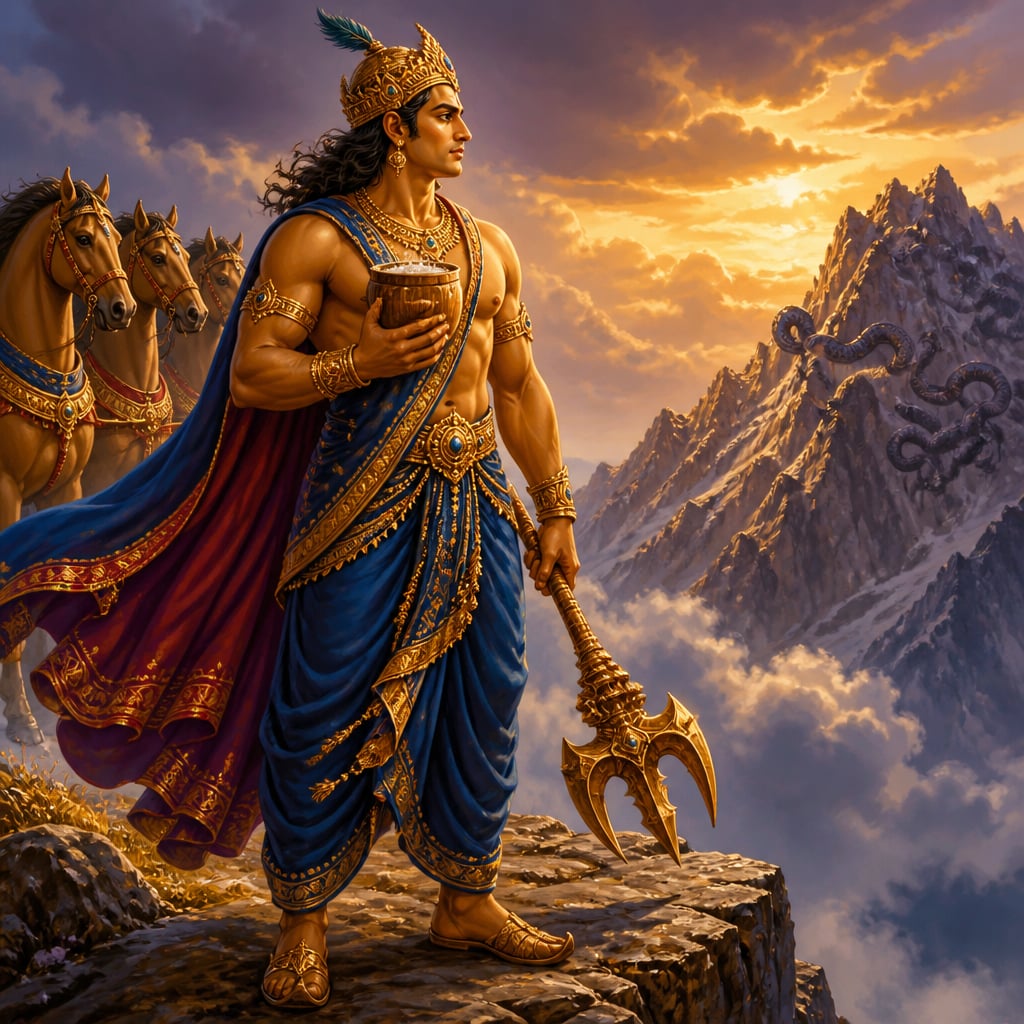
But Indra did not rush. The Rishis describe a moment between preparation and action, a stillness before the strike. This was not hesitation. It was the gathering of dhīra (steadiness) that would direct vīrya (heroic power). The difference between panic and power lies in this moment.
As we explore this principle: Modern crisis management literature increasingly recognizes what the Rishis taught millennia ago: that the quality of response matters as much as the speed of response. Panic produces action that often worsens the situation. Dhīra produces action that addresses root causes and sustains across the full arc of crisis. In an era of constant disruption, the capacity to act decisively without being driven by fear is perhaps the most valuable leadership capability.
The Two Modes of Action
Watch any creature in crisis, and you will see one of two responses: bhīti (fear-driven reaction) or dhīra (steady purpose). The frightened animal strikes wildly, wastes energy, and often misses its target. The seasoned hunter moves with measured precision, swift but not frantic, powerful but not wasteful.
The Rishis understood this distinction at the cosmic level. Indra faces the greatest obstruction in existence, the serpent holding back the waters of life, yet his response is described not as desperate or frenzied but as śūra (heroic) and dhīra (steadfast). The Rig Veda celebrates his victory not because he struck hard but because he struck right.
This is the art of crisis leadership: acting decisively without being driven by the crisis itself. The crisis creates urgency, but urgency must not become panic. Speed must not become haste. Power must not become waste.
What the Mantras Reveal
The Rishi Gṛtsamada describes Indra's essential quality:
"Śūraś cid bhītas tavasas tava svar dhṛṣṇo dadhartha dhṛṣatā suvajra"
Even the mighty fear your power, O bold one; you hold your boldness steadily, O wielder of the good vajra., RV 2.12.13
Word by word: śūraḥ (the heroic one) cit (even) bhītaḥ (is afraid) tavasaḥ (of your strength) tava (your) svaḥ (own) dhṛṣṇo (O bold one) dadhartha (you hold/sustain) dhṛṣatā (with boldness) suvajra (O wielder of the good thunderbolt).
Notice the key verb: dadhartha, he holds or sustains his boldness. Indra's power is not a flash of reactive aggression but a sustained capacity. The vajra doesn't fly from his hand in panic; he wields it deliberately, with full awareness of where and how it must strike.
Another mantra deepens this:
"Sa hi dīrghaṃ pratasthivān āminadbhir ajuryaḥ"
He stands established for the long course, unaging among those who would harm., RV 2.12.3
The phrase dīrghaṃ pratasthivān, "established for the long course", reveals that Indra's action is not short-term reaction but positioned within a longer understanding. He acts decisively in the moment because he sees the longer arc. Panic sees only the immediate; dhīra sees the whole.
The Stillness Before the Strike
Between knowing your enemy and defeating your enemy lies a crucial moment: the gathering of intent. The Rishis don't describe Indra charging mindlessly at Vṛtra. They describe him drinking soma, receiving hymns, building his ojas, and then, at the right moment, releasing the vajra with devastating precision.
Sri Aurobindo, in The Secret of the Veda, interprets this sequence as a model of conscious action. The soma represents divine clarity; the hymns represent focused intention; the ojas represents accumulated capacity. Only when all three are aligned does action succeed. Rushing to act without this alignment produces effort without impact.
Sayanacharya emphasizes that Indra's dhairya (courage/steadiness) was as important as his bala (strength). The serpent Vṛtra was vast and terrifying. A reactive response might strike at the wrong place, waste power on the coils rather than the head, or exhaust itself before breaking through. Indra's steadiness ensured that his tremendous power was directed rather than dispersed.
Decisive Without Desperate: The ICICI Story

In September 2008, global financial markets collapsed. Lehman Brothers filed for bankruptcy. Banks around the world faced runs and failures. In India, rumors spread that ICICI Bank, then the country's largest private sector bank, was on the verge of collapse. Within days, depositors began withdrawing funds. The contagion of panic had arrived.
K.V. Kamath, who had built ICICI into a financial giant, watched as competitors froze in fear or made desperate moves. Some banks issued panicked reassurances that only amplified doubt. Others retreated, slashing lending and hoarding cash in ways that deepened the crisis.
Kamath's response was different. He moved decisively, restructuring the bank's liability profile, increasing retail deposits, and communicating directly with institutional investors. But his actions were measured, not reactive. He didn't issue frantic public statements; he held steady private conversations. He didn't slash the workforce dramatically; he made surgical adjustments. He didn't abandon growth; he redirected it toward more stable segments.
Most importantly, Kamath demonstrated dhīra publicly. His calm demeanor, captured in interviews during the crisis peak, signaled that ICICI's leadership was in control. Panic is contagious, but so is steadiness. Within months, the withdrawal pressure eased. ICICI emerged from the crisis stronger than competitors who had reacted rather than responded.
This was Dhīra-Vīrya in corporate form: decisive action emerging from clarity rather than fear, power applied with purpose rather than panic.
The First Resistance: Rani Chennamma

In 1824, the British East India Company applied the "Doctrine of Lapse" to Kittur, a small but prosperous kingdom in present-day Karnataka. When the young Raja died without a biological heir, the British declared the kingdom's adopted successor illegitimate and demanded annexation.
Rani Chennamma, the young Raja's widow, received this ultimatum. She had no treaty with the British. She had a small army compared to Company forces. She had every reason to panic, or to capitulate quietly as many rulers did.
Instead, she assessed the situation with remarkable clarity. She understood the British depended on local rulers submitting without resistance. She understood her terrain, the hilly regions around Kittur favored defensive warfare. She understood the symbolic power of resistance, that even a small kingdom's defiance could inspire others.
When British forces arrived under Collector John Thackeray, Chennamma didn't attack wildly or surrender passively. She fortified key positions, organized her forces, and when negotiation failed, struck with decisive force. In the first battle, her forces routed the British, killing Thackeray himself, the first British official killed in combat by an Indian ruler resisting annexation.
The British eventually returned with overwhelming force. Chennamma was defeated and imprisoned. But her response, measured, decisive, neither panicked nor passive, made her a symbol of resistance that inspired later freedom fighters. She had understood the Vedic teaching: you cannot always control outcomes, but you can control how you respond. And response from dhīra leaves a different legacy than response from bhīti.
The Three Elements of Decisive Action
From the Vedic narrative and these modern parallels, we can identify three elements that distinguish decisive action from reactive panic:
1. Clarity Before Speed (Dṛṣṭi) Indra sees Vṛtra clearly before he strikes. Kamath understood the bank's real vulnerabilities before restructuring. Chennamma assessed terrain and enemy before engaging. Speed without sight is thrashing, not striking.
2. Gathered Power, Not Scattered Energy (Ojas) Indra's ojas was accumulated before battle, then released in focused application. Panic disperses energy across multiple fronts; dhīra concentrates it at the decisive point. The question is not "How much can I do?" but "Where must I strike?"
3. Steadiness That Sustains (Dhairya) The crisis doesn't end with the first action. Indra's battle with Vṛtra involved sustained engagement. Kamath's crisis management lasted months. Chennamma's resistance required ongoing morale. Decisive action must be sustainable decisive action, not a burst that exhausts itself.
Your Own Strike
You may be facing a crisis that demands action. The pressure is real. The urgency is real. But before you strike, pause, not from hesitation but from purpose.
Ask: Am I seeing clearly, or am I seeing through the fog of anxiety? Am I gathering my power for focused application, or scattering it across every perceived threat? Am I acting from dhīra (steadiness) or bhīti (fear)?
The difference shows in how the action feels. Panic feels like being pushed from behind. Dhīra feels like stepping forward with weight. Both may look fast from the outside, but one is driven by the crisis and the other drives through the crisis.
In our next lesson, we'll explore a related tension: speed versus stability. When does decisive action require moving fast, and when does it require holding ground? The Rishis had wisdom for this too.
Research on 'emotional regulation' by James Gross shows that people who can modulate their emotional response perform better under pressure than those who either suppress or are overwhelmed by emotion. The dhīra response, acknowledging the threat while maintaining centered action, maps directly onto healthy emotional regulation.
Studies of crisis leadership (e.g., Amy Edmondson's work on failure in organizations) show that leaders who display calm confidence, not fake optimism, but genuine steadiness, create environments where teams can function effectively under pressure. Panic cascades; dhīra stabilizes.
Cybernetic theory distinguishes between 'first-order' change (reactive adjustment) and 'second-order' change (transformation of the system's capacity to respond). Dhīra-vīrya is second-order: it doesn't just address the immediate threat but builds systemic capacity for future challenges.
Research on decision fatigue (Baumeister et al.) shows that making many small decisions depletes cognitive resources. The practice of reducing choices to one decisive action, rather than many incremental ones, preserves capacity and increases impact. One focused blow beats twenty scattered strikes.
Jack Welch's concept of 'playing to win, not playing not to lose' captures this: decisive action toward a clear objective rather than defensive responses to every perceived threat. Strategic focus often means choosing what NOT to respond to, so you can strike decisively where it matters.
Eli Goldratt's 'Theory of Constraints' teaches that any system has one primary constraint. Addressing that constraint produces breakthrough; addressing everything else produces marginal gains. Finding the 'head of the serpent', the decisive intervention point, is systems thinking in action.
Case studies
K.V. Kamath's Steady Hand: ICICI Through the 2008 Storm
In September 2008, as Lehman Brothers collapsed and global credit markets froze, ICICI Bank, India's largest private sector bank, faced its own existential moment. Rumors spread that ICICI had significant exposure to failed international institutions. Within days, retail depositors began queuing at branches to withdraw funds. The contagion of panic had reached India. K.V. Kamath had built ICICI from a development finance institution into a banking giant. Now that edifice faced a crisis of confidence. Other banks issued panicked public statements that only amplified fear. Some made dramatic public gestures, slashing lending, announcing emergency measures, that signaled they were not in control. Kamath took a different approach. He understood that the core problem was not capital adequacy but confidence. ICICI's actual exposure was manageable; the perception was the crisis. His response combined decisive action with deliberate calm.
Kamath embodied dhīra-vīrya: he acted decisively (restructuring liabilities, increasing retail deposits, direct institutional communication) while projecting steady calm that counteracted the contagion of panic. Crucially, he distinguished between the perceived threat (collapse) and the actual threat (confidence crisis). His 'vajra', the decisive intervention, was aimed at confidence, not capital. This required the clarity that comes from dhīra: seeing through the chaos to identify where the real serpent lay. His public demeanor, calm, measured, almost understated in interviews, was itself an intervention. In a system where panic begets panic, demonstrating sthairya (stability) was as important as any financial restructuring. The leader's composure became part of the solution.
Within months, withdrawal pressure eased. ICICI's stock, which had fallen dramatically, recovered. The bank emerged from the crisis without government bailout or emergency intervention. Kamath transitioned to a role at Infosys, having demonstrated that crisis leadership is as much about emotional regulation as financial engineering. Competitors who had panicked, making dramatic cuts or issuing anxious public statements, took longer to recover. The difference was not resources but response mode: dhīra versus bhīti.
In confidence-dependent systems (banks, markets, teams), the leader's demonstrated steadiness is itself an intervention. Panic is contagious, but so is calm. Decisive action must include the decision of how to *appear* while acting. Kamath's dhīra was strategic, not just temperamental.
During market panics, a CEO's visible composure is itself a stabilizing force. Jamie Dimon's steady public presence during JPMorgan's 'London Whale' crisis and Tim Cook's measured responses during Apple's supply chain disruptions both demonstrate that calm leadership during turmoil functions as a strategic tool, not merely a personality trait.
ICICI's stock fell over 80% from its 2008 peak during the crisis but recovered to pre-crisis levels within two years, faster than many global banks that received government bailouts.
Rani Chennamma of Kittur: The First Strike Against the Doctrine of Lapse
In 1824, Rani Chennamma of Kittur faced a dilemma that would confront dozens of Indian rulers over the next three decades. The British East India Company, wielding the 'Doctrine of Lapse,' declared that kingdoms without biological male heirs would be annexed. Kittur's young Raja had died; his adopted successor was declared illegitimate; the kingdom's treasury was demanded. Chennamma had limited options. Her army was small. The British had recently defeated the Marathas and seemed invincible. Most neighboring rulers advised capitulation, or were already under British control. The prudent course appeared to be negotiation, delay, or quiet surrender. But Chennamma saw clearly: negotiation meant annexation on British terms; delay meant annexation with less preparation; surrender meant the end of Kittur's identity. If action was to be taken, it must be decisive, and it must be now, while the British underestimated local resistance.
Chennamma demonstrated dhīra-vīrya in conditions where panic or passivity would have been understandable. Her decisiveness was not impulsive, she first attempted negotiation, fortified key positions, and organized her forces. Only when the British rejected all terms did she act. Her strike was concentrated: when British Collector John Thackeray arrived to enforce annexation, Chennamma's forces engaged at the optimal moment, routing Company troops and killing Thackeray himself. This was 'hanmanā', the decisive blow that changed the entire dynamic. Remarkably, Chennamma maintained dhīra even after this victory. She didn't pursue the fleeing British rashly or overextend. She understood that one battle was not the war. This discrimination between decisive action and reckless pursuit reflects the Vedic teaching that vīrya must remain under dhīra's guidance.
The British returned with overwhelming force. Kittur fell after a prolonged siege, and Chennamma was imprisoned until her death in 1829. In narrow terms, she 'lost.' But her decisive resistance achieved something surrender never could: it demonstrated that the Doctrine of Lapse could be resisted, that British power was not irresistible, and that small kingdoms could choose dignity over capitulation. Her example inspired later freedom fighters; her memory is honored in Karnataka to this day. Sometimes decisive action creates effects beyond immediate outcomes. Chennamma's dhīra-vīrya established a precedent that accumulated across generations.
Decisive action is not always about winning in the immediate frame. Sometimes it establishes precedent, builds morale for future struggles, or preserves dignity in conditions where victory is impossible. Chennamma understood that response from dhīra leaves a different legacy than response from bhīti, regardless of tactical outcome.
Not every act of resistance succeeds in the moment, but precedent-setting defiance shapes future movements. Rosa Parks' refusal to move, Malala Yousafzai's continued advocacy after being shot, and early whistleblowers at companies like Enron all demonstrate that principled action creates legacies that outlast immediate outcomes.
Kittur's treasury, seized by the British after Rani Chennamma's defeat, contained jewels and gold worth over 15 lakh rupees. The Doctrine of Lapse was later applied to over 20 Indian states before the 1857 uprising made it politically untenable.
Reflection
- Recall a recent crisis or high-pressure situation. Were your actions driven by dhīra (steady clarity) or bhīti (reactive fear)? How can you tell the difference in yourself?
- Why might the Rishis have included detailed descriptions of Indra's preparation (soma, hymns, ojas) rather than just describing his victory? What teaching is embedded in showing the process before the outcome?
- Is it possible to train dhīra, or is it an innate capacity some people have and others lack? If it can be trained, how? The Vedic tradition clearly believed it could be cultivated, how?