Javah-Sthairya: The Wisdom of Speed and Stability
When to Strike Like Lightning, When to Stand Like Mountains
Indra's strike was swift as lightning, but the Rishis also celebrated Himalayan steadfastness. When does leadership require speed, and when does it demand stability? This lesson explores the discernment that knows which quality the moment requires.
Two hymns sat side by side in the Rishi's memory. In one, Indra moves like vidyut, lightning that cannot be tracked, striking before the eye can follow. In another, the mountains are praised as dhruva, immovable, unchanging, the stable foundation upon which all else rests.
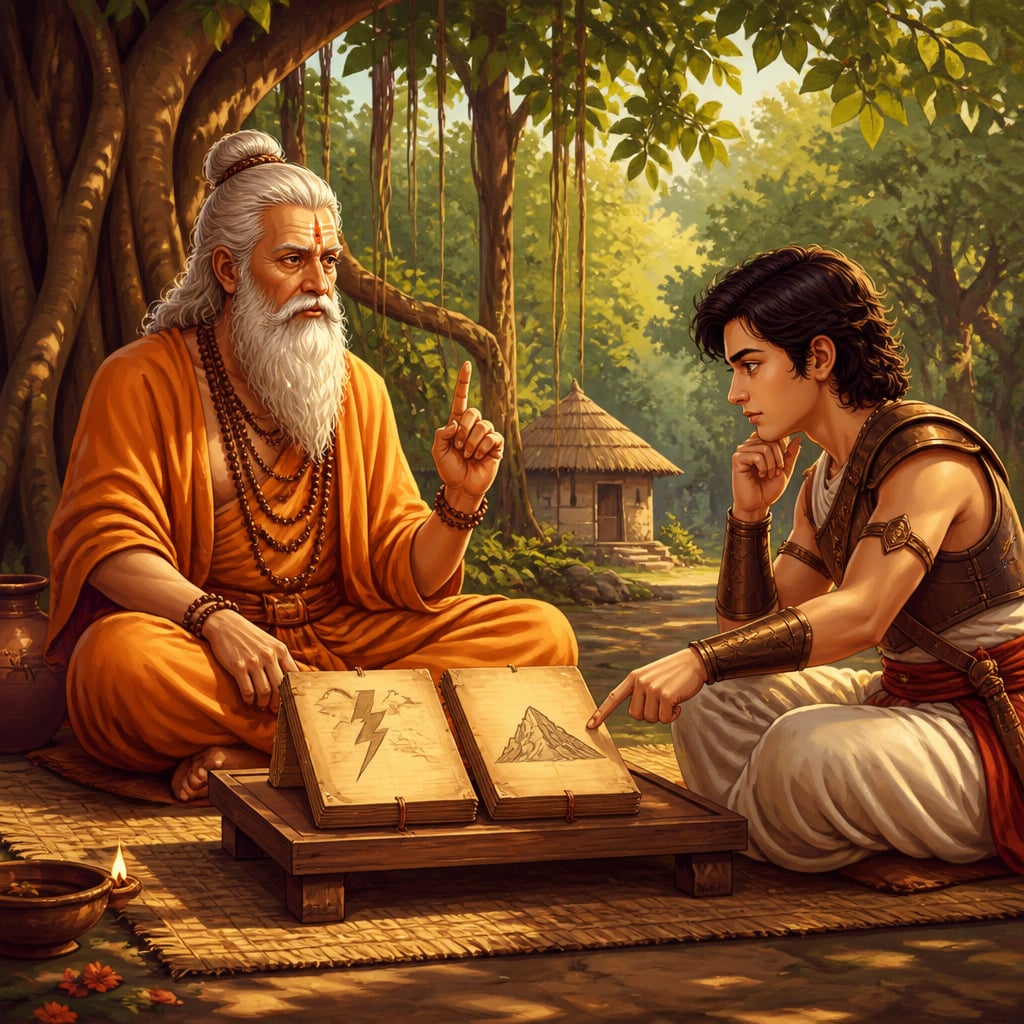
The young warrior asked: "Which should I emulate, Guru-ji? The lightning or the mountain?"
The teacher smiled. "Both. And knowing which one, when, that is the true wisdom."
This insight carries weight because: Modern business culture often celebrates speed as an unqualified virtue: 'move fast and break things,' 'first mover advantage,' 'agile everything.' The Vedic teaching offers a more nuanced view: speed serves in some contexts; stability serves in others; the wise leader possesses both capacities and deploys appropriately. In an era of disruption, this balanced capability may be more valuable than single-minded speed.
The Double Nature of Effective Action
The Rig Veda celebrates both javah (speed, swiftness) and sthairya (stability, steadfastness). Indra is praised for his lightning speed; the earth is praised for its unshakeable foundation. The Ashvins, divine healers, move with such rapidity that they arrive before the call is complete. But Varuna maintains ṛta with such stability that the cosmic order never wavers.
These are not contradictions. They are complementary capacities that effective leadership must possess and deploy appropriately. The question is never "Should I be fast or stable?" but "What does this moment require?"
Consider the Vṛtra narrative itself. Indra's actual strike is lightning-fast, the vajra flashes and Vṛtra falls. But the preparation was long: accumulating ojas, understanding the enemy, gathering allies, performing rituals. The speed of the strike was enabled by the stability of the preparation. Rush the preparation, and the strike fails. Delay the strike once prepared, and the moment passes.
This rhythm, stable foundation enabling swift action, appears throughout the Vedic understanding of effective work.
What the Mantras Reveal
The Rishi Vāmadeva describes Indra's characteristic quality:
"Javeṣu jīṣṇur asurāya vīḍu mahiṣvān rodasī vi cakrama"
Victorious in swift movements, strong against the enemy, he of great strength strode across both worlds., RV 4.20.4
Word by word: javeṣu (in swiftnesses, in swift movements) jīṣṇuḥ (victorious, conquering) asurāya (against the enemy, against the powerful) vīḍu (strong, firm) mahiṣvān (possessing great strength) rodasī (both worlds, heaven and earth) vi cakrama (he strode across, he extended over).
Notice: Indra is javeṣu jīṣṇuḥ, victorious in his swift movements, not merely swift. Speed is not the goal; victory through appropriate speed is the goal. And he is simultaneously vīḍu, firm, strong. The swift movement emerges from stable strength.
Another hymn provides the counterpoint:
"Dhruvāso antarikṣe sahasraṃ na yate dhiyā"
Firm in the atmosphere, a thousand cannot move them by thought., RV 6.67.6
Here the praise is for dhruva, that which is fixed, immovable. There are times when the highest capacity is simply not moving, not being shaken by the thousand pressures that would displace you.
The Commentators' Insight
Sayanacharya interprets the Vedic teaching as context-dependent guidance. In battle (saṃgrāma), speed is often essential, the enemy who strikes first often wins. But in governance (rāṣṭra), stability is primary, subjects need predictability, institutions need continuity, trade needs reliable conditions.
Sri Aurobindo sees a deeper integration. For him, the enlightened actor possesses both qualities simultaneously: utterly still at the center (like the hub of a wheel) while capable of tremendous movement at the periphery (like the wheel's rim). The stillness enables the speed; the speed expresses the stillness. This is not alternation but integration.
The practical implication is profound: leaders who are only fast lack foundation; leaders who are only stable lack responsiveness. The complete leader has cultivated both capacities and deploys them according to deśa-kāla-pātra, place, time, and circumstance.
The Dual-Track Master: Shivaji Maharaj

Chhatrapati Shivaji Maharaj (1630-1680) faced a strategic problem that seemed unsolvable. The Mughal Empire and the Adilshahi Sultanate were vastly more powerful than his nascent Maratha forces. Direct confrontation meant destruction. Pure defense meant slow suffocation.
Shivaji's solution was dual-track leadership: lightning raids combined with mountain-like institution building. He developed ganimi kava, guerrilla warfare characterized by extreme speed. His cavalry could cover 60-70 miles overnight, strike before dawn, and vanish before the enemy could respond. The sack of Surat (1664) exemplified this: in and out before Mughal reinforcements could arrive.
But simultaneously, Shivaji was building institutions with glacial patience. Administrative systems (Ashtapradhan), revenue structures, fort networks, naval capabilities, all developed slowly, carefully, with attention to durability. While his raids were lightning, his state-building was mountain.
This dual-track approach confounded his enemies. They couldn't pin down his speed; they couldn't undermine his stability. Each capacity protected and enabled the other: the raids provided resources for institution-building; the institutions provided base stability for raids.
The Mountain Banker: HDFC's Measured Growth

In the 1990s, India's banking sector opened to private competition. New banks rushed to capture market share: aggressive lending, rapid branch expansion, high-risk product proliferation. Speed seemed essential, the first movers would win.
Deepak Parekh and the HDFC group took a different approach. HDFC Bank, launched in 1994 under Aditya Puri, grew steadily rather than explosively. While competitors chased growth at all costs, HDFC maintained conservative lending standards, rigorous risk assessment, and measured expansion.
This looked like falling behind. Competitors opened more branches, reported faster loan growth, generated more headlines. The market rewarded aggression with higher valuations and analyst praise.
Then came the reckonings. Global Trust Bank collapsed (2004). Yes Bank spiraled into crisis (2020). PMC Bank failed (2019). Banks that had sacrificed stability for speed discovered that the mountain they hadn't built provided no foundation when storms arrived.
HDFC Bank, the "boring" one, became India's most valuable private bank. Its stability, the sthairya that seemed like slowness, proved to be the foundation for sustainable growth. The bank that refused to rush now leads the sector.
Discerning the Moment
How do you know when speed is required and when stability serves better? The Vedic tradition offers several principles:
1. External vs. Internal Operations Speed is often appropriate for external actions (market moves, competitive response, opportunity capture). Stability is often essential for internal operations (culture, processes, values). Shivaji raided fast but built institutions slowly. HDFC was stable internally while remaining responsive to market opportunities.
2. Reversible vs. Irreversible Decisions Speed suits reversible decisions, you can course-correct later. Stability suits irreversible decisions, once made, you live with consequences. Move fast on what can be undone; move carefully on what cannot.
3. Crisis vs. Building Phases Crisis often demands speed: the house is on fire, act now. Building phases require stability: the foundation must be level before walls rise. Recognize which phase you're in.
4. When You Have Advantage vs. When You Don't Speed leverages existing advantage before it erodes. Stability builds advantage when you lack it. The rich can afford to move fast; the resource-poor often need patient accumulation.
5. What the Moment Itself Teaches Sometimes the situation simply tells you. Opportunities that won't wait demand speed. Opportunities that require trust demand stability. Listen to the moment rather than defaulting to preference.
Your Own Balance
You likely have a temperamental preference. Some leaders are natural speedsters, they chafe at deliberation and thrive on rapid execution. Others are natural stabilizers, they excel at building enduring structures but may miss fleeting opportunities.
Neither preference is wrong. Both capacities are needed. The question is: Have you developed your non-preferred capacity so it's available when needed?
The speedster must learn to hold still when stability serves. This is uncomfortable, it feels like passivity, like losing ground. But some victories require patience.
The stabilizer must learn to move fast when speed serves. This is also uncomfortable, it feels reckless, premature. But some opportunities don't wait.
Indra possessed both the lightning of javah and the firmness of vīḍu. He deployed each appropriately. The teaching is not "be fast" or "be stable" but "be capable of both, and wise enough to know which."
In our next lesson, we'll explore how to maintain order when everything around you is pressing toward chaos, the art of preserving ṛta under pressure.
Research on 'flow states' by Csikszentmihalyi shows that peak performance involves focused speed, rapid action within clear parameters. Scattered speed produces exhaustion; focused speed produces accomplishment. The psychological experience of effective speed is calm intensity, not frantic rushing.
Amazon's 'two-pizza teams' model enables speed through stability: small teams with clear ownership can move fast because the organizational structure is clear. Speed is enabled by structural stability, not achieved by abandoning it.
In systems dynamics, 'smoothing' decisions often outperform reactive ones. Systems that respond too quickly to every fluctuation become unstable; systems that respond at appropriate pace maintain both stability and responsiveness. The goal is appropriate speed, not maximum speed.
Research on 'psychological security' shows that people with stable self-concept can tolerate challenges that destabilize others. This internal stability isn't rigidity, it's the secure base from which flexible response becomes possible. Stability enables rather than prevents appropriate action.
Warren Buffett's investment approach exemplifies dhruva: while markets swing wildly and competitors chase every trend, Berkshire Hathaway maintains immovable principles. This stability looks like slowness until crises reveal that the stable survived while the fast crashed.
Complex systems require stable attractors, states the system tends toward. Without stability, systems become chaotic and unpredictable. The stable elements in any system are what allow everything else to function. Stability is not the opposite of dynamism but its precondition.
Case studies
Shivaji's Dual-Track Mastery: Lightning Raids and Mountain Institutions
In the mid-17th century, Chhatrapati Shivaji Maharaj faced a strategic challenge that seemed insoluble. The Mughal Empire under Aurangzeb and the Adilshahi Sultanate of Bijapur were vastly more powerful than his nascent Maratha forces. Direct military confrontation meant destruction. Passive defense meant slow strangulation as resources and territory eroded. Shivaji's solution was not to choose between speed and stability but to operate on both tracks simultaneously. His military approach emphasized extreme speed: ganimi kava (guerrilla warfare) using cavalry that could cover 60-70 miles overnight, strike before dawn, and disappear before the enemy could respond. His sack of Surat (1664), the Mughal Empire's richest port, exemplified this lightning approach. But simultaneously, with the patience of a mountain, Shivaji built institutions. The Ashtapradhan (council of eight ministers) provided governance structure. Revenue systems ensured sustainable funding. Fort networks provided defensive depth. Naval capability opened maritime options. Each institution was built slowly, carefully, with attention to durability.
Shivaji embodied javah-sthairya, the union of speed and stability, operating simultaneously on both registers. His raids were Indra's lightning; his institutions were the mountain's immovability. This dual-track approach was not alternation (now fast, now stable) but integration (fast *and* stable, simultaneously). The raids provided resources for institution-building; the institutions provided the stable base from which raids could launch. Each capacity supported and protected the other. The Mughal response illustrates the problem of single-track leadership. Their army was optimized for slow, overwhelming force, siege warfare, massive armies, elephants. Against lightning cavalry that struck and vanished, this approach failed. They couldn't match Shivaji's speed; they couldn't undermine his stability.
Shivaji established the Maratha Empire, crowned himself Chhatrapati in 1674, and created a state that would eventually challenge Mughal supremacy across India. His kingdom expanded from a few forts to a significant portion of the Deccan. More importantly, the institutions he built with such patience survived his death. The Maratha Confederacy that emerged in the 18th century, reaching Delhi, Gujarat, and beyond, stood on foundations Shivaji had laid decades earlier. His raids were forgotten; his institutions endured. This is the long-term fruit of dual-track leadership: the speed wins battles; the stability wins generations.
Operating on two timescales simultaneously, fast where speed serves, stable where durability matters, may confound enemies who are optimized for one mode. More importantly, it ensures that short-term wins don't compromise long-term viability. Build the mountain while throwing the lightning.
The most resilient modern organizations operate on dual timescales. Amazon runs fast experiments with new products (lightning) while building decade-spanning infrastructure like AWS (mountain). SpaceX iterates rapidly on rocket designs while building a permanent launch ecosystem. Speed and stability serve different functions and both are essential.
By 1674, Shivaji controlled over 300 forts across the Western Ghats. His navy of over 160 vessels was the first indigenous naval force to challenge European maritime dominance in the Indian Ocean.
HDFC Bank: The Victory of Not Rushing
In the 1990s, India's banking sector liberalized, admitting private players for the first time in decades. New banks rushed to capture market share: aggressive lending, rapid branch expansion, flashy products, and high-profile marketing. The assumption was that first-movers would establish dominant positions; latecomers would struggle. HDFC Bank, launched in 1994, took a different approach. Under Aditya Puri's leadership and guided by the HDFC group's conservative philosophy, the bank grew steadily rather than explosively. Lending standards remained tight when competitors loosened theirs. Branch expansion was methodical when others raced. Risk management was rigorous when the market rewarded risk-taking. This looked like falling behind. ICICI Bank, the aggressive competitor, opened more branches, reported faster growth, and captured more headlines. Analysts questioned whether HDFC's conservative approach was sustainable in the new competitive environment.
HDFC Bank embodied *sthairya* in an industry that celebrated *javah*. Their approach was dhruva, immovable principles amid shifting competitive winds. Where competitors chased growth, HDFC maintained stability. This was not passivity or lack of ambition. HDFC grew consistently; they simply refused to sacrifice foundation for speed. Their lending standards were the mountains that wouldn't move; their risk management was the bedrock that competitors eventually envied. The contrast illustrates the Vedic teaching: speed without foundation often crashes; stability without speed may lag. But stability that eventually speeds up often outperforms speed that eventually crashes. The tortoise and hare is a universal story because it captures a universal truth.
The reckonings came. Global Trust Bank collapsed in 2004 and was absorbed by Oriental Bank of Commerce. Yes Bank spiraled into crisis in 2020, requiring a government-orchestrated bailout. PMC Bank failed in 2019, wiping out depositor funds. Each represented the failure of speed-over-stability banking. HDFC Bank, the 'boring' one that never rushed, became India's most valuable private sector bank. Its market capitalization exceeded the combined value of many competitors. Its stability, which had looked like missing out, proved to be the foundation for sustainable leadership. Deepak Parekh's philosophy was vindicated: in banking, mountains outlast lightning. The slow builder won because he built on rock, not sand.
In domains where trust and duration matter (banking, infrastructure, institutions), stability often outcompetes speed over long horizons. The race doesn't always go to the swift; sometimes it goes to the stable. Know your domain: is it one where lightning wins, or where mountains win?
In industries built on trust, such as banking, insurance, and healthcare, disciplined consistency often outperforms aggressive growth. Vanguard's steady, low-cost investment approach has quietly overtaken flashier competitors over decades. When compounding matters more than speed, stability is the winning strategy.
HDFC Bank's market capitalization grew from approximately ₹1,000 crore in 1999 to over ₹12 lakh crore by 2024, a 1,200x increase achieved through stability-first growth while multiple faster-growing competitors collapsed.
Reflection
- What is your natural preference, speed or stability? What does this preference cost you in situations that require the opposite quality?
- Why might the Rishis have celebrated both lightning (Indra) and mountains (Himavat), both the swift Ashvins and the stable Varuna? What understanding of effective action does this dual celebration reveal?
- Is there a higher integration beyond 'speed when speed serves, stability when stability serves'? Can a leader be simultaneously swift and stable, or must these always alternate?