Ṛta-Rakṣaṇa: Maintaining Order Under Pressure
Preserving What Must Not Change While Everything Changes
Chaos presses in; everything seems to demand change. But effective leadership knows what must remain stable. The Rishis understood Ṛta, the cosmic order that underlies all apparent disorder. This lesson explores the art of preserving essential order while the storm rages around you.
The fires had gone out in half the villages. The monsoon had failed. Raiders from the north pressed the borders. In the king's court, advisors urged abandoning the ancient rituals, they were costly, time-consuming, distracting from urgent military matters.
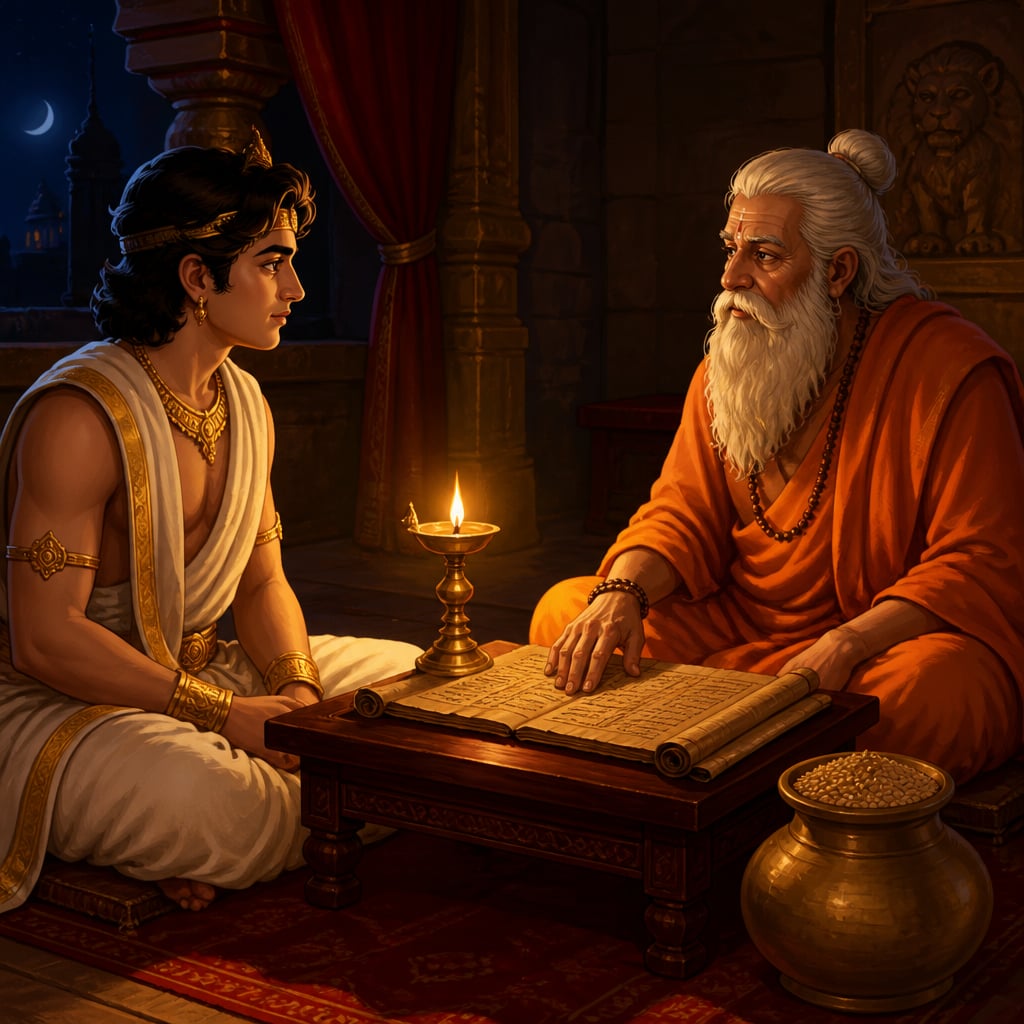
But the Rishi who served as the king's counselor shook his head. "When chaos increases, ṛta must be protected more carefully, not less. The rituals are not a luxury for peaceful times. They are the order we maintain because times are not peaceful."
"But how can we afford them?" the king asked.
"How can you afford to lose them?" the Rishi replied. "Without ṛta, what exactly are you defending?"
To appreciate this wisdom fully: In an era of constant disruption, the temptation is to treat everything as negotiable, to sacrifice anything for survival. The Vedic teaching on ṛta provides a counter-principle: some things must be protected precisely because they constitute what makes survival worthwhile. Modern organizations that understand this distinction, that know what they will and will not do regardless of circumstances, often prove more resilient than those that sacrifice everything for short-term survival.
The Invisible Structure
The Rig Veda speaks of ṛta, cosmic order, the deep pattern that underlies all appearance. The sun rises because of ṛta. The seasons turn because of ṛta. The ritual succeeds because it aligns with ṛta. This is not mere custom or preference; it is the structure of reality itself.
The opposite of ṛta is anṛta, disorder, falsehood, the collapse of pattern. When anṛta dominates, nothing can be trusted. Promises break. Processes fail. Cooperation dissolves. The leader's task during chaos is ṛta-rakṣaṇa, protecting the essential order that allows everything else to function.
This is subtle. When pressure mounts, the natural response is to sacrifice everything for the immediate crisis. But some things, when sacrificed, cannot be restored. Values abandoned under pressure don't automatically return when pressure eases. Processes cut in crisis often stay cut. Integrity compromised once tends to stay compromised.
What the Mantras Reveal
The Rishi Dīrghatamas speaks of ṛta's centrality:
"Ṛtasya panthāṃ na taranti duṣkṛtaḥ"
Those who do evil cannot cross the path of ṛta., RV 1.164.46
Word by word: ṛtasya (of ṛta, of cosmic order) panthām (the path) na (not) taranti (they cross, they traverse) duṣkṛtaḥ (those of evil deeds, wrongdoers).
The verse teaches that ṛta is not merely a nice ideal but a load-bearing structure. Those who violate it cannot proceed on the path, their progress is blocked, their efforts fail. This applies organizationally as much as cosmically: violate the essential order of your system, and you will find you cannot move forward.
Another hymn deepens this:
"Ṛtena ṛtam apihitaṃ dhruvam"
By ṛta, ṛta is concealed, firm and stable., RV 5.62.1
The phrase ṛtena ṛtam apihitam, "by ṛta, ṛta is covered", suggests that the cosmic order is self-protecting, self-perpetuating. When you maintain ṛta, ṛta maintains you. The discipline of order creates the conditions for order to continue. This is a reinforcing cycle: protect the essential, and the essential protects you.
The Commentators' Insight
Sayanacharya interprets ṛta in both cosmic and ethical dimensions. Cosmically, it is the order of nature, the reliability of dawn, of seasons, of natural law. Ethically, it is satya (truth) and dharma (righteous conduct). The leader who maintains ṛta maintains both: keeping processes reliable while keeping conduct righteous.
Sri Aurobindo sees ṛta as the "truth of being" that precedes manifestation. Before any action, there is the truth of what that action should be. Ṛta-rakṣaṇa means staying aligned with that truth even when circumstances pressure you toward convenience, shortcuts, or compromise. The easy path that violates ṛta leads eventually to collapse; the difficult path that maintains it leads to sustainable success.
Both commentators agree: ṛta is not optional. It can be violated, but the violation has consequences. Leaders who abandon essential order under pressure may survive the immediate crisis but find they've destroyed what made survival worthwhile.
The Tata Way Under Fire

In 2007, Tata Steel completed its acquisition of Corus, the Anglo-Dutch steel giant. The $12 billion deal made Tata Steel one of the largest steel companies globally. It also loaded the company with massive debt, just as the 2008 global financial crisis hit.
Steel prices collapsed. Demand evaporated. The debt burden became crushing. Analysts predicted disaster. Competitors like Arcelor Mittal began aggressive cost-cutting, including large-scale layoffs. The pressure on Tata Steel to do the same was enormous.
Ratan Tata faced a choice that revealed his understanding of ṛta. The Tata Group had built its reputation on employee welfare, ethical conduct, and long-term stakeholder value, not just shareholder returns. These weren't slogans; they were the essential order of how Tatas operated. Abandon them, and what exactly remained of being a Tata company?
Tata chose to protect the ṛta. Instead of mass layoffs, he implemented salary cuts at senior levels, reduced bonuses, and asked for voluntary separations. The company absorbed short-term losses rather than destroy the trust that had taken a century to build. Communication remained honest; no false reassurances, but no panic either.
What Preservation Cost, And Saved
The financial press criticized Tata's approach as soft, uncommercial, old-fashioned. Shareholders grumbled. The stock underperformed competitors in the short term.
But the ṛta held. When markets recovered, Tata Steel had retained its skilled workforce while competitors scrambled to rehire. Employee loyalty, maintained through the crisis, translated into productivity gains. The brand's reputation for ethical conduct attracted talent and partners that cost-cutters couldn't access.
More subtly, Tata Steel's internal order remained intact. Decision-making processes still worked. Trust between management and workers still existed. The psychological contract, "we will treat you fairly, and you will give us your best", had survived. Companies that had shattered this contract during the crisis faced years of rebuilding what Tata had protected.
This is ṛta-rakṣaṇa in corporate form: knowing what essential order must be preserved even when everything else is negotiable.
The Ninth Guru's Sacrifice

Guru Tegh Bahadur, the ninth Sikh Guru, faced a different kind of pressure. The Mughal Emperor Aurangzeb had intensified religious persecution. Kashmiri Pandits, facing forced conversion, came to the Guru seeking protection. The Guru knew that intervention meant confrontation with imperial power, likely meaning his own death.
The pressure to compromise was immense. He could have advised quiet compliance, temporary accommodation, waiting for better times. He could have protected himself and his community by avoiding confrontation. Many religious leaders in that era made exactly these calculations.
But Guru Tegh Bahadur understood that some ṛta, some essential order, cannot be compromised without destroying itself. The right to practice one's faith according to conscience was not negotiable. The principle of protecting the persecuted was not adjustable based on the strength of the persecutor. These were the ṛta of dharmic civilization itself.
He traveled to Delhi, knowing the consequences. He was arrested, tortured, and executed in Chandni Chowk in 1675. But his sacrifice preserved something that survival through compromise would have destroyed. The principle remained intact: there are things worth dying for, boundaries that must not be crossed.
What Cannot Be Negotiated
The Sikh community that followed, and eventually the broader Indian resistance to religious tyranny, drew strength from what Guru Tegh Bahadur had protected. His son, Guru Gobind Singh, would create the Khalsa, a community forged in the understanding that some ṛta must be defended at any cost.
Had the ninth Guru compromised, the spiritual ṛta of the community would have shattered. The message would have been: "When pressure is sufficient, principles yield." Instead, the message became: "Some principles cannot yield, regardless of pressure." This became the foundation on which an entire tradition of resistance was built.
The Three Levels of Ṛta
From these examples, we can identify three levels of order that leaders must protect:
1. Operational Ṛta, Processes That Must Continue Some operations cannot stop even in crisis: payroll must be processed, safety systems must function, essential communications must flow. Identify these and protect them absolutely. Everything else can flex.
2. Cultural Ṛta, Values That Must Persist Beyond processes, there are values that define who you are. Tata's commitment to employee welfare. The Guru's commitment to protecting the persecuted. These cannot be suspended "temporarily" because they constitute identity itself.
3. Principled Ṛta, Boundaries That Cannot Be Crossed Some things are simply off the table. Lines that cannot be crossed regardless of benefit. Compromises that cannot be made regardless of cost. These are the non-negotiables that define what you will not do even if it would help.
Your Own Order
Chaos will come. Pressure will mount. You will be tempted to sacrifice essential order for immediate relief.
Before that moment arrives, ask yourself: What is my ṛta? What processes, values, and principles constitute the essential order I will protect? What can flex, and what cannot?
Having this clarity before pressure arrives is crucial. In the moment of crisis, everything seems negotiable; everything seems like it could be sacrificed just this once. The time to identify your ṛta is before the test, not during it.
Indra protected the waters by slaying Vṛtra. But Varuna protected something even more fundamental: the ṛta itself, the cosmic order that made the waters worth having. Both protections are necessary. Without Indra's action, the waters don't flow. Without Varuna's order, the waters have no banks.
In our next lesson, we'll explore the opposite challenge: when leadership means not acting, when restraint rather than intervention is the higher wisdom.
Research on habit formation shows that consistency builds capacity: each time you maintain a practice, the neural pathways strengthen, making the next maintenance easier. The Vedic 'ṛtena ṛtam' describes this at civilizational scale: order creates the conditions for order.
Companies with strong cultures find that the culture maintains itself: new employees are socialized by existing ones, norms are transmitted through daily practice, and violations are naturally resisted. Building this self-maintaining culture requires consistent protection of core values.
Positive feedback loops can be virtuous or vicious. Trust begets trust; reliable processes attract people who value reliability; maintained standards raise expectations. But the reverse also holds: once order breaks, the breakdown accelerates. Protecting ṛta is investing in the virtuous cycle.
Research on cognitive dissonance shows that violating one's own values creates internal conflict that impairs function. People who compromise their principles often find themselves less effective, not more, the psychological cost of violation blocks the efficiency they sought through compromise.
Companies that violate their stated values, treating employees poorly while claiming 'people first,' quality shortcuts while advertising excellence, find that the violation blocks their path. Employees disengage, customers distrust, and the gains from violation are consumed by the costs.
In complex systems, short-term optimization that violates system integrity often produces long-term degradation. The 'path' is blocked not by external punishment but by internal contradiction. Systems that violate their own operating principles find they cannot function effectively.
Case studies
Tata Steel's Ṛta-Rakṣaṇa: Maintaining Values During the 2008 Crisis
In 2007, Tata Steel completed its $12 billion acquisition of Corus, making it one of the world's largest steel companies. The deal was celebrated, until the 2008 global financial crisis hit. Steel demand collapsed. Prices plummeted. Tata Steel found itself with massive debt and shrinking revenue. The pressure to cut costs was overwhelming. Competitors were announcing mass layoffs. Financial analysts demanded headcount reductions. The Corus acquisition, meant to establish Tata Steel globally, now seemed like a catastrophic miscalculation. Ratan Tata faced the fundamental question of ṛta-rakṣaṇa: What essential order must be protected even in crisis? For the Tata Group, employee welfare was not a policy but an identity. Since J.N. Tata's founding principles, the group had committed to treating workers as stakeholders, not costs to be minimized.
Tata's response exemplified the three levels of ṛta: **Operational ṛta**: Core production continued. Safety systems were maintained. Essential processes didn't stop. **Cultural ṛta**: The value of employee welfare was protected. Rather than mass layoffs, senior executives took salary cuts. Voluntary separation packages were offered rather than forced redundancies. Honest communication replaced false reassurance. **Principled ṛta**: The fundamental commitment, that Tatas treat their people fairly, remained non-negotiable. This wasn't calculated expediency; it was identity protection. The mantra 'ṛtena ṛtam apihitam' played out practically: by protecting the trust relationship, Tata created the conditions for trust to continue. When recovery came, the workforce was intact, loyal, and ready.
Tata Steel emerged from the crisis with its essential order intact. Employee loyalty translated into productivity when markets recovered. The company's reputation for ethical conduct, maintained through the crucible, became a competitive advantage in talent acquisition and partnership formation. Competitors who had slashed workforces faced years of rebuilding capacity and trust. The short-term savings from layoffs were consumed by long-term costs of rehiring, retraining, and reputation damage. Tata's 'expensive' choice to protect ṛta proved cheaper in the full accounting. The Corus acquisition eventually succeeded not despite the crisis management but because of it. The values that seemed costly to maintain became the foundation for sustainable success.
Essential order is not a luxury for good times but a necessity especially in bad times. The values and processes that constitute organizational identity must be protected precisely when pressure to abandon them is greatest. Short-term survival through ṛta-violation often produces long-term failure.
Companies that cut values during downturns often discover those were the exact things that enabled recovery. Costco's refusal to cut employee wages during recessions, or Toyota's commitment to lifetime employment during the 2008 crisis, created the workforce loyalty that accelerated their rebounds.
Tata Steel's employee attrition rate during the crisis remained below 5%, compared to industry averages of 15-20%. The retained institutional knowledge and workforce stability accelerated recovery when markets improved.
Guru Tegh Bahadur: Principled Ṛta at Ultimate Cost
In 1675, Kashmiri Pandits faced a grim ultimatum from Mughal Emperor Aurangzeb: convert to Islam or face death. They traveled to Anandpur to seek counsel from Guru Tegh Bahadur, the ninth Sikh Guru. The Guru understood what intervention meant. Aurangzeb had already executed his predecessor's grandfather. Challenging imperial religious policy was certain to provoke lethal response. From a purely strategic perspective, the rational choice was to counsel patience, discretion, quiet survival until circumstances changed. But Guru Tegh Bahadur saw beyond strategy. At stake was principled ṛta, the fundamental order that religious conscience cannot be coerced, that the persecuted must be protected, that some boundaries cannot be crossed regardless of the power of the transgressor.
Guru Tegh Bahadur's decision illustrates the highest form of ṛta-rakṣaṇa: protecting principle at ultimate personal cost. He reportedly said to the Pandits: 'I will protect your tilak and janeu' (the sacred marks and thread of Hindu practice). This was not a Sikh defending Sikh practice, it was a human being defending the principle of religious freedom itself. The Guru traveled to Delhi, knowing the consequences. He was arrested, tortured, and offered conversion. His companions were executed before him as pressure tactics. Through it all, he maintained ṛta, the order of truth, the principle that conscience is beyond coercion. On November 11, 1675, he was beheaded in Chandni Chowk. The site is now Gurdwara Sis Ganj, marking where he 'gave his head but not his principle.'
Guru Tegh Bahadur's sacrifice preserved something that survival through compromise would have destroyed. The message transmitted was not merely religious but civilizational: there are principles worth dying for; there are boundaries that power cannot cross. His son, Guru Gobind Singh, created the Khalsa in 1699, a community forged in the understanding that some ṛta must be defended at any cost. The entire subsequent Sikh tradition of resistance to tyranny grew from the foundation his sacrifice established. Had he compromised, the message would have been: 'When power is sufficient, principles yield.' Instead, the message became: 'Principles can outlast the power that oppresses them.' This truth, once demonstrated, could never be un-demonstrated.
Some ṛta is so fundamental that protecting it justifies even ultimate sacrifice. The Guru's example teaches that principled order is not a cost-benefit calculation but an absolute commitment. When the essential is truly essential, the question is not 'What will it cost?' but 'What kind of world results from the answer?'
Throughout history, principled stands at great personal cost have catalyzed transformative social movements. Nelson Mandela's imprisonment, Vaclav Havel's dissidence, and the self-immolation protests in Tibet all show that defending fundamental values, even at ultimate cost, can reshape the trajectory of entire communities.
Guru Tegh Bahadur's martyrdom in 1675 at Chandni Chowk, Delhi, led directly to the founding of the Khalsa by Guru Gobind Singh in 1699, transforming the Sikh community into a martial order of over 80,000 initiated members within a generation.
Reflection
- What is the ṛta of your work or life, the essential order you will protect regardless of pressure? Have you identified this clearly, or will you discover it only when tested?
- Why might the Rishis have taught that ṛta is self-maintaining, that 'by ṛta, ṛta is protected'? What does this suggest about the nature of order and the consequences of its violation?
- Is there something you would protect at ultimate cost, a principle for which you would sacrifice everything? Or is everything ultimately negotiable at sufficient price? What does your answer reveal about your deepest ṛta?