Kṣānti-Bala: When Not Acting Is Also Leadership

The Vedic Wisdom of Strategic Restraint

This lesson explores the profound Vedic insight that true strength includes the capacity for restraint. Through the metaphor of Indra's patient preparation before the strike against Vṛtra, and the cosmic stillness that precedes creation, we learn that knowing when NOT to act is as essential to leadership as decisive action. The lesson examines kṣānti (patient endurance) and upekṣā (equanimous non-engagement) as active leadership choices rather than passive weakness.

The Strength Hidden in Stillness

In the previous lessons, we have studied Indra's decisive action against Vṛtra, the vajra-strike, the courage, the speed. But there is a dimension of the Vṛtra-vadha that is often overlooked: the patient accumulation of power that preceded the strike.

Before the thunderbolt was hurled, there was drinking of Soma. Before the battle, there was preparation. Before the cosmic act of creation, the Nāsadīya Sūkta tells us, there was profound stillness, ānīd avātaṃ svadhayā tad ekam, "That One breathed, windless, by its own power."
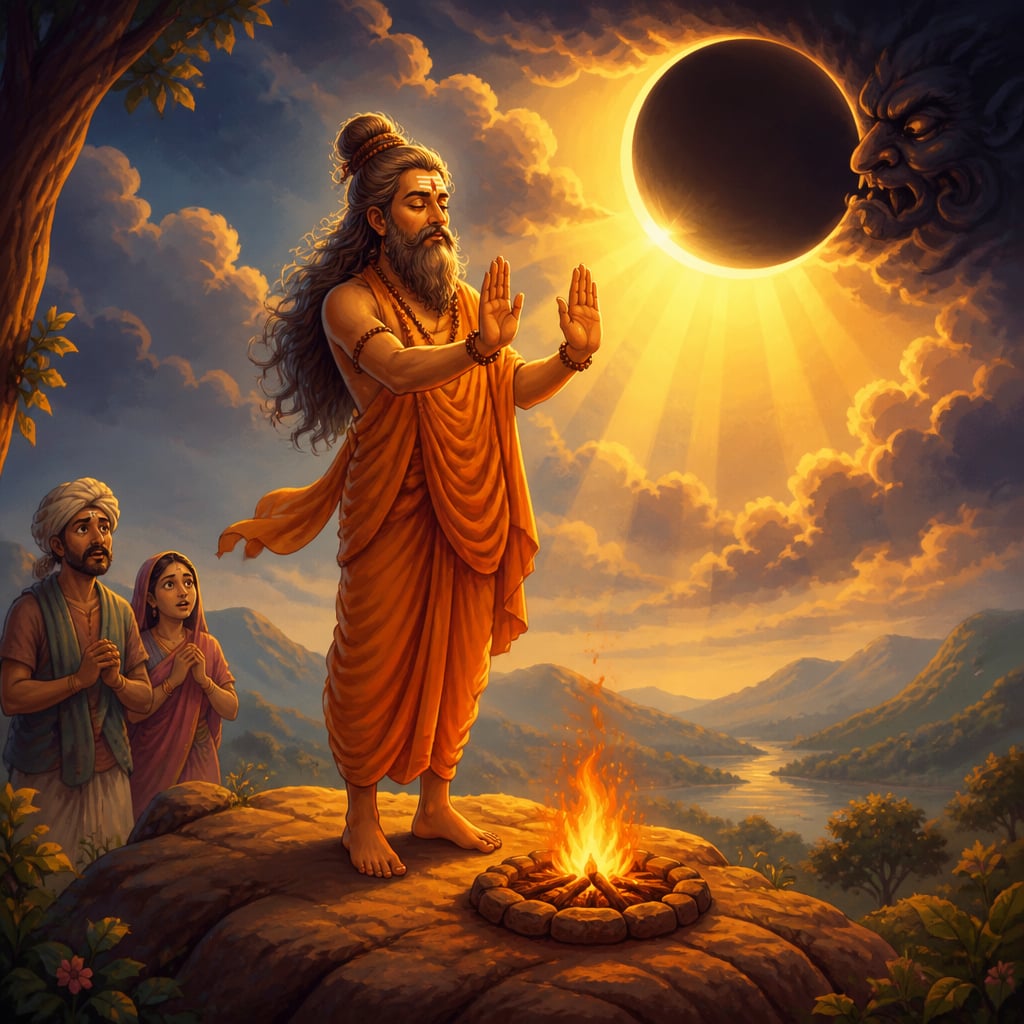
The sage Atri steadying an eclipsed sky with raised palms in tapas

This lesson explores a counter-intuitive truth: in chaos, sometimes the most powerful thing a leader can do is not act.


The Mantra of Patient Endurance

The Rig Veda contains a remarkable story of Atri, the sage who rescued the sun during an eclipse through the power of patient endurance:

svarbhānor adha yad indra māyā avo divo vartamānā avāhan | gūḷhaṃ sūryaṃ tamasāpavratena turīyeṇa brahmaṇāvindad atriḥ ||

"When, O Indra, the magic of Svarbhānu struck the sun, rolling down from heaven, Atri with his fourth prayer found the sun hidden by darkness and unlawful gloom.", RV 5.40.6

Word-by-word: svarbhānoḥ, of Svarbhānu (the demon of eclipse); māyāḥ, the magic/illusion; avaḥ, down; divaḥ, from heaven; vartamānāḥ, rolling; avāhan, struck; gūḷham, hidden; sūryam, the sun; tamasā, by darkness; apavratena, by unlawful conduct; turīyena brahmaṇā, with the fourth prayer; avindat, found; atriḥ, Atri.

What is remarkable about this story is that Atri did not rush. The sun was eclipsed, chaos descended. But Atri's power lay not in frantic action but in sustained, patient practice. The word turīya (fourth) suggests multiple attempts, a gradual building of power through persistence rather than panic.


Understanding Kṣānti: Patient Endurance as Power

The Sanskrit term kṣānti (क्षान्ति) comes from the root kṣam, to be patient, to endure, to forgive. But kṣānti is not passive suffering. It is the active choice to absorb pressure without reacting prematurely.

Sāyaṇa's insight: In his commentary on the Atri episode, Sāyaṇa emphasizes that Atri's power came not from a single dramatic act but from sustained tapas (austerity/discipline). The chaos of the eclipse could not be overcome by haste; it required the accumulation of spiritual power through patient practice.

This reveals a fundamental truth: some forms of chaos cannot be solved by action, they can only be outlasted.


The Second Key: Upekṣā, Strategic Non-Engagement

Beyond patient endurance, the Vedic tradition recognizes upekṣā (उपेक्षा), equanimous disengagement. This is not indifference born of weakness, but the deliberate choice not to engage with every provocation.

Consider this mantra from the famous Nāsadīya Sūkta:

ānīd avātaṃ svadhayā tad ekam | tasmād dhānyan na paraḥ kiṃ canāsa ||

"That One breathed, windless, by its own inherent power. There was nothing else beyond it.", RV 10.129.2

Word-by-word: ānīt, breathed; avātam, windless (without external movement); svadhayā, by its own power/nature; tat ekam, that One; tasmāt, than that; anyat, other; na paraḥ, nothing beyond; kiṃ cana, whatsoever; āsa, existed.

Before creation itself, there was stillness. The primal power did not rush to create, it breathed, svadhayā, by its own inherent rhythm. This is the deepest teaching: true power does not need to prove itself through constant motion.


The Three Moments of Strategic Restraint

From the Vedic wisdom, we can identify three distinct situations where not acting is the right leadership choice:

1. Kāla-Pratīkṣā (Waiting for Right Timing)

Some actions, taken at the wrong time, become counter-productive. The Rig Veda repeatedly emphasizes kāla, the right moment. Indra did not strike Vṛtra immediately upon seeing him. There was preparation, the drinking of Soma, the gathering of allies. The premature strike would have failed.

Modern parallel: Launching a product before the market is ready, or entering a negotiation before gathering sufficient information.

2. Śakti-Saṃcaya (Accumulation of Power)

Some chaos is too great to overcome with current resources. The wise leader recognizes this and uses apparent inaction to build capacity. Atri's four prayers were not hesitation, they were the progressive accumulation of spiritual power.

Modern parallel: Building cash reserves during good times for the inevitable crisis; developing talent pipelines before urgent need arises.

3. Viṣa-Varjana (Avoiding Poison)

Some situations are designed to provoke reaction. Engaging with them spreads the poison further. The Vedic concept of upekṣā recognizes that certain provocations lose power when ignored.

Modern parallel: Not responding to every criticism on social media; refusing to be drawn into unproductive conflicts that drain organizational energy.


Chandragupta and Chanakya: The Power of Preparation

Chandragupta and Chanakya planning Magadha in exile

The story of Chandragupta Maurya's rise to power is one of history's greatest examples of strategic patience.

When the young Chandragupta first met Chanakya (Kauṭilya), he was an exile without an army, without resources, without allies. The Nanda empire seemed invincible. A rash leader would have attacked immediately and been destroyed.

Instead, Chanakya counseled years of patient preparation:

The key insight: Chanakya did not mistake preparation for inaction. Every day of "waiting" was filled with purposeful activity, but it was activity that remained invisible to the enemy.

The Vedic parallel: Just as Indra drank Soma before striking Vṛtra, Chandragupta built his ojas (vital power) before the battle. The restraint was not weakness, it was the charging of the vajra.

The result: When Chandragupta finally moved, the Nanda empire collapsed with surprising speed. What appeared to be sudden success was the fruit of years of patient preparation.

The lesson: The most powerful strike often follows the longest preparation. Chaos creates urgency, but urgency is often the enemy of effectiveness.


Infosys: The Discipline of Focus

Narayana Murthy refusing diversification at early Infosys

In the 1990s and 2000s, as India's IT industry exploded, many companies rushed to diversify. They entered hardware manufacturing, telecom, retail, and dozens of unrelated businesses. The logic seemed sound: growth was everywhere, and missing opportunities seemed foolish.

Infosys, under Narayana Murthy's leadership, made a different choice. They said "no", repeatedly.

What they refused:

The philosophy: Murthy articulated a principle he called "predictable growth", the discipline to grow only in areas where Infosys had genuine expertise and could maintain quality. This was not timidity; it was strategic clarity.

The chaos they avoided: Many diversified IT companies later struggled with:

The Vedic lens: Infosys practiced upekṣā, equanimous disengagement from opportunities that seemed attractive but were ultimately distracting. They understood that not every opportunity is meant to be seized. Some "opportunities" are actually Vṛtra in disguise, obstructions masquerading as openings.

The result: While competitors struggled with the aftermath of overexpansion, Infosys maintained its reputation, financial stability, and ability to weather subsequent crises.

The lesson: In a world that rewards action, the discipline to not act, to say "no" to appealing opportunities, is rare and powerful. Focus requires the courage to ignore.


The False Dichotomy: Action vs. Inaction

Western leadership culture often presents a false binary: you are either acting or you are passive. The Vedic framework offers a richer vocabulary:

Term Meaning Nature
Karma Action Outward movement
Akarma Non-action Deliberate, strategic restraint
Vikarma Wrong action Misdirected or premature action

The Bhagavad Gītā (which inherits this Vedic framework) teaches that akarma, deliberate non-action, can be more powerful than karma. The key is intention and awareness.

The danger of vikarma: Action taken to appear decisive, without strategic grounding, often makes situations worse. Many leaders act not because action is needed, but because inaction feels uncomfortable or appears weak.


Practical Application: The Restraint Protocol

Before acting in a crisis, apply this Vedic-inspired checklist:

1. Kāla-Praśna (The Timing Question)

"Is this the right moment for action, or am I acting because waiting feels uncomfortable?"

If you cannot articulate why now is the right moment (beyond "we need to do something"), restraint may be wiser.

2. Śakti-Praśna (The Power Question)

"Do I have sufficient resources and clarity to act effectively, or would waiting allow me to build capacity?"

Premature action with insufficient resources often fails and depletes what little power you had.

3. Viṣa-Praśna (The Poison Question)

"Is this situation designed to provoke me? Would my engagement spread the problem rather than solve it?"

Some provocations are traps. Responding to them gives them power they would not otherwise have.

4. Ṛta-Praśna (The Order Question)

"Is there a natural rhythm or process that my intervention would disrupt?"

Sometimes situations resolve themselves if given time. Intervention can prevent natural healing.


Distinguishing Restraint from Avoidance

A critical warning: this lesson is not a justification for fear-based inaction. The Vedic tradition clearly distinguishes:

Kṣānti (Patient Endurance), Active, intentional, rooted in strength

Bhīru-tā (Fearful Avoidance), Passive, reactive, rooted in weakness

The external behavior may look similar. The internal state is entirely different. The true test: Can you act when the moment comes, or has your "restraint" become paralysis?


The Final Teaching: Stillness as Power

The Rig Veda's deepest insight about creation comes from the space before creation:

tama āsīt tamasā gūḷham agre 'praketaṃ salilaṃ sarvam ā idam | tucchyenābhv apihitaṃ yad āsīt tapasas tan mahinājāyataikam ||

"Darkness was hidden by darkness in the beginning; undistinguished, all this was water. That which was covered by the void, that One was born through the power of tapas.", RV 10.129.3

Word-by-word: tamaḥ, darkness; āsīt, was; tamasā, by darkness; gūḷham, hidden; agre, in the beginning; apraketam, undistinguished; salilam, water/fluid; sarvam, all; idam, this; tucchyena, by the void; abhv, that which existed; apihitam, covered; āsīt, was; tapasaḥ, of tapas (austerity/heat); tat mahinā, through that power; ajāyata, was born; ekam, One.

The universe itself was born from stillness, from tapas, sustained discipline that looks like inaction but is actually the most concentrated form of power.

The leader who understands this knows: sometimes your greatest act of leadership is to create the space for things to unfold, to absorb pressure without reacting, to wait with full attention until the right moment reveals itself.

Case studies

Chandragupta and Chanakya: The Power of Preparation

When young Chandragupta first encountered Chanakya around 324 BCE, he was an exile from the Nanda court, without army, resources, or allies. The Nanda empire, with its vast treasury and 200,000-strong army, seemed invincible. Chanakya recognized in Chandragupta the potential to overthrow the Nandas, but understood that premature action would mean destruction. The challenge was building sufficient power while remaining invisible to Nanda intelligence.

Just as Indra drank Soma and gathered divine allies before striking Vrtra, Chandragupta built his ojas (vital power) before battle. The restraint was not weakness. It was the charging of the vajra. Chanakya understood that chaos (the apparent invincibility of the Nandas) creates urgency, but urgency is often the enemy of effectiveness. The teaching: some victories require years of invisible preparation.

When Chandragupta finally moved around 321 BCE, the Nanda empire collapsed with surprising speed. What appeared to be sudden success was the fruit of years of patient preparation. The Maurya Empire that emerged became the largest in Indian history.

Patient preparation that appears passive is often the most effective form of action. Chanakya counseled years of purposeful activity invisible to the enemy, recruiting officials, building networks, and training armies in secret. The leader who mistakes urgency for effectiveness risks premature destruction.

In venture capital, the most successful founders often spend years in 'stealth mode,' building product, team, and network before going public. Patient preparation that looks like inaction from the outside can be the most effective form of strategic execution, as companies like Stripe demonstrated with years of quiet infrastructure building before explosive growth.

Chanakya's preparation phase lasted approximately 3 years (324-321 BCE), during which he built a coalition spanning frontier kingdoms from Taxila to Magadha. The resulting Maurya Empire governed 5 million square kilometers for over 130 years.

Infosys: The Discipline of Focus

In the 1990s and 2000s, India's IT industry exploded. Companies that had started as small software shops suddenly had access to massive capital and countless opportunities. The pressure to diversify was intense: hardware, telecom, retail, entertainment, real estate. Infosys faced constant pressure from clients wanting hardware manufacturing, the telecom boom offering easy profits, and competitors expanding aggressively in every direction. Staying focused on software services felt conservative, even timid.

Infosys practiced upeksha, equanimous disengagement from opportunities that seemed attractive but were ultimately distracting. They understood that not every opportunity is meant to be seized. Some 'opportunities' are Vrtra in disguise, obstructions masquerading as openings. Like the primal power that 'breathed windless by its own nature,' Infosys found strength in not needing to prove itself through constant expansion. Focus requires the courage to ignore.

Many diversified IT companies later struggled with debt from failed acquisitions, diluted management attention, quality issues from overextension, and brand damage from failed ventures. Infosys maintained its reputation, financial stability, and core competence. When subsequent crises hit (2008, 2020), they had the strength to weather them.

Systematic refusal is a form of strength, not timidity. Under Narayana Murthy's leadership, Infosys said no to hardware, telecom, unrelated acquisitions, and short-term contracts that would compromise quality. Growing only where you have genuine expertise preserves the integrity that makes long-term success possible.

In an era of diversification pressure, companies that maintain disciplined focus often build the strongest competitive moats. Berkshire Hathaway's 'circle of competence' principle and Apple's famously small product line both demonstrate that strategic refusal, saying no to attractive but distracting opportunities, preserves the excellence that sustains long-term growth.

Between 2000 and 2020, Infosys grew revenue from $400 million to over $13 billion while maintaining profit margins above 20%, compared to diversified peers whose margins dropped to single digits during the same period.

Reflection

More in Vṛtra-Vadha: Leadership in Times of Chaos

All lessons in Vṛtra-Vadha: Leadership in Times of Chaos · Rig Vedic Leadership course