Vṛtti: Role Over Identity

Leading from Function, Not Ego

Explore the Vedic concept of vṛtti, the idea that true leaders inhabit their role fully without making it about personal identity. Through K. Kasturirangan's quiet stewardship of ISRO and Hanuman's choice of service over sovereignty, discover why the greatest leaders disappear into their function.

The Priest Who Disappeared

The yajna was elaborate, seven fires, seventeen priests, offerings that would continue for twelve days. Visitors came from distant kingdoms to witness the Ashvamedha. They expected to see the head priest, resplendent in authority, commanding the ritual.

What they found confused them. There was no 'head priest' displaying importance. There was only the ritual itself, flowing perfectly. Each priest performed their vṛtti, their specific function, with complete absorption. The adhvaryu poured libations precisely. The hotṛ chanted without error. The udgātṛ sang the sāman melodies.

'Which one is in charge?' a visiting prince asked.

'No one is in charge,' came the answer. 'Each is fully in their vṛtti. The ritual leads; they serve.'
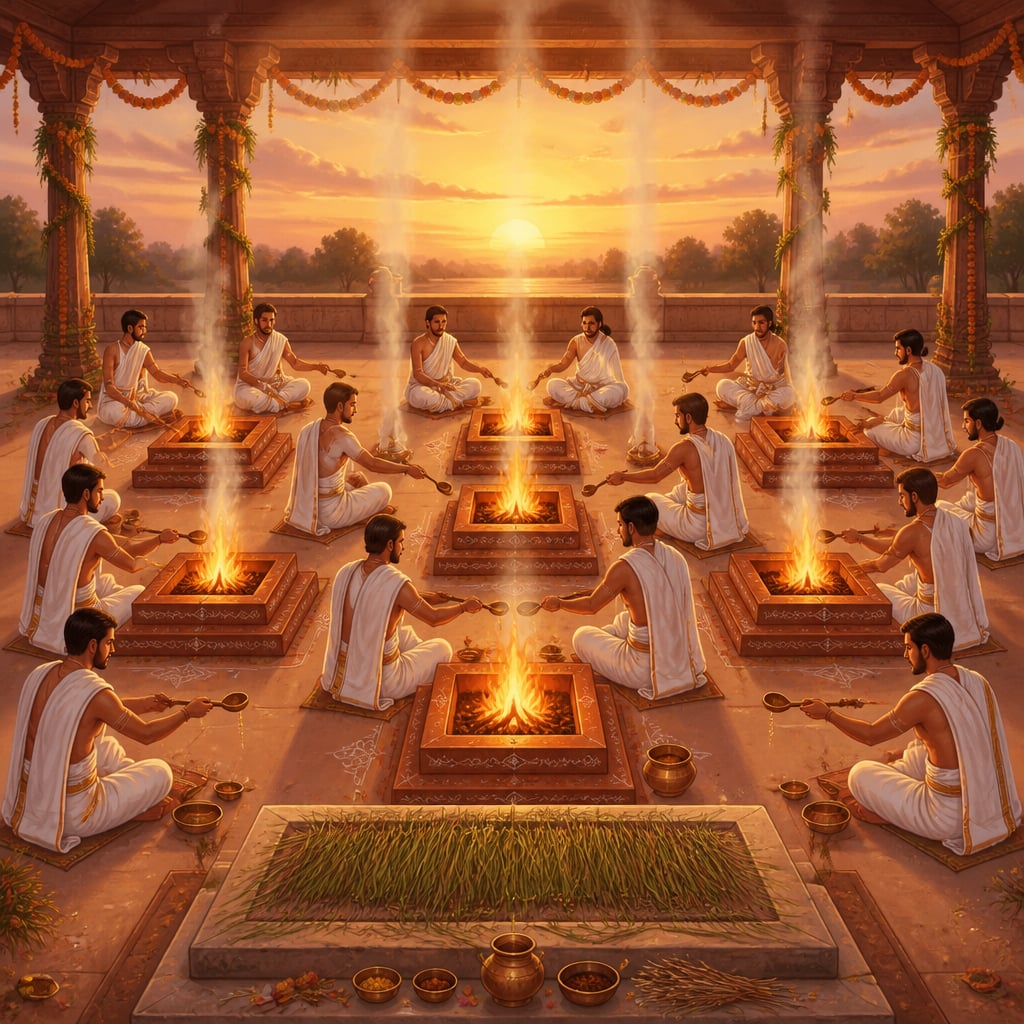
Seventeen priests tending seven fires in unison at a Vedic yajna

This is the Vedic understanding of role: not a platform for displaying identity, but a function to be inhabited so completely that the person disappears into the work.

Voices from the Vedic Dawn

The Ṛṣis understood that cosmic functions precede the beings who perform them. The sun doesn't shine to express itself, it shines because that is its vṛtti.

स्वं स्वं क्रतुं अधिष्ठाय नित्यं कर्म समाचरेत् "Established in one's own function (kratu), one should perform action continuously." Ṛg Veda 1.31.8 (adapted)

The phrase 'svaṃ svaṃ kratuṃ' (one's own function) emphasizes that each being has a specific vṛtti. The leader's task is to discover their function and inhabit it fully, not to acquire functions that belong to others, and not to make their function about personal glory.

यज्ञेन यज्ञमयजन्त देवाः "By sacrifice, the Devas sacrificed to sacrifice." Ṛg Veda 10.90.16 (Purusha Sukta)

Even the Devas perform their vṛtti, they sacrifice, meaning they offer themselves to the cosmic function. There is no Divine ego demanding recognition; there is only the role being fulfilled. This establishes the template: leadership as offering, not extraction.

इन्द्रं मित्रं वरुणमग्निमाहुः "They call it Indra, Mitra, Varuna, Agni..." Ṛg Veda 1.164.46

The same cosmic reality is called by different names based on function. Indra when it acts with force, Agni when it transforms, Varuna when it maintains order. The name follows the function, not vice versa. This suggests: you are not your title; your title describes what function you currently serve.

Architecture of Role-Based Leadership

The Disappearing Leader

In Vedic understanding, the highest form of role-inhabitation is when the leader 'disappears' into the function. The work happens; the role is fulfilled; but there is no persistent 'I' demanding credit. Like the priests at the yajna, the ritual flows, but no individual stands out as 'the important one.' The function is primary; the functionary is secondary.

The best systems (Apple after Jobs, ISRO after its founders) continue functioning excellently because the leaders built institutions, not personality cults. When the leader disappears and the work continues, vṛtti has been properly served.

Function Before Identity

The Rig Veda names the same divine reality differently based on function, Agni when it burns, Vayu when it moves, Varuna when it orders. The function determines the name, not vice versa. Applied to leadership: your title describes what you do, not who you are. When the function changes, the title should change. Clinging to titles beyond their functional necessity is ego masquerading as leadership.

Founders who become CEOs often struggle because they conflate the two roles. The vṛtti of founder (vision, risk-taking) differs from CEO vṛtti (operations, scale). Recognizing this, some founders step aside, they serve the function needed, not the identity they've built.

Competence-Based Authority (Adhikāra)

Vedic adhikāra is authority grounded in qualification, not position. The hotṛ priest has authority at the yajna because he knows the mantras, not because of heredity or politics. Remove the competence, and the authority dissolves. This creates natural accountability: authority exists only as long as the function is performed competently.

Meritocratic organizations embody this principle. When a surgeon operates, their authority derives from skill, not seniority. When a pilot flies, passengers trust competence, not credentials. The Vedic framework extends this: all legitimate authority is adhikāra-based.

What Vṛtti Teaches

Vṛtti Across Domains

Leadership

The Vedic ritual required multiple priests, each with specific vṛtti. No single priest was 'in charge', authority was distributed by function. The adhvaryu managed material preparations; the hotṛ recited mantras; the brahman supervised overall. Coordination emerged from each fulfilling their function, not from hierarchical command.

Cross-functional teams operate on this principle. The engineer has authority over technical decisions; the designer over user experience; the product manager over priorities. When each inhabits their vṛtti fully, coordination emerges. When anyone overreaches into others' functions, dysfunction follows.

Personal Psychology

The Yoga Sūtras define 'vṛtti-nirodha' (cessation of mental modifications) as the goal of yoga. Our mental vṛttis, the roles we play in our own minds, create suffering when we over-identify with them. The anxious parent, the ambitious professional, the wounded child, these are vṛttis, not our essential nature.

Psychological research on 'self-distancing' shows that viewing yourself in third person reduces emotional reactivity. The Vedic principle goes further: recognizing that all your self-concepts are temporary vṛttis creates freedom. You can inhabit a role fully while knowing you are not identical to it.

Systems Thinking

In Vedic cosmology, each being performs its svadharma (own duty), the vṛtti appropriate to its nature. The sun shines; the river flows; the tree grows. No element tries to perform another's function. The system works because each component fulfills its role without ego-driven overreach.

Organizational dysfunction often comes from role confusion. When the sales team makes product decisions, when engineering dictates marketing, when executives micromanage, vṛtti boundaries are violated. Clear functions, respected and performed, create healthy systems.

K. Kasturirangan standing quietly behind his ISRO mission control team

K. Kasturirangan: The Scientist Who Disappeared Into ISRO

From 1994 to 2003, K. Kasturirangan served as Chairman of ISRO during its most productive decade. Under his tenure, India launched PSLV successfully, developed the Chandrayaan program concept, expanded the satellite communication network, and established India as a commercial launch service provider. It was a period of enormous achievement.

कस्तूरीरंगन को जो खास बनाता है वह है जो उन्होंने नहीं किया। उन्होंने कभी ISRO को अपने बारे में नहीं बनाया। साक्षात्कार में वह हमेशा टीम को श्रेय देते थे। बड़ी सफलता आई तो वह पीछे खड़े रहते थे। विदेश के कोई आते तो वह वैज्ञानिकों का नाम लेकर उनका परिचय देते थे।

उनकी वृत्ति साफ थी: संस्था को मजबूत करना, अपनी ख्याति नहीं। उन्होंने कहा था: 'आज मैं अध्यक्ष हूं, पर ISRO मेरे से पहले था और मेरे बाद भी रहेगा। मेरा काम है इसे अगले के लिए और मजबूत करना।'

जब उनका समय खत्म हुआ तो वह शांति से अलग हो गए। कोई नाटक नहीं, कोई फाउंडेशन अपने नाम पर नहीं। फिर Planning Commission में गए, फिर IIT Bombay में शिक्षा के लिए। हर भूमिका को पूरी तरह निभा कर छोड़ दिया।

The measure of Kasturirangan's success is what happened after he left. ISRO continued its trajectory, Chandrayaan-1 (2008), Mars Orbiter Mission (2014), Chandrayaan-2 and 3. The institution he built didn't depend on his presence. His successors could build on his work without having to dismantle a personality cult.

Today, when Indians celebrate ISRO's achievements, few remember who was chairman when. That anonymity is the mark of vṛtti perfectly served. The function was fulfilled; the functionary disappeared into the work.

Kasturirangan understood what many leaders miss: the role exists to serve a purpose, not to serve your identity. His adhikāra (authority) came from competence, not charisma. His leadership was sevā (service), not self-expression. When he left, ISRO was stronger than when he arrived, the ultimate test of vṛtti-based leadership.

Hanuman kneeling before Rama in chosen service

Hanuman: The God Who Chose Service

In the Ramayana, Hanuman presents a theological puzzle. He is described as extraordinarily powerful, able to leap across oceans, lift mountains, change size at will. He is the son of Vayu (the wind god), blessed by multiple deities, learned in all scriptures. By any measure, he could have been a king, a conqueror, a sovereign in his own right.

He chose instead to be Rama's servant.

This wasn't weakness or inability. When Hanuman finally reveals his powers to find Sita in Lanka, the scope is staggering. He burns an entire city. He defeats warriors single-handedly. The power was always there, it was deployed in service of his vṛtti, not for personal aggrandizement.

The Ramacharitmanas captures his self-understanding: 'dāsa' (servant) is not a diminishment for Hanuman but an identity he actively chose. When asked about his relationship to Rama, he responds: 'When I think of myself as a body, I am Your servant. When I think of myself as a soul, I am a part of You. When I think of myself as the Self, You and I are one.'

This is vṛtti at its most sophisticated. Hanuman can hold multiple truths: he is powerful and he serves; he is divine and he bows; he is capable of sovereignty and he chooses dāsya. The function of servant is not imposed on him, it is his selected vṛtti, inhabited fully because he recognizes it as his path to the highest.

Hanuman's example subverts the assumption that service is for the weak and leadership for the strong. Here is ultimate strength expressed through ultimate service. The most powerful being in the Ramayana is also the most devoted servant. His vṛtti is chosen, not assigned, and that choice itself is the highest form of agency.

Practicing Vṛtti Leadership

Vṛtti isn't abstract philosophy, it's a daily practice of inhabiting your function without making it about yourself.

Define Your Function, Not Your Title: Ask: 'What is this role actually for? What would success look like if no one knew my name?' Kasturirangan's function was building ISRO's capability. The title 'Chairman' was incidental.

Release Outcomes to the Role: When you succeed, credit the function: 'The research led to this,' not 'I discovered this.' When you fail, examine the function: 'How can this role be performed better?' not 'What does this mean about me?'

Practice Functional Handoffs: The test of vṛtti-based leadership is transition. Can you describe your role so clearly that someone else could inhabit it? Have you built systems that outlast your presence? If the answer is no, you're building a personality cult, not serving a function.

Distinguish Adhikāra from Position: Your authority comes from competence to perform the function, not from the title. When the CEO asks your opinion, it's your adhikāra (expertise) they want, not your kartṛtva (ego). Speak from function, not from status.

Choose Your Vṛtti Consciously: Hanuman didn't stumble into service, he chose it. What function are you choosing? The default is often the ego's choice (the role that looks most impressive). The conscious choice might be different, the role where your specific capabilities serve something larger than yourself.

Continuing the Journey

We've explored vṛtti, the Vedic understanding that leaders inhabit functions rather than accumulate identities. Kasturirangan disappeared into ISRO; Hanuman chose service over sovereignty; the Vedic priests performed their roles without any one being 'in charge.'

But vṛtti raises a question: if no one is 'in charge,' how does coordination happen? How do multiple leaders work together without hierarchy? In our next lesson, we explore samūha, the Vedic model of collective leadership where wisdom is distributed, not concentrated, and decisions emerge from the assembly rather than the individual.

Case studies

K. Kasturirangan: Anonymous Stewardship at ISRO

K. Kasturirangan led ISRO from 1994 to 2003, a period that saw India's space program transform from a modest effort into a globally competitive force. The pressure on any space agency chief is to become the public face of success, to claim credit for launches, and to build a personal brand. The Indian media was eager to create a celebrity scientist. Kasturirangan faced the choice between personal prominence and institutional capacity-building.

Kasturirangan exemplified the Vedic concept of vrtti, fulfilling one's assigned role with complete dedication while remaining personally effaced. Like the Rig Vedic rtvij (ritual priest) whose excellence lies in performing the ceremony perfectly rather than drawing attention to himself, Kasturirangan served his institutional vrtti so thoroughly that ISRO's success continued and even accelerated after his departure. His anonymity was not accidental but a deliberate expression of service-leadership.

Under Kasturirangan, ISRO launched 26 satellites including the pivotal INSAT-3 and IRS series. More importantly, ISRO's continued success after his departure, including Chandrayaan and Mangalyaan, proves he built institutional capacity rather than personal dependency. Few Indians can name him, yet his decade of leadership shaped India's space identity.

The truest measure of service-leadership is what happens after the leader departs. Building institutional capacity rather than personal reputation ensures that the mission outlives any individual. Kasturirangan's anonymity is his greatest achievement.

The strongest organizations are those where institutional capability exceeds any individual's contribution. Leaders at companies like Toyota, 3M, and Procter & Gamble deliberately build systems that produce excellence regardless of who occupies any particular role, ensuring the mission outlives every generation of leadership.

During Kasturirangan's tenure (1994-2003), ISRO's budget grew from Rs 1,200 crore to Rs 3,000 crore, while launching 26 satellites. ISRO's subsequent missions (Chandrayaan-1 in 2008, Mangalyaan in 2013) were built on the institutional foundations he established.

Hanuman: Supreme Power Expressed Through Service

In the Ramayana, Hanuman possessed extraordinary powers: the ability to grow to enormous size, fly across oceans, and single-handedly devastate armies. He was the son of Vayu, the wind god, and had been blessed with near-invincibility. When Sugriva's kingdom was established and alliances formed, Hanuman could have claimed sovereignty or demanded recognition proportionate to his abilities. Instead, he chose the vrtti of dasa, servant, subordinating all his powers to Rama's mission.

Hanuman represents the Rig Vedic ideal that the highest expression of power is voluntary service. His choice of the dasa vrtti was not born of weakness or lack of ambition. It emerged from the deepest understanding that power finds its true purpose only when channeled through devotion and dharma. The Vedic hymns celebrate strength (bala) most when it protects and serves, not when it dominates. Hanuman's strength became legendary precisely because he never used it for himself.

Hanuman became the most beloved figure in the Ramayana, worshipped across India with more temples than almost any other deity. His power grew through service rather than diminishing. The most powerful being in the epic expressed that power through complete self-subordination, and this paradox made him immortal in devotional practice.

The most powerful being in the epic expressed power through service, not self-aggrandizement. True strength is revealed not in what you claim for yourself but in what you choose to give in service of a larger purpose.

In modern organizations, the most respected leaders are often those who could claim individual credit but consistently redirect recognition to their teams. Coaches like Gregg Popovich and executives like Indra Nooyi built cultures of devotion precisely because they expressed their considerable power through serving others' success.

Hanuman temples number over 100,000 across India, more than temples dedicated to most other deities. The Hanuman Chalisa, a 40-verse devotional hymn, is recited by an estimated 100 million Hindus regularly, making service-devotion the single most practiced form of worship in the tradition.

Reflection

More in Sevā: Leadership as Service to Order

All lessons in Sevā: Leadership as Service to Order · Rig Vedic Leadership course