Parirākṣaṇa - The Sacred Trust

Leading as a guardian of what was entrusted, not an owner of what was given

This lesson explores parirākṣaṇa, the Vedic understanding of leadership as stewardship rather than ownership. Through the stories of M.S. Subbulakshmi's guardianship of Carnatic music and Chanakya's stewardship of the Mauryan vision, we discover that true leaders see themselves as temporary custodians of something larger, responsible for preserving and transmitting what they've received.

The Teacher's Teacher

In 1936, a young woman sang at the Madras Music Academy. She was sixteen years old.
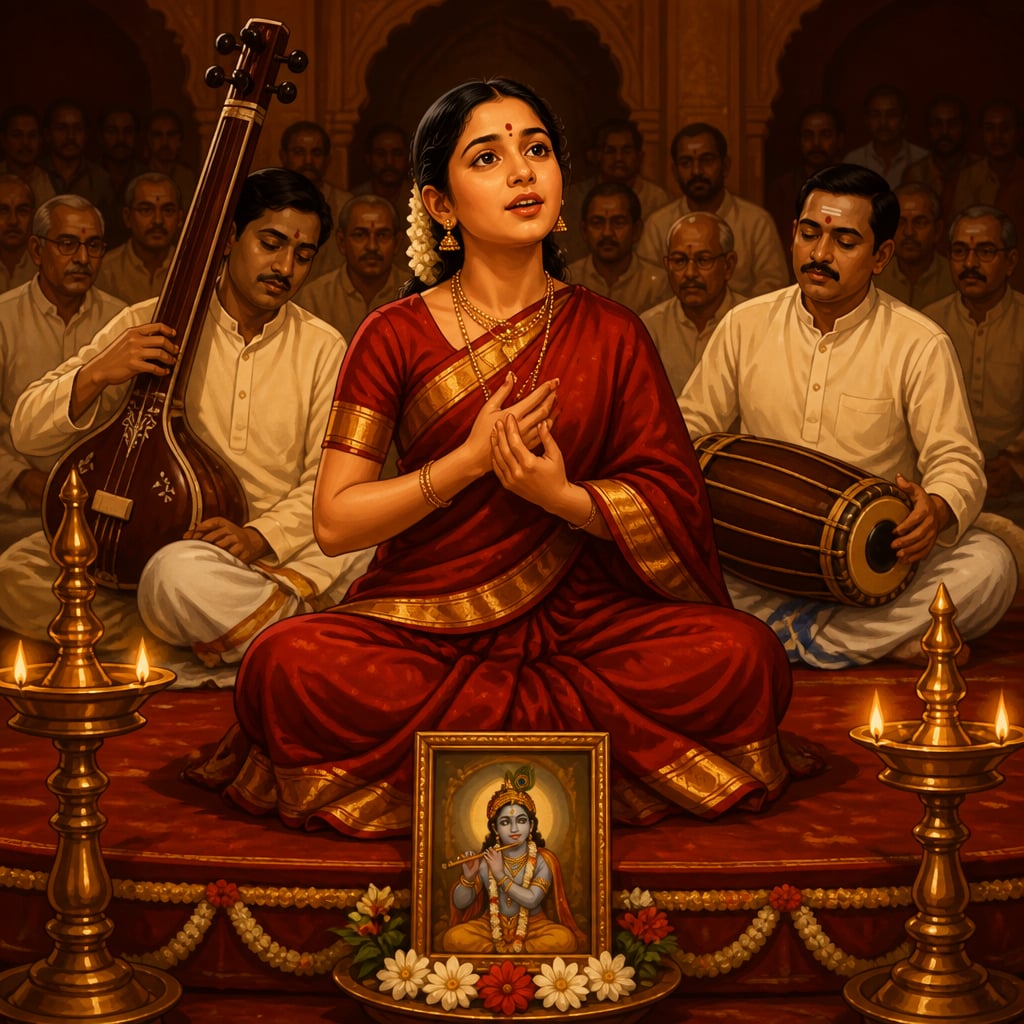
Young M.S. Subbulakshmi singing at the Madras Music Academy in 1936

The audience included the greatest musicians of the age, masters who had spent lifetimes perfecting their art. They listened to this girl from Madurai and recognized something rare: not just talent, but something in how she held the music. She wasn't displaying herself through the songs. She was allowing herself to be a vessel through which something ancient could flow.

M.S. Subbulakshmi would spend the next seven decades as the most beloved voice in Carnatic music. But she never spoke of "her" music. She spoke of the tradition she had received, the composers whose works she carried, the teachers whose lineage passed through her.

This is parirākṣaṇa, not ownership but guardianship. Not acquisition but protection. The understanding that a leader holds something in trust for those who came before and those who will come after.

The Doctrine of Sacred Trust

The Vedic tradition understood leadership through the metaphor of the nyāsa, a trust or deposit. When you lead, you don't own what you lead. You hold it temporarily, responsible for protecting it, nurturing it, and eventually passing it on in better condition than you received it.

The Manu Smriti articulates this principle for kings:

rājā rakṣaṇa-dakṣaḥ syāt "The king should be skilled in protection."

Notice: not skilled in conquest, not skilled in accumulation, but skilled in protection. The primary duty of the leader is not to expand but to safeguard.

This understanding inverts modern assumptions about leadership. We often think leaders are defined by what they build, what they grow, what they add. The Vedic view suggests leaders are defined by what they protect, what they refuse to let be lost or corrupted.

M.S. Subbulakshmi: Voice of a Tradition

Sugguni, as she was called in childhood, was born into a family of musicians in Madurai. She learned Carnatic music the traditional way, sitting at her mother's feet, absorbing the subtle variations of raga through endless repetition, receiving a lineage that stretched back centuries.

When she emerged as a public performer, she could have done what many talented artists do: innovate, experiment, put her personal stamp on the material. She had the talent to reshape the tradition around her own personality.

She chose differently.

Suggulakshmi made herself a guardian of the tradition rather than its reformer. Her life's work was to receive the compositions of Tyagaraja, Muthuswami Dikshitar, and Syama Sastri in their purest form and transmit them to new generations with that purity intact.

This wasn't passive repetition. It required active protection:

When she sang at the United Nations, she chose the devotional song "Kurai Ondrum Illai", "I have no grievance, Lord." She could have chosen something dramatic, something to display her virtuosity. Instead, she chose to be a vessel for simple devotion. The world heard not M.S. Subbulakshmi performing, but an ancient tradition speaking through her.

This is parirākṣaṇa in action: using personal talent in service of something larger, ensuring that what was received can be passed on.

Chanakya writing the Arthashastra by lamplight

Chanakya: Architect of Tomorrow

In the 4th century BCE, Alexander's armies had shattered the Nanda empire's defenses. The young Chandragupta Maurya had the martial prowess to overthrow the decadent Nandas. But it was his teacher Chanakya who had the vision.

Chanakya wasn't interested in power for himself. He was a brahmin scholar, driven by a singular purpose: to create a political order that could protect dharma across the subcontinent. He saw that the fragmented kingdoms of India were vulnerable to foreign invasion. Only a unified empire could provide the security that civilization required.

He found in Chandragupta the instrument for this vision. Together, they overthrew the Nandas and established the Mauryan Empire, the largest political entity India had ever seen.

But here is what makes Chanakya remarkable: having achieved this, he didn't rule. He remained as advisor, as teacher, as the guardian of the vision while Chandragupta held the throne.

Chanakya's stewardship operated on multiple levels:

Institutional design: He wrote the Arthashastra, a comprehensive guide to statecraft that would allow the empire to function beyond any single ruler's lifetime. He wasn't building for Chandragupta; he was building systems that would outlast them both.

Succession planning: He prepared multiple generations of leaders. When Chandragupta chose to renounce the world and follow Jain monks, the transition to Bindusara was seamless. The system didn't depend on any one person.

Transmission of wisdom: His teachings were preserved and studied for centuries. The Arthashastra remained relevant because Chanakya had thought about principles, not just immediate solutions.

Tradition holds that Chanakya lived simply despite having access to imperial wealth. He took no personal benefit from the power he had created. His life was an act of parirākṣaṇa, stewarding a vision through its vulnerable early stages until it could sustain itself.

The Steward's Mindset

What distinguishes the steward from the owner? Several shifts in thinking:

Time horizon: Owners think about what they can extract during their tenure. Stewards think about the next generation and beyond. "What will this look like in fifty years?" is a steward's question.

Relationship to resources: Owners ask "What is this worth to me?" Stewards ask "What is this worth, and how can I protect that value?" The steward sees intrinsic worth that exists independent of personal benefit.

Definition of success: Owners measure success by accumulation. Stewards measure success by transmission, did what I received pass on intact? Did it grow stronger, not weaker, in my hands?

Attitude toward change: Owners change things to mark them as their own. Stewards change only what genuinely needs improvement, preserving what is already good. They know that not all change is progress.

Response to praise: Owners want credit. Stewards redirect praise to the tradition, the institution, the lineage. "This isn't mine; I'm just taking care of it for now."

What Stewards Protect

The steward's duty extends to multiple dimensions of what they guard:

Material preservation: The physical resources, assets, and infrastructure that enable the work to continue. A library's steward protects the books; an institution's steward protects the endowment.

Knowledge preservation: The accumulated wisdom, techniques, and insights that make the tradition valuable. M.S. Subbulakshmi protected the subtle ornamentations and interpretive traditions that distinguish authentic Carnatic music.

Relational preservation: The networks, communities, and connections that give life to the tradition. Chanakya protected not just the state but the relationships between its parts, the alliances, the understandings, the trust.

Ethical preservation: The values and principles that make the tradition worth preserving. The steward must resist corrupting influences, even profitable ones.

Transmissional preservation: The pathways through which the tradition passes to new generations. Training successors, documenting knowledge, creating opportunities for the young, all are essential.

When Stewardship Is Hard

Parirākṣaṇa is not passive conservation. It requires active judgment, sometimes difficult choices:

When tradition conflicts with survival: Sometimes old forms must adapt or die. The steward must distinguish between essential essence and changeable form. What must be preserved absolutely? What can evolve?

When the next generation wants to change everything: Youth often sees tradition as constraint. The steward must find ways to transmit the deep value of what they guard, not just impose its external forms.

When protecting requires resources you don't have: Stewardship sometimes requires fundraising, persuasion, political maneuvering. The steward must be willing to do practical work in service of preservation.

When others see no value in what you guard: Many things worth preserving are not fashionable. The steward must hold the vision even when the world doesn't understand.

When you must choose what can be saved: Not everything can be preserved. The steward must sometimes make painful choices about priorities, accepting that some losses are necessary to prevent greater ones.

The Steward's Authority

A paradox: the steward who genuinely doesn't seek power often accumulates significant influence. Why?

Trust: People trust those who clearly serve something beyond themselves. The steward's lack of personal agenda makes their judgment credible.

Long-term thinking: Stewards naturally take positions that benefit everyone over time, not just immediate stakeholders. This earns respect from those who see beyond the present.

Moral authority: The steward embodies the values of what they protect. They become a living example, and examples inspire in ways that commands cannot.

Institutional memory: Stewards often know more about the tradition than anyone else. This knowledge makes them invaluable guides.

M.S. Subbulakshmi became the voice of a nation not by seeking prominence but by faithfully serving the music. Chanakya shaped centuries of Indian political thought not by grasping power but by building something that would outlast him.

Your Practice: Becoming a Guardian

Begin by identifying what you hold in trust:

Then examine your relationship to these trusts:

Finally, act on stewardship:

The shift from owner to steward is subtle but transformative. It changes what you pay attention to, what you measure success by, and ultimately, what your leadership means.

Case studies

M.S. Subbulakshmi: Voice as Vessel of Tradition

Carnatic music in the mid-20th century faced pressure from multiple directions: commercial simplification, Western influence, and declining traditional patronage. M.S. Subbulakshmi (1916-2004) rose to become the most recognized voice in this tradition. She could have used her fame to modernize the art form, blend it with popular genres, or build a commercial empire around her name. Instead she made herself a guardian rather than a reformer, studying with multiple masters to receive authentic versions, researching historical sources to verify traditional interpretations, and resisting commercial pressures to simplify the music.

Subbulakshmi embodied the Rig Vedic concept of stewardship, using personal talent and prominence as instruments of preservation rather than self-expression. Like the Vedic rishi who receives and transmits sacred knowledge without claiming ownership, she served as a vessel through which the tradition could reach new audiences without being altered. Her approach reflects the understanding that some forms of power exist to protect what has been entrusted, not to reshape it according to personal vision.

Subbulakshmi became the most recognized voice in Carnatic music, and through her, the tradition reached audiences it had never touched. Her recordings became reference standards. Young musicians studied her interpretations as models of fidelity. The tradition passed through the 20th century stronger for her stewardship. She used her global fame, including performing at the UN General Assembly, to draw attention to the tradition itself rather than to herself.

Personal talent and fame can be instruments of preservation, not just self-expression. The steward uses prominence to serve what they guard, channeling attention toward the tradition rather than toward themselves.

Cultural preservation in the digital age depends on individuals who use modern platforms to amplify traditional knowledge rather than replace it. Musicians, scholars, and artists who leverage YouTube, podcasts, and social media to make ancient traditions accessible to global audiences serve as modern stewards of civilizational heritage.

M.S. Subbulakshmi was the first musician to receive the Bharat Ratna (1998), India's highest civilian honor. She performed at the United Nations General Assembly in 1966, and her rendition of the Vishnu Sahasranama has sold over 5 million copies, the highest for any Carnatic recording.

Chanakya: Building Systems That Outlast Their Founders

In the 4th century BCE, India faced foreign invasion and internal fragmentation. A young warrior, Chandragupta, had the military capacity to unite the subcontinent. But military conquest alone could not create lasting order. Chanakya faced the steward's ultimate question: how to build something that would outlast its founders? He could have seized power himself, or he could have been content with battlefield victories. Instead he chose to build permanent systems of governance.

Chanakya embodied the Rig Vedic principle that the greatest service is building systems that do not depend on any single person. Like the Vedic rishis who codified knowledge into hymns that could be transmitted across generations without depending on any individual teacher, Chanakya encoded statecraft principles into the Arthashastra. His stewardship was oriented not toward personal legacy but toward institutional permanence, ensuring that the vision could sustain itself after its architects were gone.

The Mauryan Empire lasted three generations and set patterns for Indian governance for centuries. Chanakya's Arthashastra remained studied long after he died. His vision of unified, dharmic governance shaped Indian political thought permanently. He guided Chandragupta but did not rule himself. He prepared successors so transitions would be smooth. He built systems of administration, intelligence, and diplomacy that did not depend on any single person.

The greatest stewardship is building systems that do not need you. The steward's work is done when the vision can sustain itself without its original architect.

The most impactful founders eventually make themselves unnecessary. Leaders who codify their operational knowledge into playbooks, training systems, and institutional processes, like Ray Dalio's Principles at Bridgewater or the Toyota Production System, create organizations that can thrive independently of any single person.

The Arthashastra contains over 6,000 sutras across 15 books covering administration, economics, law, military strategy, and diplomacy. The Mauryan administrative system it established governed an empire of 50 million people across 5 million square kilometers for over 130 years.

Reflection

More in Sevā: Leadership as Service to Order

All lessons in Sevā: Leadership as Service to Order · Rig Vedic Leadership course