Tyāga - The Power of Letting Go
Why the greatest leaders know when to walk away
This lesson explores tyāga, the Vedic principle of renunciation as the highest form of power. Through the stories of Bhishma's lifelong sacrifice and George Washington's voluntary departure from power, we discover that true leaders are defined not by how they acquire power but by how they release it.
The Vow That Changed Everything
On the banks of the Ganga, a young prince made a choice that would echo through the ages.
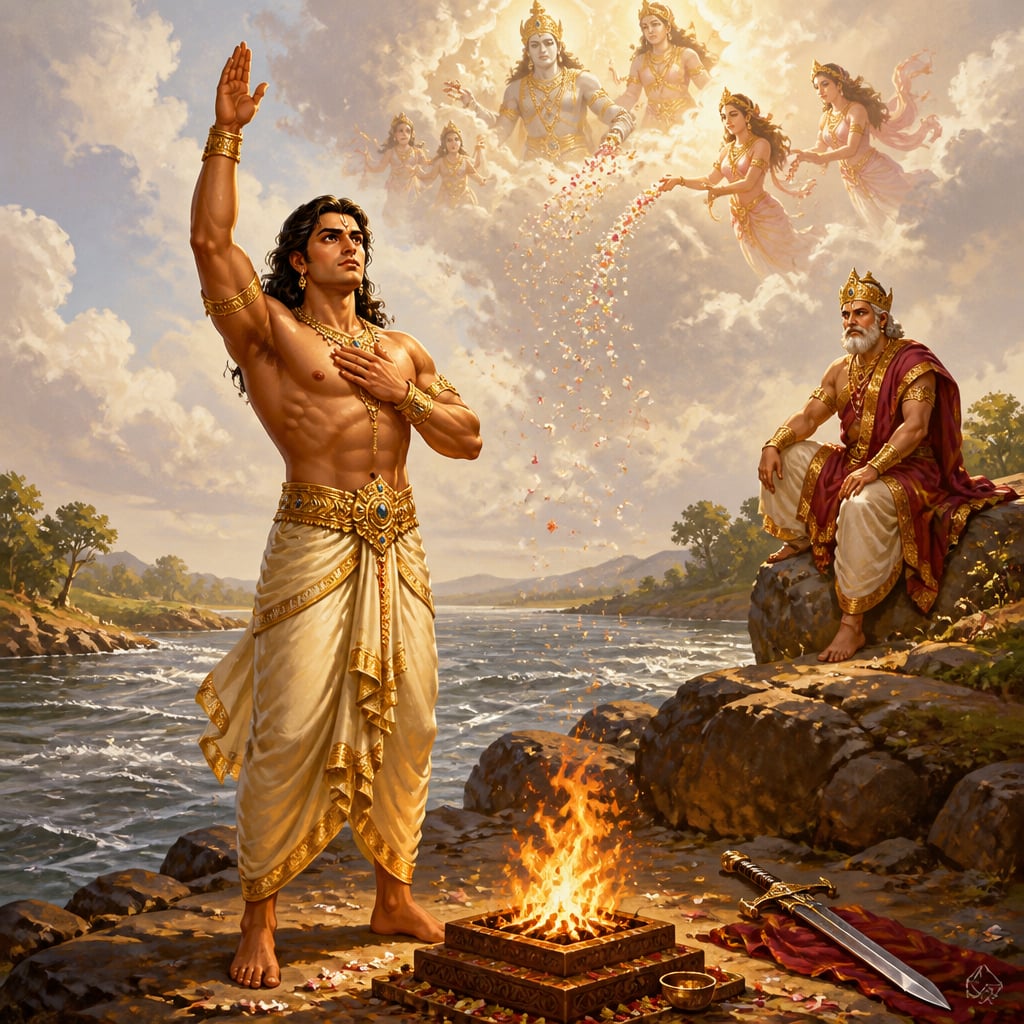
Devavrata was heir to the Kuru throne, skilled in warfare, learned in statecraft, beloved by his people. The kingdom was his by right. But his father Shantanu had fallen in love with a fisherwoman, Satyavati, whose father would consent to the marriage only if her children inherited the throne.
Shantanu said nothing, but withered with unspoken longing. When Devavrata learned the cause, he went to the fisherman's hut. There, before witnesses, he renounced his claim to the throne, not just for himself, but for any children he might have. To seal this impossibility, he took a lifelong vow of celibacy.
The gods themselves watched in astonishment. Such a sacrifice! They named him Bhīṣma, "the one who took a terrible vow."
This is tyāga, not the weakness of giving up, but the strength of letting go.
The Doctrine of Sacred Release
The Vedic tradition places tyāga among the highest virtues, not as passive surrender but as active choice. The Ṛṣis understood a profound paradox: attachment to power corrupts the very capacity to use it well.
The Isha Upanishad opens with this teaching:
tena tyaktena bhuñjīthā "By renunciation alone, enjoy." , Isha Upanishad 1
This is not ascetic rejection of the world. It is the understanding that true enjoyment, true effectiveness, comes only when we hold things lightly. The leader who clings to power becomes its prisoner. The leader who can release power remains its master.
The Bhagavad Gita distinguishes three forms of tyāga:
- Tamasic tyāga: Abandoning duty out of confusion or fear, this is not true renunciation
- Rajasic tyāga: Giving up action because it's difficult, this is also not true renunciation
- Sattvic tyāga: Performing action while releasing attachment to results, this is the dharmic path
True tyāga is not avoiding responsibility. It is fulfilling responsibility while remaining free from the intoxication of power.
Bhishma: The Lifelong Sacrifice
Bhishma's initial vow was only the beginning. For the rest of his life, spanning the reigns of three kings and culminating in the great war at Kurukshetra, he served the Kuru throne without ever claiming it.
Consider what this meant:
- He trained princes who would rule while he remained without crown
- He advised kings who were often less capable than himself
- He watched the dynasty he sacrificed for descend into dysfunction
- He eventually fought on the side he knew was wrong, bound by his vow of loyalty

On the battlefield of Kurukshetra, Bhishma lay on a bed of arrows, having finally allowed himself to be defeated. Arjuna asked him for final teachings. What Bhishma shared was not bitterness but profound wisdom, the insights of a man who had lived an entire life in service without attachment.
Was Bhishma's sacrifice a mistake? The Mahabharata doesn't offer easy answers. But it shows us something crucial: Bhishma's power came precisely from his renunciation. Because he wanted nothing, everyone trusted him. Because he had no ambition, he became the pillar around which the kingdom organized. His tyāga was not weakness, it was the source of his unmatched moral authority.

George Washington: The Man Who Could Have Been King
In 1783, the American Revolutionary War had been won. George Washington commanded an army that loved him, a nation that revered him, and he faced a government too weak to pay its soldiers. Some officers proposed making him king. The path to permanent power lay open.
Washington refused.
More than refused, he was genuinely offended. In a letter to a colonel who had suggested monarchy, he called the proposal "big with the greatest mischiefs that can befall my Country." He didn't just decline power; he recognized that taking it would destroy the very cause he had fought for.
Then, having won the war, he did something that stunned the world: he resigned his commission. He walked into the Continental Congress, surrendered his authority, and went home to Mount Vernon.
King George III, hearing of this, reportedly said: "If he does that, he will be the greatest man in the world."
Washington's retirement didn't last, he was called back to serve as the first President. But even then, he established the precedent that power is temporary. After two terms, despite offers to continue, he stepped down again. He could have ruled for life. He chose not to.
This voluntary limitation of power, this tyāga, shaped American democracy more than any law or constitution. Washington's example made peaceful transfer of power thinkable.
The Paradox of Renunciation
Here is what both Bhishma and Washington understood: Power clung to becomes power lost. Power released becomes influence eternal.
Bhishma, by renouncing the throne, became the most trusted figure in the kingdom for decades. Washington, by refusing kingship, became the model for democratic leadership across the world.
This paradox operates through several mechanisms:
Trust: When people see a leader willing to give up power, they trust that leader's motives. They know decisions aren't driven by self-interest.
Moral authority: The leader who can walk away has a credibility that the clinging leader lacks. Their words carry weight precisely because they have nothing to gain.
Institutional strength: Leaders who model voluntary transition strengthen the institutions they serve. Leaders who cling weaken them.
Personal freedom: The leader who has released attachment to position can actually lead more effectively. They can speak truth, make unpopular decisions, and serve the mission rather than their survival.
When to Let Go
Tyāga is not always appropriate. Sometimes holding on is the dharmic choice, abandoning responsibility can be cowardice disguised as renunciation. The question is: What does the situation require, independent of your personal desires?
Signs that tyāga may be called for:
- You find yourself making decisions to preserve position rather than to serve purpose
- The institution needs different leadership than you can provide
- Your presence blocks the development of successors
- You have achieved what you came to achieve, and staying serves only ego
- You cannot separate your identity from your role
Signs that holding on is still necessary:
- The work genuinely requires your continued presence
- No capable successor exists and you can develop one
- Leaving would be abandoning those who depend on you
- The desire to leave is driven by difficulty rather than completion
The Gita's teaching helps here: Sattvic tyāga is releasing attachment to results while continuing to act rightly. Sometimes right action is staying. Sometimes right action is leaving. The test is whether you can do either with equanimity.
The Art of Succession
True tyāga includes preparation. Both Bhishma and Washington understood this:
Bhishma trained the next generation, the Pandavas and Kauravas alike. He shared his knowledge freely, holding nothing back. He prepared the kingdom for life without him, even while serving it.
Washington carefully managed the transition of power. He supported the Constitution's creation. He established precedents for presidential conduct. He wrote a farewell address that set principles for the nation's future. He didn't just leave; he prepared the ground for those who would follow.
The leader who truly lets go ensures that their departure strengthens rather than weakens what they built. This requires:
- Training successors before they're needed
- Building systems that don't depend on you
- Sharing knowledge rather than hoarding it
- Stepping back gradually so others can step up
- Remaining available for guidance without grasping for control
The Final Letting Go
Ultimately, tyāga is preparation for the final renunciation, the release of life itself. The Ṛṣis understood death as the ultimate teacher of non-attachment.
mṛtyuḥ sarvaharaś cāham "I am death, the all-devouring." , Bhagavad Gita 10.34
Krishna speaks these words not to terrify but to teach. Everything we hold will be taken. The practice of tyāga in life, releasing positions, possessions, attachments, is practice for the great release.
Bhishma, on his bed of arrows, waited for the auspicious moment to die, teaching until his final breath. Washington, in his last hours, said simply: "'Tis well." Both had practiced letting go so thoroughly that the final letting go held no terror.
This is the gift tyāga offers: freedom. Not freedom from responsibility, but freedom within it. Not escape from the world, but liberation while engaged with it.
Your Practice: Releasing Grip
Begin with small things:
- Notice where you hold too tightly, to opinions, to recognition, to control
- In your next meeting, let someone else have the last word
- Give credit away more freely than feels comfortable
- Delegate something you enjoy doing, so others can grow
Then, larger questions:
- What position or role are you clinging to that might better serve others?
- What would healthy succession look like in your domains of responsibility?
- If you had to leave tomorrow, what would break? That's what needs attention.
Tyāga is not about becoming less powerful. It is about discovering that true power was never in the holding, but in the capacity to release.
Case studies
Washington's Voluntary Surrender of Power
After winning the Revolutionary War (1783), George Washington commanded a loyal army, a grateful nation, and faced a government too weak to function effectively. Officers proposed making him king. The path to permanent power was clear. Washington had the military capacity, the popular support, and the political vacuum to establish himself as monarch of the new republic.
Washington's tyaga (voluntary renunciation) mirrors the Rig Vedic understanding that the most powerful act a leader can perform is to voluntarily limit their own power. Like the Vedic king who rules as trustee of rta rather than owner of the realm, Washington demonstrated that positions of authority are temporary trusts, not permanent possessions. His restraint echoes the Vedic ideal that true sovereignty lies in dharmic self-governance, not in the accumulation of external power.
Washington's tyaga shaped American democracy more than any law. The peaceful transition of power became thinkable because he had modeled it. He resigned his military commission, returned to private life, and when called back as President, limited himself to two terms. His influence grew through his absence. He became the standard against which all future leaders would be measured.
Voluntary limitation of power strengthens institutions more than any constitution. The leader who demonstrates that positions are temporary creates space for democracy itself.
Peaceful transitions of power remain the strongest predictor of institutional health, whether in nations, corporations, or nonprofit organizations. Founders who plan their succession early and step aside willingly, like Bill Gates at Microsoft or the founders of Patagonia, create organizations that outlast their personal involvement.
Washington's precedent of a two-term limit lasted 150 years as unwritten tradition before being codified as the 22nd Amendment in 1951. King George III reportedly said that if Washington resigned his commission, 'he would be the greatest man in the world.'
Ashoka: The Emperor Who Chose Dharma Over Empire
After the devastating Kalinga War (261 BCE), Emperor Ashoka surveyed the aftermath of his greatest military victory. The Maurya Empire was at its territorial peak. He had the most powerful army in the known world, controlled the wealthiest territories in Asia, and faced no serious external threat. By every conventional measure of power, Ashoka had won. Yet the carnage at Kalinga, where over 100,000 soldiers died and 150,000 civilians were displaced, provoked a profound crisis of conscience.
Ashoka's transformation embodies the Rig Vedic principle that true leadership power (kshatra) must serve rta, the moral order. His shift from digvijaya (conquest of territory) to dhammavijaya (conquest through righteousness) reflects the Vedic understanding that force without dharma ultimately destroys itself. Like Indra who must justify his power through cosmic service, Ashoka recognized that military dominance without moral purpose creates suffering rather than order.
Ashoka spent the remaining 30+ years of his reign promoting dhamma through rock edicts, welfare programs, and diplomatic missions to kingdoms from Greece to Sri Lanka. His pillar edicts, inscribed across the empire, represent history's first public commitment by a ruler to govern by ethical principles rather than military force. The Maurya Empire maintained stability without further conquest.
The greatest transformation in leadership is the shift from conquest to service. Ashoka proved that an empire built on dharma rather than force can generate influence that outlasts the empire itself by over two millennia.
Corporate leaders who pivot from aggressive growth to stakeholder-centric governance, like Microsoft's shift under Nadella from combative competition to ecosystem collaboration, demonstrate that choosing service over dominance can unlock more value than conquest ever could. The pattern holds across eras: empires built on force fracture, while those built on shared benefit endure.
Ashoka erected over 30 major rock and pillar edicts across his empire, spanning from Afghanistan to southern India. His lion capital at Sarnath became independent India's national emblem in 1950, and the Ashoka Chakra appears on the Indian flag, demonstrating his influence 2,300 years after his reign.
Reflection
- What positions, titles, or roles are you holding onto that might better serve others? What prevents you from letting go?
- When you make decisions, how often are you protecting your position versus serving the mission? Can you honestly assess this?
- Who are you developing to succeed you? What would happen to your responsibilities if you left tomorrow?
- What small things could you let go of this week, opinions, recognition, control, as practice for larger renunciations?
- How has clinging to something ever diminished your power or effectiveness? How has releasing something ever increased it?