Niyama: Order as the Ultimate Authority
Why True Leaders Serve Principles, Not Power
Explore the Vedic insight that legitimate leadership exists to serve cosmic order (ṛta), not personal agenda. Through the stories of E. Sreedharan and Rani Chennamma, discover why the greatest leaders subordinate themselves to principles higher than their own power.
The King Who Served
The courtiers waited nervously. King Pratardana had just returned victorious from battle, his army laden with spoils. Custom demanded he take the finest treasures for himself. But as the captured wealth was displayed, the king surprised everyone.
'Distribute it according to the niyama,' he said quietly. 'The wounded first. Then the families of the fallen. Then those who fought. I take only what remains.'
One advisor protested: 'Your Majesty, you are the niyama. You make the rules!'
Pratardana's reply would echo through Vedic teaching: 'No king makes niyama. The king serves niyama. The moment I believe I am above the order, I cease to be worthy of leading it.'
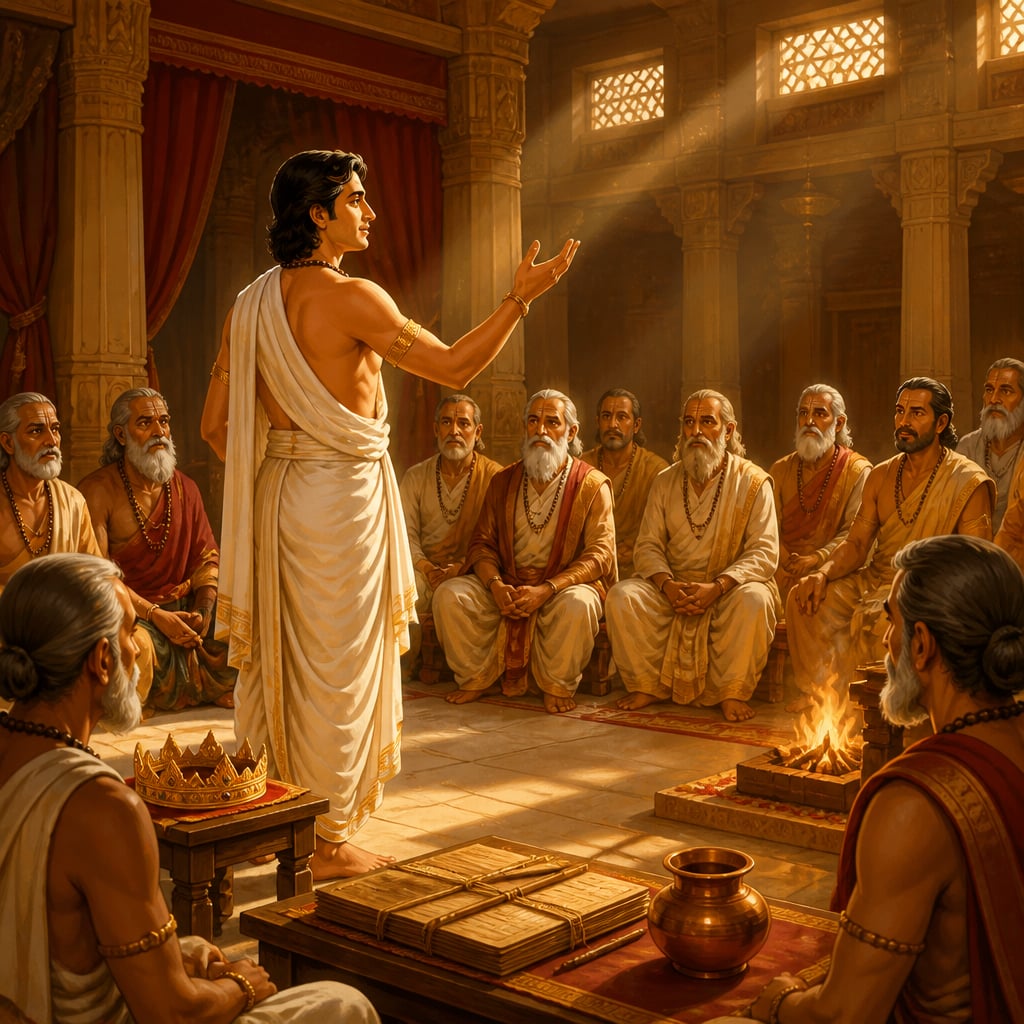
This distinction, between power that serves and power that self-serves, lies at the heart of Vedic leadership wisdom.
Voices from the Vedic Dawn
The Ṛṣis understood that cosmic order precedes all human authority. Their mantras established the hierarchy clearly.
ऋतस्य पन्थामन्वेति साधु "The righteous one follows the path of ṛta (cosmic order)." Ṛg Veda 10.133.6
The word 'anveti' (follows) is crucial, even the greatest leader is a follower of something greater. Ṛta is not a human invention but a cosmic reality that leaders must align with. The 'sādhu' (good/righteous one) is defined not by their own standards but by their adherence to this pre-existing order.
धृतव्रतो वरुणो मित्रो अर्यमा "Varuna, Mitra, and Aryaman, upholders of the sacred vow (vrata)." Ṛg Veda 7.66.11
Even the Devas are described as 'dhṛtavrata', those who uphold the vow/law. If cosmic beings serve niyama rather than creating it arbitrarily, how much more should human leaders? This mantra establishes that authority derives from service to order, not from personal will.
स्वराजो अधिराजः "Self-ruled is the supreme ruler." Ṛg Veda 9.89.3
The paradox at the heart of Vedic leadership: 'svarāja' (self-rule) precedes 'adhirāja' (sovereignty over others). One who cannot govern themselves according to niyama cannot legitimately govern others. Self-discipline (niyama) is the prerequisite for external authority.
Architecture of Principled Leadership
The Precedence of Order
In Vedic thought, ṛta (cosmic order) exists prior to and independent of any ruler. A king does not create law, he serves law. This inverts the common assumption that 'the powerful make the rules.' True leaders recognize they operate within a moral order they did not create and cannot legitimately violate.
Constitutional governance embodies this principle, even the most powerful officials operate under laws they cannot unilaterally change. The Vedic insight goes further: there is a cosmic constitution that precedes all human constitutions.
Self-Discipline as Qualification
The mantra 'svarājo adhirājaḥ' (self-ruled is supreme ruler) establishes personal niyama as the prerequisite for leadership. One who cannot regulate their own desires, emotions, and conduct has no legitimate claim to regulate others. Authority flows from demonstrated self-mastery, not from position or inheritance.
Research on leadership effectiveness consistently shows that emotional self-regulation predicts better outcomes than charisma or technical skill. The Vedic principle anticipated this by millennia.
Power Under Constraint
The Devas themselves are described as 'dhṛtavrata', vow-upholders. Even cosmic power operates under self-chosen constraints (vrata). This reframes power not as freedom from rules but as freedom through rules. The leader's vrata, their publicly declared commitments, becomes more binding precisely because they have the power to break it.
Warren Buffett's famous 'inner scorecard' reflects this: he judges himself by principles he's chosen, not by what he could get away with. The constraint is self-imposed, which makes it more rigorous, not less.
What Niyama Teaches
Authority without self-discipline is illegitimate. The Vedic tradition doesn't recognize a right to rule that isn't grounded in demonstrated capacity for self-rule. Power grab without niyama is merely force.
Leaders serve order; they don't create it. The universe has a moral structure (ṛta) that precedes all human authority. Wise leaders discover and align with this order rather than imagining they can impose their own.
Constraint is the mark of legitimate power. The more power one has, the more visible their self-imposed constraints should be. A leader without vratas is not demonstrating strength but revealing its absence.
The personal precedes the political. Governance of others begins with governance of self. Svarāja (self-rule) is not merely desirable, it is the prerequisite for adhirāja (sovereignty).
Niyama Across Domains
Leadership
The Vedic king was bound by rāja-dharma, specific duties and constraints that accompanied authority. The Arthaśāstra later codified this: 'In the happiness of his subjects lies the king's happiness.' Authority existed to serve, not to be served.
Servant leadership frameworks echo this Vedic principle. Leaders who demonstrate visible self-constraint, keeping commitments, following their own rules, putting institutional interests above personal ones, build the trust that makes coordination possible.
Systems Thinking
Ṛta describes a self-regulating system where each element, sun, seasons, rivers, beings, operates according to its proper function. Disruption of one element cascades through the whole. The king's role was to maintain systemic integrity, not to maximize personal extraction.
Sustainable systems require that no single actor extracts more than their role warrants. When CEOs take 300x worker salary, they violate systemic niyama. When short-term profits destroy long-term value, ṛta is disrupted. Systems thinking is applied Vedic cosmology.
Personal Psychology
Patañjali's Yoga Sūtras formalize niyama as one of eight limbs, personal practices (cleanliness, contentment, discipline, self-study, surrender) that prepare one for deeper development. You cannot lead others to places you haven't gone yourself.
Research on self-regulation shows it predicts life outcomes better than IQ or social class. The capacity to constrain immediate impulses for long-term values is the foundation of all achievement. Vedic niyama is evidence-based psychology avant la lettre.

E. Sreedharan: The Metro Man's Niyama
In the 1990s, Delhi's traffic was a nightmare. Multiple agencies had tried and failed to build a metro system. Politicians wanted quick announcements; contractors wanted flexible deadlines; bureaucrats wanted to avoid accountability. Into this chaos came E. Sreedharan, a soft-spoken engineer who had already delivered the Konkan Railway against all odds.
Sreedharan was offered the Delhi Metro project with a condition: he would have operational independence but would be judged by one standard, completing on time, within budget, and to specification. He accepted, but added his own condition: no political interference in technical decisions.
What followed was a masterclass in niyama-based leadership. When a contractor offered to finish early by cutting corners, Sreedharan refused: 'The specification is the niyama. We don't compromise safety for speed.' When political pressure came to award contracts to favored parties, he responded: 'The process is the niyama. Merit decides, not influence.'
Most remarkably, when the project finished ahead of schedule and under budget, Sreedharan returned the unused funds, something almost unheard of in Indian public works. 'The budget was for this work,' he explained. 'It wasn't mine to keep.'
The Delhi Metro became a model for urban transit worldwide. It runs with 99.7% punctuality. It was completed before deadline. And it transformed how Indians thought about public infrastructure, from 'inevitably delayed and corrupt' to 'possible when niyama is upheld.'
Sreedharan's retirement was telling. He refused awards that came with cash components. He returned to Kerala and lives simply. He had served the niyama of engineering excellence; personal enrichment was never the point.
Sreedharan exemplifies the Vedic principle: 'ṛtasya panthām anveti sādhu', the righteous one follows the path of cosmic order. His 'ṛta' was engineering integrity. Every decision served that order, regardless of personal consequence. The power he held was real, he could have enriched himself, favored allies, cut corners. That he didn't wasn't weakness; it was strength demonstrated through visible constraint.

Rani Chennamma: The Queen Who Died for Niyama
In 1824, the British East India Company invoked the 'Doctrine of Lapse', a policy allowing them to annex kingdoms whose rulers died without biological heirs. When the Raja of Kittur died, he had legally adopted a son according to Hindu law. The Company declared the adoption invalid.
Rani Chennamma, the queen regent, could have surrendered. She was outmatched militarily. The Company offered her a pension if she'd accept their ruling. She refused.
'This is not about my throne,' she told the British Collector St. John Thackeray. 'This is about niyama. Hindu law recognizes adoption. Your Company does not make our laws.'
The Battle of Kittur followed. Chennamma's forces initially defeated the British, killing Thackeray and capturing two British officers. The Company returned with overwhelming force. Kittur fell. Chennamma was imprisoned and died in captivity in 1829.
What makes her story remarkable is what she was willing to die for. Not merely her kingdom, she was offered that. Not her son's inheritance, he was offered a pension. She died for a principle: that legitimate succession follows dharmic law, not colonial convenience.
The Company had the power to enforce their Doctrine. Chennamma had the principle to resist it. In Vedic terms, she chose ṛta over survival. Her niyama, the law of proper succession, was worth more than her life.
The Rani Chennamma story circulated through the independence movement. Here was proof that Indian rulers had understood something the Company never grasped: authority that violates dharmic order is not legitimate, regardless of the force behind it. True sovereignty serves niyama; it doesn't create it for convenience.
Practicing Niyama Leadership
Niyama isn't abstract philosophy, it's the daily practice of leading through principle rather than preference.
Declare Your Vratas: Make your constraints visible. What will you not do regardless of pressure? Publicly stated commitments create accountability. Sreedharan's 'no political interference' vrata was known to everyone, which made it enforceable.
Apply Rules to Yourself First: Before imposing any standard on others, demonstrate you live by it. The Vedic king fasted before asking his people to fast. The CEO who takes a pay cut before layoffs has moral authority; one who doesn't has only positional authority.
Distinguish Niyama from Convenience: Is this rule you're following (or breaking) actually a principle, or just your preference dressed up as principle? The test: would you follow it even when it costs you? Chennamma's niyama cost her life. That's how you know it was real.
Build Institutions, Not Personality: Niyama-based leadership creates systems that outlast the leader. Sreedharan built a culture of punctuality and integrity at Delhi Metro, not just a personal reputation. When he left, the standards remained because they were embedded in institutional niyama, not dependent on his presence.
Remember the Hierarchy: You serve the order; the order doesn't serve you. The moment you believe your power gives you the right to change principles for your convenience, you've ceased to be a legitimate leader. You're just someone with power, and power without niyama is eventually exposed as what it is.
Continuing the Journey
We've explored niyama, the principle that true leaders serve order rather than creating it for their convenience. Sreedharan served engineering integrity; Chennamma served dharmic law; the Vedic king served ṛta. Authority flowed from demonstrated alignment with principles greater than personal preference.
But this raises a question: if leaders serve principles, not their own identity, what happens to the self in leadership? In our next lesson, we explore vṛtti, how Vedic wisdom understands the leader as a role or function rather than a personality. What does it mean to lead from your position rather than your ego?
Case studies
E. Sreedharan: Niyama-Based Leadership at Delhi Metro
When E. Sreedharan took charge of the Delhi Metro project in 1997, Indian public infrastructure had a reputation for cost overruns, missed deadlines, and endemic corruption. The project required coordinating thousands of workers, multiple international partners, and navigating Delhi's complex political landscape. Previous large-scale projects in India had consistently delivered late and over budget. No one expected the Metro to be different.
Sreedharan embodied the Rig Vedic principle of niyama, disciplined self-regulation that creates order from chaos. Like the cosmic rta that governs natural cycles without deviation, he maintained engineering standards as non-negotiable dharma. His leadership reflected the Vedic ideal that true authority comes from adherence to principle, not from the exercise of personal power. The unused funds returned to the government echo the Vedic understanding that resources held in trust must flow back to the community.
Delhi Metro's Phase 1 was completed ahead of schedule and under budget, a first for Indian public infrastructure of this scale. Sreedharan returned unused funds to the government. The Metro now carries over 2.7 million passengers daily and has been recognized internationally as a model for infrastructure delivery in developing nations.
Discipline-based leadership produces world-class results even in environments where corruption and delay are considered normal. Refusing to compromise engineering standards, despite political pressure, creates an authority that outlasts any single project.
Infrastructure projects worldwide suffer from the same problems Sreedharan solved: political interference, cost overruns, and quality compromises. His approach demonstrates that discipline-based leadership, where the leader refuses to compromise engineering standards regardless of external pressure, is transferable across cultures and contexts.
Delhi Metro Phase 1 (2002-2006) was completed 2.5 years ahead of schedule. The project saved approximately Rs 1,000 crore against the original budget estimate, which Sreedharan returned to the government.
Rani Chennamma of Kittur: Dharmic Principle Over Personal Power
In 1824, the British East India Company applied the Doctrine of Lapse to Kittur, a small but prosperous kingdom in present-day Karnataka. The doctrine declared that kingdoms without natural-born heirs would be annexed by the Company. Rani Chennamma had adopted an heir in accordance with Hindu succession law. The British refused to recognize the adoption. She could have accepted British terms and retained personal comfort, or she could fight for the principle that Hindu dharma, not colonial doctrine, determined legitimate succession.
Rani Chennamma's resistance embodied the Rig Vedic principle that leadership exists to protect rta, the cosmic and moral order. Her fight was not about personal power or territorial control. It was about upholding the dharmic principle that a community's own laws of succession are sacred. Like the Vedic warriors who fought to protect the yajna from disruption, she stood as guardian of a principle larger than herself.
Rani Chennamma initially defeated the British forces, killing the political agent St. John Thackeray in the first engagement. She was eventually captured in the second assault and imprisoned in Bailhongal fort, where she died in 1829. Her resistance, though ultimately unsuccessful militarily, became an inspiration for the broader independence movement and established the moral precedent that colonial annexation through doctrines like the Lapse violated fundamental dharmic principles.
Service-oriented leadership sometimes means fighting for a principle even when personal survival is at stake. Rani Chennamma did not resist for her own power but for the dharmic principle that a community's sacred laws of succession must be honored.
Communities that resist unjust policy changes, whether indigenous groups defending land rights or citizens opposing discriminatory legislation, often find their early resistance becomes a catalyst for broader reform movements. The principle transcends any single culture: fighting for legitimate governance norms serves everyone, not just the immediate community.
The Kittur uprising of 1824 predated the 1857 Sepoy Mutiny by 33 years, making Rani Chennamma one of the earliest Indian rulers to take up arms against the British Doctrine of Lapse, which would later be applied to over 20 Indian kingdoms.
Reflection
- What niyamas govern your decisions? When did following them cost you something?
- Where do you operate as if above rules that apply to others?
- What vratas (public commitments) constrain your own power?