Maunam - The Power of Silence
Why the most powerful leaders often say the least
This lesson explores maunam, the Vedic understanding of silence as a leadership practice. Through the examples of Ramana Maharshi's teaching through presence and Lao Tzu's philosophy of the quiet sage, we discover that true authority often speaks through stillness, and that the most profound leadership can be wordless.
The Teacher Who Did Not Speak
In 1896, a sixteen-year-old boy sat down in the temple of Arunachala. He did not leave the sacred mountain for the next fifty-four years. And for much of that time, he barely spoke a word.
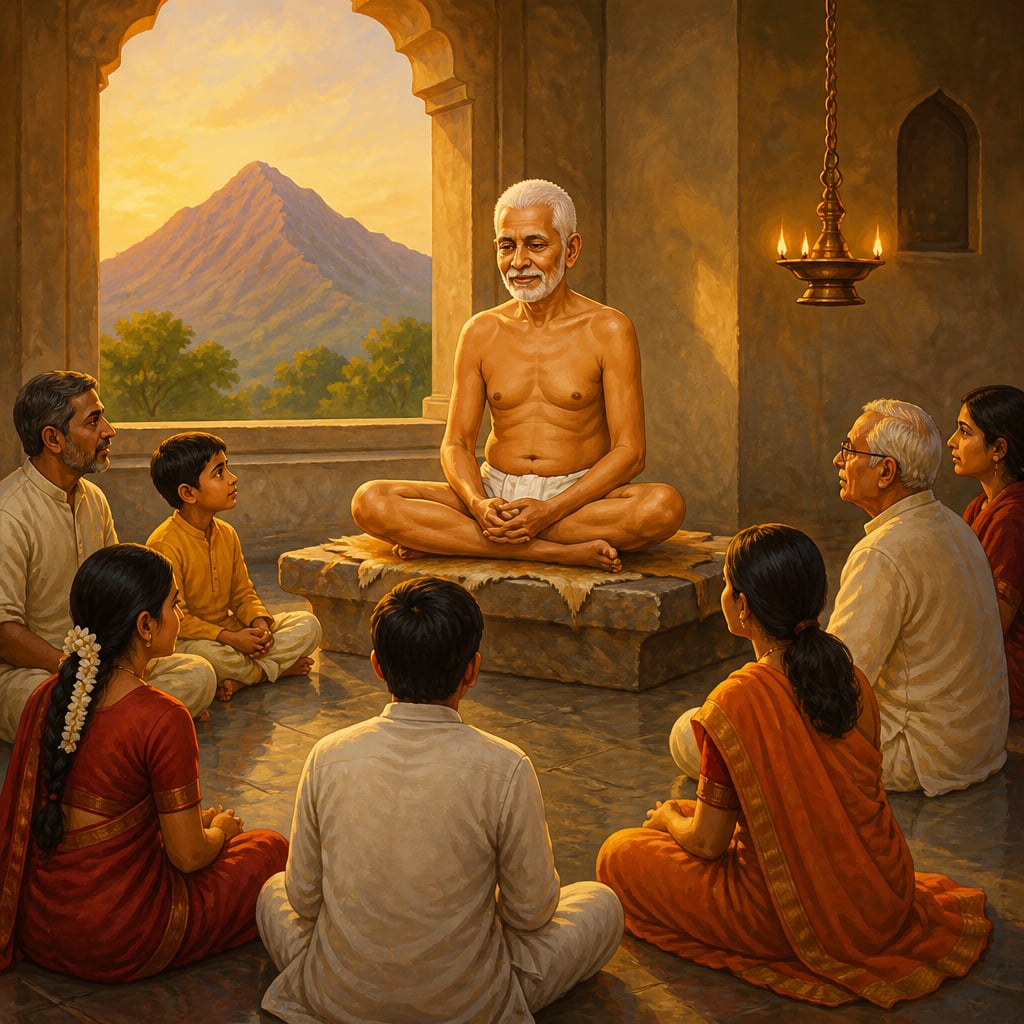
Yet Ramana Maharshi became one of the most influential spiritual teachers of the 20th century. People traveled from every continent to sit in his presence. Great scholars, troubled seekers, grieving parents, they came by the thousands. Many received what they needed without Ramana saying anything at all.
How can someone lead without speaking? How can teaching happen in silence?
The answer lies in maunam, a concept far deeper than merely being quiet.
The Doctrine of Sacred Silence
The Vedic tradition distinguished several forms of silence:
Vāk-maunam, silence of speech. Not speaking when words would be unnecessary or harmful.
Mano-maunam, silence of mind. The stillness behind thought, where noise settles into clarity.
Kāṣṭha-maunam, ultimate silence. The profound stillness that is the nature of consciousness itself.
The Ṛṣis understood that excessive speech dissipates energy and clouds understanding:
maunaṃ sarva-artha-sādhakam "Silence accomplishes all purposes." , Traditional saying
This doesn't mean words are useless. It means that silence is the ground from which effective words arise. The leader who speaks from silence speaks with power. The leader who speaks from noise merely adds to the noise.
Ramana Maharshi: Presence as Teaching
Born Venkataraman in 1879, Ramana had no interest in becoming a teacher. At sixteen, he experienced a spontaneous realization of the Self. Without telling anyone, he left home and traveled to Arunachala, drawn by an inexplicable pull to the sacred mountain.
For years, he sat in caves, absorbed in silence. He ate only when food was placed before him. He spoke only when directly questioned, and often not even then.
Gradually, seekers found him. They would sit with him, sometimes for hours, asking nothing, receiving something they couldn't name. When they did ask questions, Ramana's responses were remarkable for their economy. He would often answer the deepest metaphysical questions with a single sentence, or with silence.
A devotee once asked: "How can I attain Self-realization?"
Ramana replied: "The Self is always realized. The question is: who is asking?"
Another asked: "What is the nature of God?"
Ramana: "Be still and know."
This wasn't evasion. It was precision. Ramana understood that most questions dissolve when properly examined. Words often create the very problems they claim to solve. The question "How do I find peace?" already assumes a seeker separated from peace. Ramana's silence pointed to what was already present.
His ashram operated with minimal organization. He didn't create hierarchies, didn't accumulate wealth, didn't seek followers. Yet thousands came. His teaching spread around the world. Today, decades after his death, his words (when he did speak) continue to transform lives.
This is the paradox of maunam: the teacher who says least often teaches most.

Lao Tzu: The Sage Who Knew Not-Knowing
Twenty-six centuries ago in China, a keeper of archives grew disillusioned with the corruption he saw around him. He decided to leave civilization and retreat into the mountains.
At the western pass, a gatekeeper recognized him. "Master, you cannot leave without writing down your wisdom for those who remain."
Lao Tzu (if he existed as a historical person, scholars debate this) sat down and wrote the Tao Te Ching in five thousand characters. Then he disappeared into the mountains, never to be seen again.
The text he left begins with a paradox:
"The Tao that can be told is not the eternal Tao. The name that can be named is not the eternal name."
This is maunam in philosophical form: the deepest truths cannot be spoken. Words are fingers pointing at the moon, useful pointers, but not the moon itself.
Lao Tzu's teachings on leadership reflect this understanding:
"The best leaders are those the people hardly know exist. The next best is a leader who is loved. Next, one who is feared. The worst is one who is despised."
The quiet leader, the one people "hardly know exists", accomplishes purposes without claiming credit. They create conditions where good things happen naturally, without forcing or announcing.
"When the best leader's work is done, the people say: 'We did it ourselves.'"
This is not weakness. It is the highest skill: leading so subtly that followers don't realize they're being led. The loud leader needs constant recognition. The quiet leader needs only results.
The Power Behind Stillness
Why does silence carry such power? Several mechanisms:
Space for wisdom: When the leader stops talking, others can think. Silence creates room for insight to arise, both in the leader and in those they lead.
Gravitas: The person who speaks rarely is listened to carefully when they do speak. Constant talkers are easily ignored. The rare word carries weight precisely because it is rare.
Presence: Silence allows presence. The talking leader is always projecting outward. The silent leader is also receiving, observing, sensing, understanding what words cannot convey.
Trust: Excessive speech often signals anxiety, the need to fill space, to control perception. Silence signals confidence: "I don't need to convince you. The truth is apparent."
Depth: Surface communication happens in words. Deeper communication happens below words, in tone, in presence, in the quality of attention. Silence allows access to these deeper channels.
When to Speak, When to Be Still
Maunam doesn't mean never speaking. It means speaking only when speech serves better than silence. The question is: What does this moment require?
Situations that call for silence:
- When the other person needs to be heard, not advised
- When you don't know the answer and speaking would be pretense
- When emotions are running high and words would inflame rather than clarify
- When the truth is self-evident and explanation would only obscure it
- When action, not discussion, is needed
- When silence itself is the teaching
Situations that call for speech:
- When others genuinely need information you have
- When injustice must be named
- When confusion can be clarified
- When encouragement or correction is needed
- When silence would be misinterpreted as agreement with wrong
The wisdom is in discernment: knowing which response the moment requires.
The Stillness Behind Action
True maunam is not external silence but internal stillness, the quiet center from which all action arises. The leader who has this stillness can speak when needed, act when needed, without losing their ground.
The Bhagavad Gita describes this state:
yaṃ hi na vyathayanty ete puruṣaṃ puruṣarṣabha sama-duḥkha-sukhaṃ dhīraṃ so'mṛtatvāya kalpate "That person whom these do not disturb, who is balanced in pain and pleasure, who is wise, that one is fit for immortality." , BG 2.15
The "wise person" (dhīra) is not someone who avoids difficulty but someone who meets it from stillness. They can act decisively without being driven by reactivity. Their silence is not passivity but the ground of truly effective action.
This is why Ramana could sit motionless for years yet influence millions. His stillness was not inaction but a different kind of action, one that worked on levels words cannot reach.
The Quiet Leader in Modern Life
In a world of constant communication, emails, meetings, social media, the path of maunam might seem impractical. But its principles adapt:
Choose your words: Before sending that email, ask: Is this necessary? Does it add to understanding or to noise? Often, fewer words say more.
Create space in meetings: The leader who doesn't fill every silence with their own voice creates room for others to contribute. Some of the best ideas emerge in pauses.
Listen more than you speak: The ratio matters. Leaders who talk 80% of the time learn little. Leaders who listen 80% of the time understand everything.
Let presence speak: Your calm attention, your full engagement, your genuine interest, these communicate more than words. Being fully present with someone is itself a form of teaching.
Act, don't announce: Results speak. The leader who quietly delivers doesn't need to explain their greatness. The work explains itself.
The Courage of Silence
Maunam requires courage. Silence in the face of expectation feels risky. The world demands explanations, justifications, constant updates. To remain still is to resist this pressure.
Ramana was often questioned: "Why don't you go out and teach? Why don't you write books? Why don't you build a larger organization?"
His response was always the same: stillness. He trusted that what needed to happen would happen. Those who needed to find him would find him. Words he didn't speak wouldn't be missed.
Lao Tzu walked away from civilization rather than compromise his silence with political maneuvering. He chose obscurity over influence-through-noise.
Both understood: True teaching doesn't need amplification. It resonates at frequencies that find their way to those ready to hear.
Your Practice: Cultivating Inner Stillness
Begin with small experiments:
- In your next conversation, pause before responding. Let silence exist without filling it.
- In your next meeting, notice how often you speak out of habit versus necessity. Reduce by half.
- When asked a question, consider: Does this require words, or is my presence the answer?
Then, deeper practice:
- Spend time each day in actual silence, not just not-talking, but not-planning, not-rehearsing. Let the mind settle.
- Notice what arises when noise stops. What have you been avoiding by constant activity?
- Practice listening not just to words but to what lies beneath them, the real question, the unspoken need.
Maunam is not about becoming invisible. It is about discovering the power that was always there, obscured by noise.
Case studies
Ramana Maharshi: The Silent Sage
How can someone teach without speaking? How can leadership happen through presence alone? Ramana Maharshi spent fifty-four years on Arunachala mountain, teaching primarily through silence. When seekers came with questions, he often responded with silence, or with a question that dissolved the original question. He created no organization, wrote no systematic teachings, sought no followers. Yet thousands came. They sat in his presence and received what they needed without words.
Ramana embodies the Rig Vedic principle that the deepest truth operates beyond speech. The Vedic tradition recognizes that vak (speech) has four levels, and the highest, para, is beyond words entirely. Ramana taught from that level. His silence was not absence of teaching but the most direct form of transmission, pointing students toward the awareness that precedes and underlies all thought. His leadership through stillness reflects the Vedic understanding that the source of all action is actionless awareness.
Ramana became one of the most influential spiritual teachers of the 20th century. His teaching spread globally, translated into dozens of languages. Decades after his death, his influence continues to grow. His ashram operates simply, without the institutional complexity of many spiritual organizations.
The deepest teaching may be wordless. Presence itself can be the message. The teacher who says least may teach most, because they point to what words cannot capture.
In a world saturated with information and opinion, individuals who cultivate depth through sustained focus and minimal self-promotion often develop the most profound expertise. Deep work, as Cal Newport describes it, produces insights that no amount of networking or personal branding can replicate.
Ramana's 'Who Am I?' (Nan Yar?) teaching has been translated into over 50 languages. His ashram, which he never formally established, continues to operate 75+ years after his death, receiving over 300,000 annual visitors without any advertising or institutional promotion.
Lao Tzu: The Sage Who Disappeared
Disillusioned with political corruption in 6th century BCE China, a Chinese archivist decided to leave civilization entirely. At the western pass, he was asked to leave his wisdom behind before departing. He wrote the Tao Te Ching, a text of approximately 5,000 characters, and vanished into the mountains, never to be seen again. His text begins by declaring that the deepest truth cannot be spoken.
Lao Tzu's wu-wei (non-action) principle parallels the Rig Vedic understanding of cosmic order maintaining itself without visible effort. His teaching that 'the best leaders are those the people hardly know exist' echoes the Vedic concept of governance through rta rather than personal will. His disappearance into silence mirrors the Vedic recognition that the source of all creation (described in the Nasadiya Sukta) existed before names, forms, or words. Both traditions point to the same insight: the deepest power operates invisibly.
The Tao Te Ching became one of the most translated texts in human history, second only to the Bible. Its influence spans philosophy, religion, leadership theory, and art across every culture. Lao Tzu's disappearance into silence made his words immortal. The leader who withdrew from seeking attention found his influence growing beyond anything he could have planned.
Words pointing to silence can be more powerful than words pointing to themselves. The leader who withdraws from seeking attention may find their influence grows beyond anything they could have planned.
The most enduring works of philosophy, art, and literature often come from individuals who withdrew from public life to concentrate on their craft. J.D. Salinger, Emily Dickinson, and countless contemplatives across traditions demonstrate that creative withdrawal can produce influence that far exceeds what active promotion achieves.
The Tao Te Ching has been translated into over 250 different versions in English alone, more than any other text except the Bible. Its 5,000 characters, written in a single sitting at a mountain pass, have generated over 2,500 years of continuous commentary and interpretation across dozens of cultures.
Reflection
- When did you last experience the power of someone's silence? What did it communicate that words could not?
- In your own leadership, what is your ratio of speaking to listening? What would change if you reversed it?
- What are you avoiding by constant speech or activity? What might emerge if you let stillness exist?
- When has silence been more effective than argument in a difficult conversation?
- Can you identify a leader you admire who embodies maunam, whose power comes more from presence than from words?