Samūha - The Wisdom of Many

Why true leadership emerges from the collective, not the commander

This lesson explores the Vedic concept of samūha, leadership distributed across the collective rather than concentrated in one person. Through the examples of Linux open-source development and the Chola village assemblies, we discover that the strongest systems emerge when wisdom is gathered from many sources and authority flows to whoever can best serve in the moment.

The Fire That Has Many Keepers

In the ancient yajñaśālā, no single priest commanded the sacred fire.

The Hotṛ chanted the invocations. The Adhvaryu prepared the offerings. The Udgātṛ sang the melodies. The Brahman watched in silence, ready to correct any error. Four roles, four authorities, yet one unified purpose. The fire burned brighter because many minds tended it.
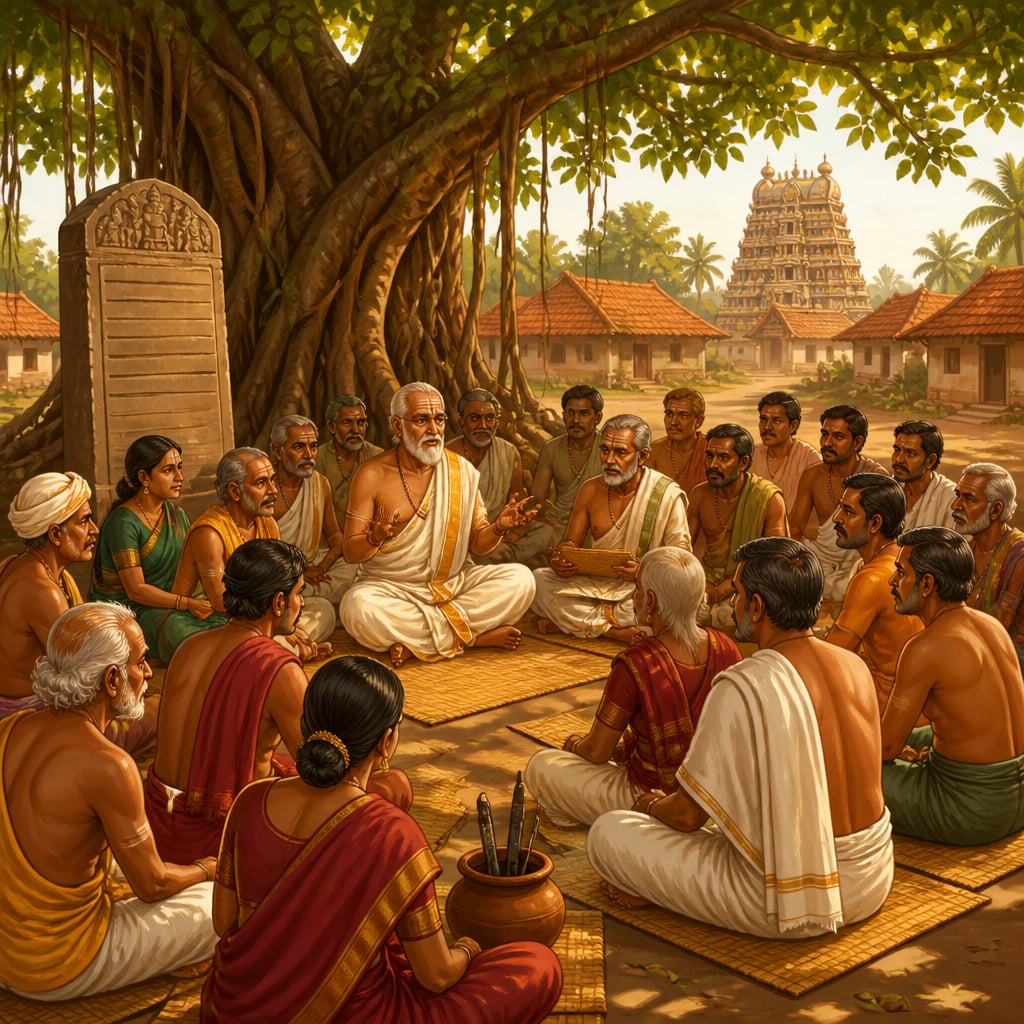
Village elders deliberating under a banyan at Uthiramerur

This was not democracy as we understand it today. It was something more subtle: samūha, the understanding that collective intelligence, properly structured, exceeds any individual brilliance.

The Ṛṣis knew what modern complexity science is rediscovering: beyond a certain threshold of complexity, no single mind can hold all the relevant knowledge. The only path forward is distributed leadership, many minds, many authorities, one purpose.

The Doctrine of Shared Flame

The Rig Veda celebrates this principle repeatedly. In the famous Saṃjñāna Sūkta, we find:

saṃ gacchadhvaṃ saṃ vadadhvaṃ saṃ vo manāṃsi jānatām "Move together, speak together, let your minds understand together." , RV 10.191.2

Notice the threefold emphasis: unified movement, unified speech, unified understanding. The Ṛṣis understood that true alignment requires all three. You cannot simply command people to move together; their minds must first understand together.

This hymn was recited at the beginning of assemblies, before any decision was made. It was a reminder: we are not here to fight for our individual positions. We are here to let wisdom emerge from our collective attention.

Why One Mind Is Never Enough

The Vedic tradition identified a fundamental limitation of individual leadership: ekākī na vijānīyāt, "the solitary one cannot fully know."

This wasn't a moral judgment against individual leaders. It was an observation about the nature of complex systems. The village that thrives has many types of knowledge:

No headman, however brilliant, could hold all this knowledge. The village that places all authority in one person becomes vulnerable, not because the leader is bad, but because one mind cannot contain what many minds together hold.

Samūha-buddhi (collective intelligence) emerges when these diverse forms of knowledge can flow together without obstruction. The leader's role is not to know everything, but to create conditions where collective wisdom can surface.

The Chola Assemblies: Democracy Before Democracy

A thousand years ago, in the villages of the Chola empire in South India, something remarkable operated: the ūr and sabhā assemblies, local governance systems of extraordinary sophistication.

Inscriptions from Uthiramerur (920 CE) reveal the details. The village was divided into wards. Each ward nominated candidates. Candidates had to meet specific qualifications, age, property, education, and crucially, having never been accused of wrongdoing. Their names were written on palm leaves and placed in a pot. A child would draw the names, random selection to prevent manipulation.

Committees were formed for different functions: irrigation, temples, justice, festivals. No single chief ruled. Authority was distributed according to function. The assembly (sabhā) met regularly, and decisions required consensus, not majority rule, but genuine agreement.

What made this work? Several principles:

Qualification-based selection: Not anyone could lead, specific competencies were required for specific roles.

Rotating authority: Leadership rotated, preventing accumulation of power.

Functional distribution: Different committees handled different domains, each with its own authority.

Collective deliberation: Decisions emerged through discussion, not decree.

This system governed villages effectively for centuries. It worked because it embodied samūha, distributed leadership matched to distributed knowledge.

Linus Torvalds at his desk connected to global contributors

Linux: The Bazaar That Builds Cathedrals

In 1991, a Finnish student named Linus Torvalds posted a message: "I'm doing a (free) operating system... just a hobby, won't be big."

Thirty years later, Linux powers most of the internet's servers, most smartphones (through Android), most supercomputers, and the systems running everything from stock exchanges to space stations. It became one of the most important pieces of software in human history.

How? Through radical application of samūha principles.

Linux has no central planning office. Thousands of developers worldwide contribute code. Anyone can propose changes. Maintainers for different subsystems review and approve code for their domains. Linus Torvalds oversees the final integration, but he doesn't write most of the code or make most of the decisions.

Eric Raymond, in his famous essay "The Cathedral and the Bazaar," captured the principle: "Given enough eyeballs, all bugs are shallow." When many minds examine a problem, solutions emerge that no single architect could design.

The Linux kernel has over 27 million lines of code, contributed by over 20,000 developers from more than 1,000 companies. No single organization controls it. Authority flows to whoever demonstrates competence. Trust is earned through contribution, not assigned by hierarchy.

This is samūha in action, collective intelligence structured to build what no individual could build alone.

The Principles of Distributed Leadership

From both ancient village assemblies and modern open-source projects, certain principles emerge:

1. Modular Authority (Vibhāga) Divide the domain into coherent pieces. Give each piece its own authority. The Chola assemblies had separate committees for irrigation, temples, and justice. Linux has separate maintainers for networking, file systems, and device drivers. Modularity allows distributed expertise without chaos.

2. Earned Trust (Arjita-Viśvāsa) Authority flows to those who demonstrate competence, not to those who claim position. In Linux, commit access is earned through good contributions reviewed over time. In the Chola system, candidates needed demonstrated qualifications. Trust is built through visible work.

3. Transparent Deliberation (Vyakta-Vimarśa) Decisions happen in the open. The Linux mailing lists are public; anyone can see the discussion. The sabhā met publicly; anyone could observe. Transparency allows collective intelligence to function, all relevant information is visible to all relevant minds.

4. Consensus Through Discussion (Saṃvāda-Sāmarasya) The goal is not to win arguments but to find the best solution. Both systems valued deliberation over declaration. Hasty decisions were distrusted. Taking time to hear all perspectives was valued.

When Distributed Leadership Fails

Samūha is not a panacea. It fails under certain conditions:

Crisis requiring immediate action: When the village is burning, you cannot convene a committee. Distributed leadership needs time to function. In emergencies, temporary concentration of authority may be necessary.

Lack of shared purpose: The yajña worked because all priests shared the goal of proper ritual. If participants have conflicting purposes, distribution creates paralysis, not wisdom.

Absence of trust: Distributed systems run on trust. If contributors suspect manipulation, they withdraw. Both Chola assemblies and Linux communities depend on earned reputation and transparent process.

Incompatible knowledge domains: Some decisions require expertise that cannot be distributed. You cannot design a bridge by committee vote if none of the committee understands engineering.

The wise leader knows when to distribute and when to concentrate. The default should be distribution, but wisdom recognizes exceptions.

The Paradox of Collective Leadership

Here is the paradox the Ṛṣis understood: Distributed leadership requires strong individual leadership to function.

Someone must design the structure that allows distribution. Someone must resolve conflicts when the system breaks down. Someone must embody the shared purpose that unifies diverse efforts.

Linus Torvalds is a strong leader, but his strength lies in maintaining the conditions for distributed contribution, not in directing all the work himself. The Chola village headman (nāṭṭār) had real authority, but that authority was exercised in maintaining the conditions for collective governance.

The leader of a samūha is like the drummer in an ensemble: not the melody, but the rhythm that allows all melodies to weave together.

Your Practice: Creating Space for Collective Wisdom

Begin with observation. In whatever group you lead or participate in, notice:

Then, small experiments:

Samūha is not abdication of leadership. It is a higher form: creating conditions where collective intelligence can emerge, where the wisdom of many exceeds the brilliance of one.

Case studies

The Chola Village Assemblies

The Chola empire (9th-13th century CE) needed to govern thousands of villages across South India. Central administration of all local matters was impossible. The challenge was maintaining order while allowing local adaptation. The Cholas developed sophisticated local assemblies (ur and sabha). Villages were divided into wards. Candidates for governance roles were selected through lottery from qualified nominees. Multiple committees handled different functions: irrigation, temples, justice, festivals. Records were inscribed in stone, ensuring transparency.

The Chola assemblies embodied the Rig Vedic ideal of distributed governance rooted in rta. Like the Vedic sabha where decisions emerged through collective deliberation rather than royal decree, the Chola system ensured that authority flowed from community participation. The lottery system prevented power from concentrating in hereditary hands, reflecting the Vedic understanding that leadership is a function to be performed, not a status to be inherited.

This system governed villages effectively for centuries. Irrigation systems were maintained. Temples were built and sustained. Disputes were resolved locally. The Chola empire became one of the most prosperous and stable in Indian history, partly because it could distribute governance to those closest to local conditions.

The most durable governance comes from distributing authority to those closest to the problems. The Chola assemblies thrived for centuries because they embedded transparency, rotation, and local accountability into the very structure of power.

Modern governance experiments like participatory budgeting in Porto Alegre, citizen assemblies in Ireland, and cooperative ownership models all echo the Chola principle: distributing decision-making authority to those closest to the problem produces more durable and legitimate outcomes than centralized control.

The Uttiramerur inscription (920 CE) records detailed election rules for the Chola village assembly, specifying 30 wards, term limits of 3 years, and disqualification criteria. This system operated continuously for over 400 years across thousands of villages.

Bhishma: Authority Through Renunciation

Devavrata (later Bhishma) was the crown prince of Hastinapura, heir to the most powerful throne in the realm. When his father Shantanu desired to marry Satyavati, her father demanded that only Satyavati's children would inherit the throne. Devavrata faced the deepest test of service-leadership: could he renounce everything he was entitled to, not because he was weak but because service to his father's happiness required it?

Bhishma's renunciation reflects the Rig Vedic understanding that the highest form of power is tyaga, voluntary surrender. His terrible vow (bhishma pratigya) to never marry and never claim the throne was not defeat. It was the most powerful act in the Mahabharata. The Vedic tradition recognizes that some authority can only be earned by demonstrating that you do not need it. Bhishma's lifelong celibacy and selfless service became the moral anchor of the entire Kuru dynasty.

Bhishma became the most trusted figure in the kingdom, the moral center around which others organized. His renunciation gave him authority that no throne could have provided. Even on his deathbed, he remained teacher and counselor, his words carrying weight precisely because he had never sought power for himself.

The highest authority can come from renunciation rather than acquisition. Trust flows to those who demonstrate they want nothing for themselves.

In corporate governance, board members and advisors who have no financial stake in a particular outcome often command the most trust in boardroom discussions. Their perceived disinterest in personal gain is precisely what makes their counsel valuable, a principle now formalized in independent director requirements across global stock exchanges.

Bhishma's counsel from his deathbed (the Shanti Parva and Anushasana Parva) comprises over 25,000 verses, nearly one-quarter of the entire Mahabharata. This is the longest deathbed teaching in any literature, reflecting the moral authority earned through a lifetime of selfless service.

Reflection

More in Sevā: Leadership as Service to Order

All lessons in Sevā: Leadership as Service to Order · Rig Vedic Leadership course