The Tangail Airdrop - March to Dhaka

Lt Col K.S. Pannu and 2 Para's Historic Jump

On December 11, 1971, 700 paratroopers led by Lt Col Pannu jumped at Tangail - India's first airborne operation since independence. They captured Poongli Bridge, cutting off Pakistani retreat. 2 Para was first to enter Dhaka on December 16.

Falling from the Sky

December 11, 1971. 4:00 PM.

Sixteen Indian Air Force AN-12 transport aircraft droned through the clear winter sky over East Pakistan. Inside, 700 paratroopers of the 2nd Battalion, Parachute Regiment sat in two rows, heavy with gear, checking equipment one final time.

In the lead aircraft, Lieutenant Colonel K.S. Pannu looked at his men. These were India's elite - the maroon berets, the toughest soldiers the army could produce. They had trained for years for this moment.

No Indian paratrooper had jumped in combat since 1947. Today, that would change.

The green light flashed. Pannu was first through the door.

"Bajrang Bali ki Jai!"

700 parachutes blossomed over Tangail, 60 kilometers north of Dhaka. India's airborne warriors had arrived.
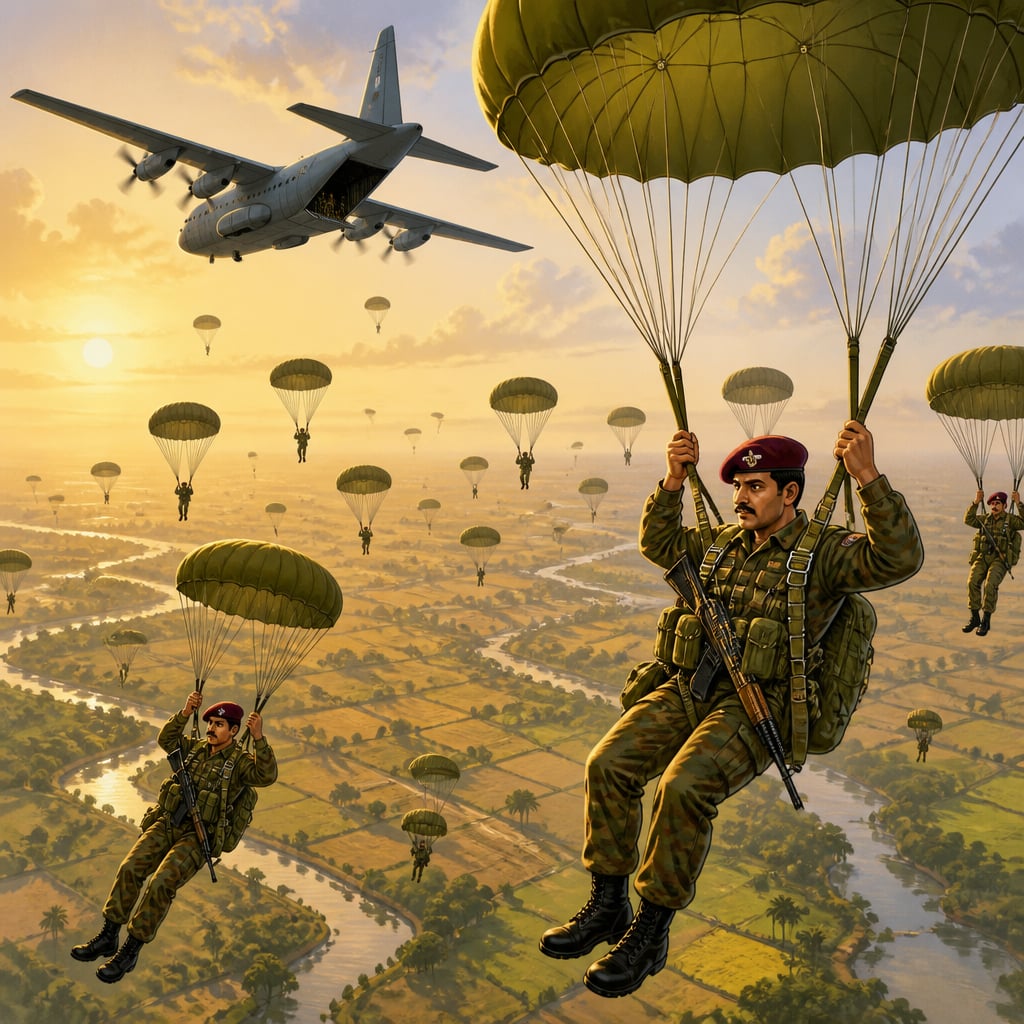
Indian paratroopers of 2 Para descend over Tangail in East Pakistan

The Race for Dhaka

Why an Airborne Operation?

By December 11, Indian forces were advancing on Dhaka from all directions. The Pakistani garrison was collapsing. Surrender was inevitable - but the timing mattered.

The problem: Pakistani forces retreating from the north could reinforce Dhaka or escape across the Jamuna River. If they consolidated, the final battle for Dhaka could be costly. If they escaped, they could continue the fight elsewhere.

The solution: cut the retreat routes. Specifically, seize the Poongli Bridge on the main road from Tangail to Dhaka. Without that bridge, Pakistani forces north of Dhaka would be trapped.

Ground forces would take days to reach the bridge. Only paratroopers could get there in time.

The Planning

The Tangail operation was planned in just 48 hours - extraordinarily fast for an airborne assault. Normal doctrine called for weeks of preparation. India didn't have weeks.

Brigadier H.S. Kler, commanding 50 Independent Para Brigade, worked with Lt Col Pannu to design a plan that was simple, aggressive, and achievable:

  1. Drop Zone (DZ) "Dogar" - an open area near Tangail town
  2. Immediate objective - secure the DZ, link up with Mukti Bahini (Bangladeshi freedom fighters)
  3. Main objective - advance south, seize Poongli Bridge, block all retreat routes
  4. End state - march to Dhaka, be first to reach the capital

The Paratroopers

The 2nd Battalion, Parachute Regiment - known as "2 Para" - was one of India's elite units. Their history stretched back to World War II, when they were raised as part of the Indian Parachute Brigade.

2 Para Statistics (December 1971)
Strength
Average age
Battle experience
Training standard
Motto

They had trained relentlessly for airborne operations. Every man could jump, fight immediately upon landing, and operate independently if separated from his unit. Now they would prove their worth.

December 11: The Jump

The Flight

The AN-12 transports took off from Kalaikunda and Dum Dum airfields in West Bengal around 2:30 PM. The flight time to Tangail was about 90 minutes.

For the paratroopers, this was the hardest part - the waiting. Crammed into transport aircraft, surrounded by equipment, there was nothing to do but think. Many prayed. Many checked their gear for the tenth time. Many simply stared at nothing.

Lt Col Pannu moved through the aircraft, speaking to his men, keeping them focused. A commander's job before battle is simple: be visible, be confident, be calm. Pannu embodied all three.

The Drop

At 4:00 PM, the first aircraft reached the drop zone. The green light flashed.

Within minutes, the sky over Tangail filled with parachutes - the largest Indian combat jump since the 1947 operations in Kashmir.

The drop went almost perfectly. Weather was ideal - clear skies, light wind. The DZ was accurate - most paratroopers landed within the designated area. Casualties on landing were minimal - a few sprains, no deaths.

The Welcome

What the paratroopers found on the ground surprised them: hundreds of Mukti Bahini fighters, waiting to greet them with cheers.

The Mukti Bahini - Bangladesh's freedom fighters - had been fighting Pakistani occupation for months. They knew the terrain, the enemy dispositions, the local population. Their intelligence would prove invaluable.

Within an hour of landing, 2 Para had linked up with Mukti Bahini guides and was moving south toward the objective.

The Capture of Poongli Bridge

Racing to the Bridge

Poongli Bridge lay about 40 kilometers south of the drop zone. Lt Col Pannu knew that every hour mattered - if the Pakistanis realized what was happening, they could destroy the bridge or fortify it.

He divided his force:

The advance was rapid. Paratroopers, trained for mobility, moved quickly despite their equipment. The Mukti Bahini guides knew every shortcut.

The Bridge Seizure

2 Para storming Poongli Bridge with Mukti Bahini fighters

The paratroopers reached Poongli Bridge on December 13th. What they found exceeded expectations: the bridge was intact, defended by only a small Pakistani force.

The attack was swift and overwhelming. 2 Para's assault teams cleared the defenders in minutes. By nightfall, Poongli Bridge was Indian hands.

With the bridge seized, Pakistani forces north of Dhaka had no escape route. The noose was tightening.

The Trap Springs

Over the next two days, Pakistani units retreating from the north ran into the 2 Para roadblocks. Expecting an open road, they found instead dug-in paratroopers with machine guns.

Some Pakistani units surrendered immediately. Others tried to fight through and were destroyed. None escaped.

By December 15th, several thousand Pakistani troops had been killed, wounded, or captured by 2 Para's blocking positions. The airdrop had achieved its objective beyond all expectations.

December 16: First into Dhaka

The Final Advance

With the northern approaches secured, Lt Col Pannu received new orders: advance to Dhaka.

Other Indian formations were approaching the city from different directions - 57 Mountain Division from the east, Indian Navy from the rivers, Mukti Bahini from everywhere. But 2 Para was closest.

On the morning of December 16, Pannu's paratroopers began their final march to the capital.

The Entry

2 Para entering Dhaka on December 16 amid cheering civilians

At 11:00 AM on December 16, 1971, elements of 2 Para entered Dhaka.

They were the first Indian troops in the city.

The streets were chaotic - some Pakistanis were still armed, most were trying to surrender, Mukti Bahini fighters were celebrating. The paratroopers moved carefully but quickly toward the designated surrender site.

The Surrender

Later that afternoon, at 4:31 PM, Lieutenant General A.A.K. Niazi, commander of Pakistani forces in East Pakistan, signed the instrument of surrender.

93,000 Pakistani military and paramilitary personnel became prisoners of war - the largest military surrender since World War II.

2 Para was there to witness it. Five days after jumping from the sky, they stood at the finish line of the war.

Heroes of the Airdrop

Lt Col K.S. Pannu, MVC

Lieutenant Colonel Kulwant Singh Pannu commanded 2 Para during the Tangail operation. His leadership - from being first out the door to directing the final advance into Dhaka - earned him the Maha Vir Chakra, India's second-highest wartime gallantry award.

Pannu exemplified the paratrooper ethos: lead from the front, move fast, hit hard. His planning under extreme time pressure and his execution under combat conditions became textbook examples studied at military academies.

He later rose to the rank of Major General.

Brigadier H.S. Kler, MVC

Brigadier Harakirat Singh Kler commanded 50 Independent Para Brigade, the parent formation of 2 Para. His decision to recommend the Tangail drop - against considerable skepticism from higher headquarters - proved decisive.

The success at Tangail justified India's investment in airborne forces and established the Parachute Regiment's reputation as combat-proven elites.

Captain P.K. Ghosh "Peter", VrC

Captain Pramod Kumar Ghosh, known as "Peter," led a company in the assault on Poongli Bridge. His aggressive leadership during the bridge seizure and subsequent blocking operations earned him the Vir Chakra.

Peter Ghosh later became a legendary figure in the Para community, his exploits at Tangail becoming part of regimental lore.

The Significance of Tangail

Military Achievement

Metric Achievement
Planning time 48 hours (normally weeks)
Jump casualties Near zero
Bridge capture Complete success
Enemy blocked Thousands trapped
Time to Dhaka 5 days
First Indian unit in capital Yes

Tangail proved that the Indian military could execute complex airborne operations with minimal preparation. The success validated decades of paratrooper training.

Strategic Impact

By seizing Poongli Bridge, 2 Para prevented an unknown number of Pakistani troops from reinforcing Dhaka or escaping to fight elsewhere. This likely saved many lives on both sides and shortened the war.

The psychological impact was equally significant. Paratroopers appearing behind enemy lines - falling from the sky - shattered Pakistani morale. The message was clear: there was no safe rear area, no escape route, no hope.

Legacy

Tangail established the Parachute Regiment's reputation as India's premier special operations force. From this baptism of fire came the confidence that would later see Para units deployed in Sri Lanka, Siachen, Kargil, and countless counter-terrorism operations.

December 11 is now celebrated as "Para Day" by the Parachute Regiment, commemorating the Tangail jump.

The Mukti Bahini Connection

Who Were They?

The Mukti Bahini (Liberation Army) were Bangladeshi freedom fighters who resisted Pakistani occupation throughout 1971. They ranged from trained Bengali military personnel who had defected to civilians who took up arms.

Without the Mukti Bahini, the Tangail operation would have been far more difficult. Their contributions included:

The Partnership

The Tangail operation showcased the close coordination between Indian forces and Mukti Bahini that characterized the entire 1971 campaign. The liberation of Bangladesh was not India fighting alone - it was India and Bangladesh fighting together.

Many Mukti Bahini fighters later became leaders in independent Bangladesh. The bonds forged in 1971 became the foundation of India-Bangladesh relations.

Lessons from Tangail

Speed Over Perfection

The Tangail operation was planned in 48 hours. Normal doctrine demanded weeks. But speed mattered more than polish - a perfect plan executed too late is worse than a good plan executed on time.

Lt Col Pannu and Brigadier Kler understood this. They planned fast, accepted risk, and executed brilliantly.

The Value of Elite Forces

Ordinary infantry couldn't have done what 2 Para did. The jump, the rapid advance, the aggressive assault - these required skills that only elite forces possess.

Investment in special operations forces pays dividends when conventional forces can't do the job.

Coalition Warfare

The Mukti Bahini contribution shows that allies matter. No army, however strong, can match local knowledge. The partnership between Indian paratroopers and Bangladeshi freedom fighters multiplied both forces' effectiveness.

Commemorating the Jump

Para Day - December 11

Every year on December 11, the Parachute Regiment celebrates Para Day. Veterans of the Tangail jump are honored. Current paratroopers conduct demonstration jumps. The maroon beret community gathers to remember its defining moment.

The Regimental Center

The Parachute Regimental Centre at Bengaluru maintains extensive records of the Tangail operation. The museum displays equipment from the jump, photographs of the paratroopers, and detailed accounts of the operation.

New recruits to the Parachute Regiment are taught the Tangail story as part of their indoctrination - a reminder of what their predecessors achieved and what is expected of them.

The March to Glory

The paratroopers who jumped at Tangail didn't know they would be first into Dhaka. They didn't know they would witness history's largest surrender since World War II. They only knew their objective: seize the bridge, block the retreat, fight until the job was done.

Five days later, they stood in Dhaka - victors.

Their path traced an arc from the sky to the capital: falling through winter air, landing in hostile territory, linking with local fighters, seizing bridges, blocking retreats, advancing through chaos, entering the city as liberators.

It was everything paratroopers train for. It was everything the maroon beret represents.

"Shatrujeet" - Conqueror of Enemies

At Tangail, 2 Para conquered. And the enemy never forgot.

Maha Vir Chakra Lieutenant Colonel K.S. Pannu 2nd Battalion, Parachute Regiment

"Bajrang Bali ki Jai!" Jai Hind.

Historical context

1971 Indo-Pakistani War - Eastern Front

The Tangail airdrop was part of the brilliant 1971 Eastern Campaign that liberated Bangladesh in just 13 days. Multiple Indian divisions, supported by the Navy and Air Force, converged on Dhaka from all directions. The airdrop at Tangail was the operational-level masterstroke that trapped retreating Pakistani forces and hastened the surrender.

Living traditions

The Tangail operation established the Parachute Regiment as India's premier airborne force. The tactics developed there influenced subsequent operations in Sri Lanka (IPKF), Siachen, and Kargil. Every new paratrooper learns the Tangail story as part of their indoctrination. The maroon beret worn by Indian paratroopers is a direct descendant of the tradition proven in combat at Tangail.

Reflection

More in Liberation - 1971

All lessons in Liberation - 1971 ยท Param Veer: Forging the Nation (1947-1971) course