Basantar - The Largest Tank Battle

2Lt Arun Khetarpal and Major Hoshiar Singh - Two PVCs in One Battle

The Battle of Basantar was the largest tank battle since World War II. 2Lt Arun Khetarpal, just 21 years old, led his tank troop against Pakistani armor. Even when his tank was hit and on fire, he refused to abandon it. His famous last words: 'My gun is still working and I will get these bastards.'

Steel Coffins and Iron Wills

December 16, 1971.

In a burning Centurion tank named Dofa Kehra ("Second to None"), a 21-year-old Second Lieutenant sat at the commander's position. His tank had been hit. Flames licked at the ammunition storage. The escape hatch was clear - he could bail out, save his life, and no one would blame him.

His radio crackled. His commanding officer ordered him to abandon the tank.

Second Lieutenant Arun Khetarpal's response became one of the most famous transmissions in military history:

"No Sir, I will not abandon my tank. My gun is still working and I will get these bastards."

Moments later, he destroyed one more Pakistani tank - his tenth of the day - before an enemy shell found his turret. The explosion killed him instantly.
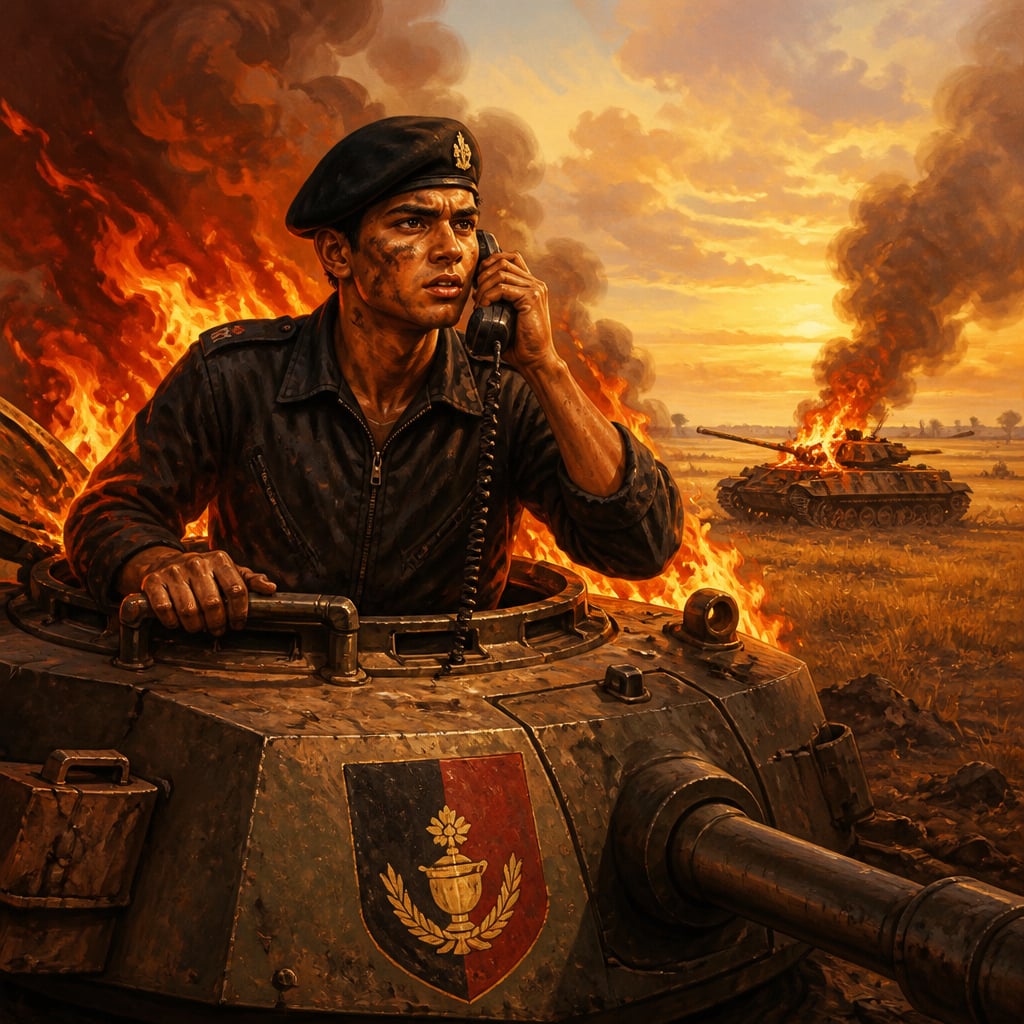
Second Lieutenant Arun Khetarpal fights from his burning Centurion tank at Basantar

Arun Khetarpal was awarded the Param Vir Chakra, India's highest wartime gallantry honor. He was one of two PVC recipients from the Battle of Basantar - the other being Major Hoshiar Singh, who held a critical position against wave after wave of Pakistani armor.

Two supreme acts of valor. One battle. This is the story of Basantar.

The Largest Tank Battle Since WWII

The Strategic Context

By mid-December 1971, the war in the East was nearly won. Pakistani forces in Bangladesh were collapsing, surrender imminent. But on the Western Front, fighting raged with undiminished fury.

The Shakargarh Sector - a region of Punjab between the Ravi and Chenab rivers - became the focal point of massive armored clashes. Both India and Pakistan committed their best tank regiments to this corridor.

The Basantar River, a small tributary, became the line of battle. Indian forces had crossed the river and established bridgeheads in Pakistani territory. Pakistan's armored counter-attack aimed to destroy these bridgeheads and push the Indians back.

The Forces Engaged

Side Tanks Committed Key Regiments
India ~200+ 17 Poona Horse, 16 Cavalry, 18 Cavalry
Pakistan ~200+ 13 Lancers, 31 Cavalry, 33 Cavalry

The tank models were roughly equivalent - Indian Centurions and Vijayanta tanks against Pakistani Pattons and Chinese Type-59s. This would be a battle decided not by technology but by training, tactics, and sheer willpower.

The Young Lieutenant

Arun Khetarpal's Background

Second Lieutenant Arun Khetarpal came from a distinguished military family. His father, Brigadier M.L. Khetarpal, was a decorated officer. The family had a tradition of service stretching back generations.

Born on October 14, 1950, in Pune, Arun grew up in the culture of the Army - the discipline, the honor codes, the stories of battles past. From childhood, he knew he would be a soldier.

At the Indian Military Academy in Dehradun, Arun was an outstanding cadet. He excelled not just academically but in leadership, earning the respect of instructors and peers alike. He was commissioned into the 17 Poona Horse - one of India's most storied armored regiments - in June 1971.

Six months later, war broke out.

His First Battle

When the 1971 war began, 2Lt Khetarpal had been an officer for barely half a year. He had never seen combat. His experience was entirely from training exercises.

But training at the Poona Horse was rigorous. The regiment had battle honors from World War II and had distinguished itself in 1965. Young officers were expected to perform like veterans from day one.

Khetarpal's first engagement came on December 15th, during the crossing of the Basantar River. His troop was tasked with securing a position against anticipated Pakistani counterattacks.

He performed brilliantly - calm under fire, decisive in command, aggressive when opportunity presented. His commanding officer noted his exceptional coolness for such a young and inexperienced officer.

But December 15th was merely a warm-up. December 16th would be the test of a lifetime.

December 16, 1971 - The Day of Fire

The Pakistani Counterattack

At dawn on December 16th, Pakistani forces launched a massive armored counterattack aimed at the Indian bridgehead at Jarpal. Over 50 Pakistani tanks advanced through the morning mist, supported by infantry and artillery.

The Indian positions were held by elements of the 17 Poona Horse and 16 Cavalry. They were outnumbered, but they held the high ground - and they had officers like Arun Khetarpal.

The First Wave

2Lt Khetarpal's troop of three tanks held a position on the flank. When the Pakistani armor appeared, he didn't wait for orders. He engaged.

His first shot destroyed a Patton. Then another. His crew - loader, gunner, driver - worked with machine-like precision, feeding the 105mm gun, traversing the turret, advancing and retreating to use terrain for cover.

In the first hour of battle, Khetarpal's tank destroyed four Pakistani tanks.

"Dofa Kehra" - Second to None

Khetarpal's tank was named Dofa Kehra, which in Punjabi means "Second to None." It was the motto of the Poona Horse, painted on his tank turret. On December 16th, he made those words reality.

As the morning progressed, the Pakistani attack intensified. More tanks emerged from the mist. The Indian line began to buckle under the pressure. Some positions fell. The bridgehead was in danger.

Khetarpal saw that a group of Pakistani tanks was about to break through a gap in the Indian line. If they succeeded, they would be behind the Indian positions, able to attack from the rear.

Without orders, without support, he charged his single tank into the gap.

The Lone Charge

What happened next entered military legend.

Khetarpal's Centurion engaged the breakthrough force alone. Tank after tank, he fired and destroyed. The Pakistani crews couldn't understand how one tank was holding them - they must have assumed they faced multiple enemies.

By mid-morning, his personal kill count had reached seven Pakistani tanks. His ammunition was running low. His tank had taken hits - nothing fatal, but the damage was mounting.

And still he fought.

The Fatal Hit

Around 11 AM, a Pakistani shell struck Khetarpal's tank. The hit disabled his engine but left the gun operational. Smoke began filling the fighting compartment.

His squadron commander, Major R.K. Nair, radioed: "Dofa Kehra, abandon your tank. The tank is on fire. Get out."

Khetarpal's response would echo through history:

"No Sir, I will not abandon my tank. My gun is still working and I will get these bastards."

In a stationary, burning tank, he continued to engage. He destroyed his eighth, ninth, and tenth Pakistani tanks.

Then a direct hit to the turret ended everything.

Second Lieutenant Arun Khetarpal died at his post, having single-handedly stopped a Pakistani breakthrough that could have changed the battle's outcome.

He was 21 years and 2 months old.

Major Hoshiar Singh - The Other Basantar PVC

The Battle at Jarpal

While Khetarpal was making his stand, another battle raged nearby. Major Hoshiar Singh of 3 Grenadiers was defending the crucial Jarpal village against wave after wave of Pakistani attacks.

Unlike Khetarpal's tank-versus-tank engagement, Hoshiar Singh's fight was infantry warfare - bunkers, trenches, close-quarters combat, and the eternal struggle to hold ground.

Background

Major Hoshiar Singh was a veteran, not a fresh-faced lieutenant. Born in 1936 in Haryana, he had served in the army for years, rising through the ranks through competence and courage.

By December 1971, he commanded a company of the 3 Grenadiers. His men trusted him implicitly - he had never failed them.

December 15-17: Three Days of Hell

The Pakistani attacks on Jarpal began on December 15th and continued relentlessly for three days. Each assault was preceded by artillery bombardment, followed by infantry and armored attacks.

Major Hoshiar Singh's company was at the tip of the Indian defensive position. They absorbed the brunt of every attack.

The Critical Night

Major Hoshiar Singh leading his Grenadiers in a wounded stand at Jarpal

On the night of December 16th-17th - the same day Khetarpal made his stand - Pakistani forces launched their most determined assault on Jarpal. This time, they nearly succeeded.

Enemy infantry penetrated the Indian perimeter. Fighting devolved into hand-to-hand combat in the trenches. Pakistani tanks rumbled through the defenses.

Major Hoshiar Singh was everywhere at once. When a Pakistani tank broke through, he personally destroyed it with an anti-tank weapon. When enemy infantry threatened to overwhelm a position, he led a counter-attack. When his communications were cut, he ran from position to position, coordinating the defense in person.

During one such move between positions, he was hit by machine gun fire. Bullets tore through his body.

Refusing evacuation, he continued to command. Bleeding, barely able to stand, he organized the final repulse of the Pakistani attack.

Only when the enemy withdrew at dawn did he allow himself to be carried to the medical station.

Survival

Unlike Khetarpal, Hoshiar Singh survived his wounds. After months of recovery, he returned to service, eventually retiring as a full Colonel.

He passed away in 1998, but his memory lives on in the Grenadiers regiment he served with such distinction.

Why Basantar Matters

Tactical Significance

The Battle of Basantar was a decisive Indian victory. Pakistani counterattacks failed to dislodge Indian forces from their bridgeheads. Indian armor established dominance over the Shakargarh Sector.

The numbers tell the story:

Metric India Pakistan
Tanks lost ~60 ~100+
Territorial control Gained Lost
Strategic objectives Achieved Failed

Psychological Impact

Basantar proved that Indian tankers could match any armor in the world. The Pakistani Pattons - American-made, considered superior - were destroyed in droves by Indian Centurions manned by crews like Khetarpal's.

This victory cemented the Indian Army's confidence in armored warfare for decades to come.

Two PVCs, One Battle

Basantar is the only battle in which two Param Vir Chakras were awarded. Khetarpal (posthumously) and Hoshiar Singh received India's highest honor for their actions on the same day, in the same sector.

This is an extraordinary statistical fact. In India's entire military history, only 21 PVCs have been awarded. That two came from one battle speaks to the intensity and significance of what happened at Basantar.

The Khetarpal Legacy

Family Grief, Family Pride

When Brigadier M.L. Khetarpal received news of his son's death, he also learned that Arun had been recommended for the Param Vir Chakra. The father's grief was mixed with immense pride.

Brigadier Khetarpal meeting his son's adversary Naser in Lahore in 2001

Years later, in a remarkable twist, Brigadier Khetarpal met his son's killer.

The Khetarpal-Beg Meeting

In 2001, decades after the war, Brigadier Khetarpal was invited to Pakistan for a military function. There, he met Brigadier Khwaja Mohammad Naser, who had commanded the Pakistani tank regiment at Basantar.

Naser told Khetarpal that the young Indian officer's stand had stunned the Pakistani tankers. They couldn't believe one man had held against so many. He expressed profound respect for Arun's courage.

Brigadier Khetarpal reportedly told Naser: "Your soldiers were also doing their duty. My son was doing his. There is no enmity between soldiers who fight honorably."

This meeting - between the father of a fallen hero and the commander of the force that killed him - embodied the grace that can exist even in war.

The Centurion Tank Memorial

Arun Khetarpal's actual tank - Dofa Kehra - was recovered from the battlefield, too damaged to be repaired but too precious to be scrapped. It now stands as a memorial at the National Defence Academy in Khadakwasla, Maharashtra.

Cadets pass by it daily, reminded of what is expected of them.

The 17 Poona Horse

A Regiment of Heroes

The 17 Poona Horse has a history stretching back to 1817, when it was raised as the Poona Auxiliary Horse. Over two centuries, it has fought in virtually every major engagement involving the Indian Army.

The regiment's battle honors include:

Remarkably, the Poona Horse has produced two PVC recipients: Lt Col Ardeshir Tarapore in 1965 and 2Lt Arun Khetarpal in 1971. No other armored regiment has this distinction.

The Regimental Motto

"Dofa Kehra" - Second to None.

Arun Khetarpal proved this motto true. In his burning tank, alone against overwhelming odds, he was second to no one in courage, skill, or devotion to duty.

Lessons from Basantar

On Youth and Courage

Arun Khetarpal was 21 years old - younger than most college graduates. Yet he performed with a calm and tactical sophistication that veterans would envy.

Age does not determine courage. Training, character, and the moment's demand do.

On Leadership Under Fire

Both Khetarpal and Hoshiar Singh made decisions under extreme pressure that saved their units. Khetarpal's lone charge plugged a critical gap. Hoshiar Singh's personal leadership held his company together when it might have shattered.

In crisis, leaders don't delegate - they do.

On the Choice to Stay

Khetarpal could have left his burning tank. Hoshiar Singh could have accepted evacuation. Both chose to stay and fight.

Sometimes the hardest decision is not what to do, but whether to stop. True warriors know when the mission requires everything, including life itself.

Commemorating the Heroes

Khetarpal's Memorials

Hoshiar Singh's Legacy

The Words That Echo

Of all the last words spoken by India's Param Virs, none are more famous than Arun Khetarpal's.

"No Sir, I will not abandon my tank. My gun is still working and I will get these bastards."

In those words live everything the Param Vir Chakra represents:

Arun Khetarpal didn't say "I will hold." He said "I will get them." Even dying, he was attacking.

That is the spirit of Basantar. That is the spirit of the Param Vir.

Conclusion: Second to None

The Basantar River still flows through Punjab. The fields where tanks clashed are now farms. The villages that witnessed history have new generations who know the battle only from stories.

But the names endure. Arun Khetarpal. Hoshiar Singh. Poona Horse. 3 Grenadiers. Basantar.

They remind us that on December 16, 1971, young men and old soldiers proved themselves in fire and steel. That numbers don't decide battles - willpower does. That the phrase "Second to None" is not a boast but a standard.

And that as long as India remembers its Param Virs, their sacrifice will never truly be in vain.

Param Vir Chakra Second Lieutenant Arun Khetarpal October 14, 1950 - December 16, 1971 17 Poona Horse

Param Vir Chakra Major Hoshiar Singh May 5, 1936 - December 6, 1998 3 Grenadiers

Jai Hind.

Historical context

1971 Indo-Pakistani War - Western Front

While the war in the East was a swift liberation campaign, the Western Front saw intense conventional warfare. Both sides committed their best armored units to the Shakargarh Sector. India's objective was to capture Pakistani territory that could be used in post-war negotiations, while Pakistan sought to inflict enough damage to force India to terms.

Living traditions

Arun Khetarpal has become a symbol of youthful courage and military excellence. His story is taught at military academies worldwide. The Indian Army regularly invokes his example in recruitment and training. The 2021 film 'Shershaah' renewed public interest in 1971 war heroes, including Khetarpal. His famous last words are quoted in military contexts as the ultimate expression of duty over self.

Reflection

More in Liberation - 1971

All lessons in Liberation - 1971 ยท Param Veer: Forging the Nation (1947-1971) course