The Surrender of 93,000

Lt Gen J.F.R. Jacob and the Liberation of Bangladesh

At 4:31 PM on December 16, 1971, Lt Gen A.A.K. Niazi signed the Instrument of Surrender at Dhaka. 93,000 Pakistani troops became prisoners - the largest military surrender since World War II. Lt Gen J.F.R. Jacob had orchestrated it.

The Largest Surrender Since World War II

December 16, 1971. 4:31 PM.

Ramna Race Course, Dhaka.

In front of a table set up on the grass, Lieutenant General A.A.K. Niazi, commander of all Pakistani forces in East Pakistan, sat with shoulders slumped. Across from him sat Lieutenant General Jagjit Singh Aurora, GOC-in-C of Indian Eastern Command.

Around them, thousands watched - Indian soldiers, Mukti Bahini fighters, Bangladeshi civilians who had survived months of genocide. Cameras from around the world captured the moment.

Niazi picked up the pen.

With his signature on the Instrument of Surrender, 93,000 Pakistani military and paramilitary personnel became prisoners of war. It was the largest military surrender since the German capitulation in 1945 - and it had taken India just thirteen days from the official start of hostilities.

Bangladesh was free. Pakistan was broken. And the architect of this moment, the man who had orchestrated the surrender terms, stood watching from the crowd: Major General J.F.R. Jacob, Chief of Staff of Eastern Command.
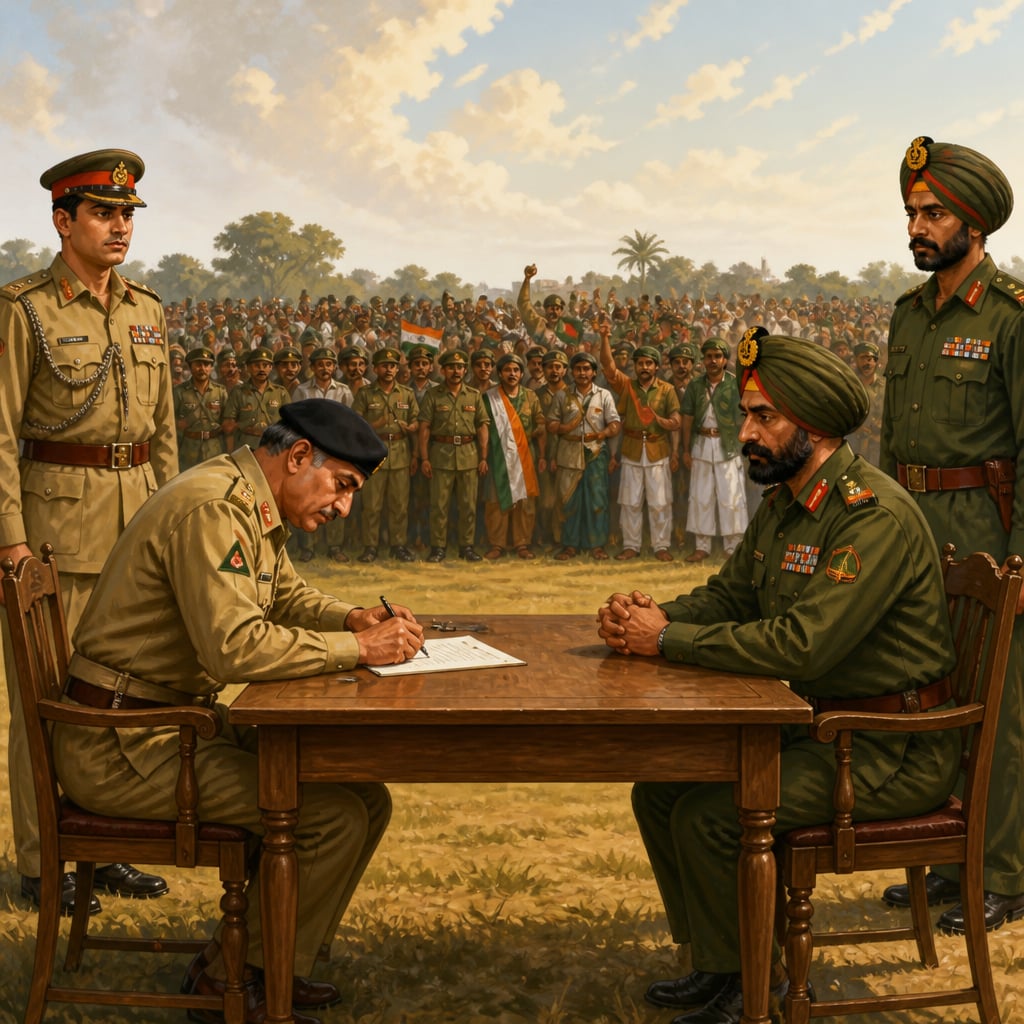
Lieutenant General Niazi signs the surrender at Ramna Race Course Dhaka

The Road to Ramna

The Thirteen-Day War

The official Indo-Pakistani War of 1971 began on December 3, when Pakistan launched pre-emptive air strikes on Indian airfields. India responded with a declaration of war and immediate offensive operations.

But the real war had begun months earlier.

The Bangladesh Liberation War

In March 1971, the Pakistani Army launched Operation Searchlight - a systematic campaign of genocide against the Bengali population of East Pakistan. The trigger was political: the Awami League, led by Sheikh Mujibur Rahman, had won Pakistan's general election, but West Pakistan refused to transfer power.

What followed was among the worst atrocities of the 20th century:

Estimated Casualties Source
300,000 - 3,000,000 killed Various estimates
200,000 - 400,000 women raped War crime documentation
10 million refugees to India UNHCR
30 million internally displaced Relief organizations

India absorbed ten million refugees - an unprecedented humanitarian burden. The international community expressed concern but took no action. Finally, in December, India intervened militarily.

The Lightning Campaign

The Indian military's plan for liberating East Pakistan was brilliant in its simplicity: bypass, isolate, and converge.

Rather than attack Pakistani strongholds frontally, Indian forces:

  1. Bypassed fortified positions using unconventional routes
  2. Isolated enemy garrisons by cutting communications
  3. Converged on Dhaka from multiple directions simultaneously
Advance Rate Force
4 Mtn Div Sylhet - 200+ km in 13 days
57 Mtn Div Comilla - Daudkandi - Dhaka
9 Inf Div Jessore - Khulna
20 Mtn Div Dinajpur - Bogra

The speed of advance shocked Pakistani commanders. Their defensive plans assumed weeks of fighting for each objective. Instead, Indian forces appeared behind them before they could react.

The Man Who Made Surrender Possible

Major General J.F.R. Jacob

Jack Frederick Ralph Jacob was one of the most remarkable officers in Indian military history. A Baghdadi Jew whose family had migrated to Calcutta, he represented the diversity that is India's strength.

Born in 1923, Jacob joined the British Indian Army during World War II. He served with distinction in Burma, earning a reputation for tactical brilliance. After independence, he rose through the ranks, eventually becoming Chief of Staff of Eastern Command.

In December 1971, his job was to translate military victory into political reality - to end the war not just with a battlefield win but with complete Pakistani capitulation.

The Psychological Campaign

Even as Indian forces advanced, Jacob waged a parallel campaign - against the Pakistani mind.

Broadcasts: Radio messages informed Pakistani troops of their hopeless situation, promising humane treatment if they surrendered.

Leaflet drops: Millions of pamphlets rained from the sky, detailing Indian advances and urging capitulation.

Symbolic operations: The Tangail airdrop and naval blockade demonstrated that Pakistan had no escape route.

Diplomatic pressure: Through international channels, the message was conveyed that unconditional surrender was the only option.

By December 14, Pakistani morale in East Pakistan had collapsed. Soldiers were deserting. Commanders were looking for exit strategies. The end was near.

The Surrender Negotiations

J.F.R. Jacob delivering the surrender ultimatum to Niazi in Dhaka

On December 14, Jacob flew into Dhaka for surrender negotiations. What happened next revealed his tactical genius.

Niazi initially hoped to negotiate terms - safe passage for his troops, perhaps even continued Pakistani administration of some areas. Jacob's response was devastating.

He presented an ultimatum: unconditional surrender by December 16, or Indian forces would assault Dhaka and show no mercy.

Niazi protested that he needed time to consult Islamabad. Jacob pointed out that communications were cut - Niazi was on his own.

The psychological pressure was immense. Niazi knew that:

At 9:30 AM on December 16, Niazi agreed to surrender.

December 16, 1971 - The Historic Day

The Ceremony

The surrender ceremony was held at Ramna Race Course (now Suhrawardy Udyan) in central Dhaka. The location was deliberate - it was where Sheikh Mujibur Rahman had addressed a million people in March, calling for resistance.

Present at the surrender:

At 4:31 PM, Niazi signed the Instrument of Surrender. He then unbuckled his revolver and handed it to Aurora.

In that moment, East Pakistan ceased to exist. Bangladesh was born.

The Numbers

Surrendered Personnel Count
Pakistani Army ~55,000
Paramilitary (Razakars, etc.) ~20,000
Civil Administration ~18,000
Total ~93,000

This was the largest military surrender since the German capitulation at the end of World War II. The sheer scale of Indian victory stunned the world.

India's Restraint

Treatment of POWs

Pakistani POWs being escorted into an Indian reception camp

Remarkably, the 93,000 Pakistani prisoners were treated humanely. Despite the genocide their army had committed, India followed the Geneva Conventions scrupulously.

POWs were:

This restraint was not weakness - it was dharmic warfare. India had won; there was no need for vengeance.

The Simla Agreement (1972)

Six months after the war, Prime Minister Indira Gandhi and President Zulfikar Ali Bhutto met at Simla for peace negotiations.

The resulting Simla Agreement included:

Critics argued India gave away too much - that 93,000 POWs could have been leverage for a Kashmir settlement. But Indira Gandhi chose statesmanship over vindictiveness.

Why Restraint Mattered

Benefit Explanation
International standing India was seen as a responsible power
Regional stability A humiliated Pakistan might have reignited conflict
Moral authority India's humanitarian conduct contrasted with Pakistani genocide
Practical reality Holding 93,000 POWs indefinitely was unsustainable

The Heroes of the Eastern Command

Lt Gen Jagjit Singh Aurora, PVSM

The official commander of Indian Eastern Command, Aurora oversaw the liberation campaign and received the Pakistani surrender. His calm, dignified acceptance of Niazi's capitulation became an iconic image.

Aurora later served as a Member of Parliament and remained a respected figure until his death in 2005.

Maj Gen J.F.R. Jacob, PVSM

The architect of the surrender, Jacob's role was often understated in public narratives. His psychological warfare, surrender negotiations, and operational planning were decisive.

After retirement, Jacob served as Governor of Goa and Punjab. He wrote extensively about the 1971 war, ensuring the full story was told. He passed away in 2016.

Field Marshal Sam Manekshaw, MC

As Chief of Army Staff, Sam Manekshaw planned and commanded the entire 1971 campaign. His famous response to Indira Gandhi's impatience for action - advising her to wait until November for optimal conditions - demonstrated his strategic wisdom.

He became India's first Field Marshal in 1973.

Vijay Diwas - December 16

Since 1971, December 16 has been celebrated as Vijay Diwas (Victory Day) in India. It commemorates:

In Bangladesh, the day is celebrated as Bijoy Dibos (Victory Day), one of the nation's most important holidays. It marks the birth of their nation from the ashes of genocide.

Lessons from 1971

Military Excellence

The 1971 campaign demonstrated that the Indian military, properly led and motivated, could achieve strategic objectives with extraordinary speed. The thirteen-day timeline shocked military planners worldwide.

Humanitarian Intervention

India's intervention was justified not by territorial ambition but by humanitarian necessity. Ten million refugees, ongoing genocide, regional instability - India acted when the world would not.

Restraint in Victory

The treatment of POWs, the Simla Agreement, the return of captured territory - India showed that victory need not mean vengeance. This restraint enhanced rather than diminished India's stature.

Diversity as Strength

The war was won by an army reflecting India's diversity: Aurora (Sikh), Jacob (Jewish), Manekshaw (Parsi), countless Hindus, Muslims, Christians, and others. This diversity was - and remains - India's strength.

The Birth of Bangladesh

What did 1971 create?

A nation of 75 million people (now 170 million) was liberated from oppression. Sheikh Mujibur Rahman, released from Pakistani prison, became the first leader of independent Bangladesh.

The new nation faced immense challenges - war damage, refugee return, economic devastation. But it was free. The genocide had ended. A people had their dignity restored.

India and Bangladesh share a bond forged in blood. The liberation war was not just India's victory - it was a shared struggle for freedom and justice.

The Pen and the Sword

At 4:31 PM on December 16, 1971, a pen moved across paper, and a war ended.

That pen was mightier than the Pakistani army. It was mightier than the suffering that had preceded it. It was the instrument through which India's sword was sheathed in victory.

93,000 men became prisoners. A nation was born. History turned.

"We came, we saw, we conquered - but we left it to others to claim." , Attributed to the spirit of 1971

India conquered but did not colonize. India won but did not humiliate beyond necessity. India proved that a great nation can be great in victory as in struggle.

Vijay Diwas - December 16, 1971 93,000 surrendered. Bangladesh free. India triumphant.

Jai Hind. Joi Bangla.

Historical context

1971 Indo-Pakistani War - Final Phase

The 1971 war was the culmination of months of preparation, as India absorbed ten million refugees while training Mukti Bahini fighters. When Pakistan attacked first, India responded with a brilliantly planned campaign that liberated East Pakistan in just 13 days. The surrender at Dhaka was the most complete military victory in India's post-independence history.

Living traditions

The 1971 victory remains India's most celebrated military triumph. Vijay Diwas is marked annually with ceremonies, veteran reunions, and public commemorations. In Bangladesh, December 16 is one of the most important national holidays, celebrating independence. The memory of 1971 continues to shape India-Bangladesh relations, which remain close.

Reflection

More in Liberation - 1971

All lessons in Liberation - 1971 ยท Param Veer: Forging the Nation (1947-1971) course