Naval Trident - Karachi Set Ablaze

Operation Trident and Python - The Birth of Navy Day

On December 4, 1971, missile boats INS Nipat, Nirghat, and Veer attacked Karachi harbor in Operation Trident. They sank Pakistani destroyers and set oil tanks ablaze. Four days later, Operation Python struck again. December 4 is now Navy Day.

Fire on the Water

December 4, 1971. 10:45 PM.

Three small boats cut through the Arabian Sea, running dark and silent toward Karachi. Each displaced barely 200 tons - specks compared to the destroyers and cruisers of conventional navies.

But these were not conventional boats. They were Vidyut-class missile boats - the first of their kind in Indian service, armed with Soviet P-15 Termit anti-ship missiles. Each boat carried four missiles capable of sinking ships many times their size.

Their target: Pakistan's main naval port. Their mission: demonstrate that India's Navy could strike the enemy's most defended harbor with impunity.

The boats' names: INS Nipat ("Deadly"), INS Nirghat ("Typhoon"), INS Veer ("Brave").

In a few hours, Karachi would burn. And India would have a new Navy Day.
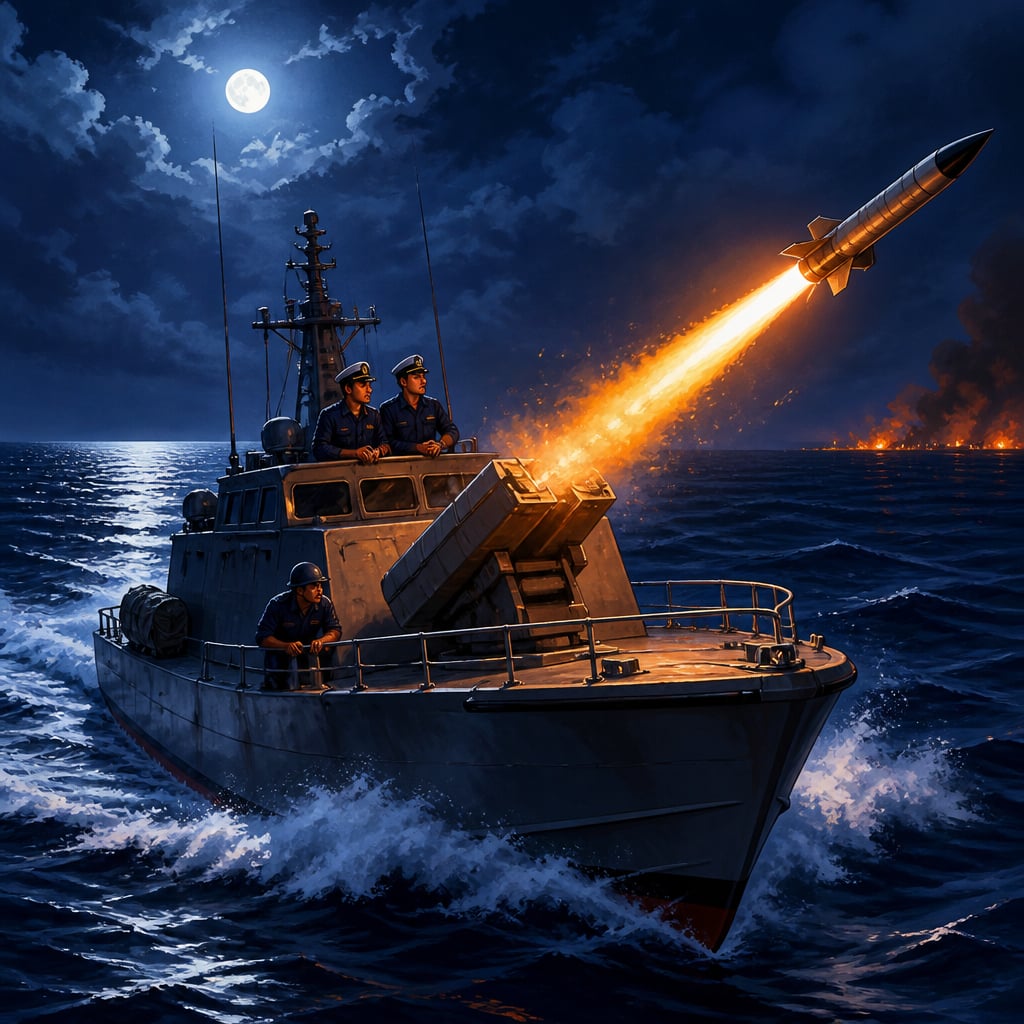
INS Nipat launches a P-15 anti-ship missile off Karachi at night

The Strategic Context

Why Attack Karachi?

Karachi was Pakistan's principal naval base - home to most of its surface fleet, its main oil storage, and critical port infrastructure. Destroying or damaging these assets would:

  1. Neutralize the Pakistani Navy - Prevent it from interfering with Indian operations
  2. Destroy fuel reserves - Cripple Pakistan's ability to sustain military operations
  3. Demonstrate reach - Show that India could strike Pakistan's most vital installations
  4. Boost morale - A bold stroke to match Army and Air Force victories

The Risks

But Karachi was also heavily defended:

For small missile boats operating 400+ nautical miles from their nearest base, these defenses posed severe challenges. If detected before launching missiles, the boats would be sitting ducks.

The plan required audacity, precision, and a bit of luck.

The Missile Boats

India's Secret Weapon

The Vidyut-class (also called Osa-class) missile boats were acquired from the Soviet Union in the late 1960s. Small, fast, and deadly, they represented a new kind of naval warfare.

Vidyut-class Specifications
Displacement
Length
Speed
Armament
Range
Crew

The P-15 Termit (called "Styx" by NATO) was a ship-killing missile. Once launched, it flew toward its target at nearly the speed of sound, carrying a 500kg warhead. A single hit could sink a destroyer.

No one in the Indian Navy had used these weapons in combat. Operation Trident would be the first test.

The Crews

The boats were commanded by young officers - lieutenants and lieutenant commanders in their late twenties and early thirties. Their crews were equally young, equally untested.

But they had trained intensively for this mission. Every possible scenario had been rehearsed. Every contingency planned. When the order came, they were ready.

Operation Trident: December 4-5, 1971

The Strike Force

Task Group 21 (Operation Trident):

Supporting the missile boats:

The Approach

The boats departed Indian waters on December 4th morning, sailing northwest toward Karachi. They maintained radio silence and avoided detection by Pakistani maritime patrol aircraft.

As darkness fell, they increased speed and approached the launch position - approximately 70 nautical miles south of Karachi. At this range, the P-15 missiles could reach their targets.

At 10:45 PM, radar contact was established with Pakistani vessels off Karachi.

First Blood

The targets were identified:

At 10:46 PM, INS Nipat fired its missiles at Khaibar. The Termits streaked toward their target, flying just above the waves, impossible to see in the darkness.

The first missile struck Khaibar.

Karachi harbour ablaze after Operation Trident

The explosion was tremendous. The destroyer's magazine detonated, breaking the ship in two. PNS Khaibar sank within minutes, taking 222 Pakistani sailors with her.

INS Nirghat and INS Veer launched their own missiles at other targets. PNS Muhafiz was hit and destroyed. Missiles struck the Keamari oil storage facility, igniting massive fires that lit up the Karachi skyline.

The Aftermath

By 11:00 PM, Operation Trident was complete. In fifteen minutes, three small Indian boats had:

The missile boats turned and ran for home, their mission accomplished. Pakistani forces, stunned and confused, made no pursuit.

Operation Python: December 8-9, 1971

A Second Strike

Four days later, the Indian Navy struck again. Operation Python aimed to finish what Trident started - complete destruction of Karachi's naval and oil infrastructure.

This time, the strike force was larger:

Task Group 22 (Operation Python):

The Attack

On the night of December 8-9, the missile boats approached Karachi again. This time, Pakistani defenses were alert - Trident had shocked them into vigilance.

But it didn't matter.

The missiles launched from beyond visual range, beyond effective anti-ship fire. INS Vinash destroyed the Greek freighter "Harmattan" (believed to be carrying Pakistani military cargo) and damaged PNS Dacca. More missiles struck the oil tank farm at Kemari, reigniting fires that had been partially controlled.

The Karachi oil fires burned for days. The smoke was visible for hundreds of kilometers.

Total Results: Trident and Python

Metric Outcome
Pakistani ships sunk 2 (Khaibar, Muhafiz)
Pakistani ships damaged 2 (Shah Jahan, Dacca)
Merchant ships sunk 1 (Harmattan)
Oil tanks destroyed 12,000+ tons of fuel
Indian losses Zero ships, zero casualties

The complete absence of Indian casualties made these operations particularly remarkable. The missile boats had struck the enemy's main base twice and returned without a scratch.

The Heroes of Trident

Cdr Babru Bhan Yadav, MVC

Commander B.B. Yadav led the Trident strike group as commanding officer of INS Nipat. His tactical decisions - the approach route, the timing, the target selection - were executed flawlessly.

Yadav was awarded the Maha Vir Chakra for his leadership. He later rose to the rank of Vice Admiral and commanded the Western Naval Command.

Lt Cdr O.P. Mehta, VrC

Lieutenant Commander Om Prakash Mehta commanded INS Nirghat during Operation Trident. His accurate targeting contributed to the destruction of enemy vessels and oil facilities.

Mehta received the Vir Chakra for his actions. He continued to serve with distinction in the Indian Navy.

Lt Cdr Nanda Nair, VrC

Lieutenant Commander N. Nair commanded INS Veer, the third missile boat in the Trident formation. His boat contributed to the missile strikes that devastated Karachi.

Nair also received the Vir Chakra. His calm professionalism under fire exemplified the missile boat crews' training and discipline.

The Naval Victory's Significance

Revolutionary Warfare

Operations Trident and Python demonstrated a revolutionary concept: small, cheap missile boats could destroy large, expensive warships. This was among the first combat uses of anti-ship missiles from surface platforms.

Naval strategists worldwide took note. The missile boat became a recognized force multiplier, and navies began investing in both missile-armed small craft and defenses against them.

Psychological Impact

For Pakistan, the attacks were humiliating. Their principal naval base, supposedly well-defended, had been struck twice with impunity. Ships were sunk in their home waters. Oil tanks burned within sight of the civilian population.

The psychological message was clear: India controlled the sea. Pakistan could not protect its own ports.

Strategic Consequences

After Trident and Python, the Pakistani Navy largely stayed in port. It could not risk further losses. This gave India complete freedom of naval action:

The war at sea was effectively won in the first week.

Navy Day: December 4

Navy Day commemoration at the Gateway of India

In recognition of Operation Trident's success, the Indian Navy changed its Navy Day from December 1 to December 4.

Every year on this date, the Indian Navy commemorates the Karachi strikes. Fleet reviews, demonstrations, and ceremonies honor those who served in 1971 and remind the nation of the Navy's capabilities.

The day serves multiple purposes:

The Human Cost

Pakistani Losses

The human cost of Trident was borne almost entirely by Pakistan. PNS Khaibar alone lost 222 sailors when she sank - more than all Indian Navy casualties in the entire 1971 war.

These were young men, many barely out of training, who died in the fire and water of Karachi harbor. Whatever the strategic necessity, their deaths remind us that war's costs are paid in lives.

Indian Casualties

Remarkably, Operations Trident and Python caused zero Indian casualties. Every sailor who departed on those missions returned safely. This reflects:

But the Indian Navy had taken risks. Had the Pakistanis detected the missile boats earlier, the outcome could have been very different.

Lessons from Trident

Technology Changes Warfare

The P-15 missile transformed naval combat. A boat displacing 175 tons could destroy a destroyer displacing 2,000+ tons. This asymmetry forced all navies to rethink their force structures.

Today, even the largest aircraft carriers carry defensive systems specifically designed to counter the threat that Trident demonstrated.

Audacity Wins

Operation Trident could have been rejected as too risky. Small boats, far from base, attacking a defended port - the plan seemed audacious to the point of recklessness.

But audacity, properly planned and executed, often succeeds precisely because the enemy doesn't expect it. Pakistan didn't anticipate a missile boat attack on Karachi. That failure of imagination cost them dearly.

Planning Enables Boldness

The Trident crews could be bold because they were prepared. Every contingency was planned. Every crew member knew their role. When missiles launched, there was no hesitation.

True boldness is not recklessness - it's thorough preparation meeting a willingness to act.

The Flame That Still Burns

On the night of December 4, 1971, Karachi burned. The flames of the oil tank farm lit the sky, visible for kilometers, a beacon of India's naval power.

Fifty years later, on every December 4th, the Indian Navy remembers. Ships are dressed with lights. Salutes are fired. Veterans of Trident - those few who remain - are honored.

The flame still burns - in memory, in tradition, in the spirit of a Navy that proved itself in fire and water.

"Shamno Varunah" - May the Lord of the Waters be auspicious to us (Indian Navy motto)

At Karachi, on December 4, 1971, the waters were auspicious indeed. Three small boats carrying young sailors struck a blow that changed naval warfare forever.

Maha Vir Chakra Commander B.B. Yadav INS Nipat - Operation Trident

Jai Hind. Jai Bharatiya Nau Sena.

Historical context

1971 Indo-Pakistani War - Naval Operations

The Indian Navy in 1971 was a growing force that had acquired modern Soviet weapons including missile boats. The war provided the first opportunity to test these systems in combat. The success at Karachi validated India's investment in missile technology and established the Navy as a true three-dimensional force.

Living traditions

Operation Trident revolutionized naval warfare globally. The successful use of anti-ship missiles from small boats influenced naval strategies worldwide. Today's Indian Navy maintains multiple missile boat squadrons that trace their lineage directly to INS Nipat, Nirghat, and Veer. Every December 4, the Navy celebrates with operational demonstrations that echo the spirit of Trident.

Reflection

More in Liberation - 1971

All lessons in Liberation - 1971 ยท Param Veer: Forging the Nation (1947-1971) course