Longewala - 120 Against a Division
Major Kuldip Singh Chandpuri's Epic Defense
At Longewala in Rajasthan, Major Chandpuri's 120 men faced Pakistan's 2,000 troops and 45 tanks. He was told to retreat; he refused. Through the night, his men held, and at dawn, the IAF arrived. By evening, the desert was a tank graveyard. Later became the film 'Border.'
The Night That Shook the Desert
December 4, 1971. 11:30 PM.
The desert wind carried a sound that Major Kuldip Singh Chandpuri had never heard before - the rumble of dozens of tanks, moving through the darkness toward his small outpost at Longewala.
His company of 23rd Battalion Punjab Regiment consisted of just 120 men. They had no tanks. No artillery. Just their rifles, machine guns, a few mortars, and two jeep-mounted recoilless rifles.
Advancing toward them through the Rajasthan desert was Pakistan's 51st Infantry Brigade - over 2,000 soldiers supported by 45 tanks of the 22nd Armoured Regiment. Their objective: punch through Indian defenses, capture Ramgarh, and cut off the vital Jodhpur-Jaisalmer highway.
What happened that night would become one of the most celebrated defensive stands in Indian military history - immortalized in the 1997 film Border that made Longewala a household name.
But the real story is even more extraordinary than the movie.
The Geography of Defiance
Longewala was a tiny border outpost in the Thar Desert, about 50 kilometers from the international boundary. The name means "Place of Cloves" in local dialect, though the barren landscape offered nothing but sand dunes and sparse scrub.
The outpost's strategic importance lay in its position - it guarded the approach to Ramgarh and controlled access to the main highway connecting Rajasthan's major cities. If Longewala fell, Pakistani forces would have a clear path deep into Indian territory.
Major Chandpuri had arrived at Longewala on December 1st. His orders were simple: hold the post. But no one expected a full-scale armored assault on such a remote location.
The Warning
The first indication of trouble came from an unlikely source - a local camel herder who reported seeing a massive Pakistani column moving through the desert. His warning was initially dismissed as exaggeration. How could tanks operate in such deep sand?
But Major Chandpuri took no chances. He positioned his men and prepared defenses. When his commanding officer, Brigadier Kuldip Singh Chandpuri (no relation, despite the same name), offered to send reinforcements, the Major replied that he could hold until morning.
At 11:30 PM, the rumble of Pakistani armor confirmed the herder's warning. The attack was real.
The Crucial Decision
As the Pakistani tanks approached, Major Chandpuri faced the most important decision of his life.
His brigade headquarters radioed with an offer: "You can withdraw. We'll cover your retreat."
Withdrawal was tactically sensible. His 120 men against 2,000 troops and 45 tanks was suicide by any military calculation. No one would have blamed him for falling back to fight another day.
Major Chandpuri's response became legend:
"We will not withdraw. We will fight to the last man, last round."
These were not empty words. He knew what he was choosing - a battle against impossible odds, through a long desert night, with help hours away at best.
Why did he refuse to retreat?
Decades later, in interviews, Major Chandpuri explained his reasoning. If he withdrew, the Pakistani force would advance unopposed, possibly reaching Ramgarh before Indian defenses could be organized. Every hour he held them at Longewala was an hour for reinforcements to mobilize, for air support to be arranged, for a defensive line to be established.
His job was to buy time. And time is purchased with blood.
The Night Battle
The First Wave - Midnight to 2 AM
The Pakistani commander, Brigadier Tariq Mir, ordered a direct assault. His plan was straightforward - overwhelm the small Indian post with armored might and infantry numbers, then press on to Ramgarh by morning.
The first tanks advanced confidently into the killing ground. They expected the Indians to break and run.
Instead, they ran into a wall of fire.
Major Chandpuri had positioned his two jeep-mounted 106mm recoilless rifles at key points. These weapons, while modest, could destroy a tank at close range. More importantly, he had mapped the terrain - he knew where the sand was soft, where tanks would get stuck, where the approaches narrowed.
The Pakistani tanks, designed for conventional warfare, struggled in the soft desert sand. Several bogged down immediately. Those that pressed forward found themselves channeled into the defenders' fields of fire.

The first tank was hit and burst into flames, illuminating the battlefield. The burning hulk became a beacon - and a warning.
The Infantry Assault - 2 AM to 4 AM
When the tank assault stalled, Pakistani infantry was sent forward. Waves of soldiers advanced across the open desert toward the Indian positions.
Major Chandpuri's men had prepared well. Fields of fire were interlocking. Machine guns covered every approach. Each soldier knew his sector and his job.
The defenders were helped by an unexpected factor - the Pakistani forces had advanced in vehicles and were unfamiliar with the terrain. The Indians, who had been patrolling this area for days, knew every dune and depression.
Throughout the night, assault after assault was repulsed. Pakistani soldiers fell in the sand. Tanks that attempted to advance were hit by recoilless rifle fire or got stuck and became stationary targets.
The Longest Hours - 4 AM to Dawn
By 4 AM, the situation was dire. Ammunition was running low. Several soldiers were wounded. The Pakistani commander had realized that frontal assault was futile and was preparing a flanking movement.
Major Chandpuri radioed for air support. The response: help would come at first light. The Indian Air Force needed daylight to operate effectively in the desert.
First light was still two hours away.
Two hours. For men who had been fighting continuously since midnight, who were outnumbered 15 to 1, who knew that any moment could bring a successful Pakistani breakthrough.
They held.
Dawn of Destruction
As the first rays of sun touched the Rajasthan desert on December 5th, 1971, the Pakistani force saw something that must have filled them with dread.
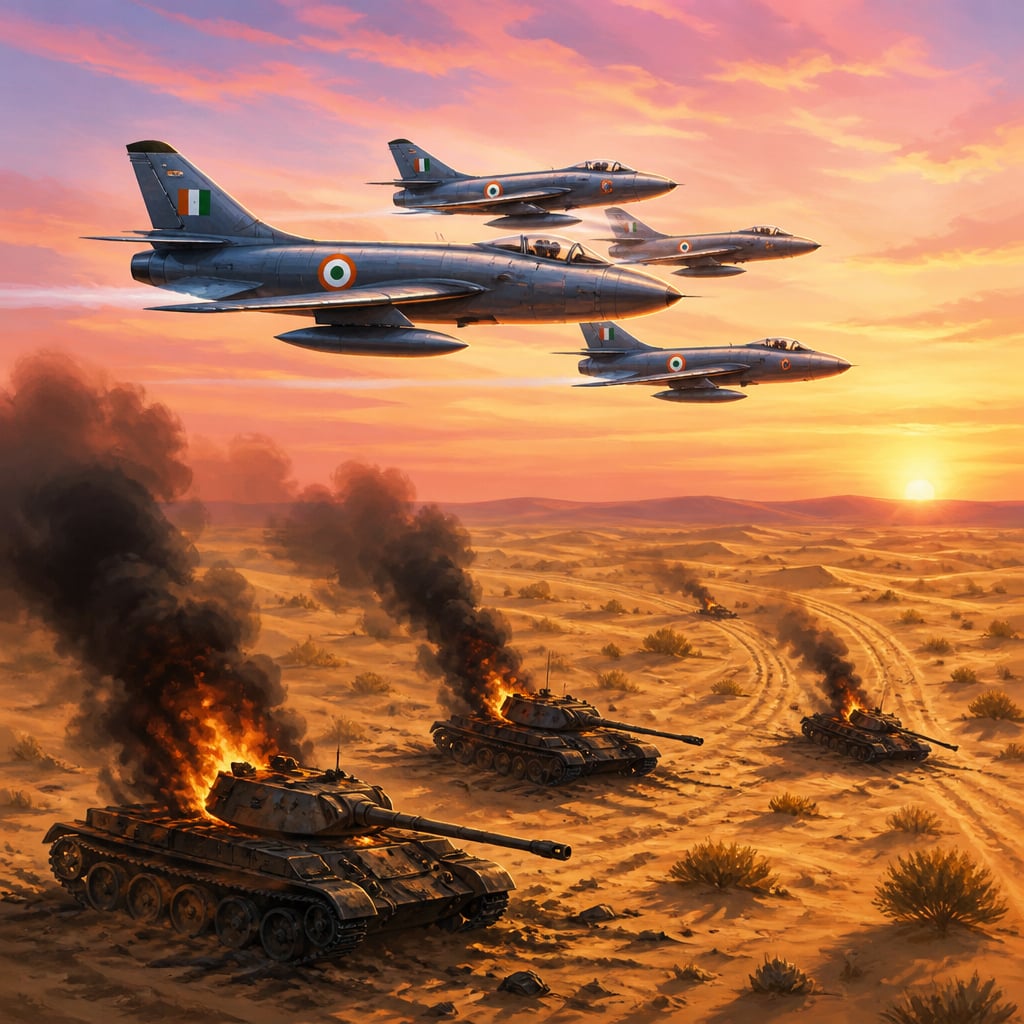
Four Hawker Hunter jets of the Indian Air Force, screaming low across the dunes.
The Hunters were armed with rockets, cannons, and bombs. Against tanks stranded in soft sand with no air cover, they were devastatingly effective.
"It was like a turkey shoot," one IAF pilot later recalled. "The tanks had nowhere to hide. They couldn't move. We just picked them off one by one."
The first strike destroyed several tanks. The Hunters returned, refueled, rearmed, and came back. Again and again throughout the day, they hit the Pakistani column.
The Tank Graveyard
By evening on December 5th, the Battle of Longewala was over. The desert floor was littered with the wreckage of Pakistani ambition:
| Pakistani Losses | Count |
|---|---|
| Tanks destroyed | 37 (of 45) |
| APCs destroyed | 100+ |
| Vehicles destroyed | 200+ |
| Soldiers killed | 200+ (estimated) |
| Prisoners captured | Several dozen |
| Indian Losses | Count |
|---|---|
| Soldiers killed | 2 |
| Soldiers wounded | Several |
| Vehicles lost | 0 |
| Position lost | None |
The disparity is almost beyond belief. Two Indian deaths against an entire enemy brigade's destruction.
The Heroes of Longewala
Major Kuldip Singh Chandpuri, MVC
Major Chandpuri was awarded the Maha Vir Chakra - India's second-highest wartime gallantry award - for his leadership at Longewala. His decision to stand and fight, his tactical positioning, and his calm command under fire turned an impossible situation into a legendary victory.
Born on November 22, 1940, in Fazilka, Punjab, Chandpuri came from a family with military traditions. He had joined the Indian Army in 1962 and served through the 1965 war before his defining moment at Longewala.
After the war, he continued his military career, eventually retiring as a Brigadier. He passed away on November 17, 2018, but his legend lives on - not just in history books but in the national consciousness.
The Men of Alpha Company
While Major Chandpuri rightly receives the glory, the 119 men who fought alongside him deserve equal honor. These soldiers - riflemen, NCOs, junior officers - held their positions through a night of terror, firing until their barrels overheated, moving ammunition through enemy fire, tending to wounded comrades while fighting off assaults.
Their names may not be as famous, but their courage was identical to their commander's.
The IAF Hunter Pilots
The Hawker Hunter pilots who arrived at dawn completed the victory. Flying low over the desert, they exposed themselves to ground fire while methodically destroying the Pakistani armor. The coordination between ground forces and air support at Longewala became a textbook example studied in military academies.
The Strategic Impact
Longewala was more than a tactical victory - it was a strategic turning point in the Western Sector of the 1971 war.
Pakistan's plan for the Rajasthan sector was to capture territory that could be used as a bargaining chip in post-war negotiations. The destruction of 51st Brigade at Longewala ended that plan.
More importantly, it freed Indian forces to take the offensive. Within days, Indian troops had crossed into Pakistani territory, capturing the town of Naya Chor and threatening the vital Hyderabad-Karachi railway.
The message was clear: Pakistan's army could not defeat India even in the desert terrain that supposedly favored armor.
The Movie "Border" (1997)
Twenty-six years later, filmmaker J.P. Dutta brought Longewala to the big screen with Border - a war epic starring Sunny Deol as Major Chandpuri.
The film took some creative liberties (the casualty figures were somewhat dramatized, and certain events were compressed or rearranged), but it captured the essential spirit of the battle. Its songs - particularly "Sandese Aate Hain" about soldiers waiting for news from home - became anthems of Indian patriotism.
Border was a massive commercial success and introduced the Longewala story to a generation that hadn't been born when the battle occurred. Major Chandpuri himself was consulted during the film's production and appeared in a cameo.
The Psychology of Standing Fast
Why did Major Chandpuri and his men not break? Military psychologists have studied Longewala to understand what enables soldiers to hold against impossible odds.
Several factors emerge:
Regimental Pride
The 23rd Punjab Regiment has a distinguished history. Its soldiers are trained to believe that retreat brings dishonor not just to themselves but to generations of soldiers who wore the same uniform before them.
Unit Cohesion
The men at Longewala had served together, trained together, lived together. When the tanks came, they weren't fighting for abstract patriotism - they were fighting for the brothers beside them.
Leadership Example
Major Chandpuri didn't issue orders from a bunker - he moved among his men, exposed to the same dangers, sharing their fear and their resolve. His visible courage made retreat unthinkable.
Tactical Preparation
The defenders knew their terrain, had clear fields of fire, and understood their weapons. This competence created confidence - they believed they could hold, which made them willing to try.
The Promise of Support
Knowing that air support would come at dawn gave the defenders something to hold on for. They weren't fighting to win outright - they were fighting to survive until help arrived.
Visiting Longewala Today
The battlefield at Longewala has been preserved as a war memorial. Visitors can see:

- The original Indian bunkers and trenches
- Wreckage of Pakistani tanks (some have been left in place as monuments)
- A museum with photographs, weapons, and battle narratives
- The post office that Major Chandpuri defended
The site lies about 150 kilometers from Jaisalmer and is accessible by road. The best time to visit is October through March, when the desert heat is manageable.
For many Indian families, Longewala has become a pilgrimage site - a place where children can touch the history they've read about, where the film Border becomes real, where the phrase "We will not withdraw" takes physical form.
The Lesson of Longewala
What does Longewala teach us?
It teaches that numbers don't decide battles - will does. That a handful of determined defenders, well-led and well-positioned, can defeat a force many times their size. That the decision to stand and fight, even when retreat is possible, can change history.
Major Chandpuri made a choice that night. He could have saved his men by withdrawing. Instead, he saved his country by staying.
"Jo desh ke liye mrte hain, woh kahin nahin mrte." (Those who die for their country never truly die.)
At Longewala, 120 men proved that true.
Historical context
1971 Indo-Pakistani War - Western Front
The 1971 war was fought on two fronts - the main thrust toward Dhaka in the East, and defensive operations against Pakistani attacks in the West. Pakistan's strategy in the Western Sector was to capture Indian territory that could be used as bargaining chips. Longewala was meant to be the breakthrough point for their Rajasthan offensive.
Living traditions
The 1997 film 'Border' by J.P. Dutta made Longewala a national legend. Sunny Deol's portrayal of Major Chandpuri and songs like 'Sandese Aate Hain' became iconic. The film is regularly screened on television during national holidays. Longewala has become a pilgrimage site for patriotic Indians, with the war museum receiving thousands of visitors annually. The battle is featured in school textbooks and military academy curricula as an example of defensive tactics and leadership.
- Longewala War Memorial: The actual battlefield preserved as a memorial. Features original bunkers, captured Pakistani tanks left as monuments, a museum with photographs and artifacts, and the famous post office that was defended. The wreckage of destroyed tanks still lies scattered in the surrounding desert.
- Jaisalmer War Museum: Comprehensive museum covering the 1971 war with special focus on the Longewala battle. Houses the actual weapons used, scale models of the battle, and multimedia presentations. Major Chandpuri's medals and personal effects are displayed here.
Reflection
- Major Chandpuri was offered a legitimate option to retreat but chose to stand. Think of a time when you were given an 'easy out' from a difficult situation. Did you take it or refuse it? Looking back, what would you do differently?
- The defenders of Longewala knew help would come at dawn - they just had to survive until then. How does knowing that help is coming change how you face difficulty? Is struggle different when you can see the end?
- Only two Indian soldiers died at Longewala against hundreds of enemy casualties. Was this victory about superior weaponry (the IAF), superior tactics, superior will, or something else? What really wins battles?