Swalapasanthoshabhava: Lack of Contentment
Discontent with what you have
In the southern forests, Raktamukha the monkey king rules a prosperous kingdom from the great fig tree. With abundant food, loyal subjects, and peace on all borders, he has everything a king could desire. Yet a creeping dissatisfaction begins to poison his heart, as whispers of grander kingdoms and greater glories awaken a hunger that plenty cannot satisfy.
The Great Fig Tree
In the southern forests, where rivers sang over ancient stones and sunlight danced through endless green canopies, there stood a magnificent fig tree. Its trunk was as wide as ten men standing shoulder to shoulder, and its branches spread outward like the arms of a generous king, offering shade to all who sought refuge beneath.
This was the kingdom of Raktamukha, "Red Face", so named for the brilliant crimson markings that adorned his noble countenance. He was king of the monkey tribe, and his throne was the highest fork of the great fig tree, from which he could survey his entire domain.
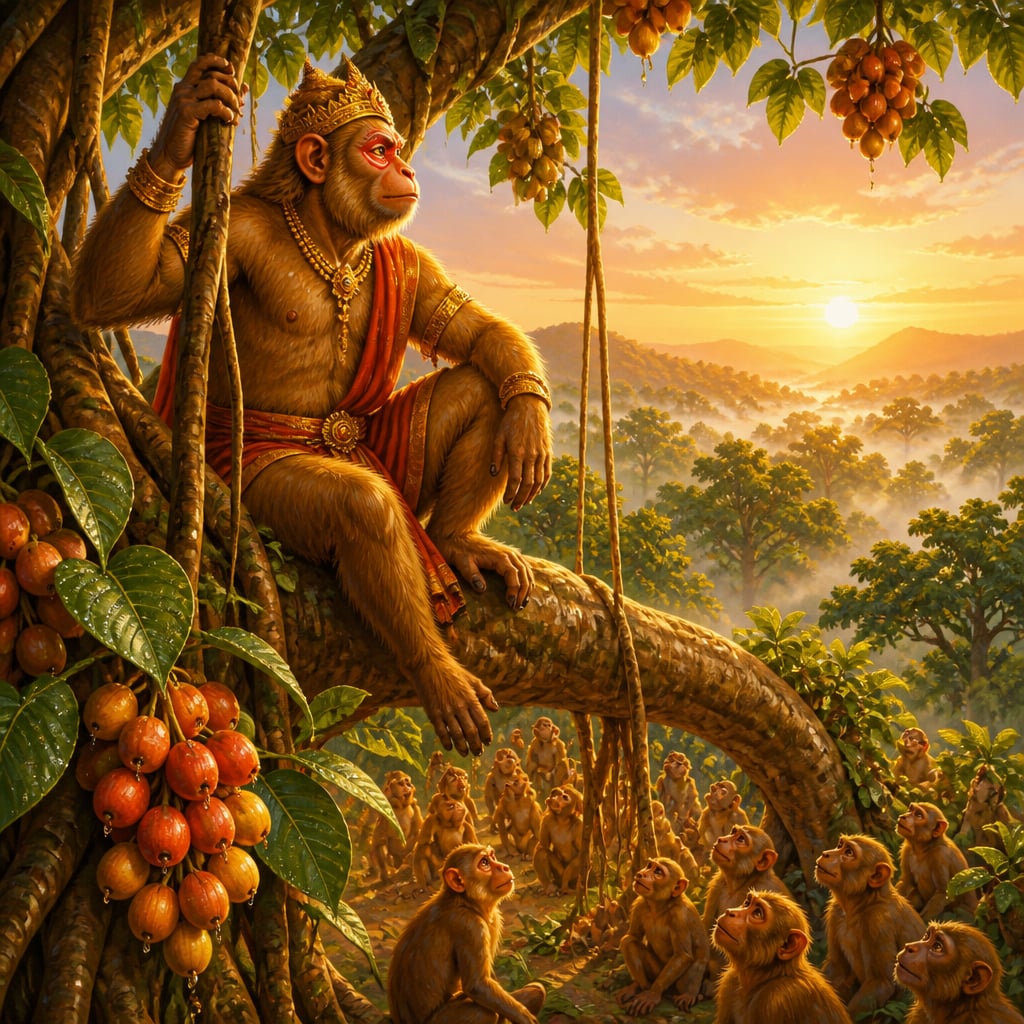
And what a domain it was! The fig tree bore fruit in every season, its bounty so abundant that no monkey ever went hungry. Fresh streams flowed nearby, their waters cool and sweet. The surrounding forest offered endless variety, mangoes in summer, berries in monsoon, nuts in winter. Even the predators kept their distance, for Raktamukha had established boundaries that all respected.
"Truly," the elders would say, "we live in an age of gold. Our grandfathers spoke of lean seasons and hungry moons. We know only plenty."
A King's Morning
Every morning, Raktamukha would wake before dawn and climb to the highest branch to watch the sun rise over his kingdom. The mist would lift from the forest floor like a veil being drawn aside, revealing the countless trees that comprised his realm.
"All this is mine," he would think with satisfaction. "Mine to protect, mine to govern, mine to enjoy."
His subjects would gather below, waiting for their king to descend. There was Chirakarin the elder, whose grey fur spoke of wisdom earned through long years. There was Vegavati the swift, who could leap from branch to branch faster than the eye could follow. There was Sthiramati the steady, whose calm counsel had guided the tribe through many challenges.
They loved their king, for Raktamukha had been a good ruler. He settled disputes fairly, ensured that even the weakest members of the tribe received their share of food, and had never led them into unnecessary danger. The monkey kingdom prospered under his reign.
"Long live King Raktamukha!" they would cheer each morning as he descended from his perch. "May his reign last a thousand seasons!"
And Raktamukha would smile and wave, feeling the warmth of their love like sunlight on his fur.
But lately, that warmth had begun to feel... insufficient.
The Merchant's Tales
It began with a traveling merchant, a human who passed through the forest each month, his bullock cart laden with goods from distant lands. The monkeys had learned to ignore him; he meant no harm and his cart sometimes dropped interesting items that the younger monkeys would collect.
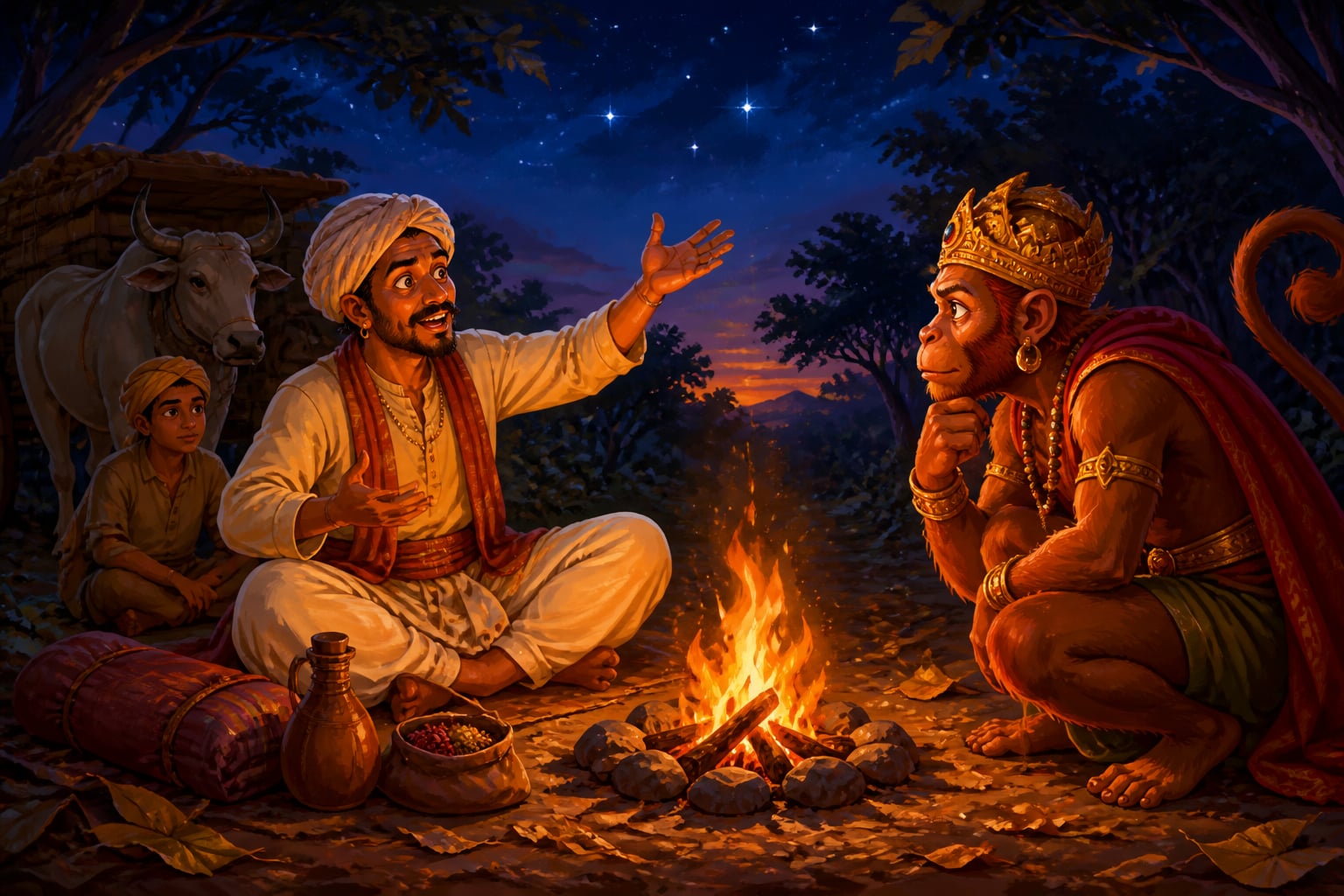
But one evening, Raktamukha found himself drawn to the merchant's campfire. Hidden in the branches above, he listened as the man spoke to his assistant about the wonders he had seen.
"In the northern kingdoms," the merchant said, "the monkey kings live in palaces of carved stone. Their subjects number in the thousands. They feast on fruits brought from across the seven seas, fruits so sweet they make our forest mangoes taste like dust."
"Surely you exaggerate," the assistant replied.
"I speak only what I have seen with my own eyes," the merchant insisted. "King Kapiraja of the mountain realm has a throne carved from a single sapphire. His crown is studded with rubies that glow like captured fire. When he speaks, ten thousand monkeys fall silent to hear his words."
Raktamukha listened, and something stirred in his chest, something unfamiliar and uncomfortable. He looked back at his own kingdom: the simple fig tree, the modest streams, the ordinary forest. Everything that had seemed so precious that morning now appeared... small.
"A throne of sapphire," he whispered to himself. "Ten thousand subjects..."
He slept poorly that night.
The First Whisper of Greed
Over the following days, Raktamukha found himself unable to shake the merchant's words. He still performed his kingly duties, settling disputes, organizing the gathering of food, watching for predators, but his mind was elsewhere.
"Why should Kapiraja have so much more than me?" he wondered. "Am I not a king as well? Are my subjects less deserving of abundance?"
He began to notice flaws in his kingdom that he had never seen before. The fig tree, magnificent as it was, had a certain roughness to its bark. The streams, sweet as they were, occasionally ran muddy after rains. The forest fruits, delicious as they were, were not "fruits from across the seven seas."
"My lord," said Chirakarin one morning, noticing the king's distraction, "is something troubling you? You seem distant."
"Tell me, old one," Raktamukha replied, "have you heard of King Kapiraja of the mountain realm?"
Chirakarin's brow furrowed. "I have heard the name. A king in distant lands. What of him?"
"They say his kingdom is vast beyond measure. They say he rules ten thousand subjects from a throne of sapphire. They say, "
"My lord," Chirakarin interrupted gently, "they say many things about distant lands. What matter is it to us? We have all we need here."
"All we need," Raktamukha repeated slowly. "But is 'all we need' the same as 'all we deserve'?"
Chirakarin said nothing, but concern flickered in his aged eyes.
The Growing Hunger
Weeks passed, and Raktamukha's discontent deepened. The merchant returned with new tales, of kingdoms even grander, of treasures even more magnificent, of kings whose power made Kapiraja himself seem humble. Each story fed the hunger growing in Raktamukha's heart.
He stopped enjoying his morning ritual of watching the sunrise. What was the sunrise over his small forest compared to the sunrise over Kapiraja's mountain realm?
He stopped savoring the fig tree's sweet fruit. What were figs compared to "fruits from across the seven seas"?
He stopped feeling the warmth of his subjects' love. What was the praise of a hundred monkeys compared to the adulation of ten thousand?
"I deserve more," he began to tell himself. "I am a king. I should have what other kings have."
He did not notice that the fig tree still bore the same abundant fruit. He did not notice that his subjects still loved him just as deeply. He did not notice that the predators still kept their distance, that the streams still flowed sweet, that the forest still offered everything his tribe could need.
All he could see was what he lacked.
The Elder's Warning
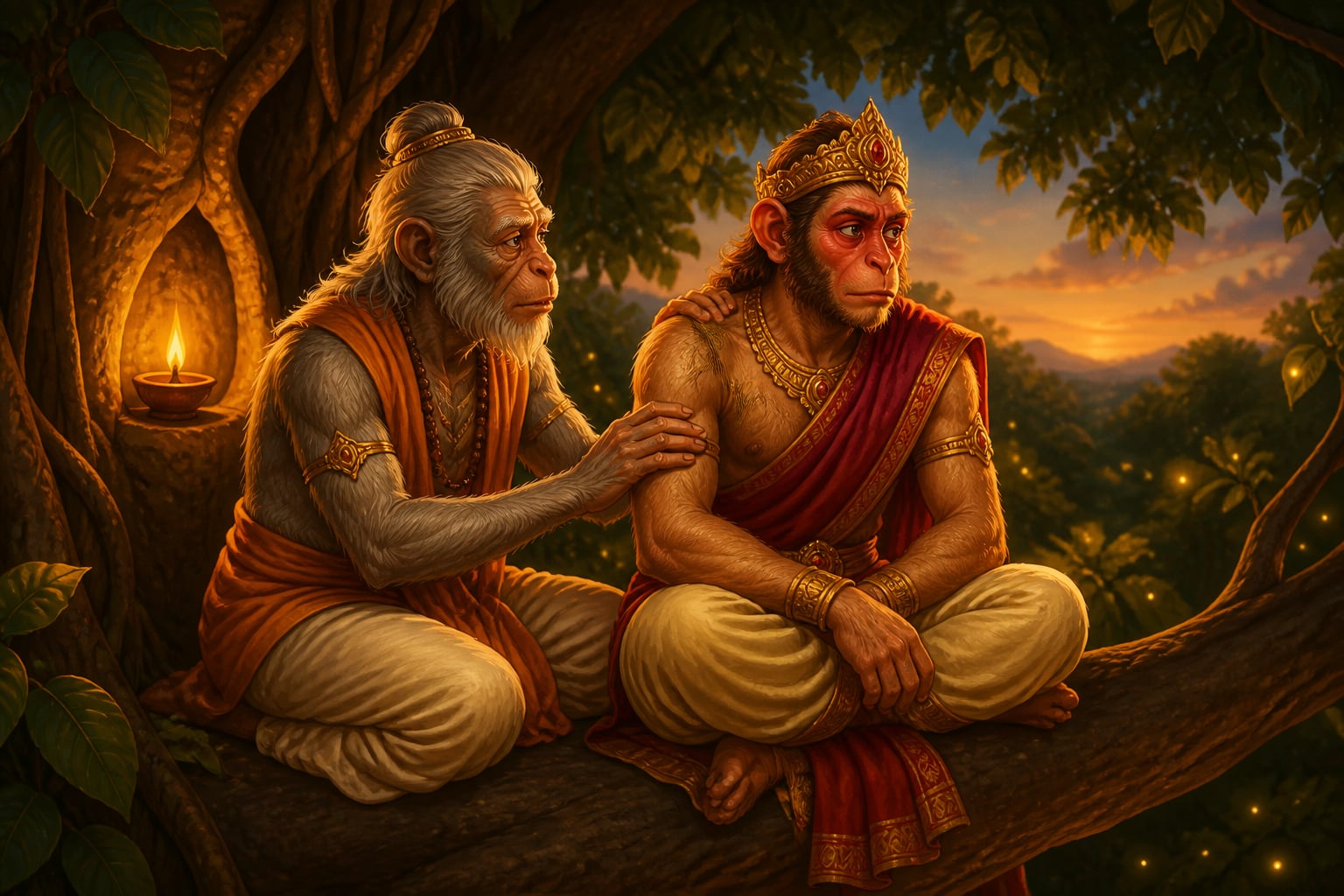
One evening, Chirakarin sought a private audience with the king.
"My lord," he said, "I have served your father before you, and his father before him. I have seen many things in my long years. Will you hear an old monkey's counsel?"
"Speak," said Raktamukha, though his mind was elsewhere, calculating how many monkeys he would need to conquer the neighboring territory.
"There is a sickness, my lord, more dangerous than any fever. It enters through the ears, through tales of what others have. It settles in the heart, as dissatisfaction with what we possess. And it consumes from within, making us blind to our own blessings while we chase shadows of greater fortune."
Raktamukha frowned. "You speak of greed?"
"I speak of labdhapranasha, the loss of what we have gained. It is not enemies that destroy most kingdoms, my lord. It is not famine or plague. It is kings who, having everything, convince themselves they have nothing, and in reaching for more, lose all."
"You think me greedy, old one?"
"I think you have stopped seeing the kingdom you have while dreaming of kingdoms you don't. I think you have stopped hearing your subjects' love while listening for distant praise. I think you have stopped tasting our abundant food while hungering for imaginary feasts."
Raktamukha was silent for a long moment. Then he said, "You may go, Chirakarin."
The elder bowed and departed, his heart heavy with premonition.
The Seed Takes Root
That night, Raktamukha climbed to the highest branch of the fig tree and looked out over his kingdom. Chirakarin's words echoed in his mind, but they could not silence the louder voice, the voice that whispered of sapphire thrones and endless subjects and fruits from across the seven seas.
"The old one fears change," Raktamukha told himself. "He has grown comfortable with smallness. But I am a king in my prime. Should I settle for this modest realm when greater glory awaits?"
He looked at the moon, hanging full and silver above the forest.
"No," he decided. "I will not be content with 'enough.' I will have more. I must have more."
And so the seed of greed, planted by a merchant's tales, watered by comparison and envy, took root in the heart of a king who had everything.
He did not yet know the price he would pay. He did not yet know how much he would lose in his quest for more. He only knew the hunger, endless, insatiable, consuming.
The story of labdhapranasha, of losing what one has gained, had begun.
Reflection
- Think of a time when you were genuinely content with something, your home, your job, your possessions, until you saw what someone else had. How did that comparison change your feelings about what you owned?
- Why do you think Raktamukha was so affected by tales of King Kapiraja, when he had never met this distant king and would likely never see his kingdom? What does this reveal about the nature of desire?
- Is contentment (santoṣa) the same as complacency? Can a person be content and still strive for growth, or does contentment require accepting things as they are?