Dhananasha: Wealth Lost Through Foolishness
Poor decisions lose fortune
Raktamukha's scouts return with devastating news: the neighboring tribes have formed an alliance, and war would mean certain defeat. Yet pride prevents the king from retreating. Through tales of a merchant's son who squandered his inheritance and a foolish investor who lost everything chasing shortcuts, Chirakarin shows how poor judgment, especially judgment clouded by ego, transforms recoverable mistakes into catastrophic losses.
The Scouts Return
One moon had passed since Raktamukha's declaration of war. The young scouts he had sent north returned, their faces grim, their reports grimmer.
"My lord," said the lead scout, a young monkey named Drshtanta, "I bring news from the northern territories."
Raktamukha sat forward eagerly. "Tell me of Kapila's weakness. Tell me how easily we will take his mango groves."
Drshtanta hesitated. "My lord... Kapila is not weak. His tribe numbers three times ours. And there is more."
"More?"
"Kapila has formed an alliance with Meghanada of the tamarind forests. Together, their forces outnumber ours five to one. They have learned of your intentions and are preparing to defend."
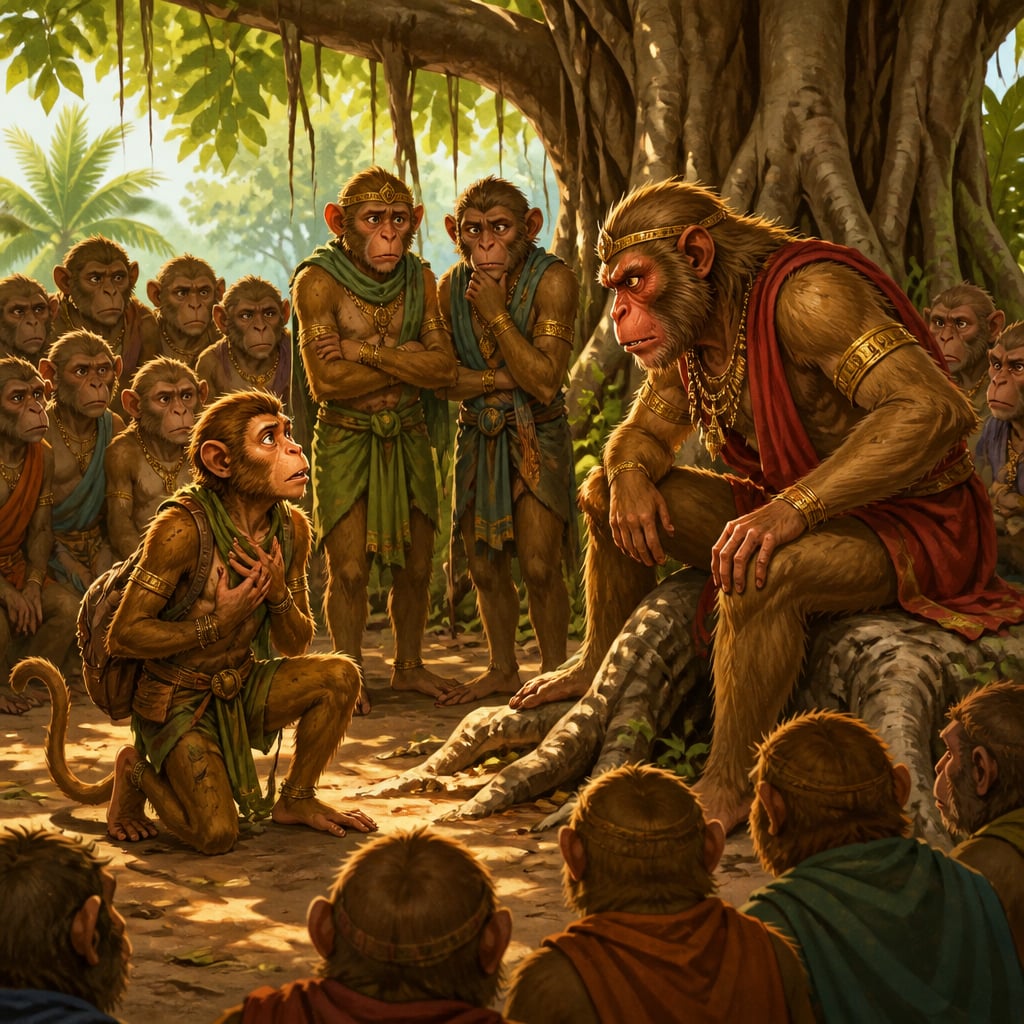
A heavy silence fell over the assembly. Five to one. Even the most optimistic warrior could not imagine victory against such odds.
Sthiramati stepped forward. "My king, this changes everything. We cannot, "
"Cannot what?" Raktamukha snapped. "Cannot fight? Cannot claim what is rightfully ours?"
"My lord, it is not cowardice to recognize impossible odds. To attack now would be suicide. We should withdraw our declaration, seek peace, preserve what we have."
The tribe held its breath, waiting for the king's response.
The Trap of Pride
Raktamukha's face twisted through several expressions, shock, anger, calculation, and finally, something harder: pride.
"Withdraw?" he said slowly. "After I have announced our expansion to the entire tribe? After I have promised them mango groves and tamarind forests? You would have me admit that I was... wrong?"
"My lord," Chirakarin said gently, "admitting error is wisdom, not weakness. The greatest leaders are those who can change course when circumstances change."
"The greatest leaders," Raktamukha replied coldly, "do not change course. They find a way to achieve their goals despite obstacles. That is what separates kings from commoners."
"But my lord, "
"Enough! I will not be remembered as the king who promised glory and delivered retreat. We will find another way. Perhaps smaller raids, guerrilla tactics, or..."
His voice trailed off as he grasped for strategies that did not exist.
The Tale of the Merchant's Son
That evening, Chirakarin gathered those who would still listen, mostly the older monkeys and a few thoughtful youngsters like Tarunika and Vichara.
"Let me tell you," he said, "of a merchant's son named Dhanahina, 'one who loses wealth.'"
Dhanahina was born into prosperity. His father, a successful trader, had spent decades building a fortune through careful investments, shrewd dealings, and patient accumulation. By the time he died, he left his son a vast inheritance, warehouses full of goods, ships in the harbor, gold in the vault.
"With this wealth," the dying merchant told his son, "you can live comfortably for ten lifetimes. But remember: it took me forty years to build. A foolish man can destroy in one year what a wise man builds in forty."
Dhanahina nodded solemnly, but in his heart, he was already making plans.
"My father was a plodding trader," he thought after the funeral. "Patient, cautious, boring. I am cleverer than he was. I will double this fortune in a single year!"
He began with speculation. Where his father had traded in reliable goods, grain, cloth, spices, Dhanahina invested in exotic ventures: a pearl fishery that failed, a shipping route that was plagued by pirates, a mine that produced only ordinary stone.
Each failure made him more desperate. Each loss made him take greater risks to recover.
"I cannot admit to my friends that I have lost money," he thought. "I must win it back quickly, before anyone notices."
He borrowed money to invest. When those investments failed, he borrowed more. When he could no longer borrow, he sold his father's warehouses. When the warehouses were gone, he sold the ships. When the ships were gone, he sold the house.
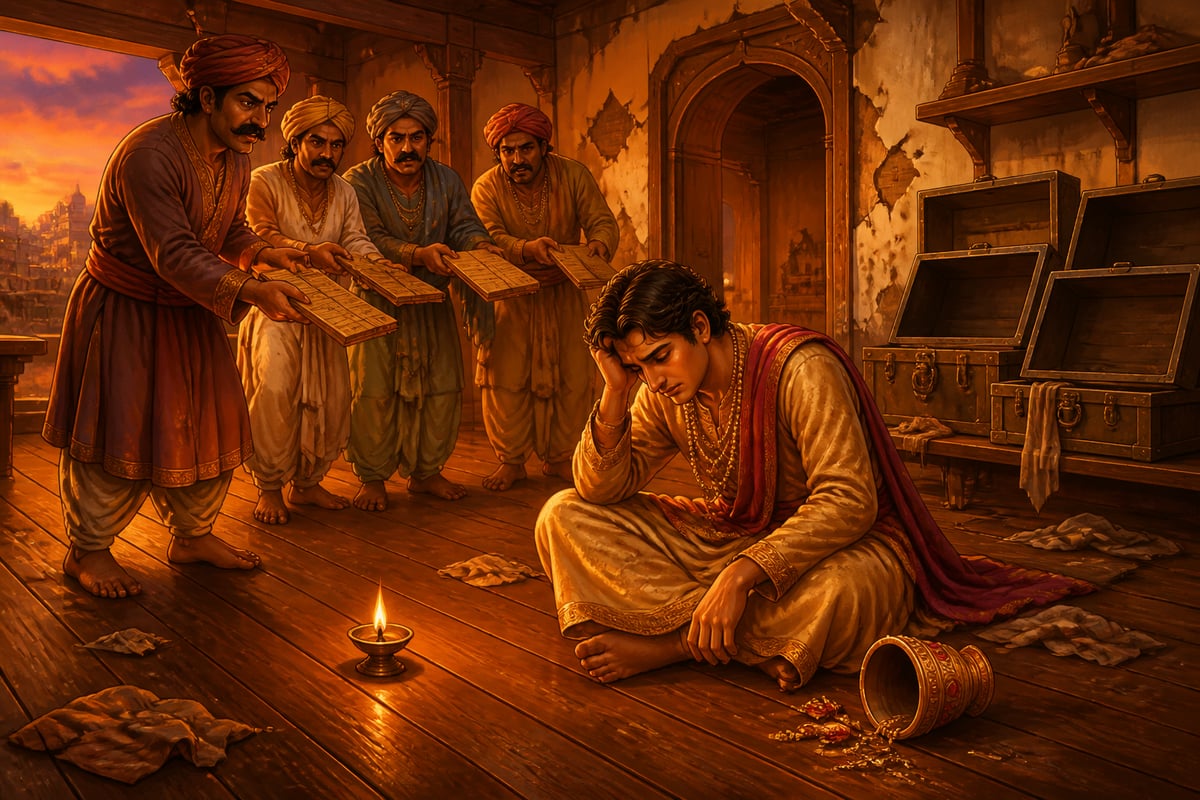
Within three years, Dhanahina had transformed his father's lifetime of wealth into nothing. He died a beggar in the streets of the very city where his father had been respected.
"And so," Chirakarin concluded, "the son destroyed in three years what the father built in forty. Not because he was evil, but because he could not admit error. Each mistake, properly acknowledged, could have been recovered from. But pride turned small losses into complete ruin."
The Tale of the Foolish Investor
Vichara spoke up. "But elder, surely Dhanahina was simply unlucky? His investments failed through no fault of his own."
Chirakarin shook his head. "Listen to another tale, then. This one concerns Kutarkika, 'one who reasons poorly.'"
Kutarkika was not born wealthy, but through years of hard work, he had saved a modest sum, enough to buy a small plot of land and live comfortably in his old age.
One day, a stranger came to the village with an offer: "Invest your savings with me, and I will triple them within a year through a secret trading method."
The village elders warned Kutarkika: "If this method were real, why would a stranger share it with us? He would use it himself."
But Kutarkika's greed overwhelmed his reason. "They are jealous," he thought. "They don't want me to become richer than them."
He gave the stranger his life savings. The stranger, of course, disappeared.
A wiser man would have learned from this mistake. But Kutarkika could not accept that he had been fooled.
"It wasn't my judgment that was wrong," he told himself. "It was just bad luck. The next opportunity will be different."
When another stranger came with another scheme, Kutarkika borrowed money to invest. When that failed, he borrowed more for the next scheme. Each failure reinforced his determination to prove that his original judgment was sound.
In the end, Kutarkika lost not only his savings but incurred debts he could never repay. He spent his final years in servitude, working to pay off obligations incurred in the pursuit of shortcuts.
"The difference between Kutarkika and a wise man," Chirakarin said, "was not the initial mistake. Everyone makes mistakes. The difference was what came after. A wise man says, 'I was wrong; let me learn and recover.' A fool says, 'I was not wrong; let me prove it by risking more.'"
The Parallel to the Present
Tarunika saw the connection clearly. "Elder, you speak of Raktamukha. His initial ambition was a mistake. But now, instead of admitting error and preserving what we have, he insists on continuing."
"And each continuation," Chirakarin agreed, "makes the final loss greater. Had Dhanahina stopped after his first failed investment, he would still have been wealthy. Had Kutarkika stopped after the first scheme, he would have lost only his savings, not his freedom. Had our king stopped after learning the odds against us, we would still have our peaceful kingdom."
"But he cannot stop," Vichara said slowly. "Because stopping means admitting he was wrong."
"Precisely. And that is the trap of dhananasha, the loss of wealth. It is rarely a single catastrophe. It is a series of decisions, each one made to avoid admitting the previous one was wrong. Pride transforms recoverable mistakes into total ruin."
The King's Calculations
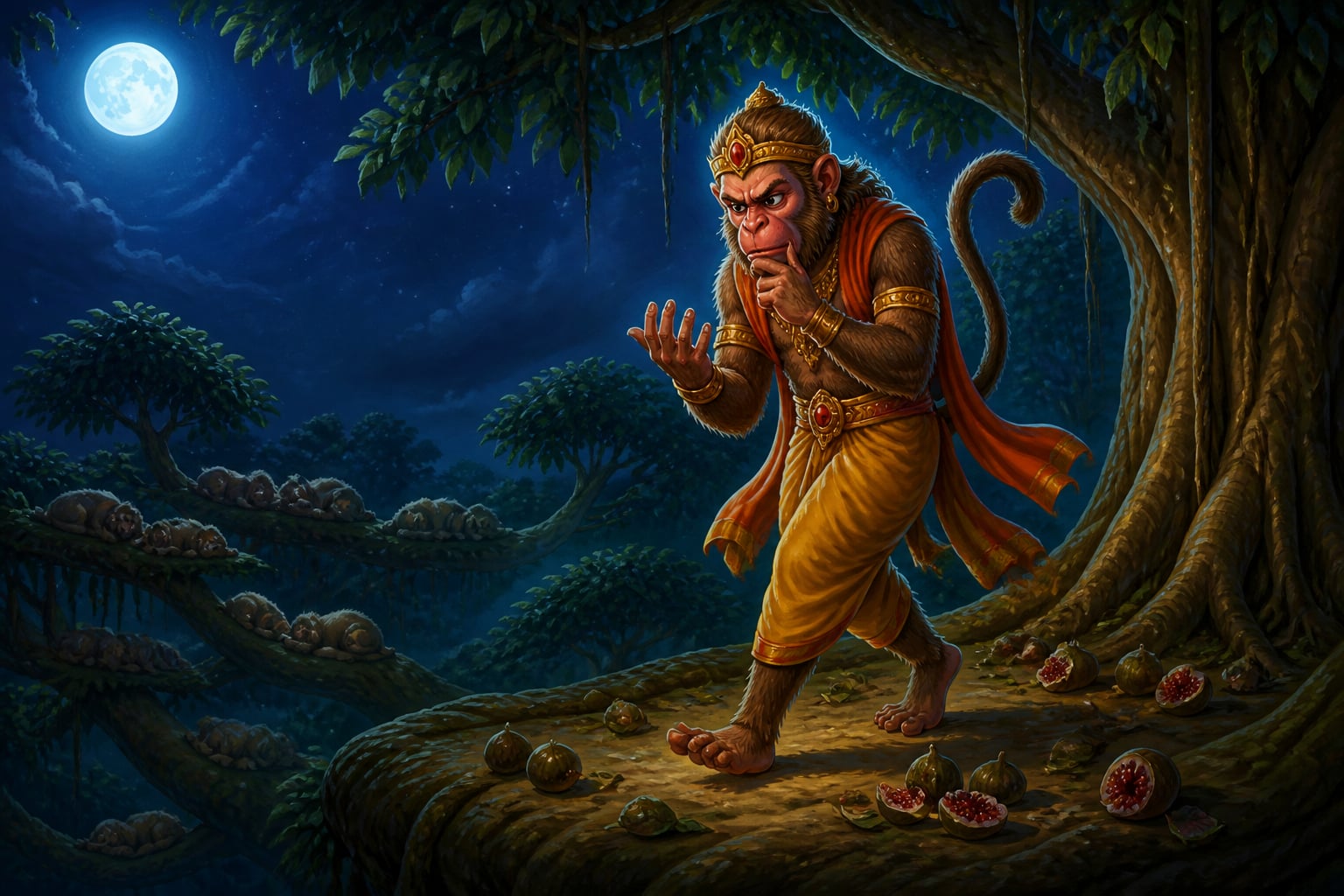
While Chirakarin told his stories, Raktamukha paced on his private branch, calculating impossible equations.
"If we attack at night... if we target their food stores... if we form our own alliance..."
But every calculation led to the same conclusion: they could not win. The scouts' numbers were clear. Five to one. Alliance against isolation. Preparation against surprise lost.
A wise king would have called the tribe together and said, "I was wrong. The circumstances have changed. We will make peace and preserve what we have."
But Raktamukha was not wise. He was proud.
"I cannot withdraw," he muttered to himself. "The young warriors believe in me. The tribe expects glory. If I retreat now, I will be seen as weak, foolish, a king who makes empty promises."
He did not see that continuing would make him something worse: a king who destroyed his people for the sake of his pride.
"There must be a way," he insisted. "There is always a way for those bold enough to find it."
But there was no way. There was only the choice between a small humiliation now and a great catastrophe later.
Raktamukha chose the catastrophe.
Reflection
- Think of a time when you made a mistake but found it difficult to admit, perhaps at work, in a relationship, or with a decision. What made admission so hard? What might have happened if you had acknowledged the error immediately?
- Why do you think Kutarkika blamed 'bad luck' rather than 'bad judgment' after being scammed? What psychological purpose does this reframing serve?
- The verse says knowledge is the 'supreme wealth' because it cannot be stolen or lost. But can knowledge protect us from the kind of pride-driven mistakes we see in these stories? Is wisdom the same as knowledge?