Mithyaasha: False Hopes
Building castles in the air
Unable to accept defeat, Raktamukha retreats into fantasy, imagining miraculous victories, divine interventions, enemy weaknesses that don't exist. Through the tale of a potter who destroyed his wares while daydreaming of wealth, and a weaver whose imagination convinced him he was a king, Chirakarin shows the final and most dangerous stage of greed: when the mind constructs false hopes to avoid facing unbearable reality.
The King's Fantasy
In the days following the scouts' report, Raktamukha withdrew from the tribe. He no longer attended councils, no longer settled disputes, no longer even ate with his subjects. He sat alone on his branch, staring into the distance, muttering to himself.
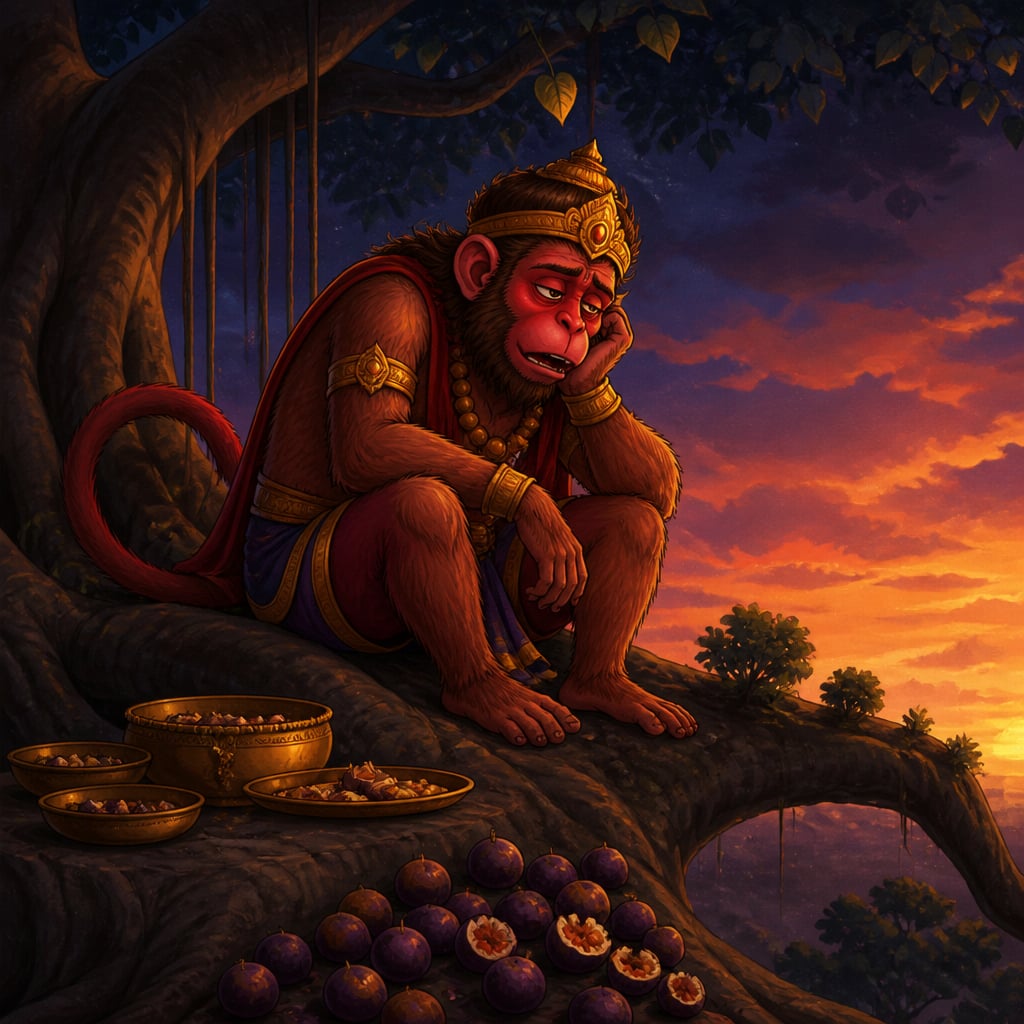
The tribe watched with growing alarm.
"What is happening to our king?" Vegavati asked Sthiramati. "He looks... lost."
Sthiramati shook his head sadly. "He cannot accept what is. So his mind is constructing what he wishes were true. It is the final stage of the disease."
"Final stage?"
"First came discontent, wanting more than he had. Then came greed, planning to take what wasn't his. Then came pride, refusing to admit error when the plan failed. And now comes mithyaasha, false hope. His mind, unable to accept defeat, is building fantasies of victory."
Indeed, those who listened closely could hear the king's murmurings:
"Perhaps the monsoon will flood their territories... Perhaps disease will strike their camps... Perhaps the gods will send a sign... Perhaps, if we attack from the east while the moon is dark..."
Fantasy upon fantasy, each more desperate than the last.
The Tale of the Potter and His Pots
Chirakarin gathered his small circle of listeners for what he sensed might be one of his final teachings.
"Let me tell you," he said, "of a potter named Kumbhakara, 'pot-maker.'"
Kumbhakara was a skilled craftsman who made his living selling clay pots in the village market. His pots were well-made and fairly priced; he earned enough for a comfortable life, though never enough to become wealthy.
One year, Kumbhakara's business flourished. He produced more pots than usual, each one perfectly formed. As he loaded his cart for market day, he surveyed his work with satisfaction, dozens of beautiful pots, ready to sell.
As he walked beside his cart, leading his ox down the dusty road, his mind began to wander.
"These pots will sell quickly," he thought. "And with the money, I will buy more clay than ever before. I will make even more pots next season..."
His imagination took flight, the same illness that had consumed the Brahmin Svabhavakripana.
"With more pots, I will earn more money. With more money, I will buy a second cart. With two carts, I will double my production. Soon I will be the greatest potter in the region!"
He smiled at the thought, his steps growing more animated as his fantasy grew.
"As the greatest potter, I will become wealthy. Wealthy enough to buy land. Wealthy enough to marry a beautiful wife. Wealthy enough to have servants of my own!"
He gestured grandly, imagining himself a man of importance.
"My servants will call me 'Master.' They will bow when I pass. And if any servant should displease me, like this!, I will kick him aside!"
Swept up in his daydream, Kumbhakara actually kicked out with his foot.
His foot connected with his cart.
The cart tilted. The pots shifted. And then, in a cascade of shattering clay, every single pot, his entire season's work, crashed to the ground.
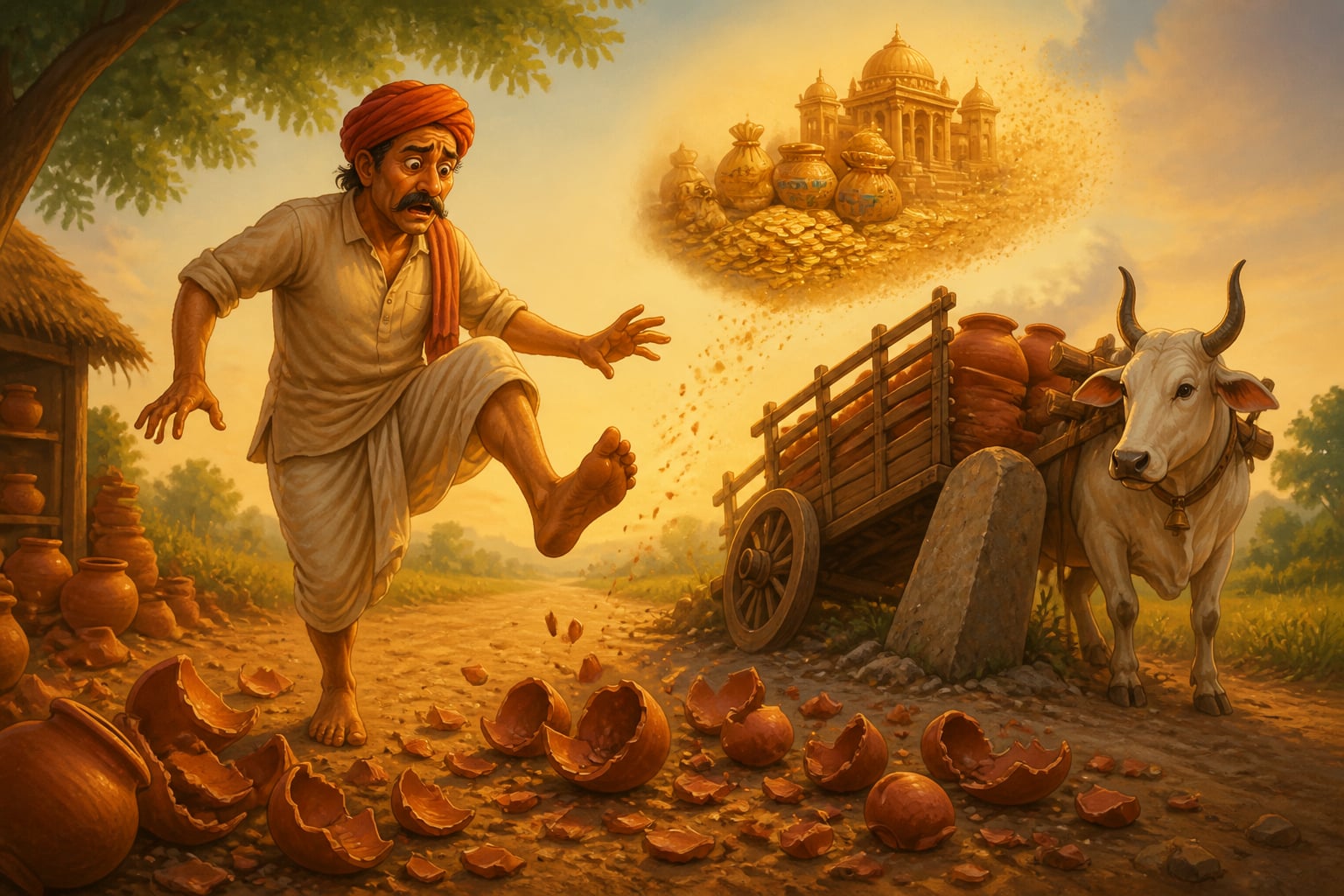
Kumbhakara stood in the road, surrounded by broken pottery, his fantasy shattered along with his merchandise.
"And so," Chirakarin concluded, "the potter who dreamed of wealth destroyed the very pots that could have given him modest prosperity. His feet walked the real road, but his mind walked an imaginary one, and when the two collided, reality won."
The Tale of the Weaver Who Became a King
Tarunika spoke up. "Elder, the potter's tale is similar to the Brahmin's, both destroyed their actual possessions while dreaming of greater ones. Is this the same lesson?"
"Similar, but mithyaasha goes deeper," Chirakarin replied. "Listen to the tale of Tantukara, 'the weaver.'"
Tantukara was a weaver who worked at his loom from dawn to dusk, producing cloth that he sold in the market. He was neither rich nor poor, neither happy nor unhappy, merely ordinary.
But Tantukara had an extraordinary imagination.
As his shuttle flew back and forth, his mind wandered to far realms. He imagined himself not as a weaver but as a great king, commanding armies, feasting in palaces, wearing silk instead of producing it.
At first, these fantasies were harmless entertainments that helped pass the tedious hours.
But gradually, the fantasies became more real than reality.
Tantukara began to walk with a kingly stride, even though he walked the same muddy village streets. He began to speak with a kingly tone, even though he spoke to the same ordinary villagers. He began to expect kingly treatment, even though he was still just a weaver.
"Why do you not bow to me?" he demanded of his neighbors.
"Bow to you? You are Tantukara the weaver!"
"I am no mere weaver! I am a king in disguise, testing my subjects' loyalty!"
The villagers laughed. Then they grew concerned. Then they grew annoyed.
Tantukara's business suffered. Customers avoided the "mad weaver" who demanded to be treated as royalty. His cloth went unsold. His debts mounted.
But in his mind, these setbacks were merely temporary obstacles on his path to the throne.
"Soon," he told himself, "my true kingdom will be revealed. Soon these fools will regret how they treated their future king."
He stopped weaving altogether, spending his days in elaborate preparation for a coronation that existed only in his imagination. He fashioned a crown from scraps of cloth. He rehearsed royal proclamations. He designed a palace in his mind, every room more magnificent than the last.
When the landlord came to collect rent, Tantukara offered him a "royal pardon" instead.
When creditors came to collect debts, Tantukara promised them "positions in the royal court."
When hunger came, Tantukara convinced himself that kings sometimes fast.
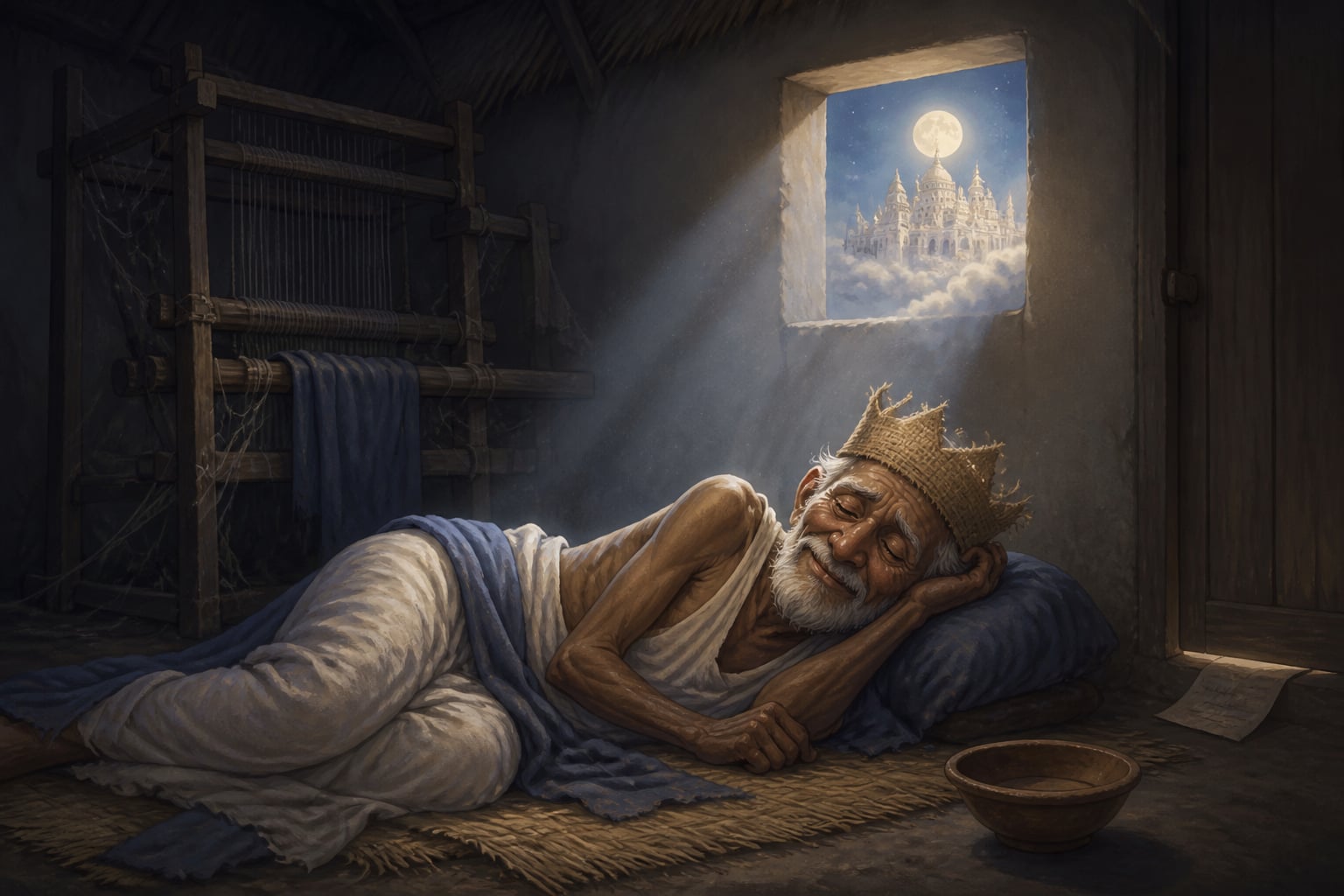
He died in poverty, alone, wearing his cloth crown, still waiting for the kingdom that was never coming.
"And that," Chirakarin said softly, "is mithyaasha in its final form. Not merely dreaming while awake, but replacing reality entirely with fantasy. The potter still knew he was a potter; he simply daydreamed while working. The weaver stopped knowing anything true, he lived entirely in a world of false hope."
The Application to the Present
Vichara's voice was barely a whisper. "Elder... is that what is happening to our king?"
"Watch him," Chirakarin replied. "Watch his eyes. They do not see what is before him. They see what he wishes were before him. Listen to his words. They do not describe reality. They describe fantasy. He speaks of strategies that cannot work, of advantages that don't exist, of victories that will never come."
"But... we cannot let him lead us to destruction based on fantasy!"
"That is the tragedy of mithyaasha," Chirakarin said. "It does not merely destroy the one who holds it. It destroys all who follow him. The weaver's delusion harmed only himself. But a king's delusion... a king's delusion can destroy an entire people."
He looked up at the fig tree, its branches filled with monkeys who had once been happy, who had once known peace, who were now preparing for a war they could not win, led by a king who had lost touch with reality.
"The saddest part," Chirakarin continued, "is that mithyaasha feels like hope. It feels like optimism, like courage, like faith. The king tells himself he is being strong by refusing to accept defeat. But there is a difference between hope grounded in reality and hope that replaces reality. One sustains us through difficulty; the other blinds us to disaster."
The Final Warning
That night, under a sky thick with stars, Chirakarin climbed to the highest branch of the fig tree, the branch where Raktamukha usually sat alone with his fantasies.
The king looked up, startled. "Chirakarin. You are not welcome here."
"I know, my lord. I come not to counsel but to warn. Not as an advisor but as one who has loved this tribe since before you were born."
"Warn me of what? That I should surrender? That I should admit defeat?"
"Warn you that you are building castles in the air while the house you actually live in burns. The strategies you mutter to yourself, they are not strategies. They are wishes. The victories you imagine, they are not coming. The gods you hope will intervene, they help those who help themselves, not those who abandon reality for fantasy."
Raktamukha's eyes flashed with anger. "You call me deluded?"
"I call you what you are: a king who has lost his way. Who began with discontent and has ended with delusion. Who had everything and will soon have nothing, not because of enemies, not because of fate, but because of the disease in his own heart."
"GET OUT!"
Chirakarin bowed his head. "As you wish, my lord. But remember my words when the castle in the air collapses, and you find yourself falling with nothing to catch you."
He descended slowly, leaving the king alone with his fantasies.
Below, the tribe slept uneasily, dreaming of mangoes they would never taste, in a kingdom that was about to fall.
Reflection
- Have you ever held onto hope that, looking back, was clearly unrealistic? A relationship that couldn't be saved, a project that couldn't succeed, a situation that couldn't change? What made it so hard to let go of that hope, even when reality contradicted it?
- The weaver's fantasy started as harmless imagination to pass the time. At what point did it become dangerous? Can you identify the turning point where daydreaming became delusion?
- How do we distinguish between healthy hope (which sustains us through difficulty) and mithyāśā (which blinds us to reality)? Both feel similar from the inside. Is there a reliable test?