Asantosha: Discontent with What You Have
Never satisfied
As war preparations begin, Raktamukha's discontent spreads through the tribe like a disease. Monkeys who were once happy begin comparing themselves to others. The young dream of glory; the old remember peace. Through a tale of a jackal who could never be satisfied with any meal, Chirakarin shows how the disease of discontent destroys not just individuals but entire communities, turning brothers against brothers, neighbors against neighbors.
The Spreading Sickness
In the days following Raktamukha's announcement, a strange transformation came over the monkey tribe. It began subtly, a shift in conversation, a change in how they looked at one another, a new edge to voices that had once been gentle.
The fig tree still bore its abundant fruit. The streams still ran sweet. The forest still offered all it ever had. Nothing in their external circumstances had changed.
But everything had changed within.
"Have you noticed," one young monkey whispered to another, "that Vegavati always gets the ripest figs? She's fast enough to reach them first. Meanwhile, we eat what's left."
"And Sthiramati," another added, "always has the best sleeping spot, that broad branch near the trunk where the wind doesn't reach. Why should he have that while I shiver on outer branches?"
Before, these small inequalities had gone unnoticed. The tribe had shared freely, and what one monkey had today, another might have tomorrow. But now, infected by the king's discontent, they began to see every difference as an injustice, every advantage as theft.
The Tale of the Unsatisfied Jackal
Chirakarin watched the poisoning of his tribe with growing despair. He saw friendships fracturing, trust eroding, community dissolving into collections of suspicious individuals. One evening, he gathered the younger monkeys, those most susceptible to the disease of comparison.
"Let me tell you," he said, "of a jackal named Asantushta, 'the unsatisfied one.'"
Asantushta lived in a forest rich with game. There were rabbits in the meadows, birds in the trees, fish in the streams. For any normal jackal, this would have been paradise.
But Asantushta was never satisfied.
One morning, he caught a plump rabbit. As he prepared to eat, he spotted a bird landing nearby.
"That bird looks fatter than this rabbit," he thought. "Why should I settle for rabbit when I could have bird?"
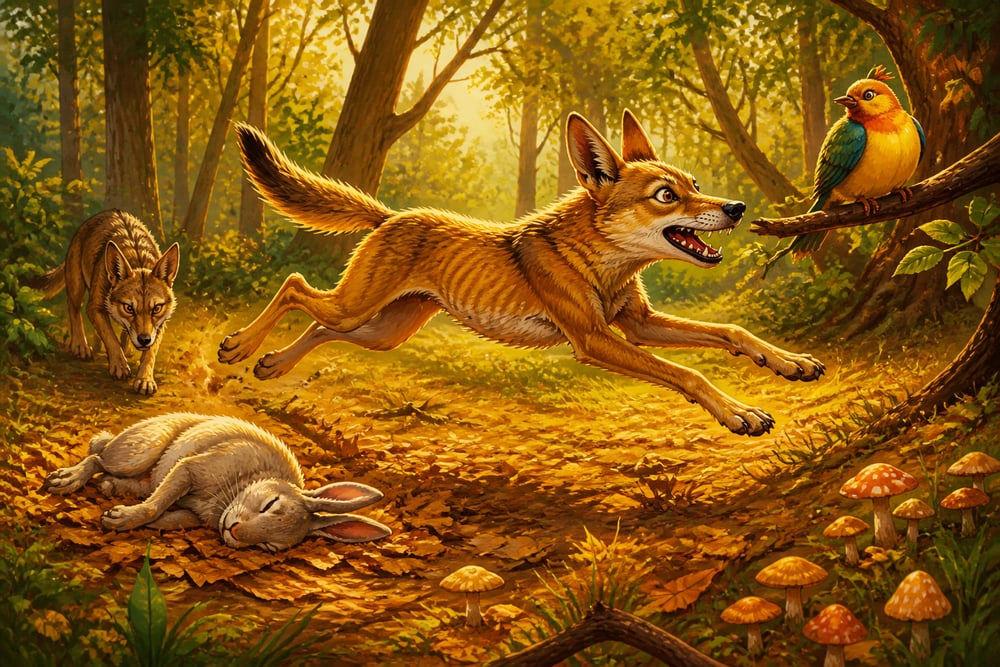
He dropped the rabbit and chased the bird. The bird flew to a tree. As Asantushta paced below, frustrated, he noticed fish jumping in a nearby stream.
"Those fish look even better than the bird," he thought. "Juicier, tastier. Why waste time on a bird when I could have fish?"
He abandoned the bird and ran to the stream. He snapped at fish but caught none, he was no fisherman. As he stood wet and frustrated, he heard rustling behind him.
The rabbit he had dropped was being carried away by another jackal.
Asantushta howled with rage and gave chase, but the thief was faster. By the time he returned to the tree, the bird was gone. The fish still jumped mockingly in the stream, forever out of reach.
And so Asantushta, in a forest of abundance, went hungry.
This happened day after day. He would catch something, see something better, chase the better thing, and lose everything. His den grew empty while other jackals' dens filled with food.
"The forest must be cursed," he complained. "There is never enough!"
But the forest was not cursed. Only his eyes were, eyes that could not see what he had, only what he lacked.
"And so," Chirakarin concluded, "Asantushta starved in plenty. His brothers, with the same opportunities, grew fat. The difference was not the forest but the jackal, a heart that could never say 'this is good.'"
The Comparison Game
One of the young monkeys, a thoughtful one named Vichara, spoke up.
"Elder, I understand the jackal's foolishness. But surely there is a difference between chasing after things we don't have and simply noticing that others have more than us? Is it wrong to see that Vegavati gets better figs?"
Chirakarin nodded. "You ask a wise question. Noticing is not wrong, noticing is merely seeing. The danger begins when noticing becomes comparing, and comparing becomes resenting, and resenting becomes wanting what others have."
He gestured to the fig tree above them.
"Before the king's speech, did you notice which figs Vegavati ate?"
Vichara thought. "No. I ate my figs and was satisfied."
"And were her figs better then?"
"I... I don't know. I wasn't paying attention."
"Exactly. The figs have not changed. Vegavati has not changed. What has changed is your attention, where you place your eyes, where you direct your mind. Once, you looked at your own figs and saw abundance. Now you look at her figs and see your own lack. The figs are the same; your asantosha, your discontent, makes them seem different."
The Division Deepens
As the days passed, the tribe divided into factions.
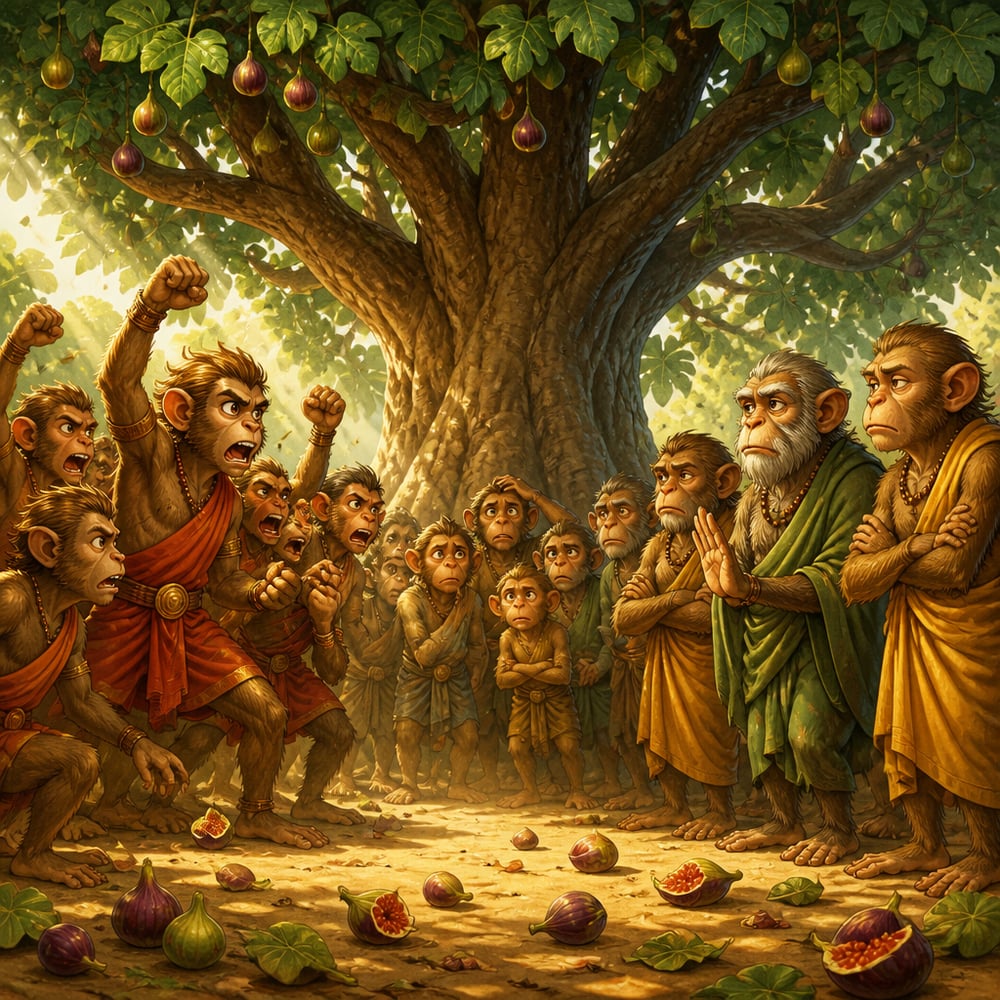
One group rallied around Raktamukha's vision of expansion. These were mostly young monkeys, restless with energy, eager for glory they had only heard about in stories. They practiced fighting, scouted the northern territories, and spoke of the mango groves as if they already owned them.
"When we conquer Kapila's territory," they boasted, "we will feast on mangoes every day! No more figs for us!"
Another group gathered around Chirakarin and Sthiramati. These were mostly older monkeys who remembered harder times, who valued peace because they knew what war cost. They spoke quietly, worried, uncertain what they could do against a king consumed by ambition.
"The figs have sustained us for generations," they reminded each other. "Our grandparents thrived on them. Why are they suddenly not enough?"
But there was a third group, the largest, who belonged to neither camp. These were the majority, the ordinary monkeys who simply wanted to live their lives. They did not dream of conquest, but neither did they want to defy their king. They watched the growing conflict with anxious eyes, hoping somehow it would resolve itself.
The Poison of Comparison
The true tragedy was not the factions themselves but what they did to relationships. Childhood friends found themselves on opposite sides. Parents and children argued. Mates who had groomed each other for years now sat on separate branches.
Vegavati, once beloved for her speed and generosity, she often shared her early catches with slower monkeys, now found herself resented. The very quality that had made her valuable became a source of envy.
"Why should she be fastest?" some muttered. "It's not fair."
Sthiramati, whose calm wisdom had guided the tribe through many difficulties, was now dismissed as a coward.
"He's just afraid," the young warriors sneered. "Afraid to fight, afraid to grow, afraid of everything."
Even Chirakarin, respected for his age and knowledge, faced ridicule.
"Old stories for old monkeys," Raktamukha's supporters laughed. "The world has changed. We need leaders, not storytellers."
Chirakarin's Lament
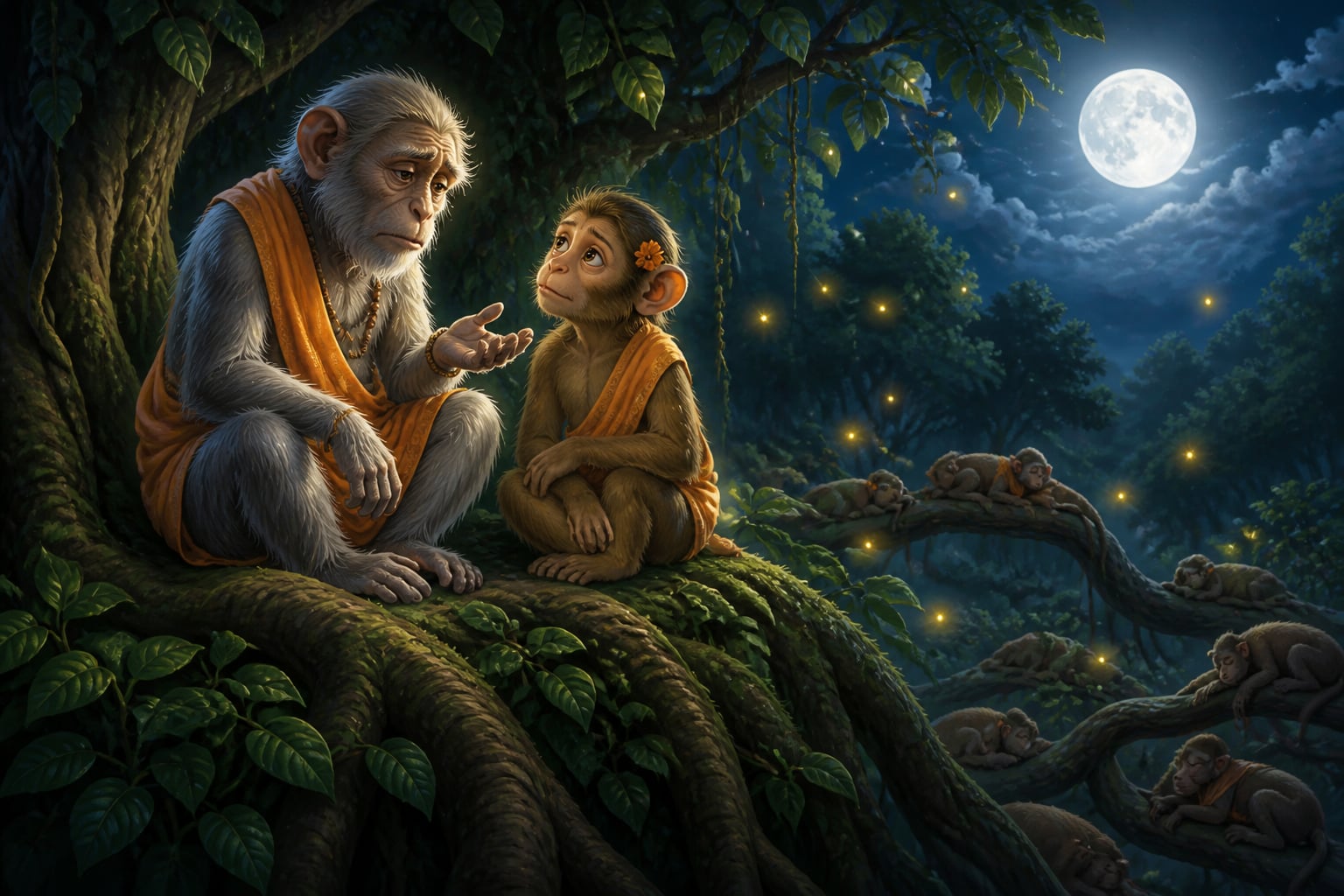
One night, Tarunika found Chirakarin sitting alone, staring at the moon.
"Elder," she said softly, "you look troubled."
"I am watching something die," Chirakarin replied. "Not a body, bodies die and are mourned and are replaced. I am watching something harder to replace die. I am watching trust die. Community. The simple faith that we are one tribe, one family, one people."
He turned to face her.
"Do you know what asantosha truly destroys, child? Not wealth, wealth can be regained. Not position, position can be restored. Asantosha destroys the ability to be happy with anything. The unsatisfied jackal did not merely lose his rabbit, he lost the capacity to enjoy any meal. Even if he had caught the bird, he would have seen a deer and dropped the bird. Even if he had caught the deer, he would have seen an elephant and deemed the deer worthless."
"Discontent is not about what we have," Chirakarin continued. "It is about who we are. It is a disease of the heart, not the hand. And once it takes root, it spreads, from the king to the court, from the court to the warriors, from the warriors to the families, until the whole tribe is infected."
Tarunika looked at the fig tree, where even now small arguments were breaking out over sleeping spots that had never been contested before.
"Can nothing cure it?"
"Only the patient can cure himself," Chirakarin said again, as he had said before. "And by the time the patient realizes he is sick, the disease is often too advanced. Raktamukha does not see his greed as greed, he calls it 'vision.' The young warriors do not see their envy as envy, they call it 'ambition.' The tribe does not see its fracturing as fracturing, they call it 'healthy debate.'"
He sighed heavily.
*"By the time they realize they are sick, they will have lost everything that made them well."
The Last Peaceful Night
That night, as the tribe settled into uneasy sleep, the fig tree stood as it always had, broad, generous, abundant. Its fruit hung heavy on the branches. Its shade cooled the warm earth. Its roots drank deep from ancient streams.
It did not know that its children were preparing to abandon it for mango groves they had never seen. It did not know that the peace it had sheltered for generations was crumbling. It did not know that this was one of the last peaceful nights it would ever see.
But somehow, in the way of old trees, it seemed to mourn.
Reflection
- Think of a time when you were content with something until you saw what someone else had. What specifically triggered the comparison, and how did it change your experience of what you already possessed?
- Why do you think the same figs that had satisfied the monkeys for generations suddenly seemed insufficient? What changed between 'before the king's speech' and 'after'?
- The verse says 'discontent is the highest suffering.' Is this true? Are there not worse sufferings, physical pain, loss of loved ones, injustice? Or does discontent make all other sufferings worse?