Lobhamuladvamsa: Greed Destroys Everything
Wanting more leads to losing all
As Raktamukha's greed deepens, Chirakarin shares two ancient tales as warnings. First, the story of Svabhavakripana, a poor Brahmin whose elaborate daydreams about wealth built on a pot of flour end in disaster when reality intrudes. Then, the tale of a farmer whose miraculous goose laid golden eggs, until impatience drove him to destroy the very source of his fortune. Both stories illuminate the same truth: greed destroys what contentment would preserve.
The Elder's Stories
Days passed after Chirakarin's warning, and Raktamukha's condition only worsened. He barely ate the abundant figs, finding them tasteless. He barely acknowledged his subjects' greetings, finding their love insufficient. His eyes were always on the horizon, as if watching for the arrival of the greater kingdom he believed he deserved.
The other monkeys began to whisper.
"What ails our king?" asked Vegavati. "He was once so joyful, so present. Now he seems to walk among shadows."
"Greed has entered his heart," Chirakarin replied sadly. "The most dangerous of all poisons, for it makes the sick man believe he is well, makes him believe that his fever is clarity and his madness is wisdom."
"Can nothing cure it?"
"Only the patient can cure himself. But perhaps... perhaps stories might plant seeds of understanding. Even if he does not listen now, perhaps the seeds will grow."
That evening, as the tribe gathered for their customary sharing of the day's events, Chirakarin raised his voice.
"My king, may I share two ancient tales? Stories our ancestors passed down as warnings, though also as entertainment. They are short, and the evening is long."
Raktamukha, lost in calculations of how to expand his territory, waved his hand dismissively. "As you wish, old one. Tell your stories."
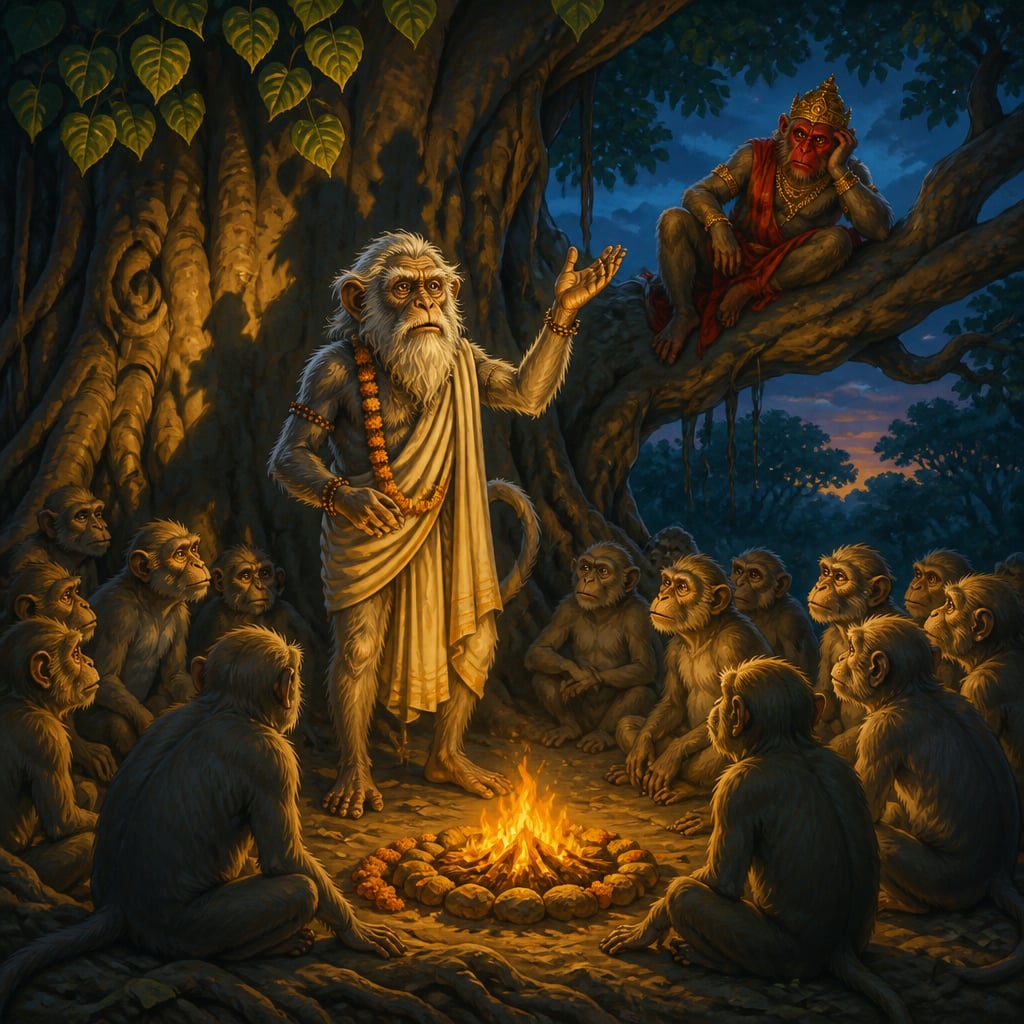
The First Tale: The Brahmin and His Pot of Flour
In a certain village, there lived a Brahmin named Svabhavakripana, "naturally miserly", who survived on the charity of others. He was not a bad man, merely a poor one, and his poverty had taught him to cling tightly to whatever little he received.
One day, a wealthy merchant, pleased by the Brahmin's recitation of sacred verses at a ceremony, gave him a large pot filled with flour. This was more food than Svabhavakripana had possessed in many months.
"A pot of flour!" he exclaimed, carrying it home carefully. "With this, I shall never go hungry!"
But that night, as he lay in his humble hut with the pot beside him, the Brahmin's mind began to wander.
"This flour," he thought, "I need not eat it all myself. I could sell half and buy more flour with the profit. Then I would have even more to sell..."
His imagination took flight.
"If I sell my flour wisely, I could buy goats. Goats multiply quickly, within a year I would have a flock. I would sell the goats and buy cows. Cows give milk, which I could sell in the market..."
The dream grew larger with each passing moment.
"With my cow-wealth, I would buy land. On my land, I would build a great house. In my great house, I would live as a wealthy man. Other Brahmins would seek my patronage. The village headman would seek my counsel..."
Svabhavakripana sat up in excitement, his eyes gleaming in the darkness.
"And when I am wealthy," he continued, "I shall marry! Yes, I shall marry a beautiful woman from a good family. My parents-in-law will shower me with gifts. My wife will bear me a son, a strong, handsome son who will carry forward my legacy..."
He could see it all so clearly, the house, the wife, the child.
"I will name him Chandrasena, 'Moon-warrior.' He will be the light of my life. I will teach him everything I know. But boys can be mischievous, what if he misbehaves? What if he does not listen to his father?"
The imaginary son took shape in his mind, a playful toddler ignoring his father's instructions.
"If he disobeys me, I shall discipline him! I shall raise my stick and say, 'Listen to your father, boy!' Like this!"
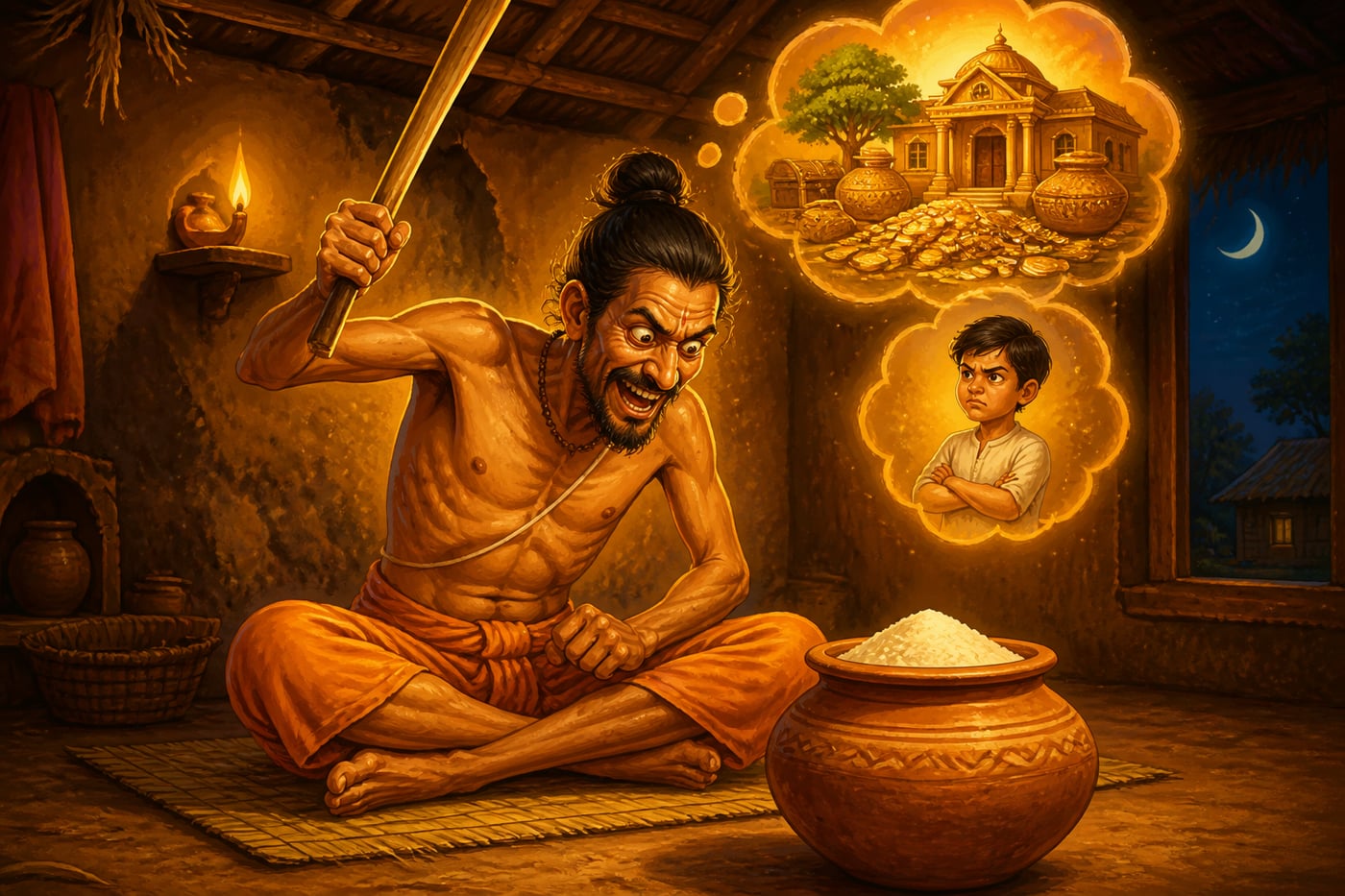
Swept up in his fantasy, the Brahmin raised his actual stick, and brought it down with a crash.
Not on an imaginary son.
On the very real pot of flour.
The pot shattered. Flour exploded everywhere, covering the Brahmin, covering his hut, covering his dreams. Where moments before he had been a wealthy landlord with a wife and son, now he sat in a cloud of white powder, surrounded by broken pottery, possessing nothing.
Less than nothing. For even the flour he had truly owned was now mixed with dirt and shards, useless.
"And so," concluded Chirakarin, looking directly at Raktamukha, "the Brahmin who dreamed of palaces lost even his humble pot of flour. He who builds castles in his mind may destroy the house he actually lives in."
The Second Tale: The Farmer and the Golden Goose
Raktamukha stirred uncomfortably but said nothing. The other monkeys listened in rapt attention as Chirakarin began his second tale.
In a village near the mountains, there lived a farmer named Dhanalobhin, "desirous of wealth", who worked a small plot of land. He was neither rich nor poor, and his life was neither easy nor hard. He had enough.
One day, while walking through the forest, Dhanalobhin found a most extraordinary creature, a goose with feathers that shimmered like liquid gold.
"What manner of bird is this?" he wondered, approaching carefully.
The goose did not flee. Instead, it looked at him with intelligent eyes and spoke: "Take me home, farmer. Feed me well, and I shall repay your kindness beyond your dreams."
Dhanalobhin, astonished but hopeful, carried the golden goose home. He built it a comfortable shelter, fed it the finest grain, and treated it with the utmost care.
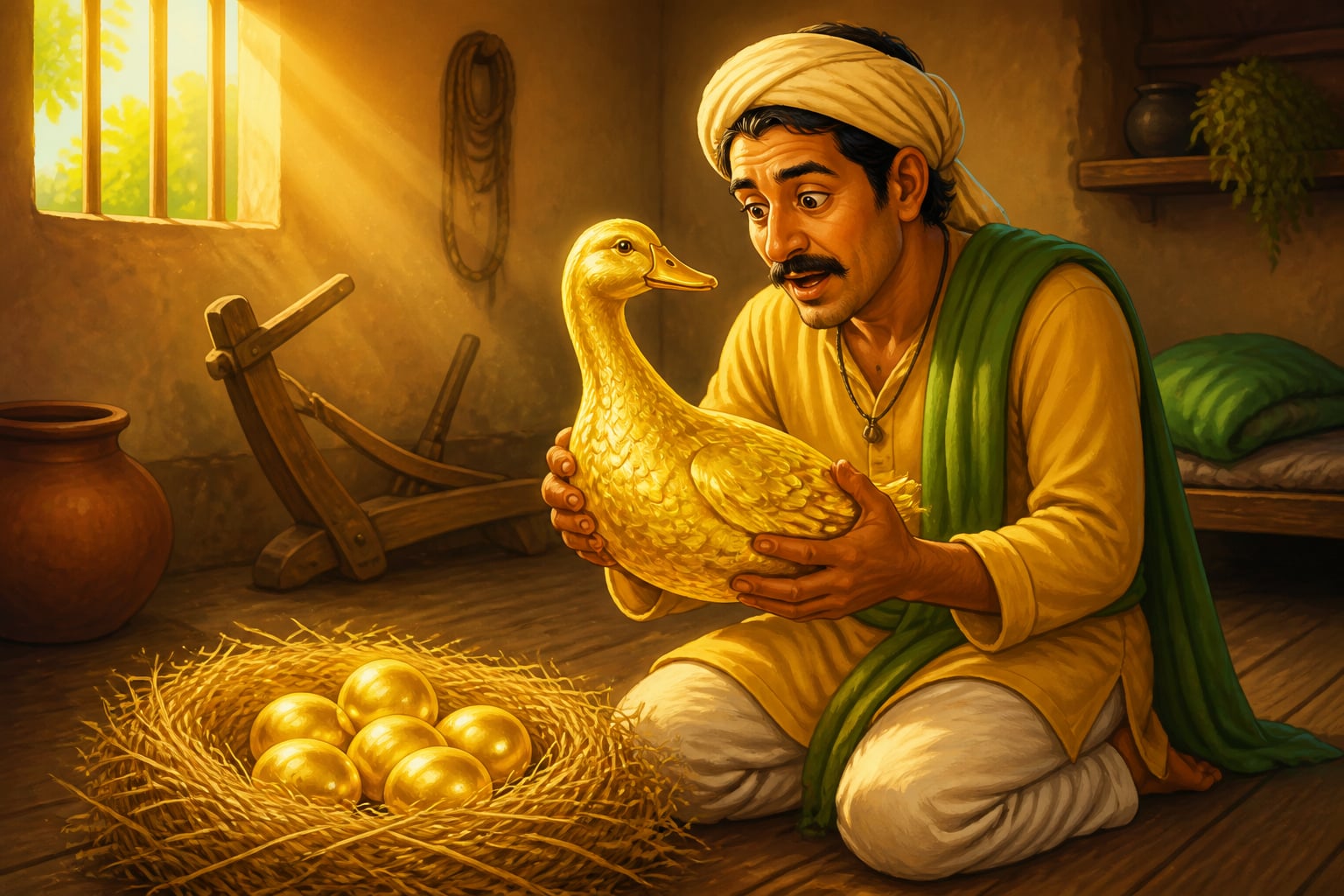
The next morning, he found a golden egg in the goose's nest.
Not yellow-gold like marigolds. Actual gold. Solid, heavy, precious gold.
"It cannot be!" the farmer gasped. But it was. And the next morning, there was another. And the next, another still.
Day after day, the miraculous goose laid one golden egg. Within a month, Dhanalobhin had more gold than the village headman. Within a year, he was the wealthiest man in the district. He bought more land, built a fine house, hired servants, wore silk.
"One egg per day," he would muse, counting his treasure. "One egg per day makes me richer than I ever dreamed."
But as his wealth grew, so did his hunger for more.
"One egg per day," he thought one evening, "is fine. But imagine if I could have all the eggs at once! Surely this magical goose must have many, many eggs inside her. Why should I wait day by day when I could have the entire fortune immediately?"
The thought consumed him. He stopped enjoying his daily golden egg, seeing it instead as a reminder of all the eggs he did not yet have.
"Tomorrow," he decided, "I shall cut open the goose and take all the gold at once. Then I shall be the richest man in the kingdom!"
The next morning, Dhanalobhin sharpened his knife. The goose, who had served him faithfully for so long, looked at him with those same intelligent eyes.
"What are you doing?" the goose asked.
"I am taking what is mine," the farmer replied. "All of it, at once."
"If you do this, you will have nothing."
"Impossible! You are made of gold. Inside you must be a treasure beyond imagining!"
The goose said nothing more. What could it say? Greed does not hear wisdom.
Dhanalobhin killed the goose and cut it open.
Inside, he found exactly what one finds inside any goose: organs, blood, and ordinary flesh. No gold. No treasure. No eggs.
The magic, whatever it was, died with the goose.
Dhanalobhin stood over the body of his golden fortune, knife in hand, covered in blood and feathers, possessing nothing. The goose that would have made him rich forever was dead. His daily source of wealth was gone. He had destroyed the very thing that gave him everything.
"And so," Chirakarin concluded quietly, "the farmer who dreamed of all the gold lost even the one egg he was guaranteed. He who grasps for everything at once may end with nothing at all."
The King's Response
Silence fell over the gathering. The young monkeys shifted uncomfortably. The older ones exchanged meaningful glances. Everyone understood that these stories were meant for one listener above all.
Raktamukha sat very still for a long moment. Then he rose from his seat and looked at Chirakarin with cold eyes.
"Pretty stories, old one. Tales for children. But I am not a foolish Brahmin dreaming over flour, nor a stupid farmer who kills his source of gold. I am a king who sees clearly that his kingdom could be greater. There is no fantasy in my ambitions, only vision."
"My lord, " Chirakarin began.
"These tales speak of men who had little and lost it through foolishness. I have much, and I intend to have more through strategy. The situations are not comparable."
"My lord, the Brahmin also believed his plans were strategy, not fantasy. The farmer also believed his choice was rational, not greedy. The nature of this sickness is that it makes us believe we are immune to it."
Raktamukha's face hardened. "You try my patience, Chirakarin. I have heard your stories and your warnings. Now hear my command: speak no more of this. I am king, and I will do what kings do, I will expand my domain, increase my power, and make my name known throughout the forest. If you cannot support this vision, remain silent."
The old monkey bowed his head. "As you wish, my lord."
Raktamukha stalked away to his private branch, leaving the tribe in troubled silence.
The seeds had been planted. Whether they would grow remained to be seen. But Chirakarin, who had lived long and seen much, felt a terrible certainty in his heart.
The golden goose was already dead. The pot of flour had already shattered. The king simply did not know it yet.
Reflection
- Have you ever destroyed something real by focusing too much on something imaginary? Perhaps a relationship damaged by fantasizing about a different one, or actual savings spent on get-rich-quick schemes?
- Why do you think the farmer could not appreciate one golden egg per day? He was becoming richer every day than most people become in a lifetime. What made 'daily guaranteed wealth' feel insufficient?
- The verse describes desire as a river that 'destroys the trees of fortitude.' What is the relationship between desire and inner strength? Does wanting things make us weaker?