Atilaulyavipatti: Excessive Desire Brings Ruin
Too much desire is dangerous
Raktamukha's discontent transforms into concrete action as he announces his plan to expand the monkey kingdom. He ignores the counsel of his advisors and begins mobilizing for conquest. Meanwhile, Chirakarin shares the tale of the greedy dog who lost his reflection's bone, and a crane whose excessive hunger led to its doom, warnings that fall on deaf ears as the king's excessive desire spirals toward inevitable ruin.
The King's Announcement
The morning after Chirakarin's stories, Raktamukha summoned the entire tribe to the great clearing beneath the fig tree. There was an unusual energy about the king, a feverish brightness in his eyes, a restless movement in his limbs. The monkeys gathered in nervous silence, sensing that something significant was about to happen.
"My people," Raktamukha began, his voice carrying across the assembly, "for too long we have been content with this single tree, this small patch of forest. For too long we have watched other tribes prosper while we remain stagnant. For too long we have accepted 'enough' when we deserve 'more.'"
Murmurs rippled through the crowd. Some of the younger monkeys leaned forward with interest; the elders exchanged worried glances.
"I have decided," the king continued, "that our kingdom will expand. The territories to the north, the mango groves by the river, the tamarind forests beyond the ridge, these will be ours. We will no longer be a tribe of one tree but a nation of many!"
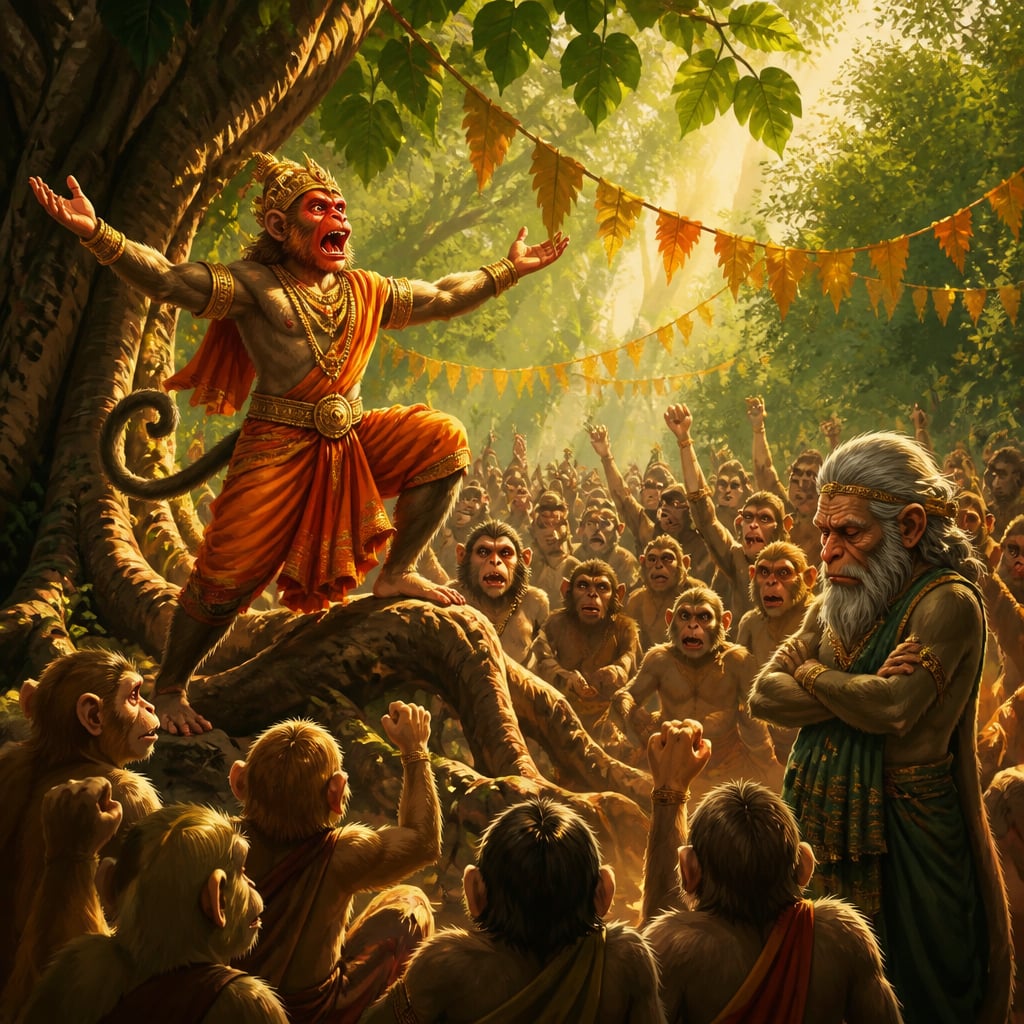
Vegavati, ever impulsive, let out a cheer. A few others joined her. But most of the tribe remained silent, uncertain.
Sthiramati stepped forward, his expression grave. "My king, the territories you speak of, they are not empty. The mango groves belong to Kapila's tribe. The tamarind forests are Meghanada's domain. To take them would mean war."
"Then war it shall be," Raktamukha replied coldly. "We are stronger than we know. We have grown complacent, but our claws are still sharp, our numbers still great. Why should Kapila feast on mangoes while we eat figs?"
"Because the figs sustain us," Chirakarin said quietly. "Because we have peace, which is worth more than mangoes. Because war brings death, and death cannot be undone."
Raktamukha turned on the elder with fury in his eyes. "I commanded you to be silent on this matter!"
"You commanded me not to speak of your greed, my lord. I speak now of war, and its consequences. They are different subjects."
The tribe held its breath. Never had anyone defied the king so openly.
The Tale of the Greedy Dog
Raktamukha's face twisted with anger, but before he could respond, a young monkey named Tarunika spoke up.
"Elder Chirakarin, perhaps you could tell us a story? A short one, to help us understand what we face. The king speaks of gaining mangoes, but what might we lose?"
It was a clever move. By framing the request as innocent curiosity rather than opposition, Tarunika gave Chirakarin an opening. Raktamukha could not refuse without appearing tyrannical.
The king waved his hand impatiently. "Be quick about it, old one. We have plans to make."
Chirakarin bowed and began.
There was once a dog named Lobhamukhya, "face of greed", who wandered the streets of a village, always hungry, always searching for scraps. One fortunate day, he found a large bone lying outside a butcher's shop.
"At last!" he thought, seizing it in his jaws. "A bone all my own! I will take it somewhere safe and enjoy it in peace."
He trotted away from the village toward a quiet place he knew, a small bridge over a stream where no other dogs would disturb him.
As he crossed the bridge, Lobhamukhya happened to look down into the water below. There, he saw another dog, a dog with a bone in its mouth!
"What is this?" he thought. "Another dog with a bone? And his bone looks even bigger than mine! Why should he have such a large bone while I have this smaller one?"
Envy consumed him. He had been happy moments before, he had a bone, more than he'd had that morning, more than enough for a good meal. But now, seeing what he believed another possessed, his own bone seemed worthless.
"I will take his bone too!" Lobhamukhya decided. "Then I will have two bones, and be twice as satisfied!"
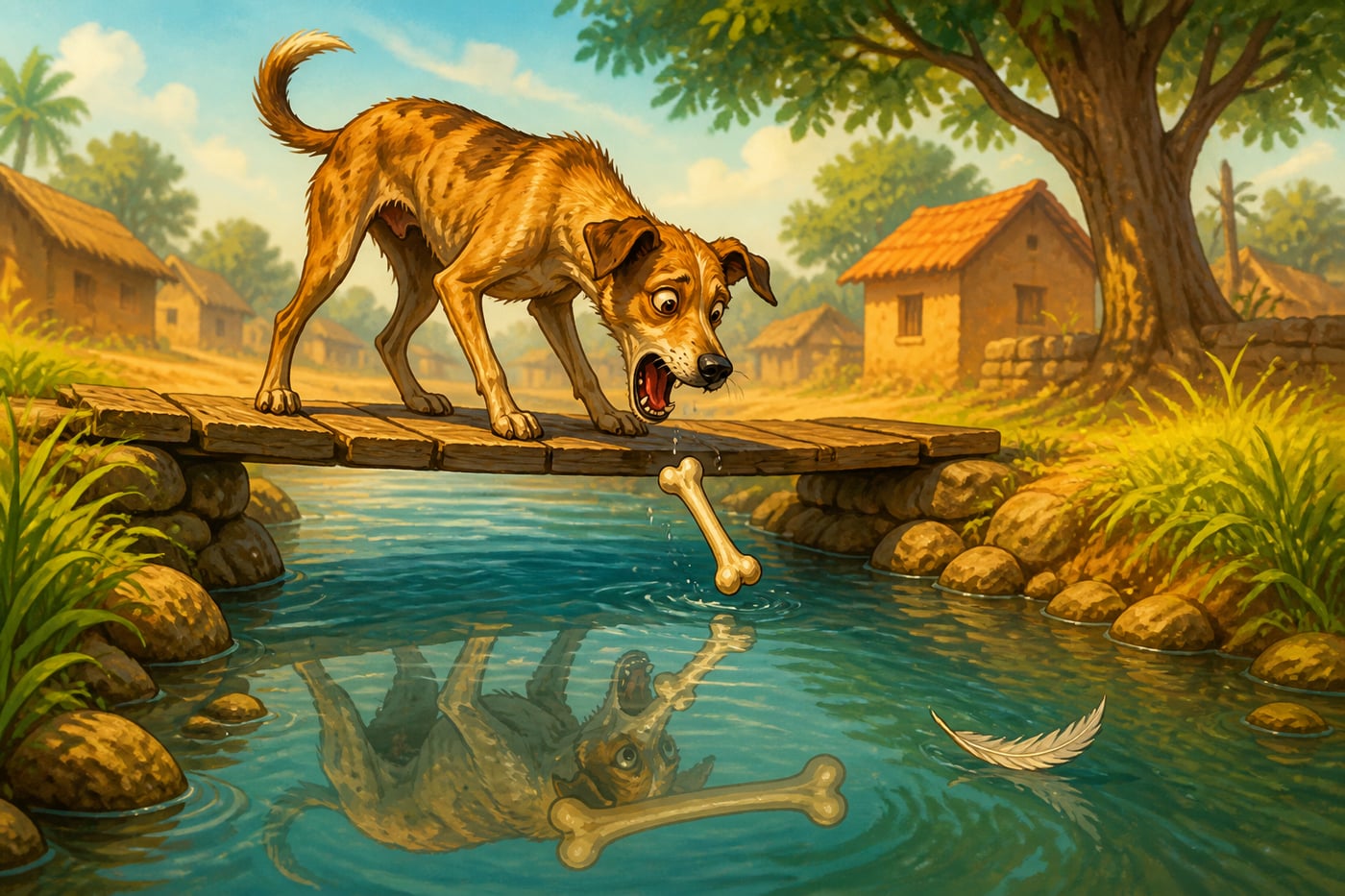
He opened his mouth wide to bark at the dog in the water, to frighten him into dropping his bone.
The moment his jaws parted, his own bone fell, splash!, into the stream below.
The dog in the water vanished. There had never been another dog. Only his own reflection. Only an illusion.
And now Lobhamukhya had nothing. Not two bones. Not one bone. Nothing.
"And so," Chirakarin concluded, "the dog who had enough lost everything by reaching for more. The bone in the water was never real, only his own possession, reflected and distorted. But the bone he dropped was very real indeed."
The King's Reaction
Raktamukha's jaw tightened. The parallel was clear, Kapila's mangoes were the reflection; the fig tree was the bone.
"Another children's tale," he said dismissively. "But I am not a foolish dog chasing reflections. Kapila's mangoes are real. His territory is real. And I intend to take what is real, not shadows."
"My lord," Sthiramati ventured, "even if the mangoes are real, the question remains: at what cost? We may take the mango grove and lose half our warriors. We may win the war and find the trees stripped bare, the fruit poisoned by conflict. Victory is not always gain."
"Victory is always gain for those bold enough to seize it," Raktamukha snapped. "You speak like cowards, all of you. I speak like a king."
The Tale of the Crane and the Crab
Chirakarin raised his hand once more. "One more story, my king, and then I will trouble you no further. This one concerns not a dog but a crane, a creature known for its patience and cunning."
Raktamukha sighed with exasperation but nodded.
In a pond that was slowly drying up, there lived many fish who grew increasingly desperate as the waters shrank. Among them lived a crane named Atilolupa, "excessively greedy", who saw in their desperation an opportunity.
"Friends," the crane announced to the fish, "I have discovered another pond nearby, deep and cool, fed by underground springs that never run dry. If you wish, I can carry you there one by one, and you will be saved."
The fish were suspicious, cranes eat fish, after all, but their need was great. One brave fish volunteered to go first. The crane carried him carefully to the new pond, which was real, and returned for another.
Day after day, the crane carried fish to safety. And day after day, the crane grew fatter. For while he did save many fish, he also ate one or two along the way, his payment, he told himself, for his service.
The arrangement was sustainable. The fish were being saved; the crane was being fed. Everyone benefited.
But Atilolupa grew greedy. Why eat one fish when he could eat three? Why eat three when he could eat five? The fish trusted him now, they practically jumped into his beak!
His hunger grew excessive. He began eating more fish than he saved. The fish in the pond noticed their numbers declining rapidly.
"Something is wrong," said an old crab named Buddhiman, "one with intelligence." "The crane takes many but few arrive at the other pond. I will go next and discover the truth."
The crane agreed, thinking a crab would make a fine meal. He flew Buddhiman toward the other pond, but veered instead toward a rock where he liked to eat his catches, littered with fish bones.
"What is this?" the crab demanded, seeing the bones. "This is not the new pond!"
"No," the crane laughed, "this is where I eat. And you will be my meal today!"
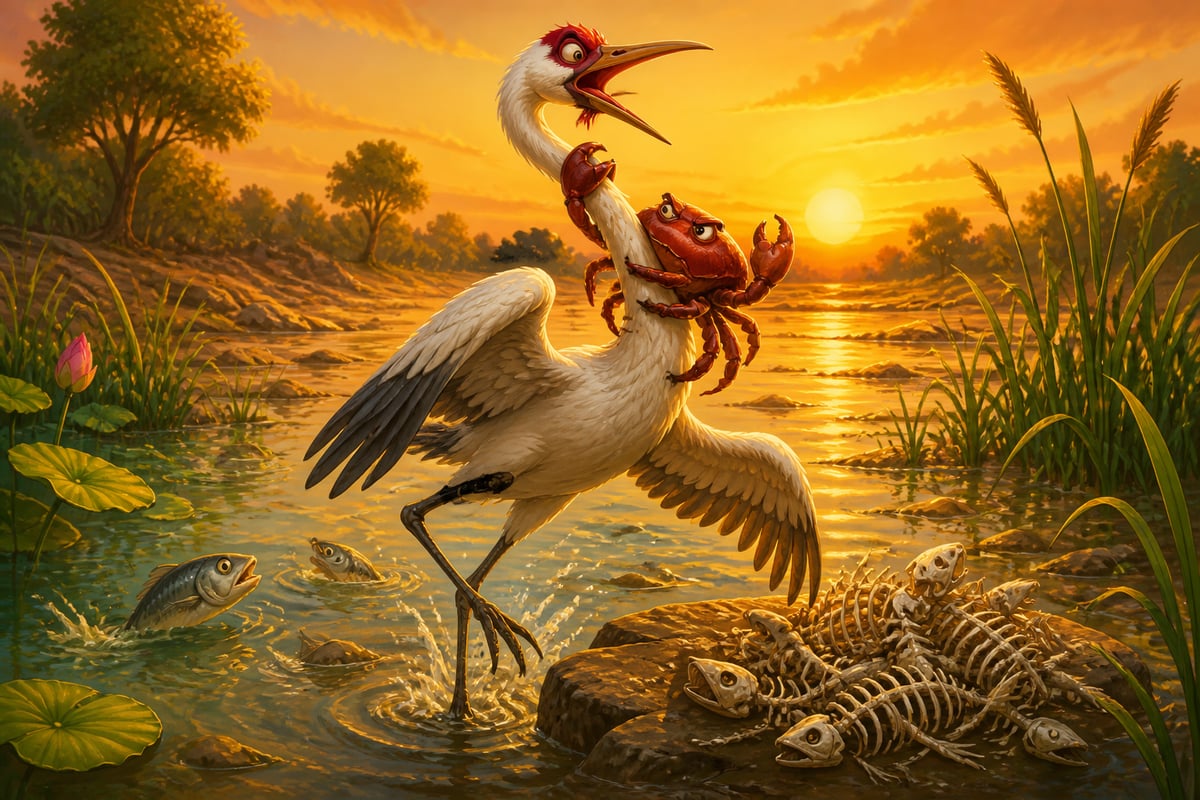
But the crane had miscalculated. A crab is not a fish. Before Atilolupa could strike, Buddhiman clamped his powerful claws around the crane's neck and squeezed until the life left the greedy bird.
The crane who had everything, food, trust, a sustainable arrangement, died because he wanted too much.
"And so," Chirakarin said, looking directly at his king, "excessive desire destroys even the cleverest schemes. The crane could have fed himself for years on occasional fish. His greed gave him a few extra meals, and then death."
The Point of No Return
Raktamukha stood in silence for a long moment. The tribe watched, hoping, some praying, that their king would hear the wisdom in these words.
Then he spoke, and their hopes died.
"The crane was a fool because he was caught. I will not be caught. The dog was a fool because he chased reflections. I chase real territory. Your stories are wise, old one, but they do not apply to me. I know what I am doing."
He turned to address the tribe.
"We will begin preparations tomorrow. Scouts will map the northern territories. Warriors will train for battle. Within three moon cycles, we will have doubled our kingdom."
He swept away to his private branch, leaving the tribe in stunned silence.
Chirakarin sat heavily on a root, looking older than he ever had before.
"Elder," Tarunika whispered, "will he truly do this? Will he lead us to war?"
"He will," Chirakarin replied. "That is the nature of excessive desire, atilaulya. It is not satisfied by anything, not even wisdom. It feeds on itself, growing larger and more demanding, until it consumes everything around it. The crane thought he was in control. The dog thought he was being clever. The king thinks he is being bold. They are all the same, consumed by a hunger that can never be fed."
The elder looked up at the fig tree that had sheltered their tribe for generations.
"Enjoy this tree while you can, young one. I fear we will not have it much longer."
Reflection
- Think of a 'sustainable arrangement' in your life, a steady income, a stable relationship, a reliable routine. Have you ever been tempted to disrupt it by pushing for more too quickly? What happened, or what held you back?
- The dog saw his own reflection as a rival with something he wanted. How often do we create imaginary competition, with friends, colleagues, or even strangers, where none actually exists?
- Raktamukha heard multiple warnings and dismissed them all as 'not applicable' to him. How can we tell the difference between genuinely being an exception and dangerously deluding ourselves?