Vyavaharashunyagyana: Knowledge Without Practical Sense
Theory vs practice
A weaver studies military strategy from borrowed books and dreams of becoming a general. He memorizes formations and tactics, then challenges a real army, with predictable results. Meanwhile, an old soldier who cannot read wins battles through instinct and experience.
The Village of Two Warriors
In the years after Manthaputra returned to his village, he often shared the tale of his brothers. But one evening, an old soldier named Bhimadeva, scarred from countless battles, missing two fingers on his left hand, offered a story of his own.
"Your brothers are not the first," Bhimadeva said, settling by the fire. "Nor will they be the last. Let me tell you of the weaver who would be a general."
The Weaver's Ambition
In the city of Pushpakarandaka, there lived a weaver named Shankuka who was skilled at his craft but bored by it. While his hands worked the loom, his mind wandered to dreams of glory.
One day, a traveling merchant left behind a bundle of books, old military treatises written by famous generals. Shankuka could read just well enough to puzzle through them, and what he read set his imagination ablaze.
"The Chakravyuha formation... the Padmavyuha array... the Garuda attack pattern..." He memorized every word. He drew diagrams in the dust. He moved pebbles around his workshop floor, practicing troop movements.
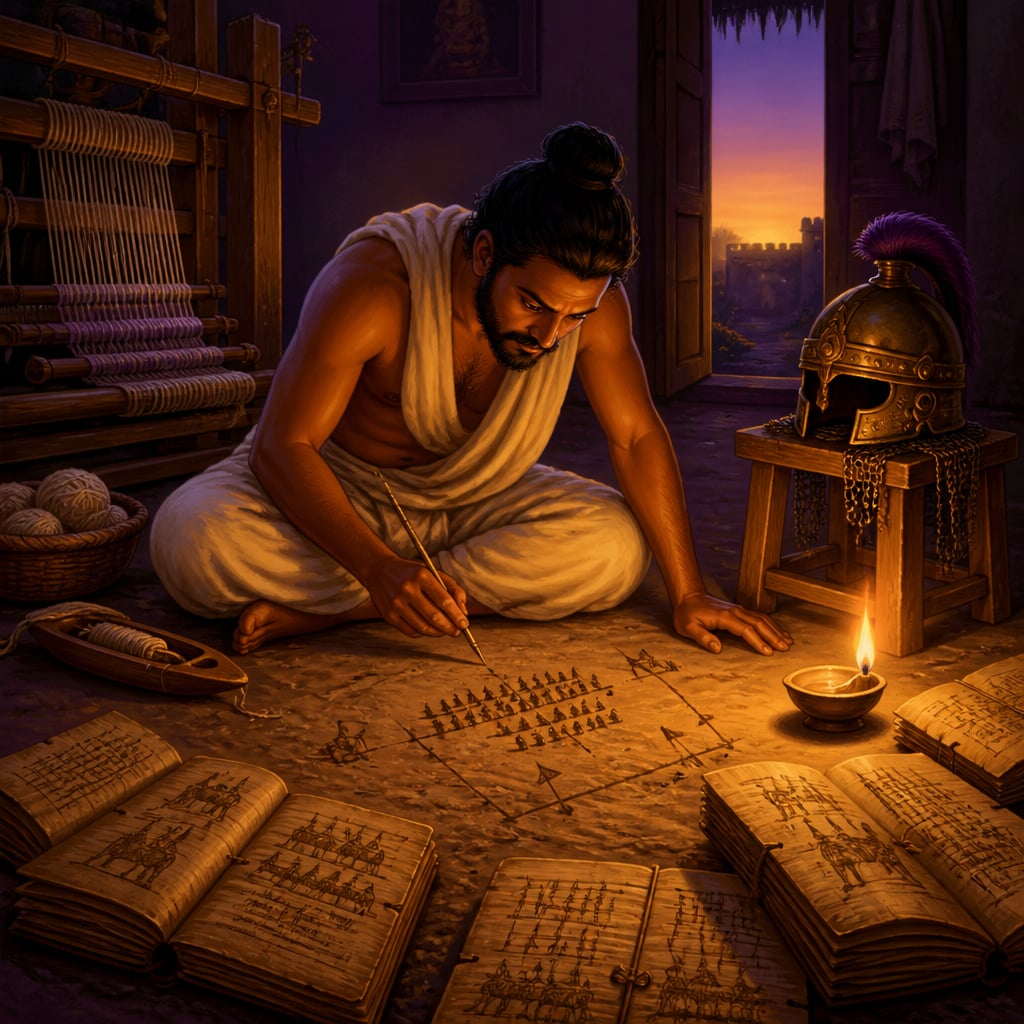
His wife watched with growing concern. "Husband, you are a weaver. What use is military strategy to you?"
"I was born a weaver," Shankuka replied loftily, "but I have the mind of a general. These books have taught me everything the great commanders knew. Why should I waste my gifts on cloth?"
The Challenge
Shankuka's fame as a military scholar spread through the city. He lectured on tactics to anyone who would listen. He corrected old soldiers, telling them how their past battles should have been fought. He criticized the king's generals, declaring their formations obsolete.
At last, the king himself heard of this remarkable weaver. Intrigued, he summoned Shankuka to court.
"They say you know more of war than my generals," the king said. "Is this true?"
Shankuka bowed deeply. "Majesty, I have studied every treatise ever written. I know formations your generals have never heard of. I could defeat any army using the principles I have mastered."
The generals laughed. One of them, an old warrior named Kritavarma who had fought in twenty campaigns, spoke up.
"Books are one thing, weaver. Battle is another. The enemy does not wait for you to consult your diagrams."
Shankuka smiled condescendingly. "That is because you fight by instinct, like an animal. I fight by science."
The king, curious to see who was right, proposed a test. A neighboring kingdom had been making raids on border villages. Shankuka would lead a force against them. If he succeeded, he would be made a general. If he failed... well, failures rarely returned from such missions.
Shankuka accepted without hesitation.
The Theory of War
Shankuka was given a small army, five hundred soldiers, experienced men who had fought many battles. He immediately began implementing his book-learning.
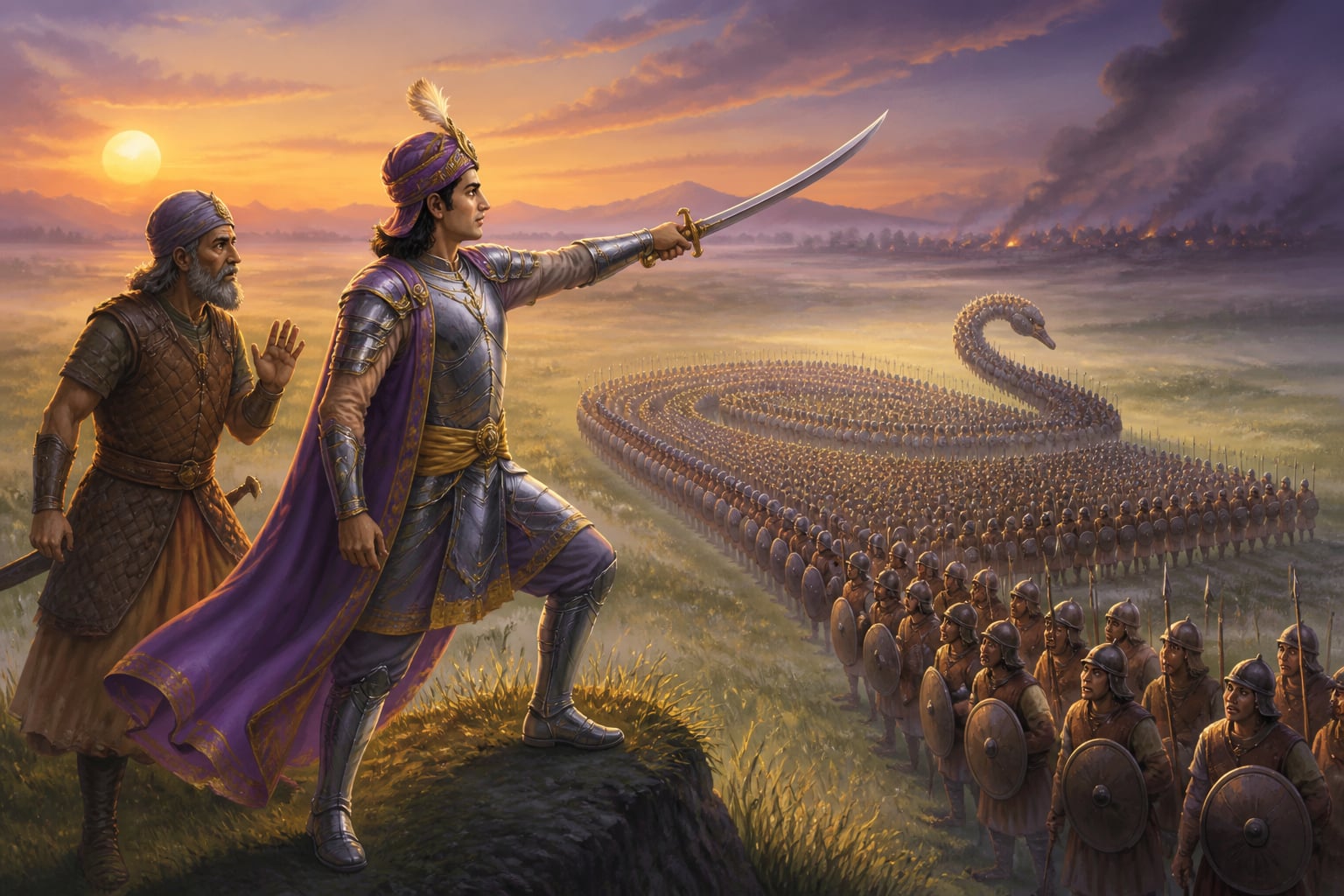
"You will march in the Hamsavyuha, the Swan Formation," he announced. "It says in the Arthashastra that this is ideal for approaching fortified positions."
The soldiers exchanged glances. The Swan Formation was designed for flat plains. They would be marching through hill country.
"Sir," ventured one old sergeant, "the terrain, "
"The formation is perfect," Shankuka interrupted. "I have studied this extensively."
They marched. In the hills, the Swan Formation became chaos. Soldiers stumbled over each other. Supply wagons got stuck. What should have taken two days took five.
When they finally reached the enemy's camp, Shankuka consulted his notes.
"We will attack at dawn, using the Surya-Chakra, the Sun Wheel, approach. The enemy will be blinded by the rising sun."
"Sir," the sergeant tried again, "the enemy camp faces west. The sun will be behind them, not in their eyes."
Shankuka waved him away. "The book clearly states that attacking with the sun behind you gives advantage. I know what I read."
The Practice of War
At dawn, Shankuka led the attack exactly as his books prescribed. His soldiers charged with the sun in their own eyes. The enemy, alerted by the noise of the chaotic approach over the previous days, was waiting.
The battle lasted less than an hour.
Shankuka, who had been certain his Vajra Formation would be impenetrable, found himself surrounded within minutes. His soldiers, trained men who knew how to fight but had been forbidden from fighting properly, were slaughtered in their rigid positions.
Shankuka himself survived only because his guards threw him on a horse and fled. He returned to the capital with fewer than fifty men.
The Soldier's Victory
The same week, old General Kritavarma was sent to handle a similar raiding party on the eastern border. He had no books, no diagrams, no theories.
He had thirty years of scars.
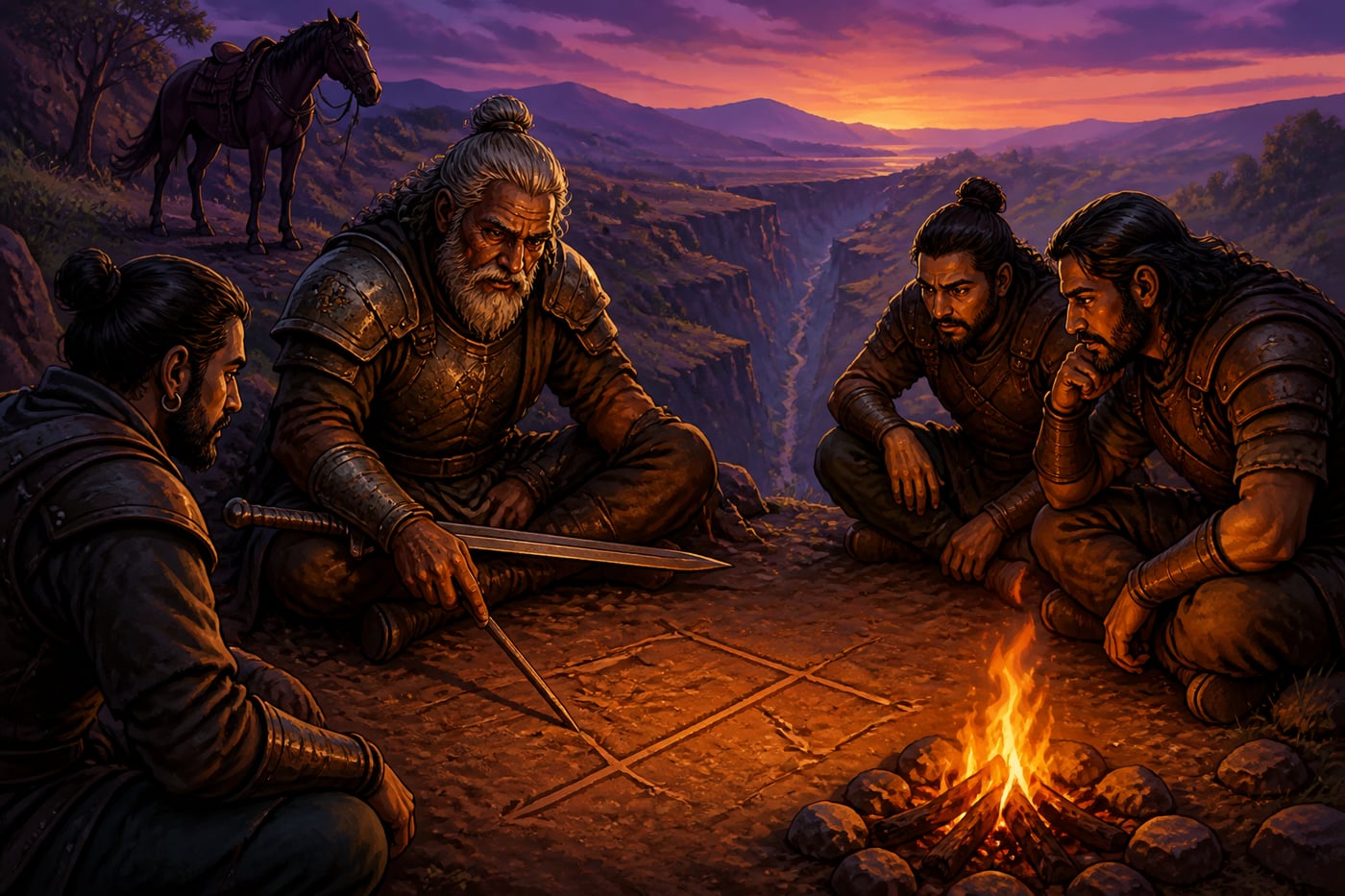
Kritavarma looked at the terrain. He talked to local villagers. He watched how the enemy moved. Then he did something no book would have recommended, he attacked at night, in the rain, from a direction the raiders believed impassable.
The raiders never saw it coming. Kritavarma lost eleven men. The enemy lost everything.
When asked how he planned such an unconventional attack, Kritavarma shrugged.
"The enemy expects you to fight by the rules. If you want to win, break the rules they think you'll follow. No book teaches this, you learn it by almost dying a few dozen times."
The Weaver Returns to His Loom
Shankuka was stripped of his borrowed rank and sent back to his workshop. His wife said nothing when he returned, which was, perhaps, worse than anything she could have said.
For months, he wove in silence. But slowly, he began to think.
"I knew every formation," he admitted one evening. "I knew where every soldier should stand. But I did not know what the enemy would do. I did not know how fear feels in battle. I did not know that hungry soldiers cannot hold formation. I knew the theory of war but not the reality."
His wife looked up. "Then you have learned something."
"I have learned," Shankuka said slowly, "that knowledge is not understanding. The books told me how war should work. Only war could teach me how it does work."
The Lesson Deepens
Manthaputra listened to Bhimadeva's tale, recognizing his own brothers in the weaver's arrogance.
"So books are useless?" he asked.
"No," Bhimadeva replied. "Books are valuable, if you remember that they are maps, not territories. A map of a river does not make you wet. A book about war does not make you a warrior. The map helps you find the river; then you must cross it yourself."
"My brothers had many maps," Manthaputra said quietly. "They knew how to reach the river. But they never learned to swim."
Bhimadeva nodded. "Your brothers could assemble bones, weave flesh, and invoke breath. But they had never stood before a lion. They had never felt its gaze. They had never heard its roar. Their books told them what a lion was; only the lion could teach them what a lion does."
"And that lesson," Manthaputra concluded, "came too late."
"As it always does," the old soldier agreed, "for those who trust pages more than experience."
Reflection
- Think of something you learned first from books or videos, then had to actually do. What surprised you when you moved from theory to practice? What did reality teach that the instructions never mentioned?
- Kritavarma attacked at night, in rain, from an 'impossible' direction. He broke every conventional rule and won. How do you know when to follow rules and when to break them?
- In our age of information abundance, where any fact is a search away, has the gap between 'knowing about' and 'being able to do' grown larger or smaller? Does easy access to information make us more or less competent?