Pandityagarvita: Pride of Learning
When scholars fail due to arrogance
The great pandit Garveshvara has never lost a debate. His learning is vast, his arguments flawless, his reputation supreme. When he challenges an illiterate farmer to a battle of wits, the farmer asks three simple questions. The pandit's brilliant mind has no answers, because some truths cannot be found in books.
The Undefeated Pandit
In the ancient city of Shashtrapura, there lived a pandit named Garveshvara, literally, 'Lord of Pride', though he had been born with a humbler name that no one remembered anymore.
Garveshvara was, without question, the most learned man in the kingdom. He had studied for thirty years under the greatest teachers. He had memorized the Vedas, mastered the Upanishads, and could debate any point of grammar, logic, philosophy, or law. In public debates, he had defeated every challenger for two decades. Kings consulted him. Scholars feared him. Students worshipped him.
And Garveshvara knew all this very well.
"Learning," he often said, "is the highest achievement of man. Those who possess it stand above those who do not, as the sun stands above a lamp."
He was not entirely wrong. But his pride in his knowledge had grown so vast that it had become its own kind of blindness.
The Challenge
One day, Garveshvara announced he would travel through the kingdom, stopping in every village to offer public debates. Any man who could defeat him in argument would receive a thousand gold coins. Any man who lost would publicly acknowledge Garveshvara's supremacy.
"I do this," Garveshvara declared, "to spread learning and humble ignorance."
Village after village, he debated and won. Priests could not match his knowledge of scripture. Doctors could not match his knowledge of Ayurveda. Lawyers could not match his knowledge of Dharmashastra. He collected acknowledgments of his supremacy like a king collecting tribute.
Then he came to the small farming village of Dhanyapura.
The Farmer's Response
The village had no scholars, no priests, no learned men of any kind. It had only farmers, men and women who grew grain, tended cattle, and had never opened a book in their lives.
When Garveshvara arrived with his entourage and announced his challenge, the villagers looked at each other in confusion.
"We have no one to debate you," the village headman said apologetically. "We know nothing of the things you study."
"Then you acknowledge my supremacy?" Garveshvara asked, already preparing to have the declaration written.
"We acknowledge you know many things we do not know," the headman said carefully. "But supremacy? In what? In growing rice? In reading the monsoon clouds? In knowing when a cow is sick?"
Garveshvara laughed. "In knowledge, old man. In the only thing that matters."
An old farmer named Bholanath stepped forward. He was weathered and wrinkled, his hands calloused from sixty years of working the earth. He had never learned to read.
"I will debate you," Bholanath said quietly.
The crowd gasped. Garveshvara's students laughed.
"You?" Garveshvara asked incredulously. "An illiterate farmer debates the greatest scholar in the kingdom?"
"You said any man," Bholanath replied. "I am a man. I accept your challenge."
The Terms
Garveshvara, amused, agreed. "What shall be our rules?"
"I will ask you three questions," Bholanath said. "If you can answer all three, I will bow before you and tell everyone of your greatness. If you cannot answer even one, you will acknowledge that there are things your learning has not taught you."
"Fair enough," Garveshvara said, settling into his debate seat. "Ask your questions, farmer. I have answered harder riddles than you can dream."
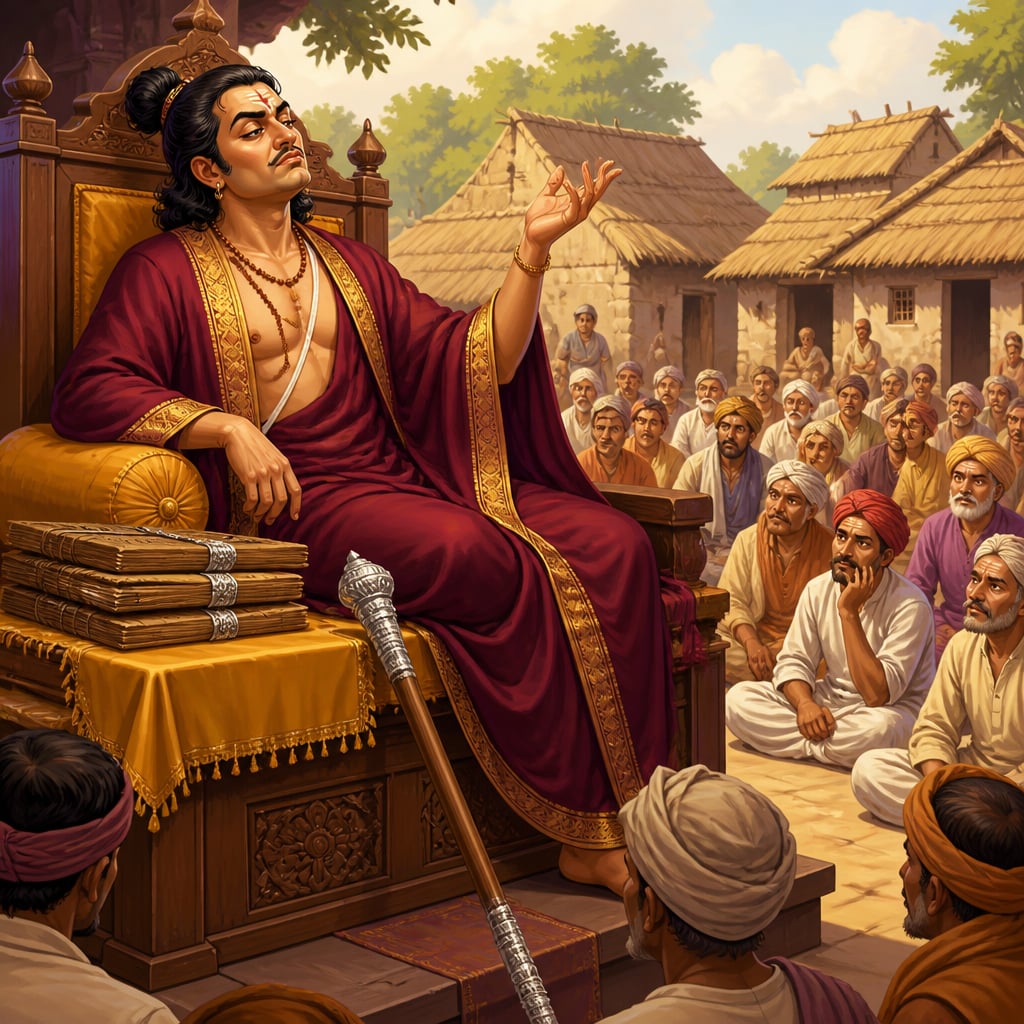
"I do not deal in riddles," Bholanath said. "Only in truths."
The Three Questions
First Question
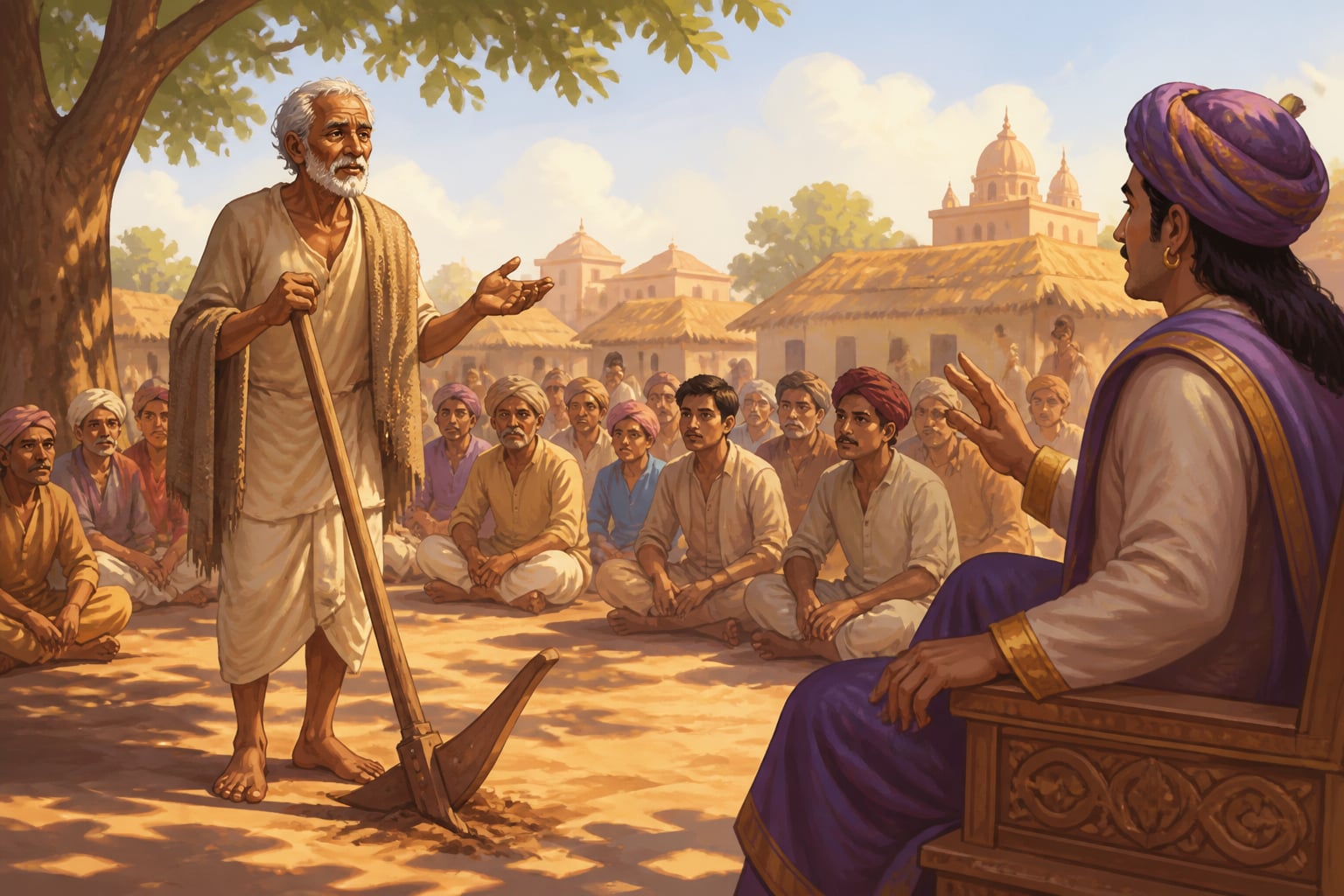
"Great pandit," Bholanath began, "you have studied for thirty years. Tell me: why do the rains come in some years and not in others?"
Garveshvara smiled. "The rains are governed by Indra, lord of storms, and by the cosmic cycle of, "
"I did not ask who governs them," Bholanath interrupted gently. "I asked why they come in some years and fail in others. I have watched the sky for sixty years. I cannot predict it. Can you?"
Garveshvara paused. He could recite dozens of shlokas about rain, explain the mythology of the monsoon, describe the ancient rituals for calling rain. But could he actually predict when rain would fall?
"No," he admitted slowly. "I cannot predict the rain."
"Nor can I," Bholanath said. "But I know I cannot. You did not know you could not. That is the first difference between us."
Second Question
"Great pandit, you have memorized the Vedas. Tell me: what makes a man happy?"
Garveshvara began confidently. "The Upanishads teach that happiness comes from the realization of Brahman, from, "
"I have not read the Upanishads," Bholanath said. "But I have been happy and I have been unhappy. I know what made the difference. Do you? When you finished memorizing the Vedas, were you happy?"
Garveshvara thought. He remembered the moment he completed his studies, the pride, the sense of achievement. But happiness? Had he felt joy, or only superiority?
"I felt accomplished," he said finally.
"But were you happy?"
"I... do not know," Garveshvara admitted.
"I have been happy," Bholanath said simply. "When my son was born. When my wife laughed. When the first shoots appeared after I thought the seeds had died. None of these came from books. Yet they are what I live for."
Third Question
"Great pandit, last question. You have studied death, the rituals, the philosophy, the afterlife. Tell me: are you afraid to die?"
The crowd fell silent. Garveshvara opened his mouth, then closed it.
He knew everything about death. He could recite the Bhagavad Gita's teachings on the immortality of the soul. He could explain the transmigration of atman, the liberation of moksha, the peace that awaits the wise.
But was he afraid?
"I..." he began, then stopped.
He had never asked himself this question. All his learning had been about understanding death, not about accepting it. Faced with his own mortality, all his philosophy felt thin as paper.
"I do not know," he whispered.
"I am not afraid," Bholanath said. "Not because I understand death, I do not. But because I have lived fully. I have loved. I have worked. I have seen my children grow. If death comes tonight, I will have no regrets. Can you say the same?"
Garveshvara could not speak.
The Lesson of Humility
For a long moment, the great pandit sat in silence. Then, slowly, he rose from his debate seat.
"I have an answer to none of your questions," he said. "I acknowledge that there are things my learning has not taught me."
The crowd murmured in shock. The great Garveshvara, defeated by an illiterate farmer?
But Garveshvara was not finished. He walked to Bholanath and bowed, not the slight bow of a superior to an inferior, but the deep bow of a student to a teacher.
"For thirty years I have studied," he said. "For thirty years I have believed that knowledge was wisdom. You have shown me in three questions that I knew much but understood little."
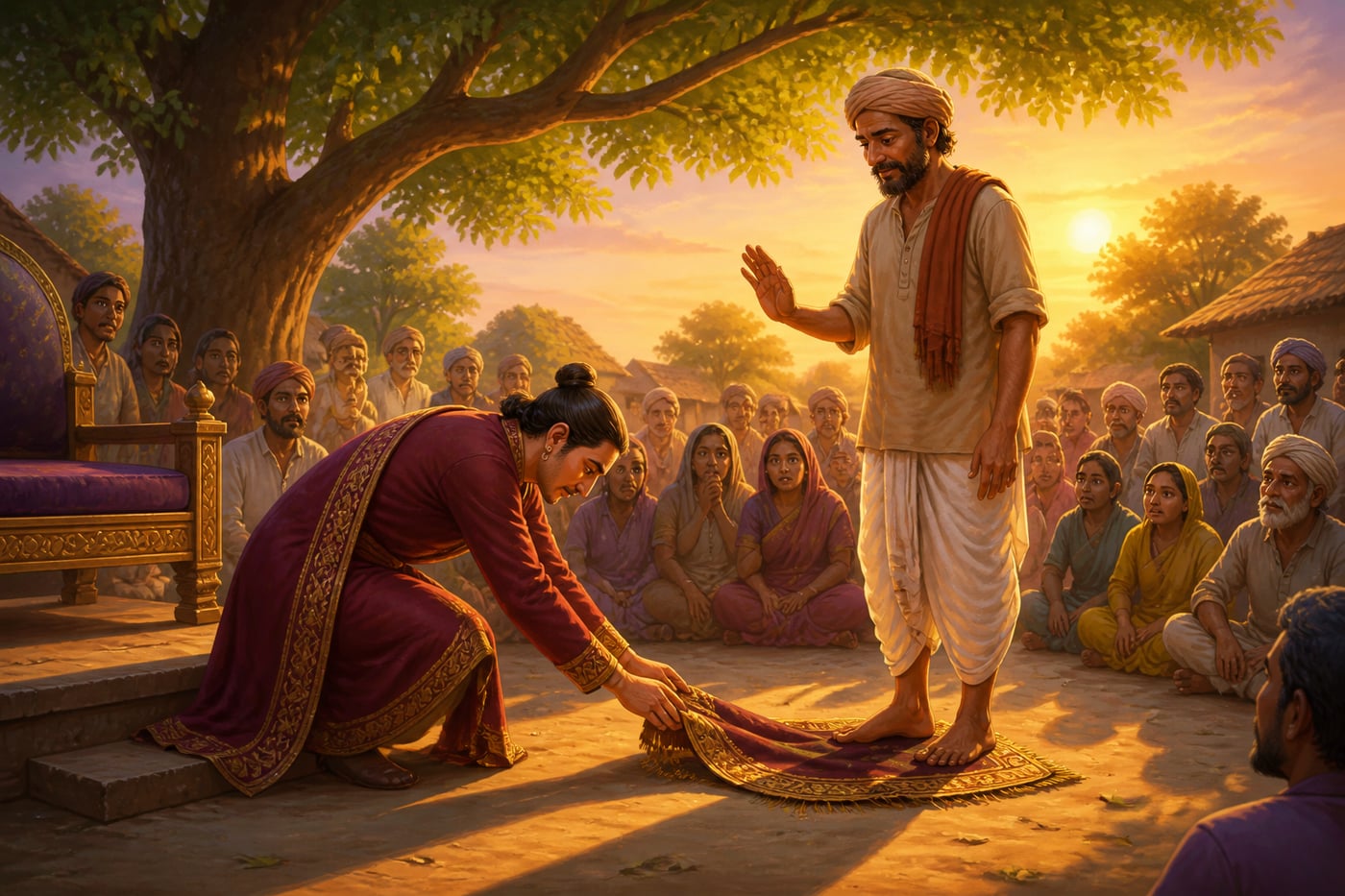
He removed his scholar's shawl and placed it at Bholanath's feet.
"Keep your gold," he said. "I have received something more valuable. I have learned, at last, that learning is not enough."
After the Debate
Garveshvara did not return to Shashtrapura. Instead, he asked Bholanath if he could stay in Dhanyapura, not as a teacher, but as a student.
"What could I possibly teach you?" Bholanath asked.
"How to be happy," Garveshvara replied. "How to know what you do not know. How to not be afraid of death. I have read about these things for thirty years. Perhaps it is time I learned them."
And so the greatest scholar in the kingdom became a farmer's student. He learned to plant rice and read clouds. He learned to sit in silence without needing to display his knowledge. He learned that the simplest people often knew the deepest truths.
Years later, travelers would sometimes pass through Dhanyapura and ask about the old man who worked in the fields.
"Oh, that's Bholanath's student," the villagers would say. "He used to be very learned. Now he's becoming wise."
Reflection
- Can you answer Bholanath's three questions for yourself? What makes you truly happy? What important things do you not know? Are you at peace with your mortality?
- Why did Garveshvara stay to learn from Bholanath instead of returning to his prestigious life? What did losing the debate give him that winning never had?
- The verse says knowledge should produce humility. Why does knowledge so often produce pride instead? What goes wrong in the process of learning?