Anubhavahina: Lacking Experience
Experience matters more than books
Prince Vidyasagara has studied every text on statecraft and governance. Shepherd Goraksha cannot read a single letter but has led his village for forty years. When the same crisis strikes both domains, only one leader knows what to do, and it is not the one with the library.
Two Leaders, One Crisis
In the prosperous kingdom of Vidyanagara, young Prince Vidyasagara was known as the most learned heir in seven generations. From age five, he had studied the Arthashastra under the finest scholars. He could recite Kautilya's maxims on taxation, debate the merits of different administrative systems, and explain the theory of the seven limbs of the state.
His father, King Dharmasena, was proud but worried.
"My son knows everything a king should know," he confided to his old minister Shakatayana. "Yet he has never collected a tax, never settled a dispute, never faced a drought or a flood. All his knowledge lives in his head, not in his hands."
"Perhaps," Shakatayana suggested, "he should learn from one who has ruled without books."
The Shepherd Who Rules
In the hills above Vidyanagara, there was a village called Govardhana, home to shepherds who tended flocks on the high meadows. For forty years, they had been led by a man named Goraksha, a shepherd whose only education was the mountain wind and the turning seasons.
Goraksha could not read. He could not write. He had never heard of Kautilya or the Arthashastra.
But he had kept his village fed through seven famines. He had settled a thousand disputes. He had negotiated with bandits, bargained with merchants, and once talked a neighboring clan out of war using nothing but a goat and a proverb.
When the king sent Prince Vidyasagara to learn from Goraksha, the court was scandalized.
"What can an illiterate shepherd teach a prince?" they asked.
The king replied: "Everything I cannot."
The Prince Arrives
Vidyasagara arrived at Govardhana with a trunk of books and a head full of theories. Goraksha greeted him with calloused hands and weather-beaten face.
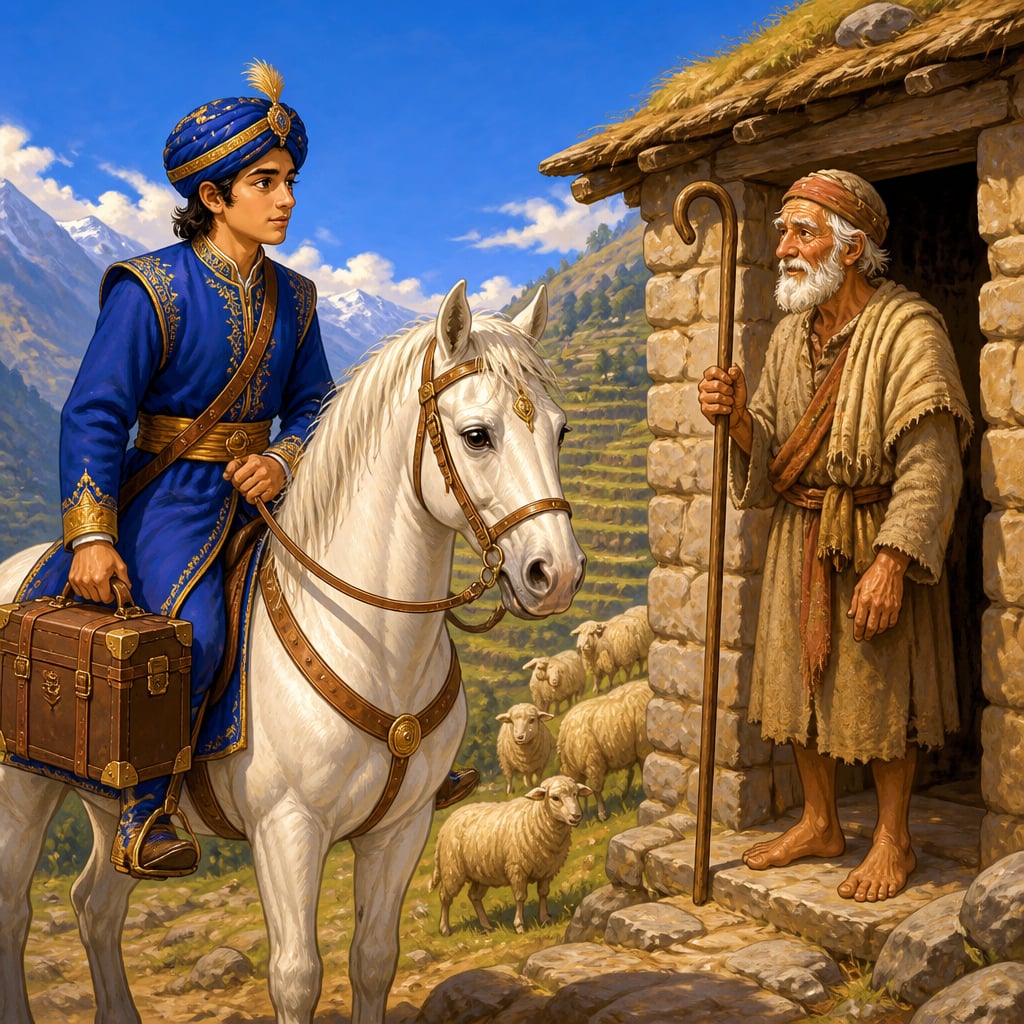
"Welcome, young lord. What do you wish to learn?"
"I wish to understand how you govern without studying governance," the prince said, not unkindly but with genuine puzzlement. "My texts say that a ruler must understand the shastras. How can you lead without them?"
Goraksha smiled. "When a lamb is born on a winter night, does it wait for me to consult a book about keeping it warm? When two neighbors fight over a boundary stone, do they pause while I read about dispute resolution? A ruler must act, young lord. Books tell you how others acted. Life tells you how you must act."
"But surely," Vidyasagara pressed, "there are principles..."
"There are," Goraksha agreed. "Fairness. Listening. Thinking of tomorrow while handling today. Admitting when you do not know. These I learned by failing, not by reading about others' failures."
The Test Arrives
The prince had been in Govardhana for three weeks when crisis struck.
A messenger arrived from Vidyanagara: King Dharmasena had fallen gravely ill. Vidyasagara must return at once to serve as regent. On the same day, news reached Govardhana that a pack of wolves had descended from the high passes, threatening the flocks.
Both leaders faced their challenge alone.
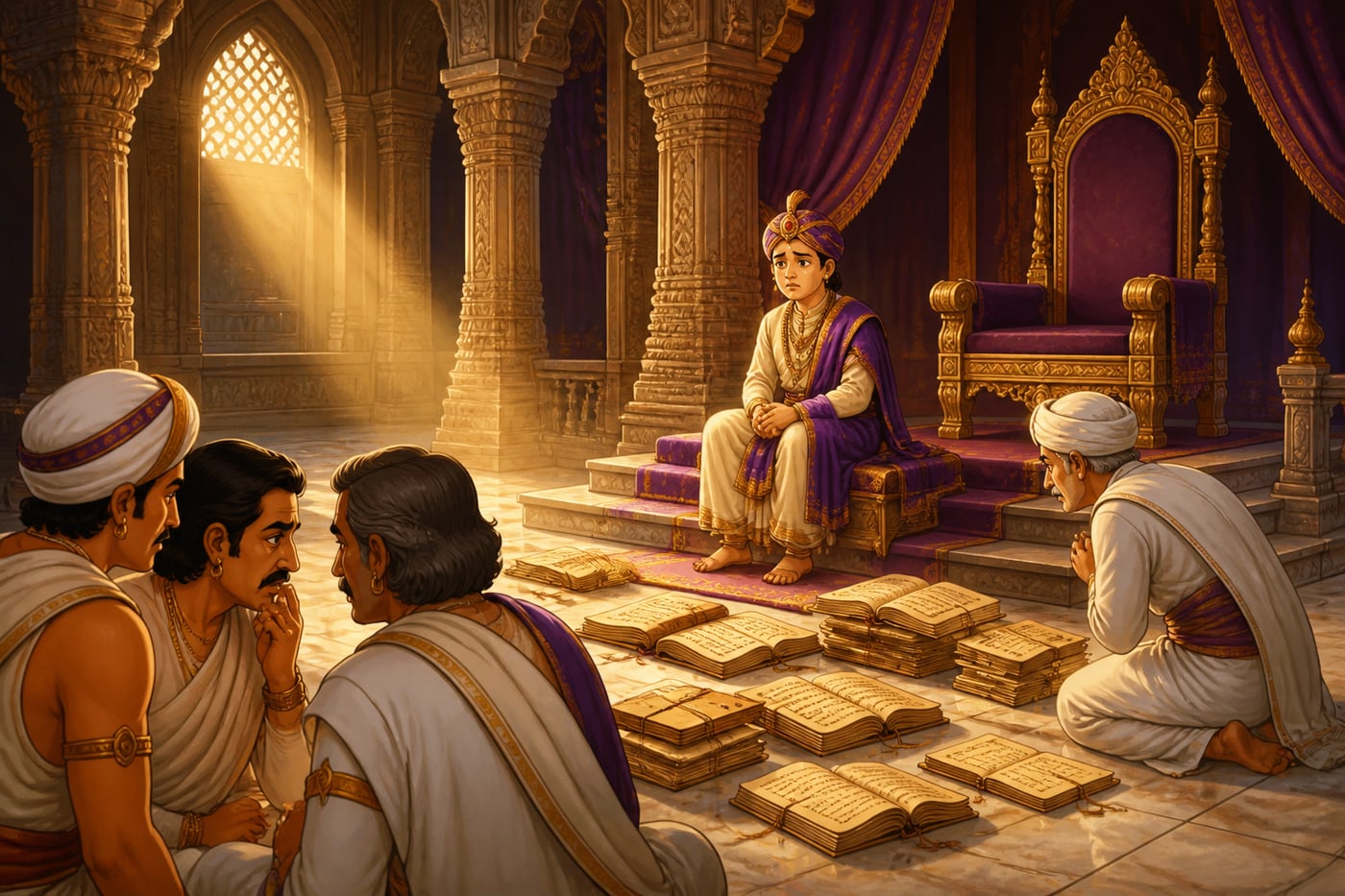
In Vidyanagara, Vidyasagara convened a council and immediately consulted his texts. "The Arthashastra," he announced, "prescribes that in the king's absence, the heir should maintain all policies unchanged until the king recovers."
He issued no new orders. He made no decisions. He waited, as his books advised, for the king to recover.
But the kingdom did not wait. Merchants needed rulings on trade disputes. Villages needed decisions on irrigation. Soldiers needed commands about a border skirmish. Each day, Vidyasagara consulted his texts, searching for exactly the right precedent, exactly the right procedure.
The kingdom began to drift.
The Shepherd Acts
In Govardhana, Goraksha did not consult anything. He stood on the ridge, looked at the wolf tracks, and began giving orders.
"The eastern flocks move to the stone corrals tonight. Young men form watches at the three passes. Women and children stay close to the village fires. We burn pine branches, wolves hate the smoke."
"But master," a young shepherd asked, "what if the wolves attack from the west?"
"Then we were wrong and we change," Goraksha said simply. "We act on what we know. We adapt when we learn more. Standing still waiting for perfect information gets sheep killed."
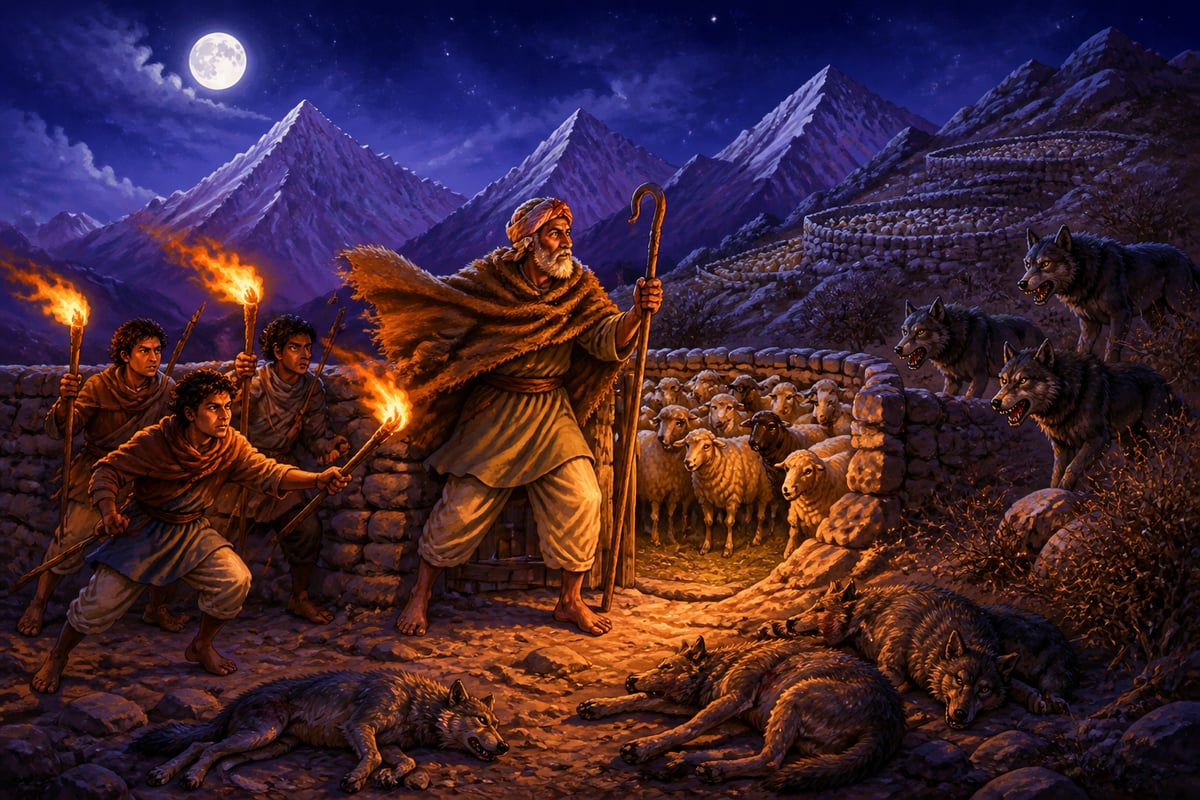
That night, the wolves came. They found corrals instead of scattered flocks. They found men with torches instead of sleeping villages. They found smoke and noise and spears.
By morning, three wolves were dead and the rest had fled. Not a single sheep was lost.
The Prince Returns
When King Dharmasena recovered, he found his kingdom in disorder. Trade had slowed. Disputes had multiplied. The border skirmish had become a standoff.
"Why did you not decide these matters?" the king asked his son.
"The texts advise caution in a regent's position," Vidyasagara replied. "I did not wish to overstep my authority."
"The texts advise caution in uncertainty," the king corrected gently. "But these were not uncertain matters. A merchant cannot wait three weeks to know if his cargo can proceed. A village cannot wait to plant while you search for precedents. Sometimes, my son, a wrong decision made quickly is better than a perfect decision made too late."
Vidyasagara bowed his head. "The shepherd would have decided."
"Yes," said the king. "And he would have been wrong sometimes. But his village would have known they were led. A shepherd who hesitates while wolves circle is no shepherd at all."
The Return to Govardhana
Vidyasagara asked his father's permission to return to the hills. This time, he brought no books.
"Teach me," he said to Goraksha, "how you know what to do."
"I do not always know," the shepherd admitted. "But I have failed so many times that I recognize the shape of failure approaching. I know what questions to ask. I know which advisors to trust and which merely tell me what I want to hear. This cannot be taught with words. It must be lived."
"Then let me live it," said the prince.
For a year, Vidyasagara worked as a shepherd. He lost lambs to cold and learned to prevent it. He settled arguments between herders and learned what fairness meant when you looked both parties in the eyes. He made decisions without texts, sometimes wrongly, and learned how to repair what his mistakes had broken.
When he finally returned to Vidyanagara, he was no longer the same prince.
"What did you learn?" his father asked.
"I learned," Vidyasagara said slowly, "that my books were like maps of a country I had never visited. Now I have walked the land. Now the maps make sense, and I know where they are wrong."
King Dharmasena smiled. At last, his son was ready to be king.
Reflection
- Think of a skill you learned by doing, where practice taught you things no instruction ever mentioned. What was most surprising about the gap between what you expected and what actually happened?
- Goraksha could 'recognize the shape of failure approaching', a skill gained only through experiencing failures. How much of true expertise is pattern recognition that can only come from lived experience?
- Modern education emphasizes credentials, degrees, and certifications, all based on demonstrating knowledge rather than experience. Does this create more 'Vidyasagaras' than 'Gorakshas'? How might education better combine both?